‘The Most Important Work of Political Theory
Of the Grand Siècle’
[FÉNELON, François de Salignac de La Mothe.]
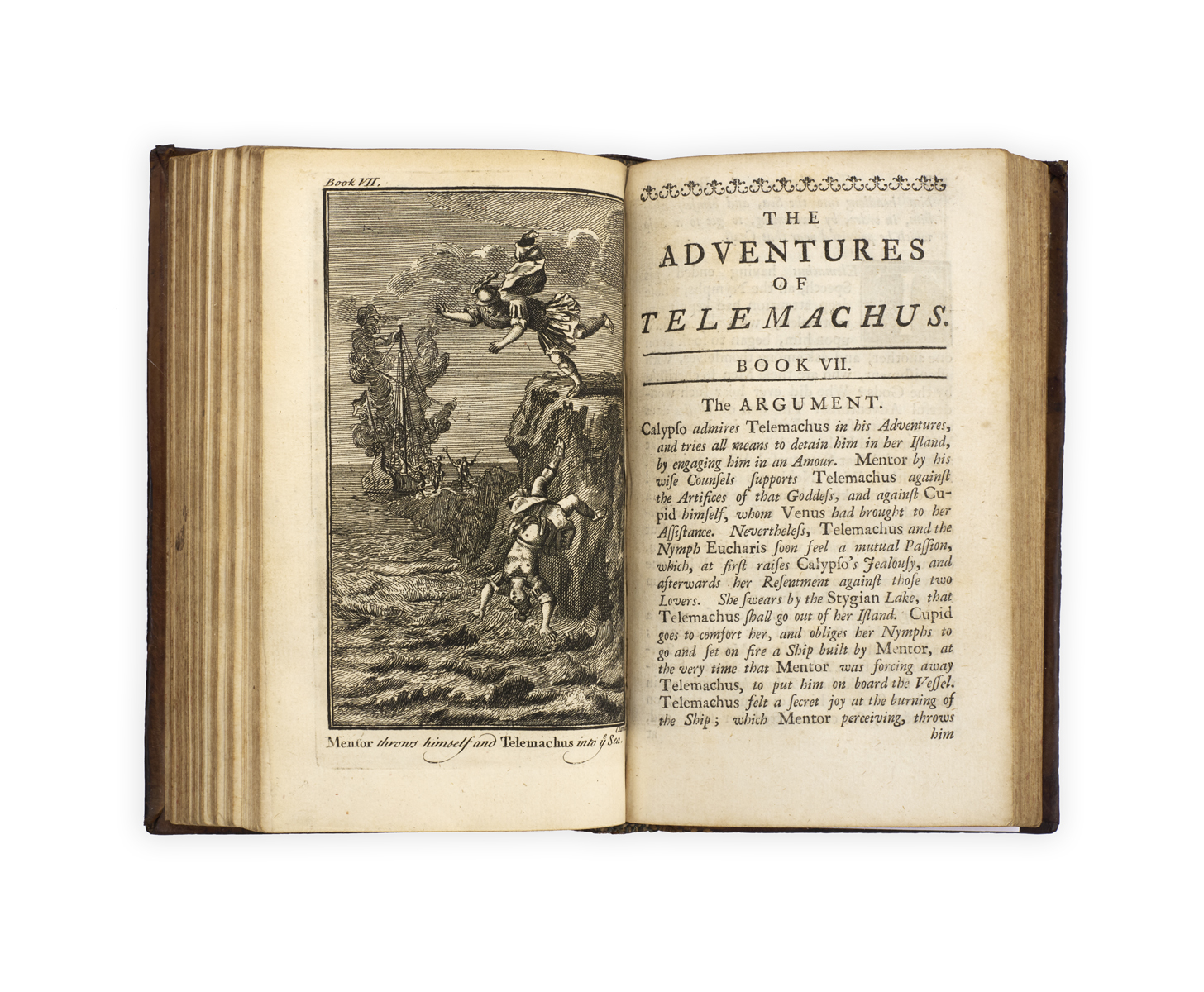
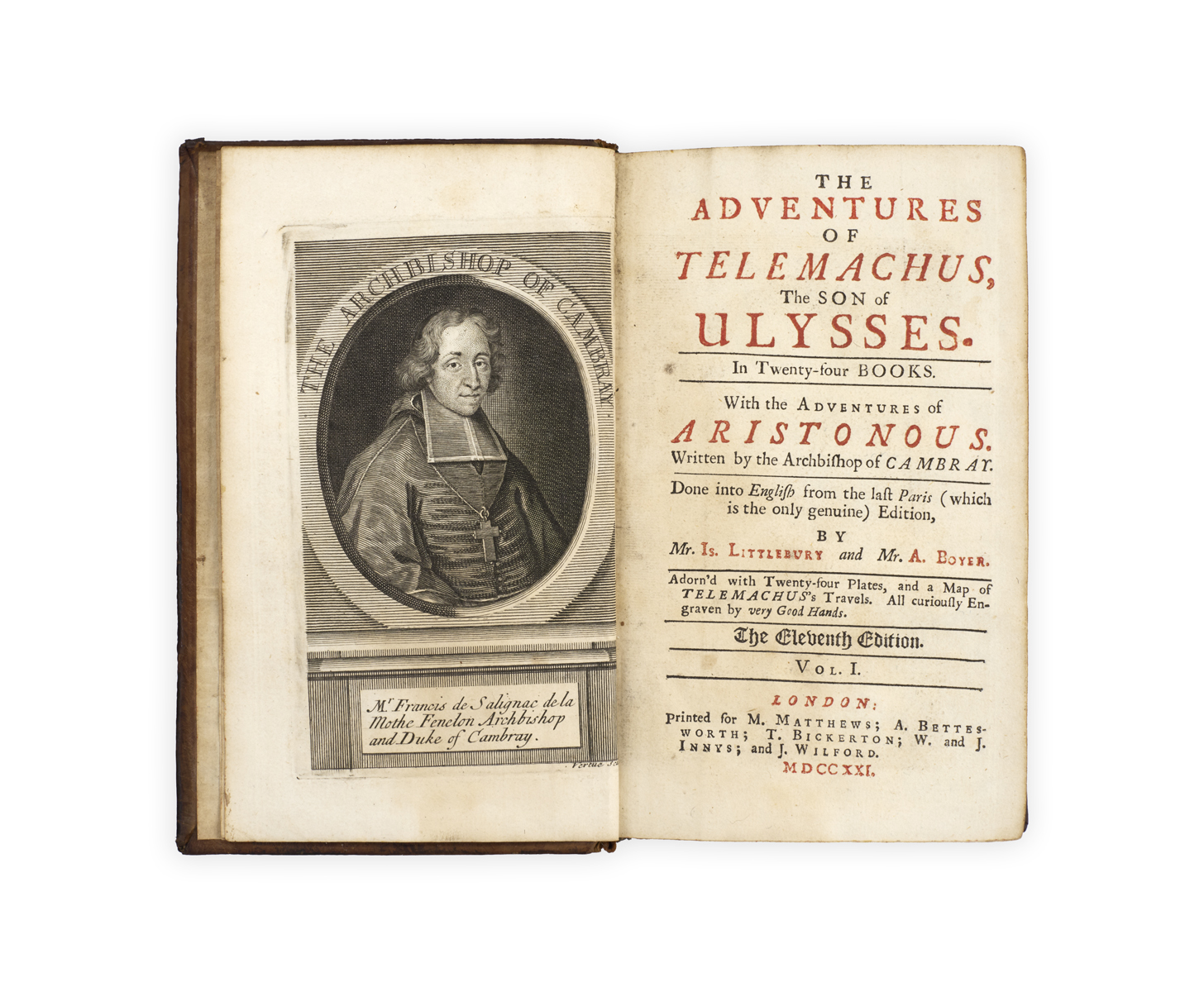
The Adventures of Telemachus, the son of Ulysses. In twenty-four books. With the adventures of Aristonous written by the Archbishop of Cambray done into English from the last Paris (which is the only genuine) edition, by Mr. Is. Littlebury and Mr. A. Boyer. Adorn’d with twenty-four plates, and map of Telemachus’s Travels. All curiously Engraven by very good Hands. The Eleventh Edition. London, M. Matthews; A. Bettesworth; T. Bickerton; W. and J. Innys; and J. Wilford, 1721.
Two vols, 12mo; I: pp. [2], xxiv, [42], 282, with 11 copper-engraved plates, engraved map and frontispiece portrait, II: pp. [2], 372, with 13 plates; title-pages printed in red and black, woodcut initials and tailpieces, typographic headpieces; a fine copy in contemporary sprinkled calf, raised bands, gilt red morocco lettering-pieces to spines; front joint of vol. II neatly restored; contemporary ownership inscription ‘Peregrine Herbert’ to title-page of vol. II, contemporary annotation comprising underlining and marginal marks to 12pp.; armorial bookplate of Lord Wenman to front pastedowns.
Added to your basket:
The Adventures of Telemachus, the son of Ulysses. In twenty-four books. With the adventures of Aristonous written by the Archbishop of Cambray done into English from the last Paris (which is the only genuine) edition, by Mr. Is. Littlebury and Mr. A. Boyer. Adorn’d with twenty-four plates, and map of Telemachus’s Travels. All curiously Engraven by very good Hands. The Eleventh Edition.
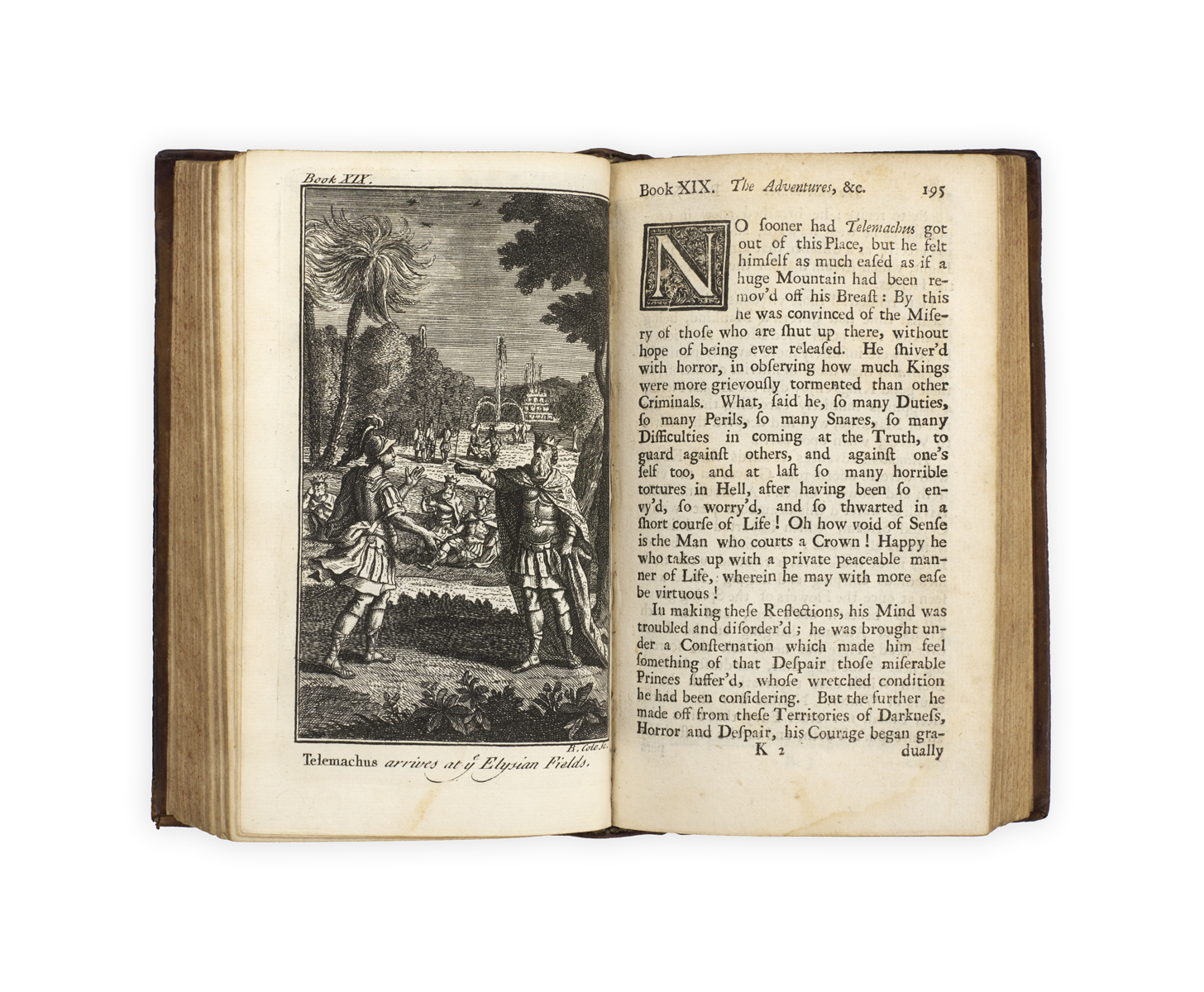
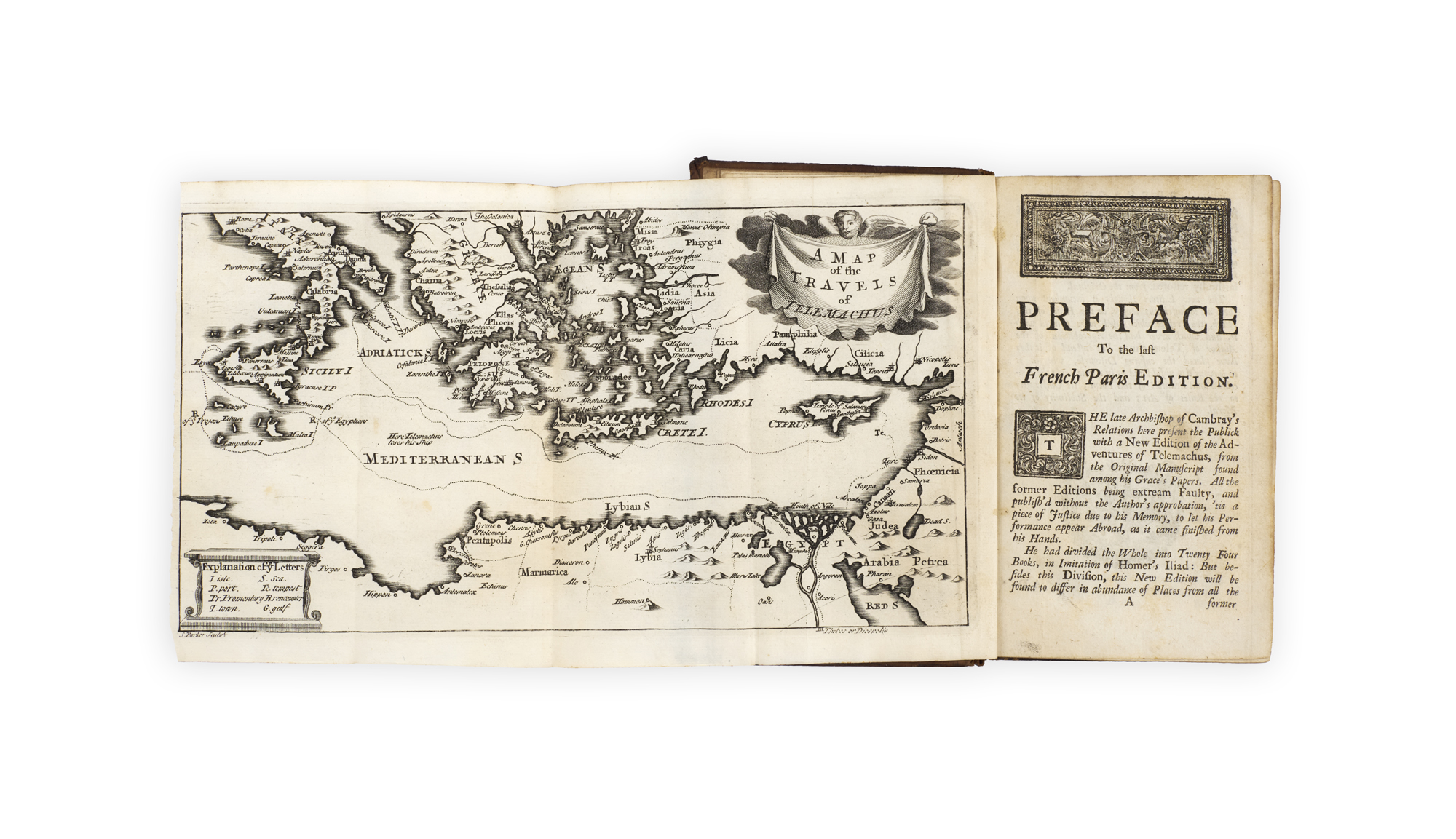
First illustrated edition of the first English translation of Francois de Salignac de La Mothe-Fenelon’s speculum principis, with twenty-four engraved plates and a map of Telemachus’ journey through the Mediterranean.
Originally written as a didactic novel for Fénelon’s tutee, the seven-year-old Duc de Bourgogne, grandson of Louis XIV, Les Aventures de Télémaque was published without the author’s consent in 1699 to instantaneous success, with more than six hundred copies bought up in a single day. Isaac Littlebury published a translation of part I in 1699, the other four parts completed by Alexander Oldes and Abel Boyer in 1700. Their version was later revised in 1719 after a rival version by Ozell had appeared (1715). The present edition is the first to contain the fine set of engravings depicting the young Telemachus’ travels with his tutor, Mentor through, inter alia, the deserts of Egypt, the commerce of the Tyrians, and Tartarus.
Widely perceived as a scathing critique of Louis XIV, this speculum principis follows the moral and political education of Telemachus, young son of Ulysses, as Mentor (the goddess Minerva in disguise) tutors him in the virtues of patience, courage, and modesty. The work has been called ‘the most important work of political theory of the grand siècle in France’ (Riley); its influence can be traced on Montesquieu and Rousseau and it was a favourite of Thomas Jefferson. One of the most widely read and revered works of the century, it passed through numerous editions and translations; there were more than ten English prose and poetry versions alone.
Provenance: Bookplate of Lord Wenman to pastedowns, likely Philip, seventh Viscount Wenman (1742–1800), who sat in the House of Commons from 1768 to 1796.
ESTC lists five copies only: Leeds, UCLA, Chicago, Princeton, and Columbia. Another issue, for John Walthoe, is recorded in three copies.
See Riley ed. Fénelon: Telemachus (1994). For bookplate, see Howe 31310.