
Dancing and Fencing, but Not Magic Tricks or Romances
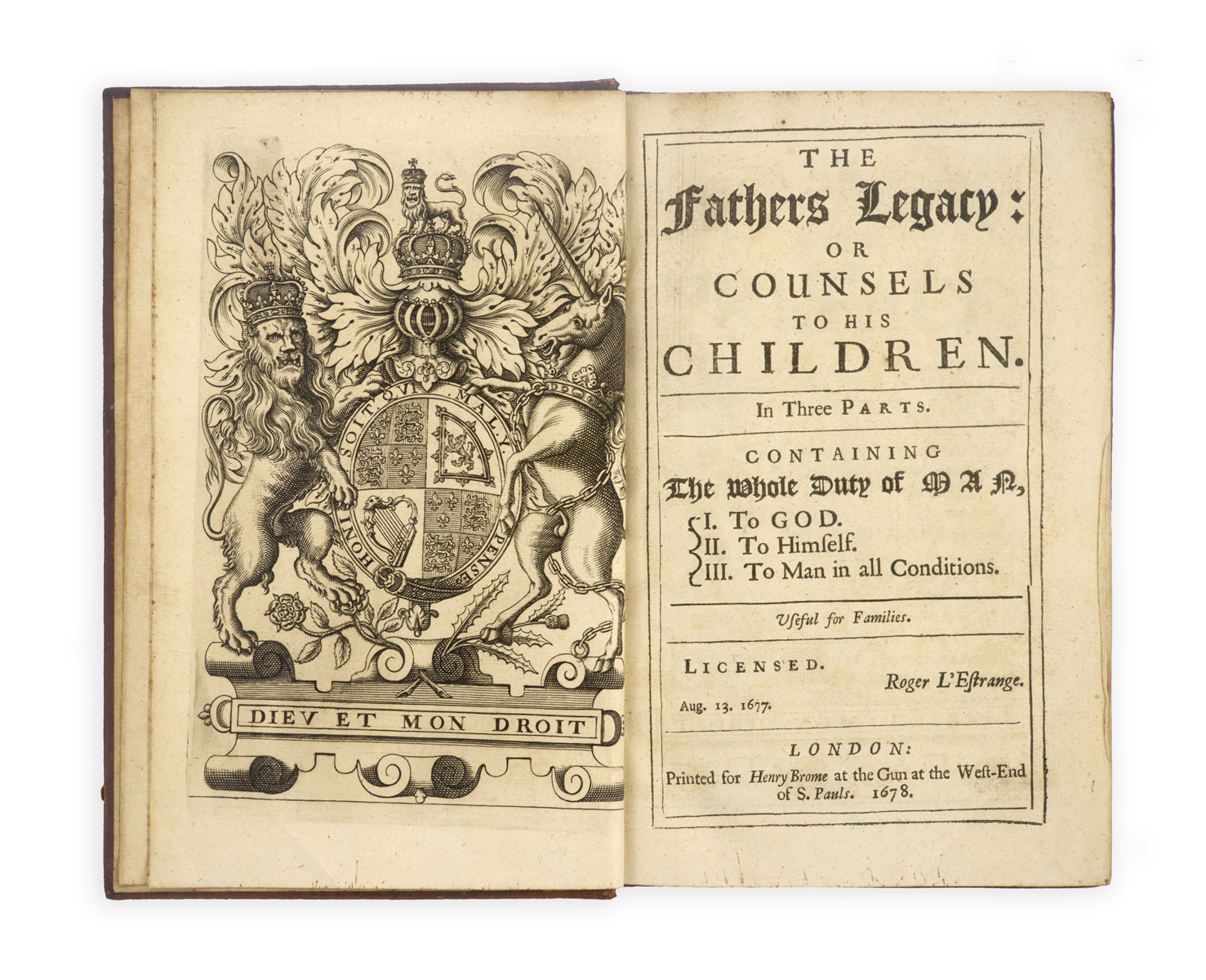
FATHERS LEGACY (The):
or Counsels to his children. In three Parts. Containing the Whole Duty of Man, I. To God. II. To himself. III. To Man in all Conditions. Useful for Families … London, Printed for Henry Brome … 1678.
8vo, pp. [12], 220, [10, table and advertisements], with an engraved frontispiece of the royal arms; a fine crisp copy in contemporary speckled calf; ownership inscription ‘Eliz: Trumbull July ye 24th 1679’ to front free endpaper.
Added to your basket:
or Counsels to his children. In three Parts. Containing the Whole Duty of Man, I. To God. II. To himself. III. To Man in all Conditions. Useful for Families …
First and only edition, very scarce, of a fine courtesy book written by an anonymous former soldier, framed as a father's guidance to his children, this copy owned by the wife of the English Ambassador to France.
Part I, dealing with religion, is unexpectedly brief (pp. 1–26), and the bulk of the text is more practical, with an emphasis on physical as well as mental education – ‘Studies and Exercises ought to be jointly performed’. It is almost certainly a translation from a French original (internal evidence suggests a date of c. 1660), slightly modified for an English audience. The author’s children are named as Philip, Armand, Hardowin, and Charles; his brother and sister lost children fighting in Battles of the Thirty Years’ War in the 1630s, while he himself was at the Siege of Breda (1637, aged forty); and references to the King and Queen on p. 71 make no sense for Charles II and would seem to refer to Louis XIV and his mother.
‘There is no man of what condition soever, nor any Nation whether of the new or old world, that loves not dancing’; sword play is also recommended, but not hunting which ‘brutifies’ a man.
‘Renounce all sorts of dangerous leaps, jugling tricks, and slights of hand’, but you are allowed to see others perform them at Bartholomew Fair. In study ‘before all things, learn Cosmography’, learn arithmetic but not algebra, and take as your model the life of the ‘Chevalier Wayard’ (i.e. de Bayard). In reading, Romances inculcate more morality than True Histories, but daughters should avoid them, especially ‘Astrea [L’Astrée, by Honoré d’Urfé], which by the variety of many amorous Histories … secretly kindles in young hearts that natural and sweet passion’, and so is ‘only fit to be read at an after Season, when these wanton flames are extinguished’.
Considerable time is devoted to the military, which he intends as his sons’ profession (he recommends the academies of M. de St Luc in Brouage and M. de Vic at Calais), and the court, with advice on the vices to avoid there and how best to survive – be pliable, not too scrupulous about honour, follow fashion but do not set it. In ‘Of the will of a child’, the author seems remarkably modern in observing that his son’s self-will first presented itself in the ‘resistance that you made to mine … as if the desire of acting in liberty were more violent in us, that of our own our security’. In ‘Of Sensual Love’ he is more courtly, advising his son to find a beautiful mistress ‘somewhat more mature than you’ and endeavour to win her esteem chastely, serving her until the ‘season of debauchery’ passes.
There are also chapters on, inter alia, moderation of the appetite, wealth and poverty – (‘regard more the poor man that is undefended, than the rich’), lying, anger, grief, play (chess is approved, dice not), the duties of spouses to each other and to their children, joy, sedition, and death.
Provenance:
The bold ownership inscription is that of (Katherine) Elizabeth Trumbull (née Cottrell or Cotterell, 1653–1704), wife of Sir William Trumbull (1639–1716). Well educated and sprightly, daughter of the Master of Ceremonies and Master of Requests at court, she had married for love in 1670 – ‘never wife had such a husband as my selfe’, she would write – and their affection, though childless, saw them through her husband’s unexpected appointment as Special Envoy to France in 1685, just after the Revocation of the Edict of Nantes, and then Constantinople in 1687. Elizabeth’s father Charles Cotterell (1615–1710) was himself a very accomplished courtier, but also a competent translator from French and a friend of the poet Katherine Philips – could he perhaps have been responsible for this text?
ESTC R201986; Wing F555.