
The Golden Fleece Legend as Speculum Principis
[FILLASTRE], Guillaume.
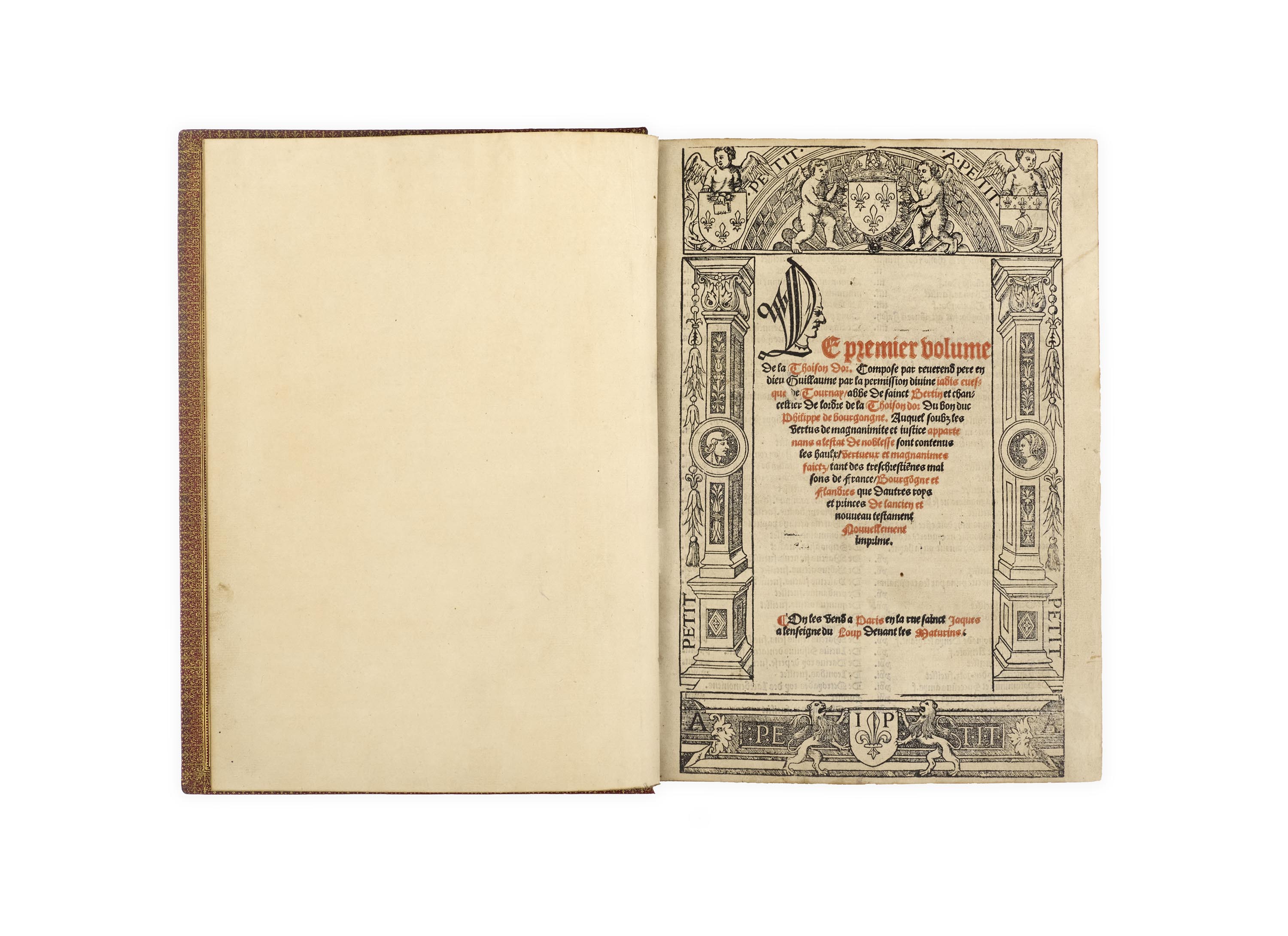
Le premier [– second] volume de la Thoison dor … Auquel soubs les vertus de magnanimite et iustice appartenans a Lestat de noblesse sont contenus les haulx vertueux et magnanimes faictz tant des treschrestiennes maisons de France Bourgongne et Flandres que dautres roys et princes de lancien et nouveau testament. Nouvellement imprime [– Traictant de la vertu de justice et des autres vertus qui delle dependent et precedent]. Paris, Jean Petit [for Poncet Le Preux], [(colophon:) Troyes, Nicolas Le Rouge, 21 April 1530].
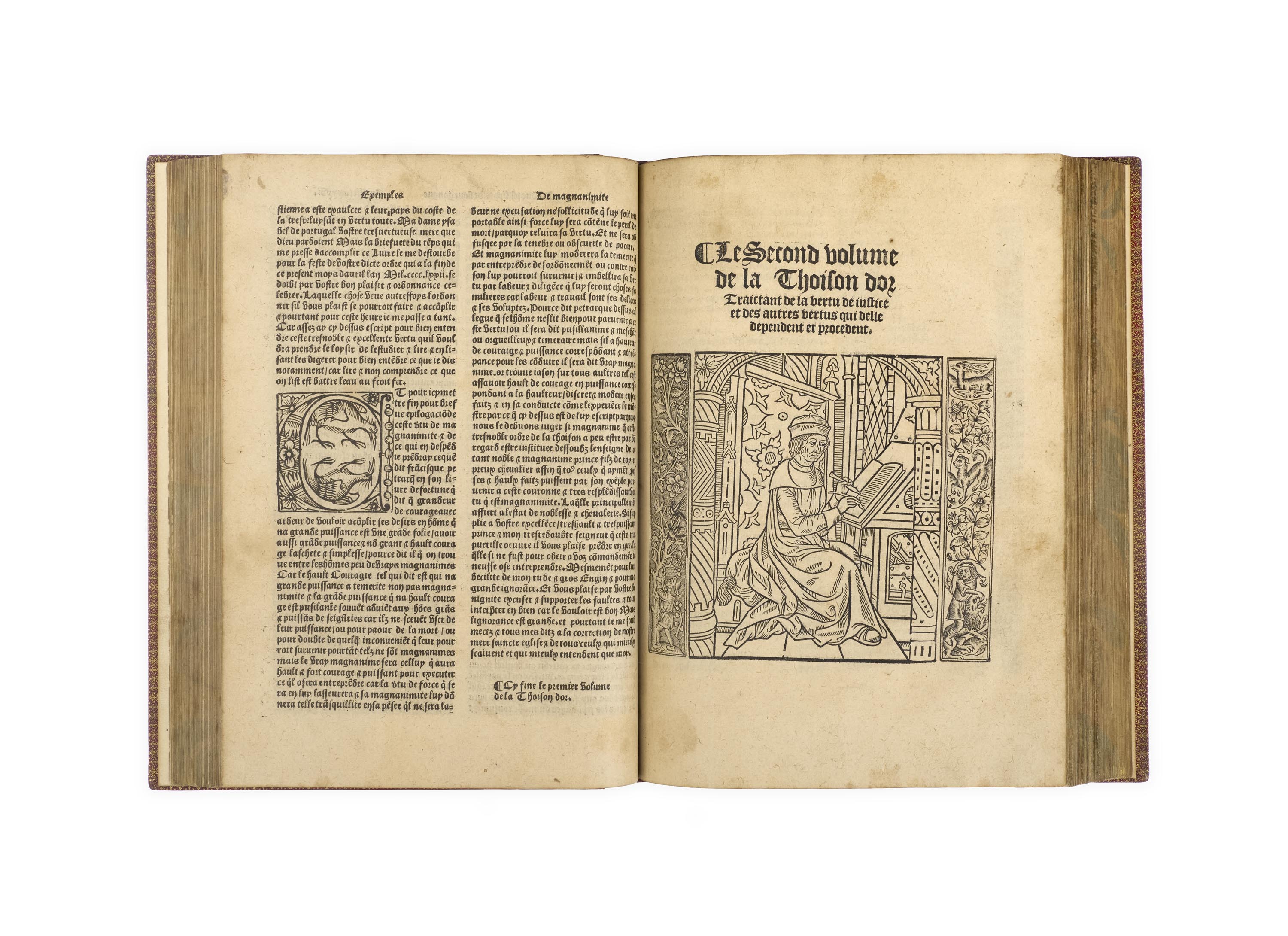
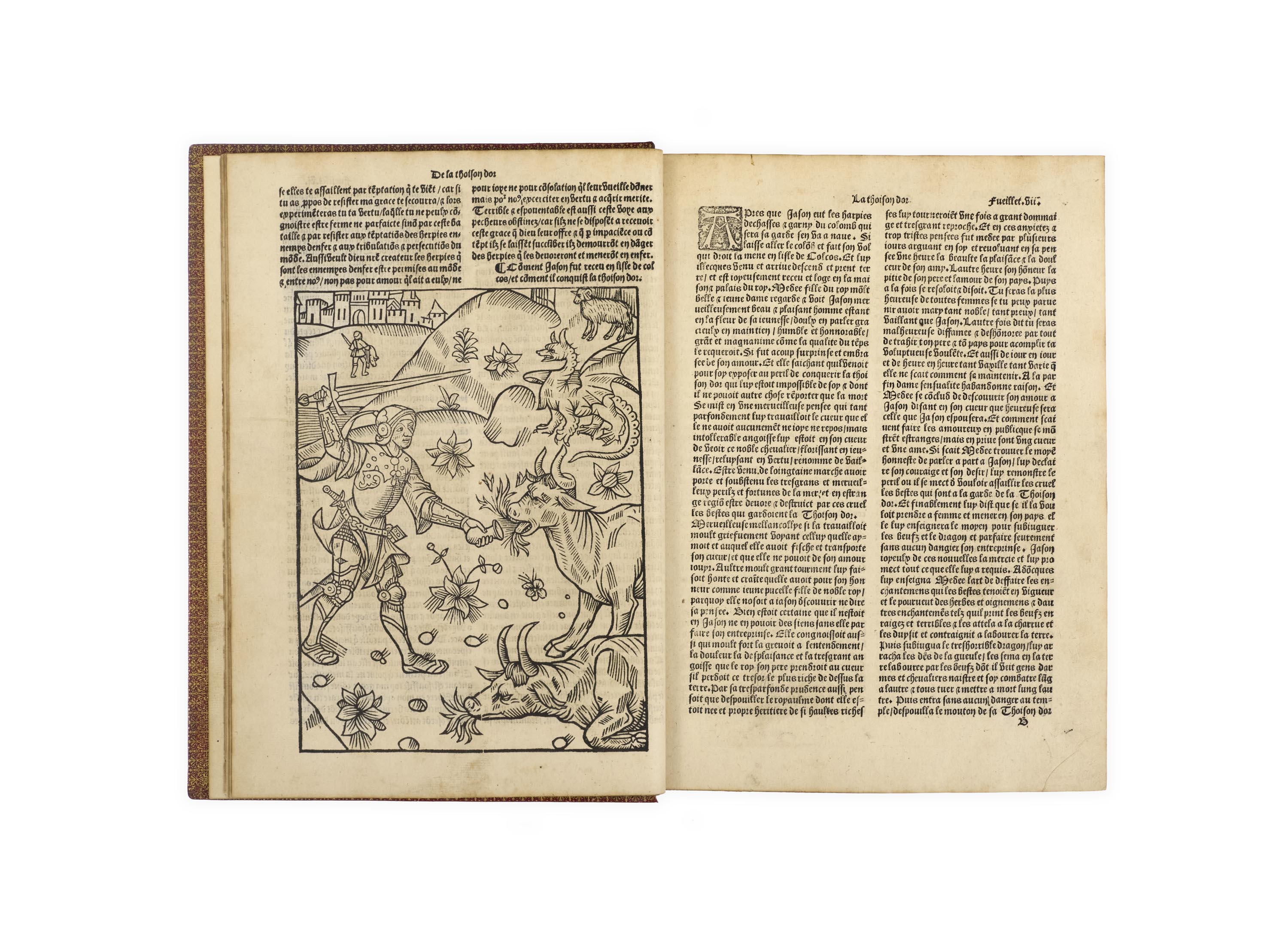
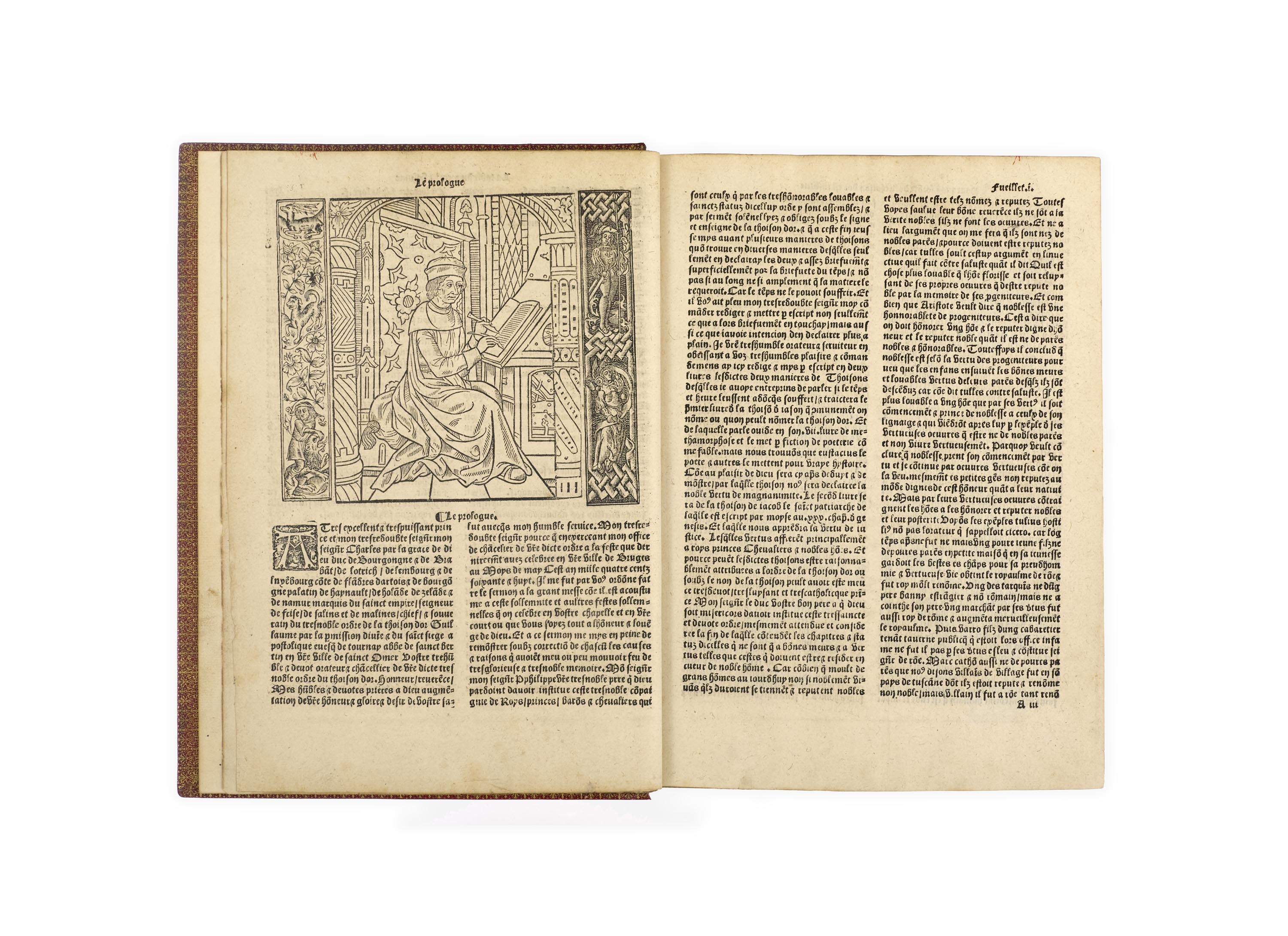
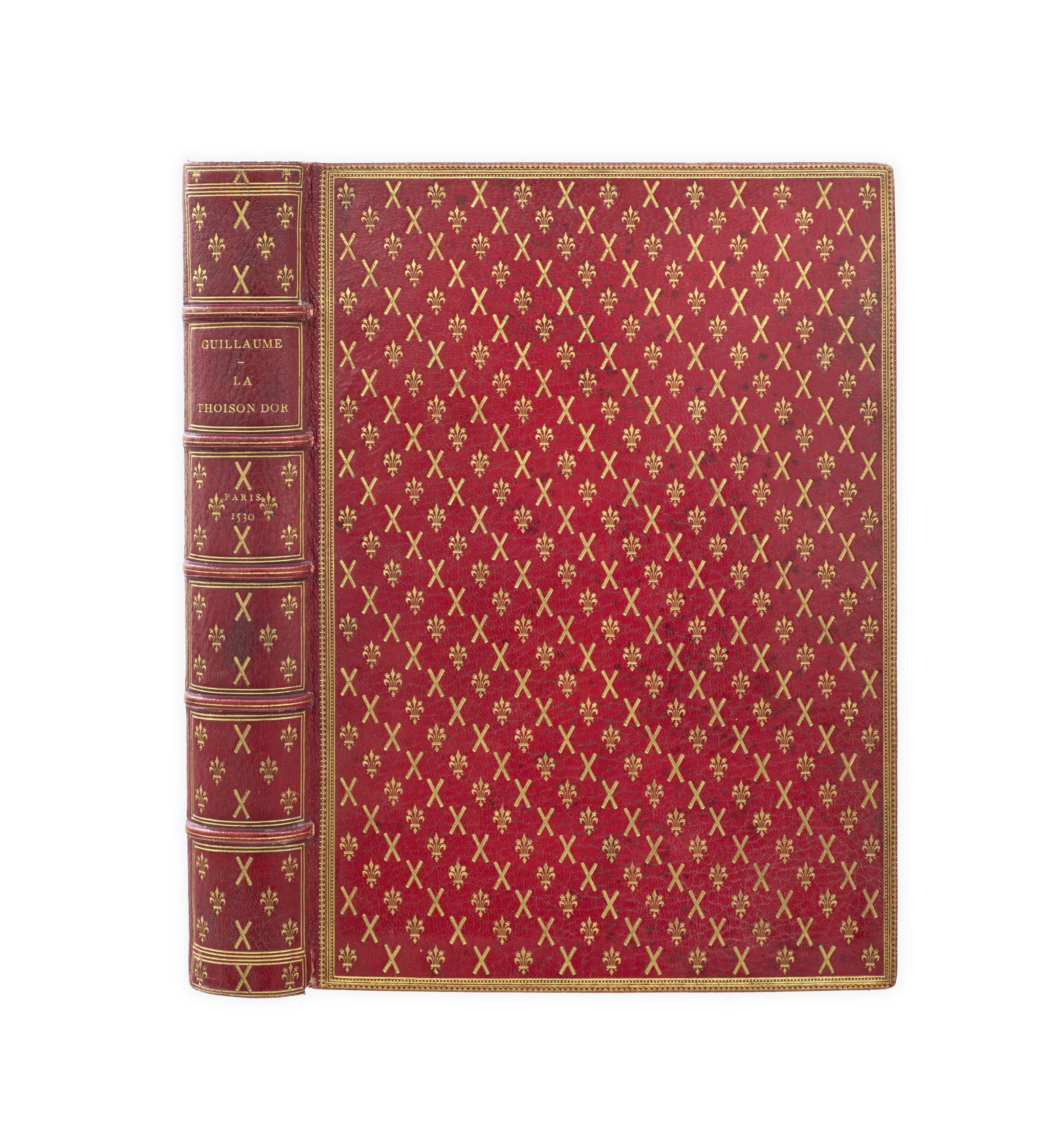
Two vols bound in one, folio, ff. I: [ii], cxxxv, II: [iv], [1, blank], ‘ccxliii’ (recte ccxliv); lettres bâtarde, title printed in red and black within architectural woodcut border incorporating Petit’s name and device, woodcut illustrations (including one of the author writing at a desk to title verso, repeated on second title-page and AA1r), woodcut initials; bound in late nineteenth-century crushed red morocco by Lortic (front turn-in signed in gilt), boards gilt with a semé of fleurs-de-lys and saltires, spine gilt in compartments and lettered directly in gilt, edges marbled and gilt, marbled endpapers; minimally rubbed at extremities, a few faint spots, small hole at foot of front joint, but a very good copy; small modern ticket removed from rear pastedown.
Added to your basket:
Le premier [– second] volume de la Thoison dor … Auquel soubs les vertus de magnanimite et iustice appartenans a Lestat de noblesse sont contenus les haulx vertueux et magnanimes faictz tant des treschrestiennes maisons de France Bourgongne et Flandres que dautres roys et princes de lancien et nouveau testament. Nouvellement imprime [– Traictant de la vertu de justice et des autres vertus qui delle dependent et precedent].
Rare third edition (first, 1516) of the most successful contemporary treatise on the Order of the Golden Fleece, composed by a prominent member of the order for the son of its founder, Charles the Bold of Burgundy.
Guillaume Fillastre (?1400–1473) was a Burgundian statesman and bishop in the service of Philip the Good, Duke of Burgundy, who had established the chivalric Order of the Golden Fleece in 1430. Fillastre was appointed the second Chancellor of the Order. After Philip’s death in 1467, which ended Fillastre’s political career, he began composing this work about the Order and the moral and theological origins of political power; only two of the projected six volumes were completed. Fillastre, an accomplished humanist, recruits heroes and exemplary men from classical antiquity, from early French history, and from the Bible to advance ideals of just leadership, magnanimity, and trust between a ruler and his subjects. ‘Such a relationship implied that the rulers reigned justly and exhibited generosity, while the subjects obeyed him of their own free will and granted him financial support when need dictated it’ (Schulte, p. 399). Fillastre’s elegant and inventive transformation of the mythological Jason into a Christian model and his semi-historical account of French history combine to create a speculum principis for the dedicatee, Philip’s successor Charles the Bold, who was presented with an illuminated manuscript of the treatise in 1473.
This is one of perhaps sixteen works printed by or for Nicolas Le Rouge in Troyes. Three issues of this edition exist, one with just the address of Poncet Le Preux on the title-page, as here, another including his name, and a third, recorded in a single copy at the BnF, with the name of Gilles de Gourmont. The woodcuts of Jason on A4r and on A8v, while seemingly identical, are in fact different blocks; one was previously used by Antoine Vérard, and the other by Philippe Le Noir, for their editions of Colard Mansion’s translation of Ovid (see Fairfax Murray, French 364). The woodcut of the author in his study belonged to Guillaume Le Rouge, the cousin of Nicolas Le Rouge, and some of the smaller woodcuts were also used in books of hours by Simon Vostre.
This is one of two copies similarly bound by Pierre-Marcellin Lortic (1822–1892); the other, with the addition of coloured morocco onlays, was Lortic’s own copy and included in the posthumous sale of his library in 1894 (lot 153).
We have located only four copies of any issue in the US (Harvard, Morgan, UCLA, Williams College).
Bechtel F-96; BP16 106293; USTC 1047; Rép. bibl. xvie siècle 12: Troyes, Le Rouge 14. See Schulte, ‘The Concept of Trust in the political Thought of fifteenth-century Burgundy’ in Trust and Happiness in the History of European Political Thought (2018).