Written for and Sung by the Girls’ Choir
GALUPPI, Baldassare.
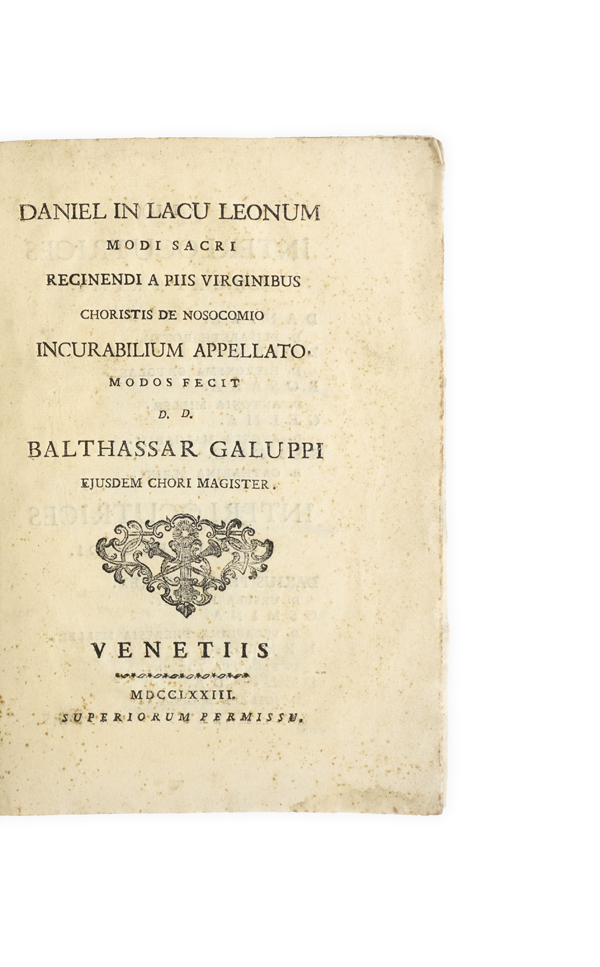
Daniel in lacu leonum modi sacri recinendi a piis virginibus choristis de Nosocomio Incurabilium appellato. Modos fecit D. D. Balthassar Galuppi eiusdem chori magister. Venice, s.n., 1773.
8vo, pp. xvi; woodcut ornament to title; minimal foxing, light marginal waterstain to last few leaves, but a very good copy, in later marbled wrappers.
Added to your basket:
Daniel in lacu leonum modi sacri recinendi a piis virginibus choristis de Nosocomio Incurabilium appellato. Modos fecit D. D. Balthassar Galuppi eiusdem chori magister.
First edition, very rare, of the libretto for this oratorio written by the celebrated composer Baldassare Galuppi for the renowned women’s choir of the Ospedale degli Incurabili in Venice.
Founded in 1522 by Gaetano Thiene (later Saint Cajetan) with the patronage of two noblewomen, Maria Malipiero and Marina Grimani, the Ospedale degli Incurabili was one of the four Ospedali Grandi of Venice, charitable hospices providing assistance to the sick and the poor. Governed by a council of twelve noblewomen, the Ospedale degli Incurabili was initially founded to accommodate women with incurable diseases such as syphilis, later becoming an orphanage.
The Incurabili, like the other Ospedali Grandi, was most famous for providing extensive and professional musical education to selected female pupils (called ‘figlie del coro’). The first documented oratorio performance at the Incurabili was in 1677; by the eighteenth century, the performances of these all-female ensembles had become an international sensation, attracting tourists from all over Europe (with the like of Charles Burney, Goethe, and Jean-Jacques Rousseau among those who gave accounts of such performances). Half of the takings from the performances were set aside to form a fund for future dowries in the event of any of the girls getting married, to which the board of governesses also contributed.
The Ospedali competed to hire the best choirmasters available, with the choir of the Incurabili being led by the likes of Carlo Pallavicino, Nicola Porpora, Johann Adolph Hasse, Niccolò Jommelli, Vincenzo Legrenzio Ciampi, and Baldassare Galuppi, among others, throughout the seventeenth and eighteenth centuries. Galuppi (1706–1785), called ‘il Buranello’ after the island of Burano where he was born, was one of the most renowned composers of opera and sacred music in Europe at the time; his career took him to London, Vienna, and later Saint Petersburg, although it was in Venice where he enjoyed the greatest popular acclaim. He was elected choir master of the Incurabili in 1762, a post which he held until 1776, with a three-year hiatus in 1765–1768 in Saint Petersburg at the court of Catherine II. ‘Charles Burney, who in August 1770 heard Galuppi’s singing girls at the Incurabili, one of Venice’s four competing Ospedali or musical orphanages, admired both their excellent performing standard (“indeed all were such as would have merited and received great applause in the first operas of Europe”), and the quality of the music that the aging maestro was still able to write for them: “it is generally allowed here that his last operas, and his last compositions for the church, abound with more spirit, taste, and fancy, than those of any other period of his life”’ (Carlo Vitali, Opera Today, online).
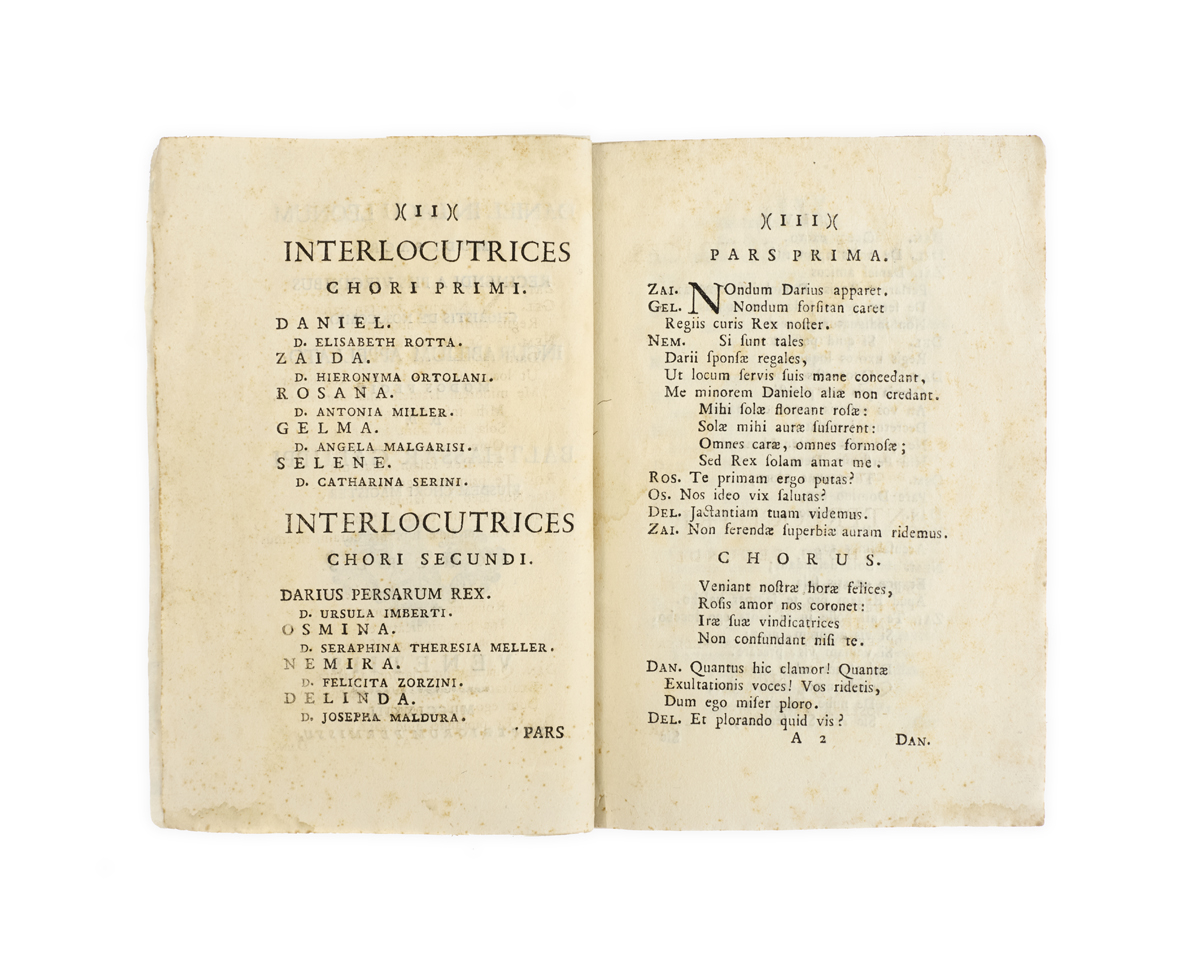
Galuppi’s Daniel in lacu leonum was performed by some of the most famous and appreciated singers of the time. These included the soprano Elisabetta Rota (also Rotta, active 1764–1778) and the contralto Girolama Ortolani (active 1763–1785), who Burney calls ‘Buranello’s Nightingales’, in the leading roles of Daniel and Zaida respectively, accompanied by the sisters Antonia and Serafina Teresa Miller (active in the 1770s), Angela Malgarisi, Felicita Zorzini, sopranos, and the contraltos Caterina Serini, Orsola Imberti (active 1763–1785), and Giuseppina Maldura.
These pages mark the end of the musical golden era at the Incurabili which, like all the other Ospedali, fell into bankruptcy due to rising costs and the financial instability in Venice at the end of the eighteenth century. The last oratorio was performed in 1785; the Incurabili finally closed its doors in 1805, following Napoleon’s invasion of Venice in 1797 and the subsequent suppression of religious orders. The building was turned into a hospital first and later into military barracks, while its associated church, which had served as a veritable concert hall for over 200 years, was demolished in 1831.
Not found on OCLC or Library Hub. OPAC SBN finds only three copies in Italy.