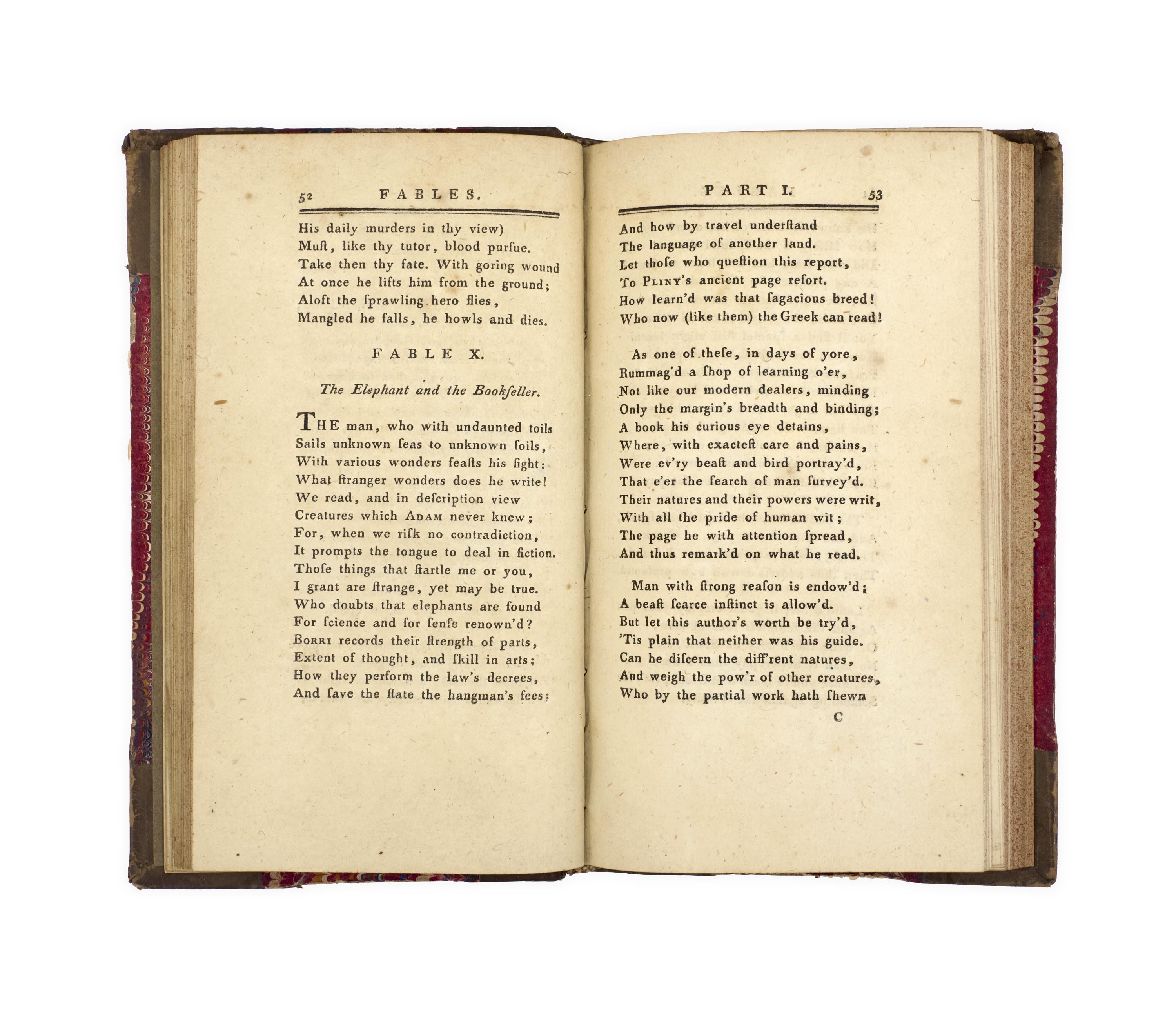
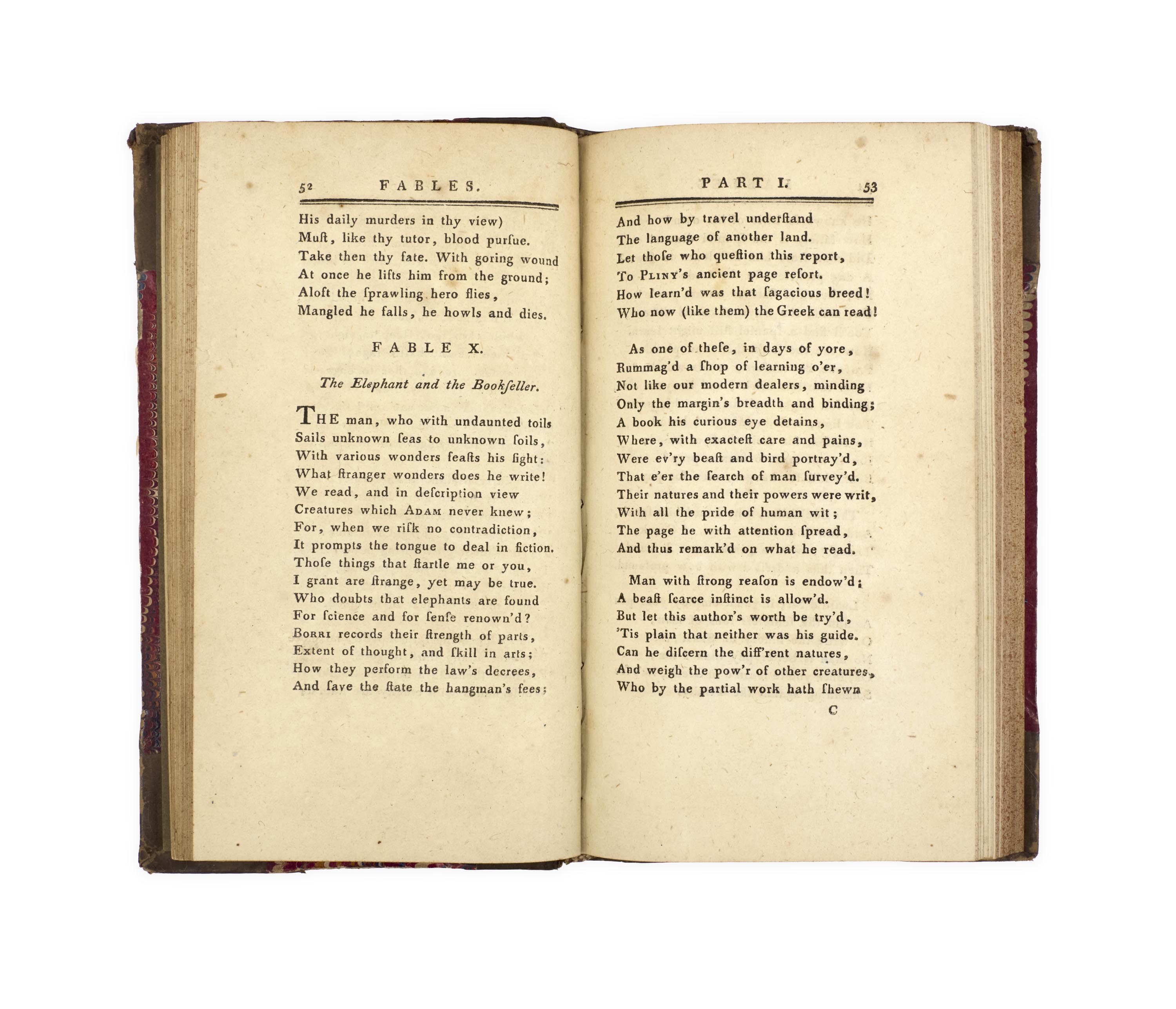
‘The Bookseller and the Elephant’
GAY, John.
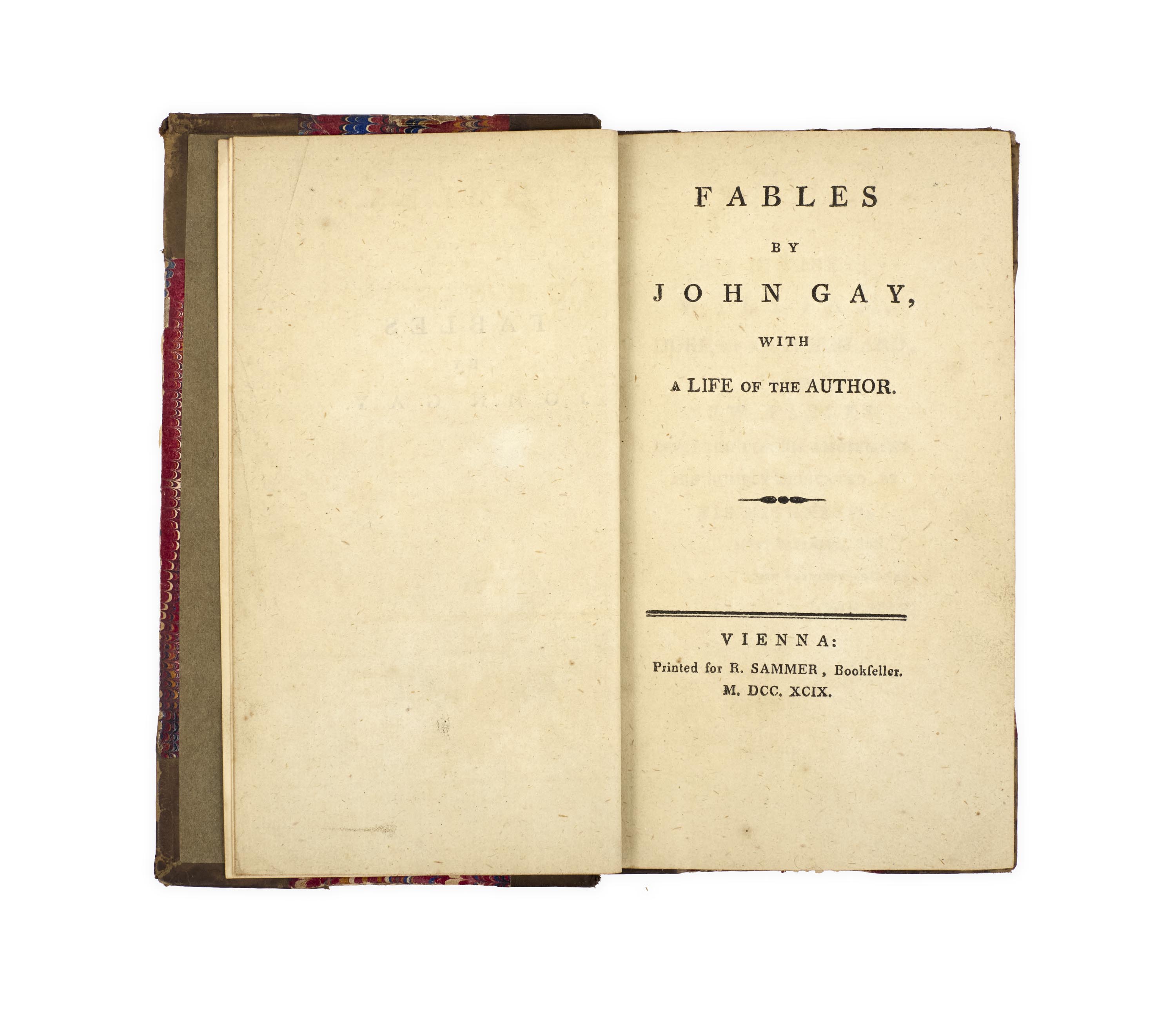
Fables by John Gay, with a Life of the Author. Vienna, Rudolph Sammer, 1799.
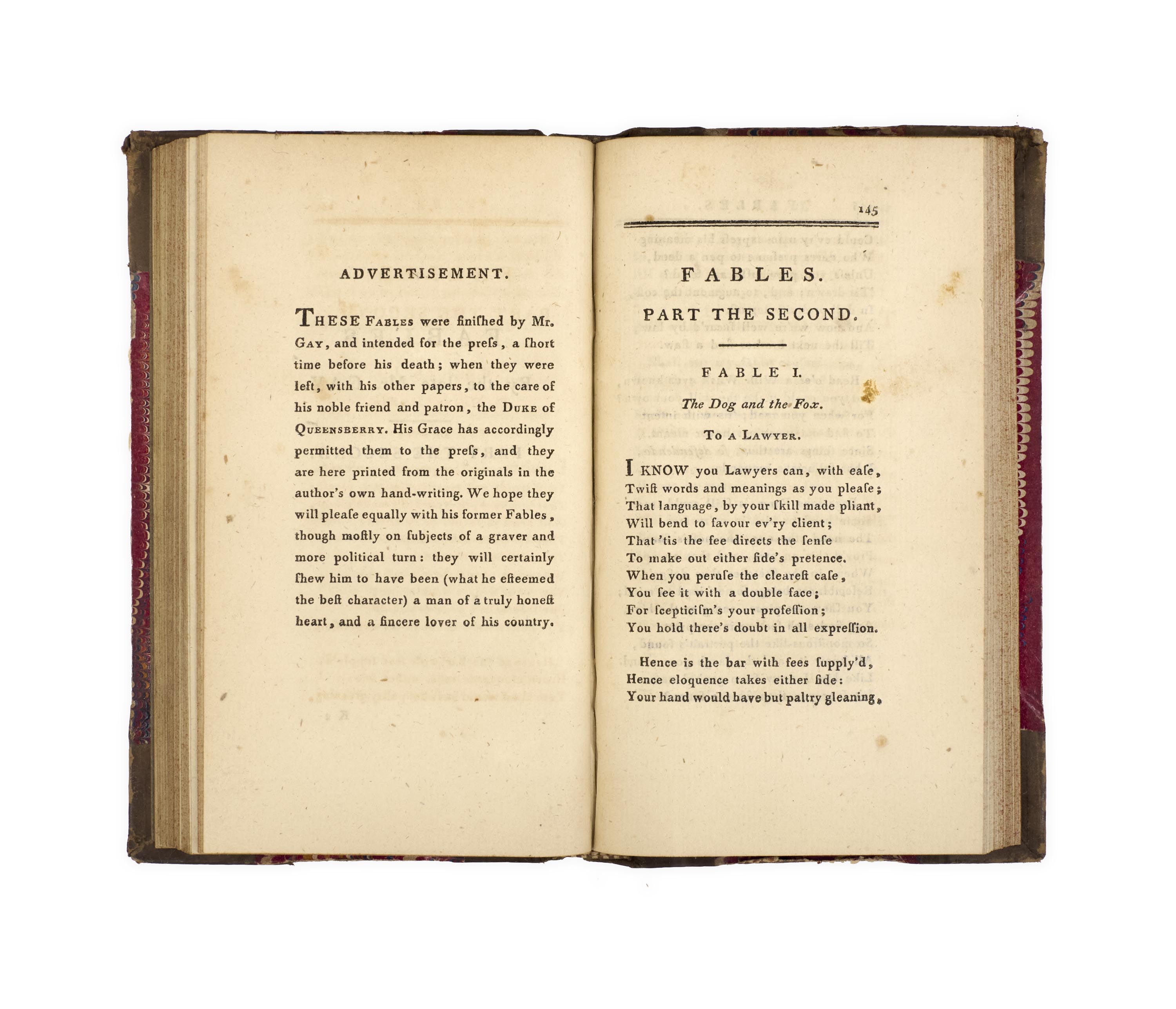
12mo, pp. 237, [1, blank]; with half-title; a few scattered spots and stains, half-title dusty, but a good copy; bound in nineteenth-century half calf with marbled sides, spine gilt à travers with gilt red morocco lettering-piece, edges speckled red, green endpapers; somewhat rubbed; inscription ‘Francis […]’ to front flyleaf.
Uncommon Vienna-printed edition of this series of fables by John Gay (1685–1732), which humorously subverts expectations of power and authority through the juxtaposition of characters from beggars and kings to booksellers and elephants.
First published in 1727 as a series of fifty-one fables for the six-year-old Prince William, later Duke of Cumberland, this edition includes also his posthumously published fables of 1738. His final fable, ‘The Ravens, the Sexton, and the Earth Worm’, satirises the theme of human haughtiness in the face of death with an ever-present tone of mock solemnity: the ending sees an earthworm delivering a parodic speech on the inevitability of death and decay at a sexton’s graveside, blissfully unaware of the nearby pair of ravens eyeing him up as their next meal. Particularly celebrated for his Beggar’s Opera, considered to be the first of the eighteenth-century genre of ballad operas, Gay was buried at Westminster Abbey and honoured with an epitaph by Pope.
The printer, Rudolph Sammer (1783/87–1821) of Vienna, was a former English teacher; this is one of several works of English literature he published, along with Laurence Sterne, Goldsmith, Milton, and Shakespeare, and he issued catalogues of books in various foreign languages.
OCLC and Library Hub find a single copy in the UK (BL) and three in the US (Chestnut Hill, Harvard, Stanford).
ESTC N31965; VD18 11269014. See Dugaw, ‘Folklore and John Gay’s Satire’ in Studies in English Literature 1500–1900 31:3 (1991), pp. 515–533.