Anti-Aristotelian Incest
[GIRALDI, Giovanni Battista.]
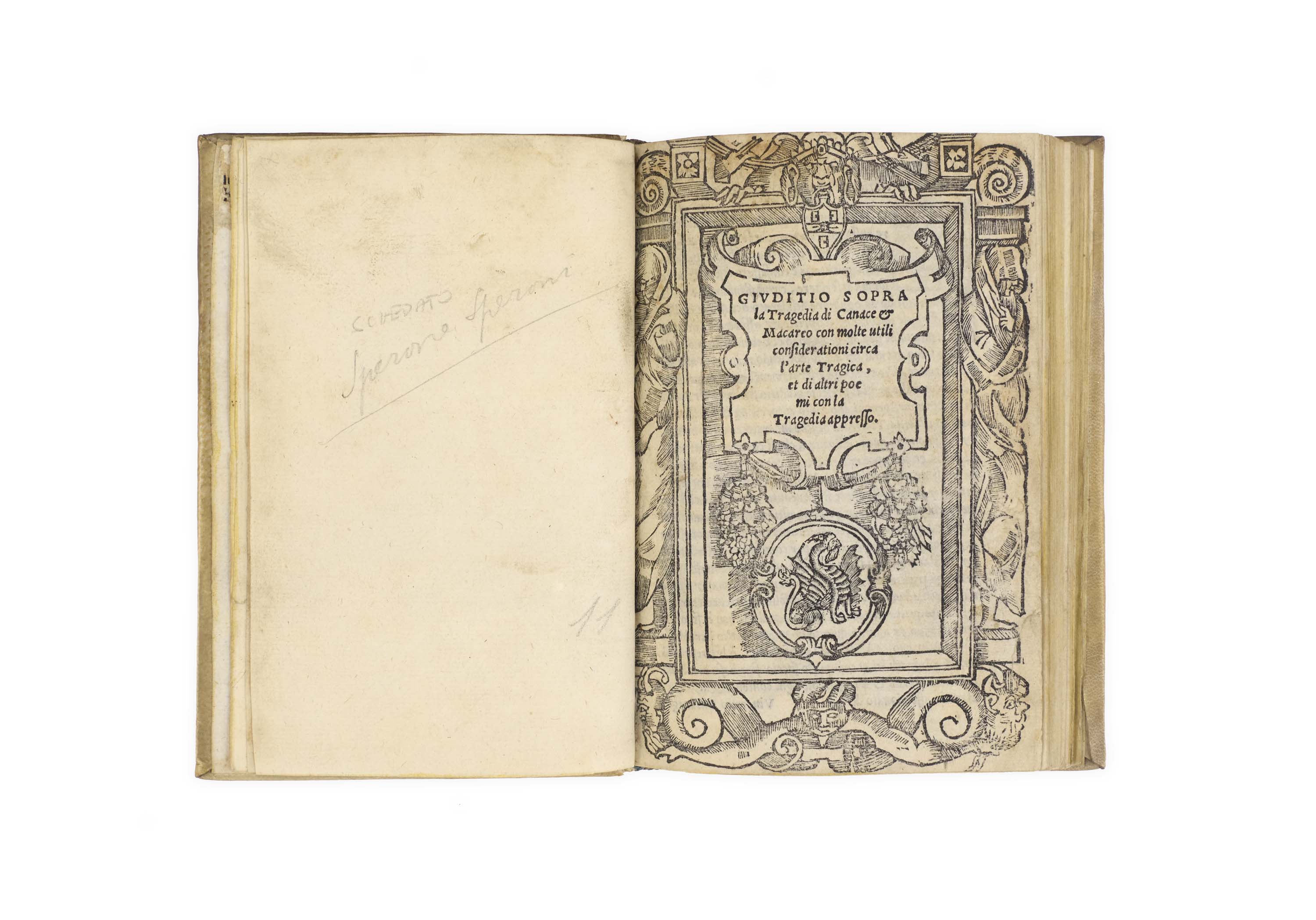
Giuditio sopra la tragedia di Canace et Macareo con molte utili considerationi circa l’arte tragica, et di altri poemi con la tragedia appresso. (Colophon:) Lucca, Vincenzo Busdraghi, 4 May 1550.
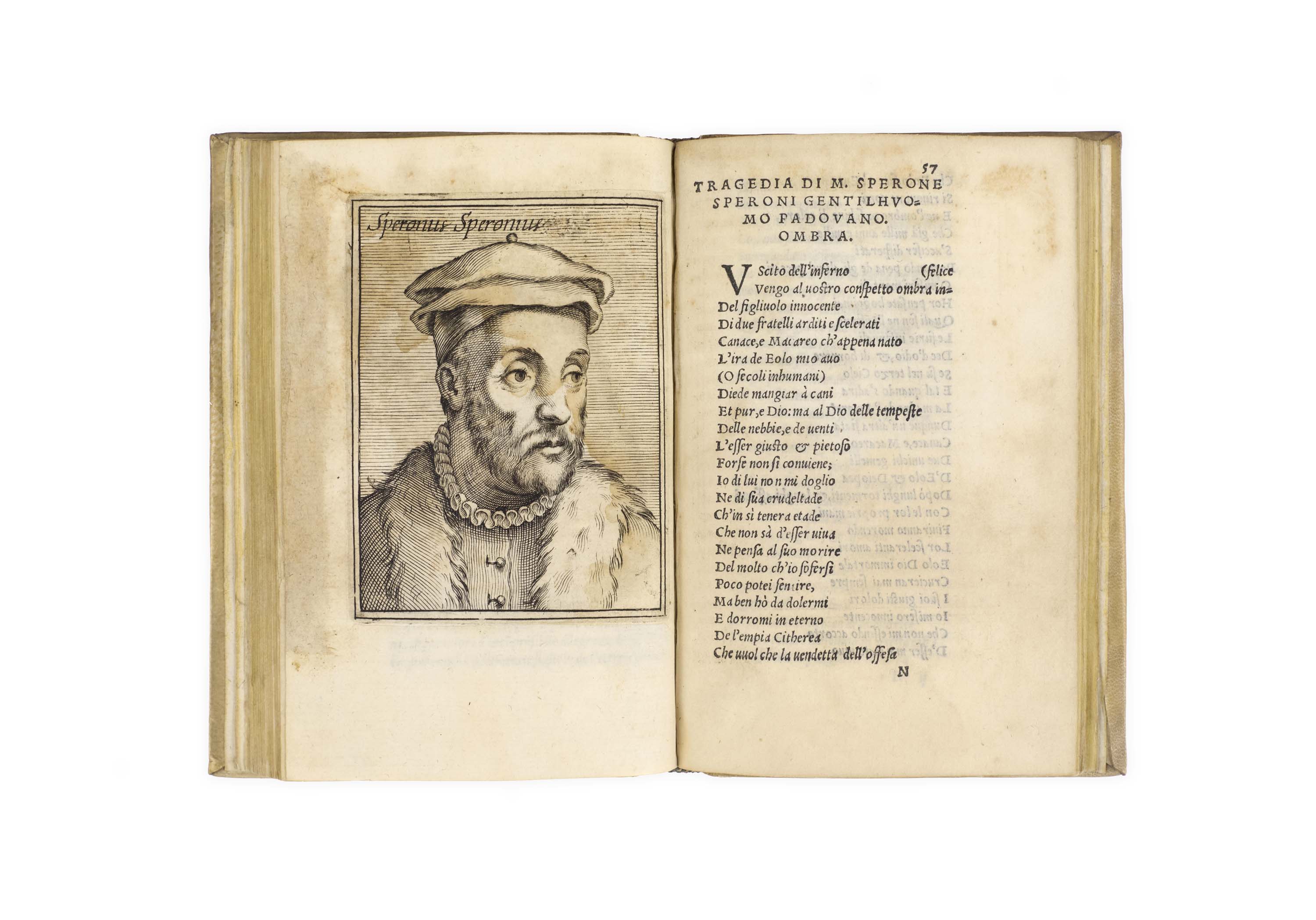
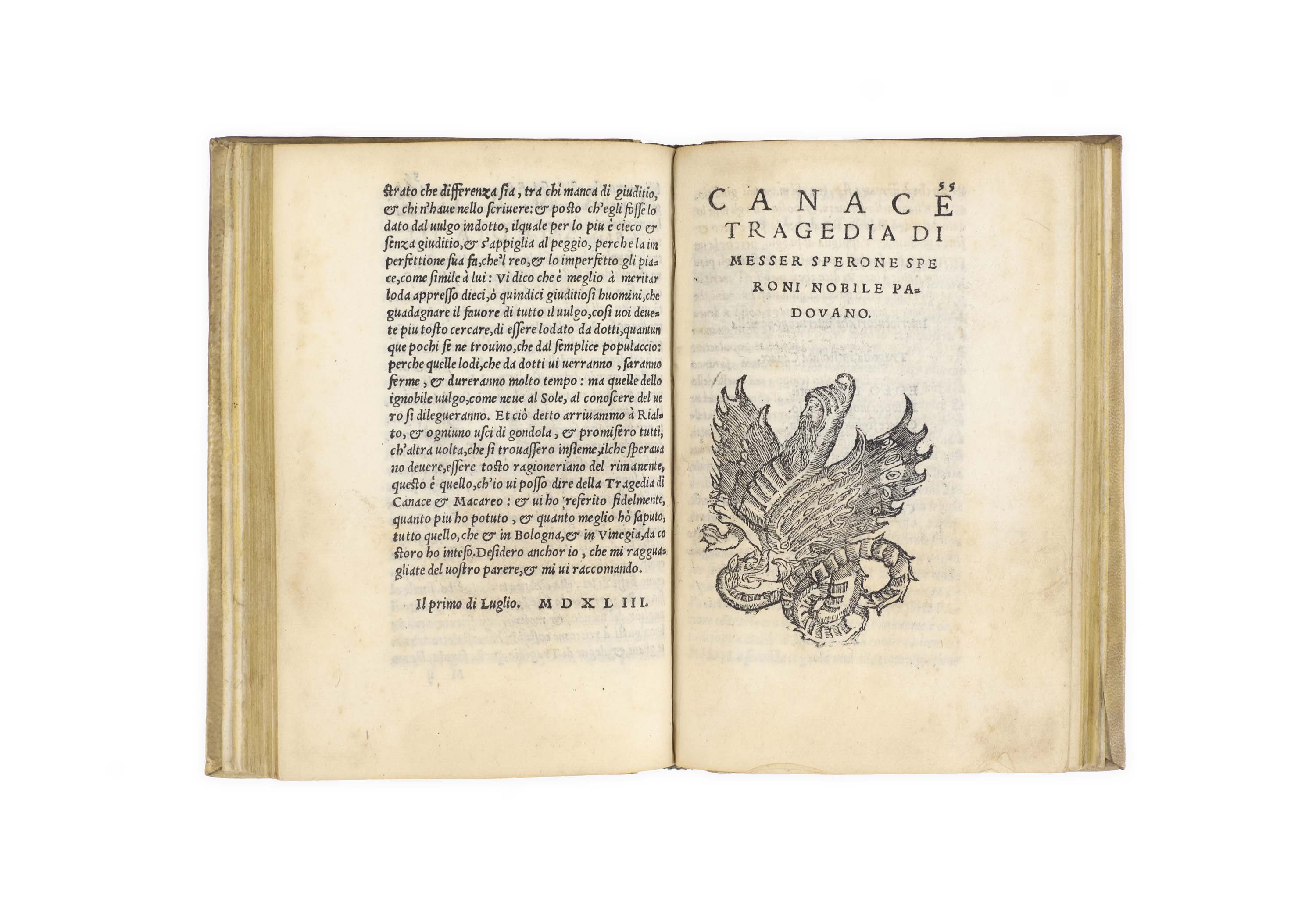
8vo, ff. 95, [1, blank]; title within woodcut border incorporating printer’s device, woodcut initials, woodcut printer’s device to M3, larger woodcut printer’s device above colophon, additional engraved portrait of Sperone Speroni pasted to a leaf inserted between ff. 56 and 57; title border slightly shaved, occasional light browning or staining, fore-edge of O4 defective, paper repair to foot of Q3 (see below), a good copy; bound in later vellum retaining old flyleaves (with watermark AA surmounted by a trefoil); binding very lightly soiled.
Added to your basket:
Giuditio sopra la tragedia di Canace et Macareo con molte utili considerationi circa l’arte tragica, et di altri poemi con la tragedia appresso.
First edition of this criticism, in the form of a dialogue, of Speroni’s play Canace et Macareo, which sparked one of the most remarkable literary debates of the time. The text was previously attributed to Bartolomeo Cavalcanti, but the authorship of Giraldi is now generally accepted. The full text of the play is included in this edition.
Sperone Speroni (1500–1588) was a Paduan scholar, the author of numerous works on language, history and rhetoric, championing the use of the vernacular in his translations of Aristotle. Giraldi (1504–1573, also known as Giraldi Cinzio), a writer and scholar from Ferrara, is better known for his collection of tales, Gli Hecatommithi, which served as a source for later writers, most notably Shakespeare. He was also the author of the first vernacular treatise on drama, written in around 1543 but not published until 1554.
‘The “Aristotelian” debate over tragedy was rekindled by Sperone Speroni’s Canace, read at the Accademia degli Infiammati in Padua in 1542 and published in 1546. The play – centering on the incestuous love of Canace and her brother Macareus – was harshly criticized by an anonymous treatise (Giudizio d’una tragedia di Canace e Macareo, 1550), most likely authored by Giraldi himself (Roaf 1982). The main critique concerned the choice of the story and its characters: Canace and Macareus were evil characters; their tragedy could not, then, arouse terror or pity (and hence “moral” catharsis). In his Apologia (1554), Speroni replied that Canace and Macareus were not evil but “median” characters and thus tragic; moreover, they were young and sinned for love, sent to them by Venus, and this was pitiful. Later on (Lezioni in difesa della Canace, 1558), Speroni also claimed that the real tragic character was in fact their father Eolus’ (Schironi, ‘The reception of ancient drama in Renaissance Italy’, in A Handbook of the reception of Greek drama, 2016, p. 136). This is one of the first books printed by Busdraghi in Lucca; copies are recorded with a typographical fleuron beneath the colophon, which is not present in this copy. The paper repair to the foot of Q3 has added an additional line of letterpress text (in an almost identical font) to the foot of Q3r, though this line also appears in its proper place at the head of the following page. The engraving of Speroni has been extracted from Claude Pernet’s 1625 book of images of famous men.
EDIT16 CNCE 21258; USTC 833266.