Schoolboy Fables, Teenage Verse, and Aristotle
GOODRICH, Bartlet.
Four commonplace and exercise books, with verse, exercises and essays. 1799, 1807–8, 1820, and 1830s.
Four vols, 4to, in contemporary blue wrappers (first volume), quarter calf or roan (second and third volume), and quarter red morocco (last volume); generally in very good condition, signed with full-name or initials in various places.
Added to your basket:
Four commonplace and exercise books, with verse, exercises and essays.
Three and a half decades of a life as seen through manuscript notebooks, following Goodrich (1790–1855) from the age of nine, through university, to his years as a clergyman in Essex.
The Goodrich family had strong links to the Americas. They were early settlers in Virginia, and were powerful and well-established by the time of the Revolution in 1776 – the patriarch John Goodrich famously switched sides to remain loyal to the crown and was imprisoned, while Bartlett Goodrich (1753–1824/5, a senior namesake of our Bartlet) fled to England and bought Saling Hall, a grand house in Essex, in 1796; his brother Bridger remained in the West Indies as a privateer and was known as ‘the scourge of the Chesapeake’.
The junior Bartlet responsible for these volumes was educated in Bristol, where his father, a different John Goodrich, had connections to the slave trade; he matriculated at Oriel College, Oxford, in 1808, and then University College in 1812, becoming first rector of Hardmead, then vicar of Great Saling, presumably in the gift of his wealthy relative at Saling Hall.
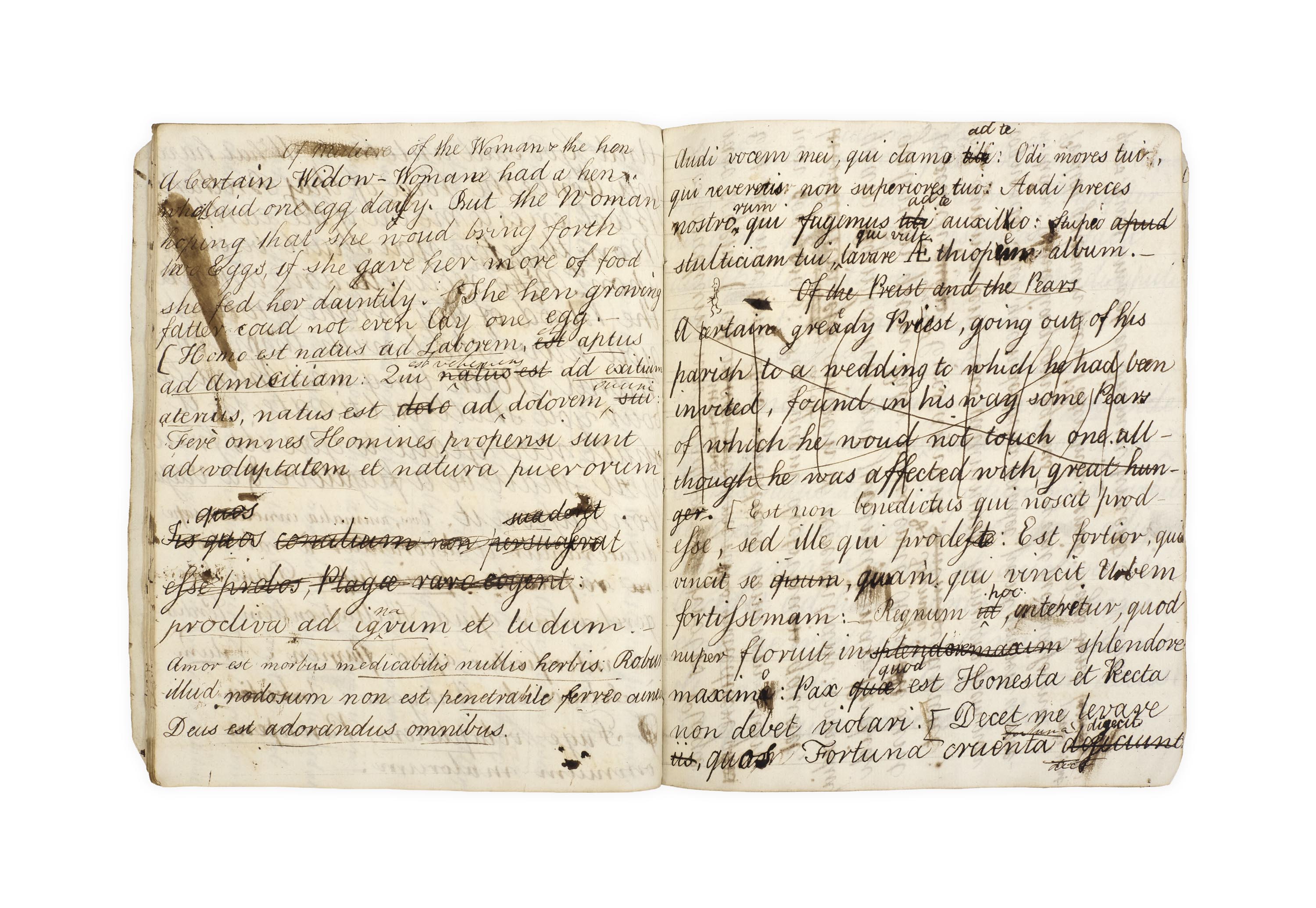
The earliest exercise book here is dated 'Aug 7 1799' on the front cover and is a collection of school exercises in a juvenile hand, opening with ‘Select Passages from profane Authors’ on the nature of divinity, followed by some short fables, some translated (‘the Members & the Bully, taken from Pliny’ etc), interspersed with texts in Latin, all heavily revised and corrected.
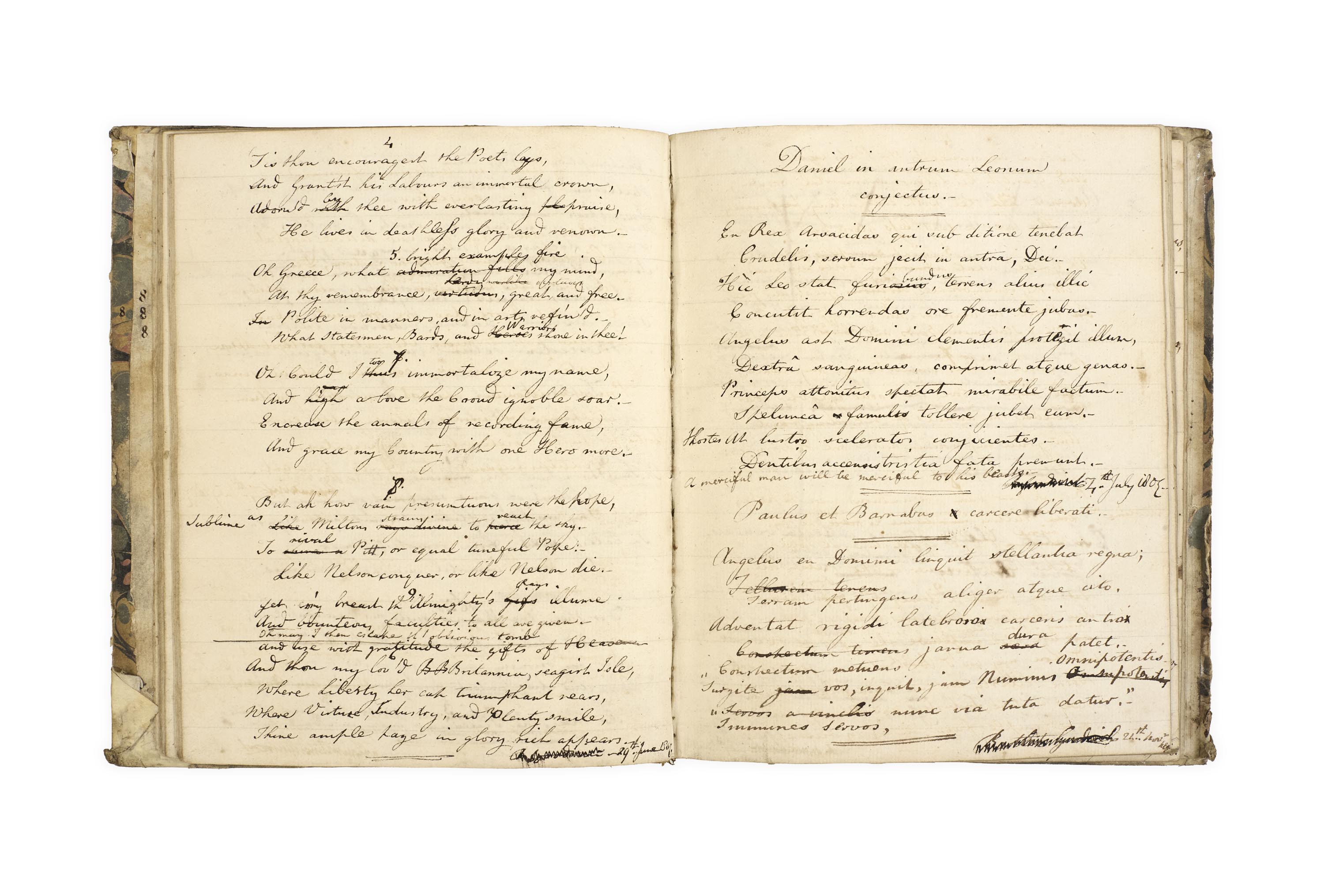
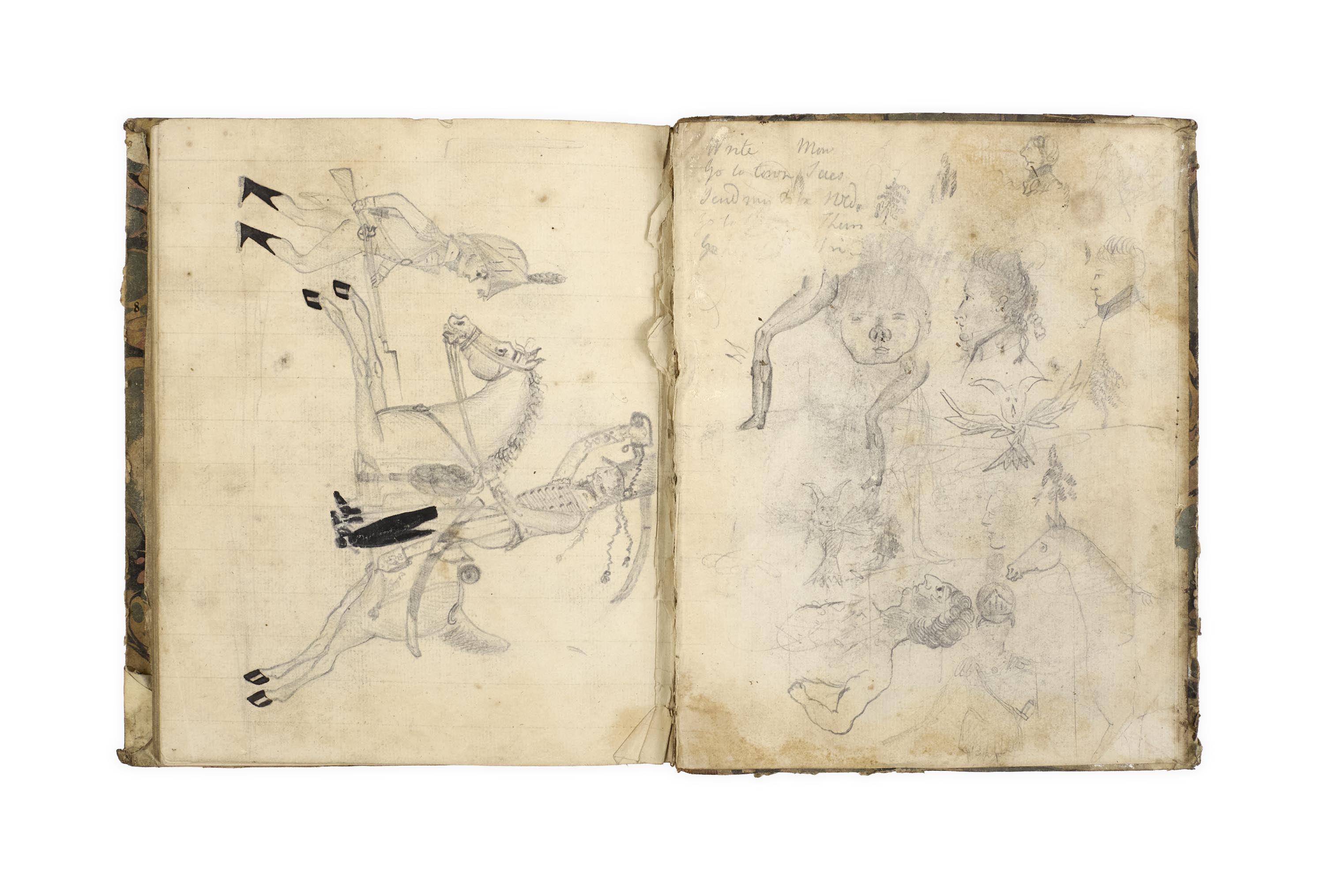
The second notebook takes Goodrich up to university, and contains longer English, Latin and Greek texts, some of the latter with English translations in pencil. Goodrich was perhaps not the most conscientious student, and there are a few naïve sketches of faces and horses as well as some intermittent doggerel verse of a humorous nature:
On Sunday free
At Westbury
And in my Fathers Gig sir
I aim a Thump
At Violets rump
And think I’m mighty big Sir …
The 1820 notebook comprises a number of longer prose entries written at Sandgate in August and September, opening with a quotation from Locke. The content is philosophical with a spiritual bent. The final notebook, perhaps produced over a period of time, includes an unrecorded printing of ‘A Collection of Tables for the Use of Schools’ (Bristol, W. Browne, n.d., pp. [1], 3; 4to, affixed to a pastedown). From one end is a summary of Aristotle’s Ethics in 39 pages (rectos only, with some commentary on facing pages), from the other some lengthy extracts from books – Inglis’s Narrative of a Journey through Norway, Part of Sweden, and Denmark (1835), Davis’s Description of the Empire of China (1836), and several others.