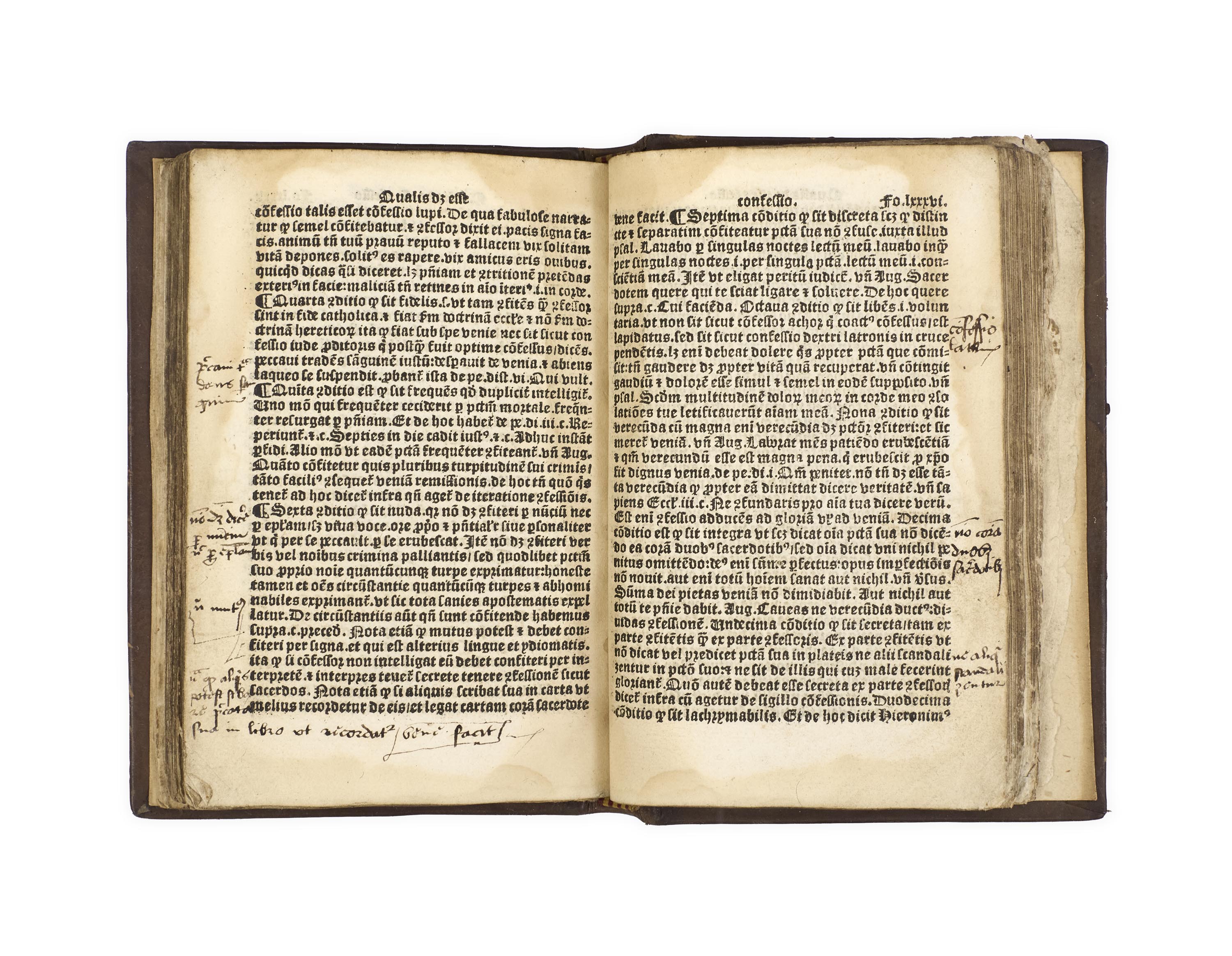
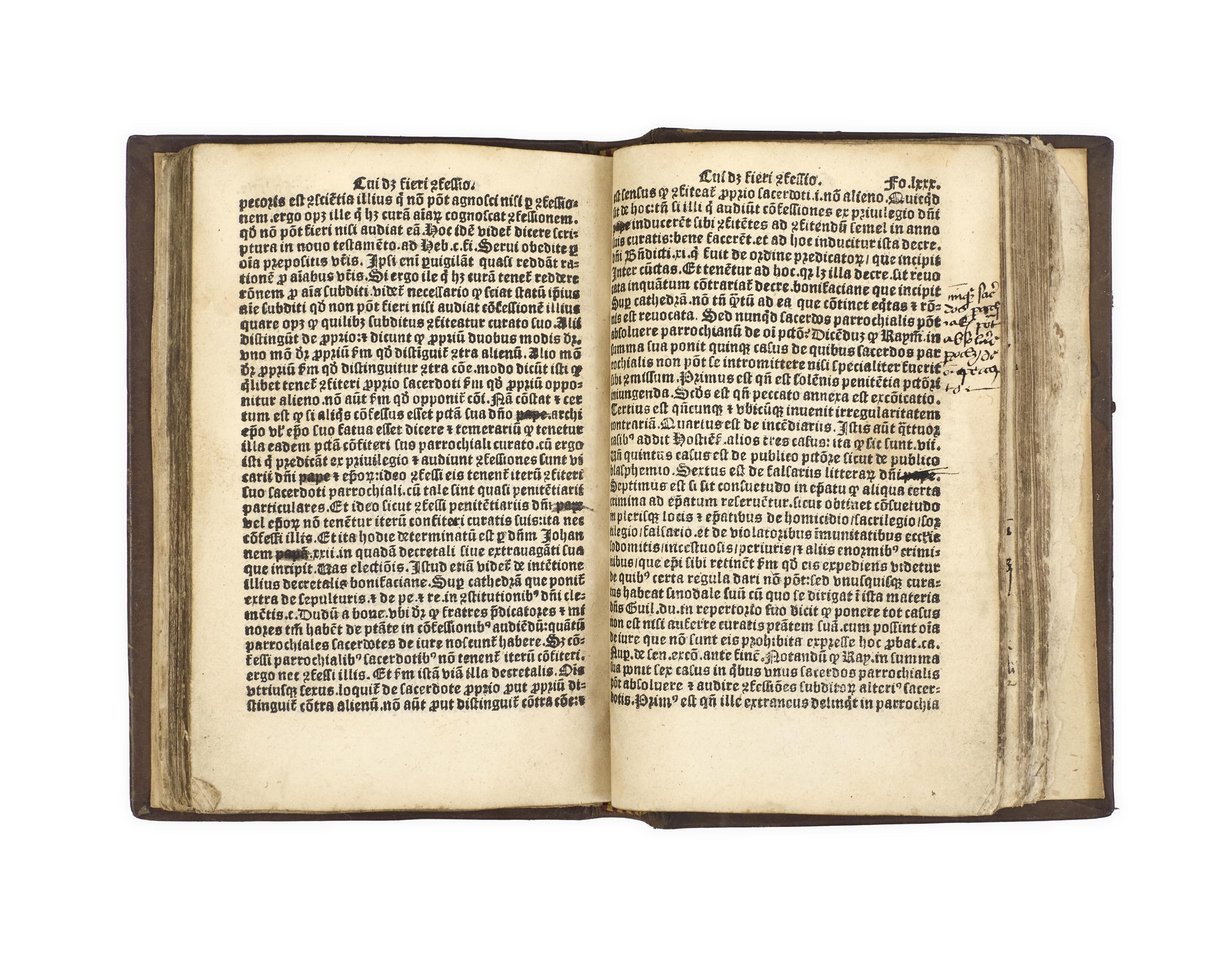
Contemporary Annotations
[GUIDO DE MONTE ROCHEN.]
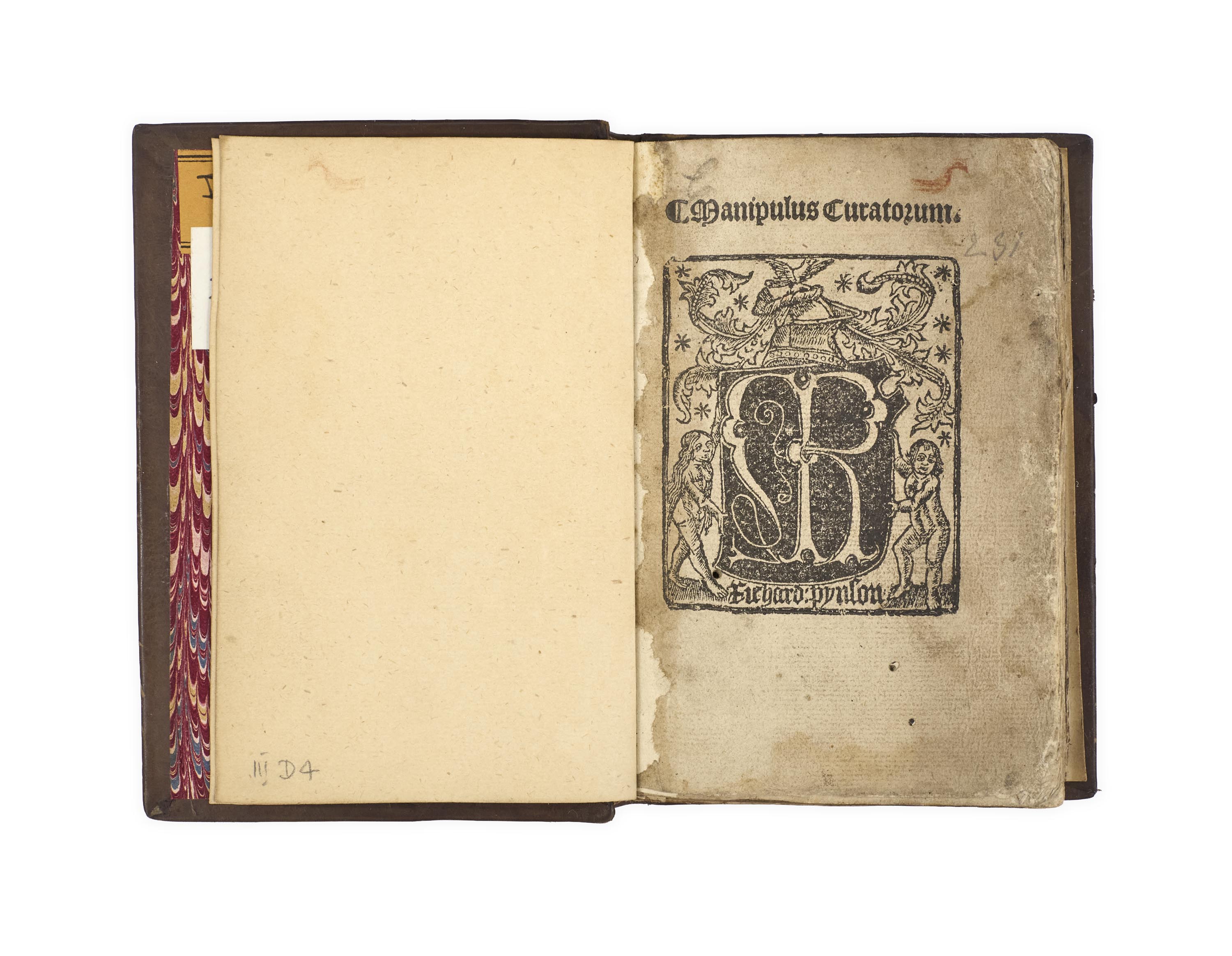
Manipulus curatorum. [(Colophon:) London, Richard Pynson, 1508.]
8vo, ff. cxxvii; A–P⁸ Q1–7 (-Q8); gothic type, woodcut Pynson device (McKerrow 9, without border) to title; light dampstains to margins throughout, small wormtracks to first two quires affecting printer’s device and a couple of letters per page, title worn at inner margin and mounted on stub, loss to lower corner of P5 affecting half a dozen words, marginal tear without loss to H7, quire Q coming loose, some leaf-edges frayed; else a good copy in nineteenth-century divinity calf blind-panelled with ‘Oxford’ rules, spine lettered directly in gilt; extremities a little rubbed; annotations in a contemporary English hand to c. 30 pp. (see below), modern paper labels with shelfmarks to front pastedown.
Very rare Pynson edition of the Manipulus curatorum, an immensely popular medieval handbook for priests, with annotations to some thirty pages in a contemporary English hand.
Composed in the 1330s by Guido de Monte Rochen (also Monte Rocherii or Roterio), the Manipulus curatorum met the growing need for pastoral guidance and the training of priests in the wake of the Fourth Lateran Council (1215). Aimed at simple curates and written in a suitably unadorned style, the work is in three parts: the first on six of the seven sacraments; the second on penance (the remaining sacrament and a matter of particular complexity for parish priests); and the third on catechesis. ‘Although Guido’s manual had much in common with contemporary pastoralia, it stood out from the pack by adapting and simplifying the genre’s basic features to serve its audience more effectively. The Handbook is long enough to be comprehensive, but short enough to be truly useful’ (Thayer and Lualdi, p. xxiv).
‘More than 250 manuscript copies of the Handbook for Curates are still extant, but it truly came into its own with the advent of printing. Between circa 1468 and 1501, some 122 editions of the Handbook rolled off European presses both big and small, making it the eleventh most printed title in the period’ (ibid., pp. xiii–iv). Only the Inquisition in the Catholic world and the Reformation in the Protestant put an end to its widespread use, as witnessed by the anti-papal deletions in our copy.
The Norman-born Richard Pynson (c. 1449–1529/30) was the first to print this exceptionally popular handbook in England, in an edition of 1498 (two complete copies in ESTC) followed by a second in 1500 (four complete copies in institutions). The present edition was his third, finished in November 1508, by which time he had been appointed king’s printer.
The contemporary annotations in our copy show a particular interest in the practicalities of confession, including writing sins down in a book, and in the seven deadly sins. In keeping with the dictates of the Henrician Reformation the word ‘pope’ is crossed out six times.
ESTC finds only three other complete copies of the present edition in institutions (BL, Bodley, St Paul’s Cathedral), with an imperfect copy recorded at Cambridge and a further copy once in the collection of Lord Kenyon, now likely dispersed. We find no copies in auction records.
ESTC S111363; STC 12474.