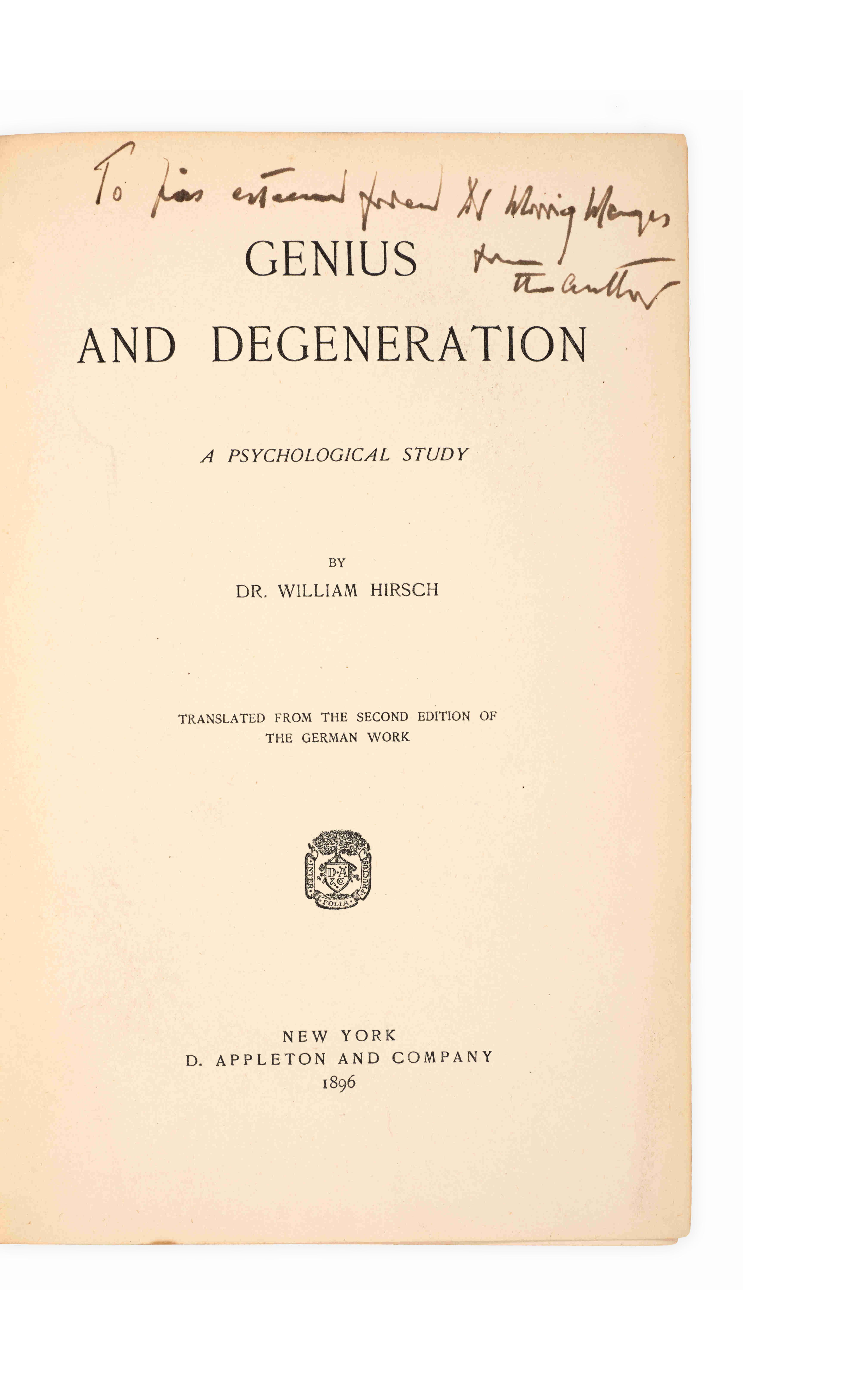
On Genius and Insanity – Presentation Copy
HIRSCH, William.
Genius and Degeneration. A Psychological Study. New York, Appleton, 1896.
8vo, pp. vi, [2] 333, [1 (blank)], [2 (advertisements)]; an excellent copy in original drab cloth, front board blocked in color and gilt with title and burning torch device, spine gilt; binding slightly cracked but holding; presentation inscription in ink to title-page, ‘to his esteemed friend Dr Morris Menger from the author'.
First edition in English, translated from the second edition of the German original, Genie und Entartung (1895).
The psychiatrist and neurologist William Hirsch (d. 1937) was born in Germany and moved to the United States as a young man, graduating from Columbia’s College of Physicians and Surgeons in 1891.
Hirsch’s work, which was admired by William James, is a refutation of the assertion made by Lombroso and Nordau that the condition of genius was degenerate or akin to inherited ‘criminality’, and therefore related in some way to insanity. The view that genius is pessimistic and therefore degenerate – characterized by melancholia, the desire for death and world-weariness – is countered by Hirsch’s optimistic conception of genius. Here, he discusses the limits of insanity; the psychology of genius; genius and insanity; degeneration; the influence of education upon genius; secular hysteria; and art and insanity. The final chapter, ‘Richard Wagner and psychopathology’, is Hirsch’s entertaining defence of Wagner’s psychology from accusations of insanity and ‘erotomania’.
Notably, Hirsch was one of several psychiatrists called in as experts to assess the competence of Harry K. Thaw – husband of ‘Gibson Girl’ Evelyn Nesbit – in the notorious 1908 trial for the murder of Stanford White. Often called ‘the trial of the century’, it was the first twentieth-century celebrity trial to involve an insanity plea – with the defence claiming that Thaw had suffered a momentary ‘brain storm’ of madness.
Provenance:
Presented by the author ‘to his esteemed friend Dr Morris Menger’. Menger, a New York physician, was named a Fellow of the American Academy of Medicine in 1899.