Unexpurgated Proofs
[HOLBEIN, Hans, the Younger; Joseph SCHLOTTHAUER, lithographer.]
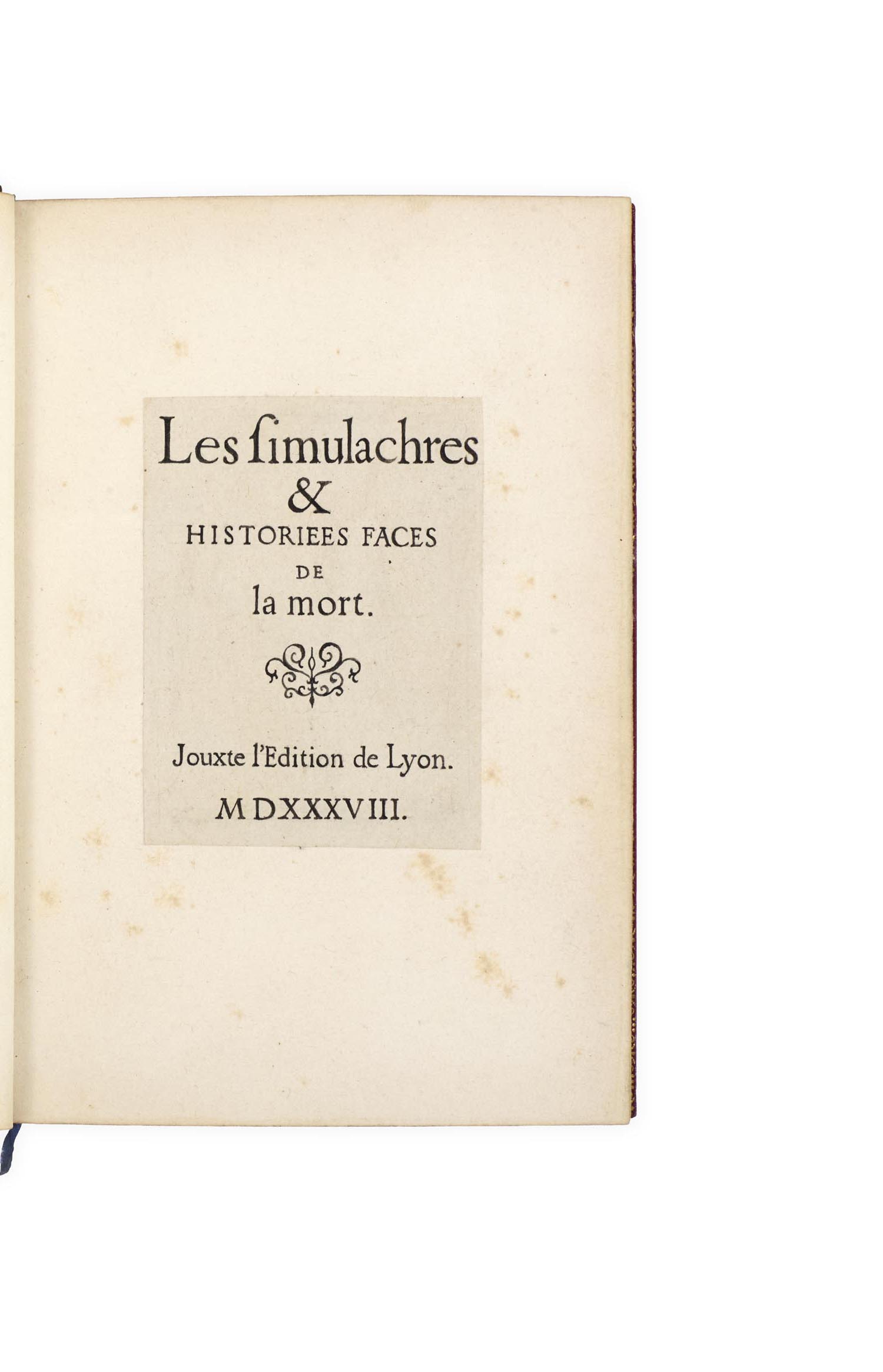
‘Les simulachres & historiees faces de la mort. Jouxte l’Edition de Lyon. MDXXXVIII.’ [Munich, 1832?]
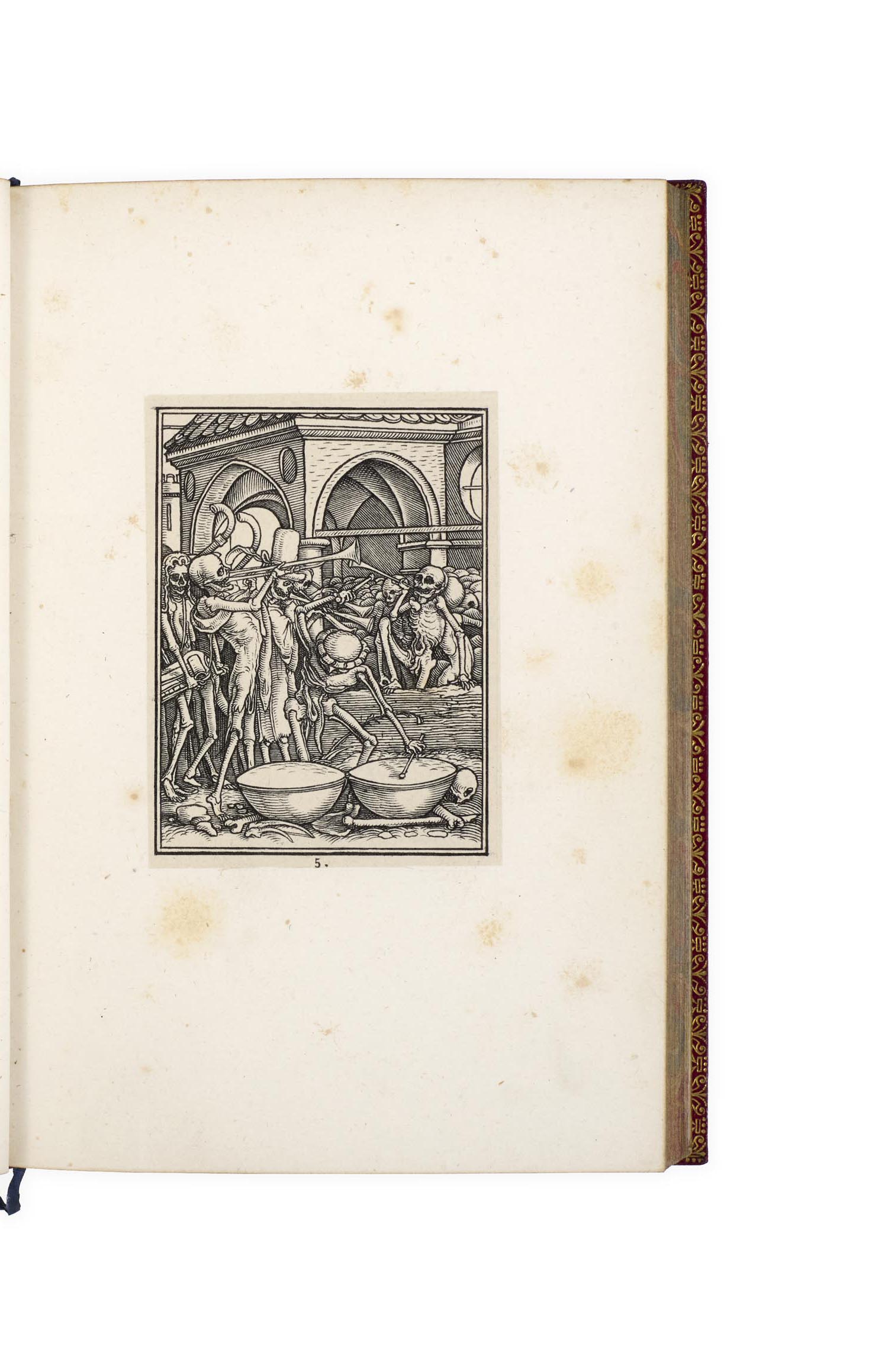
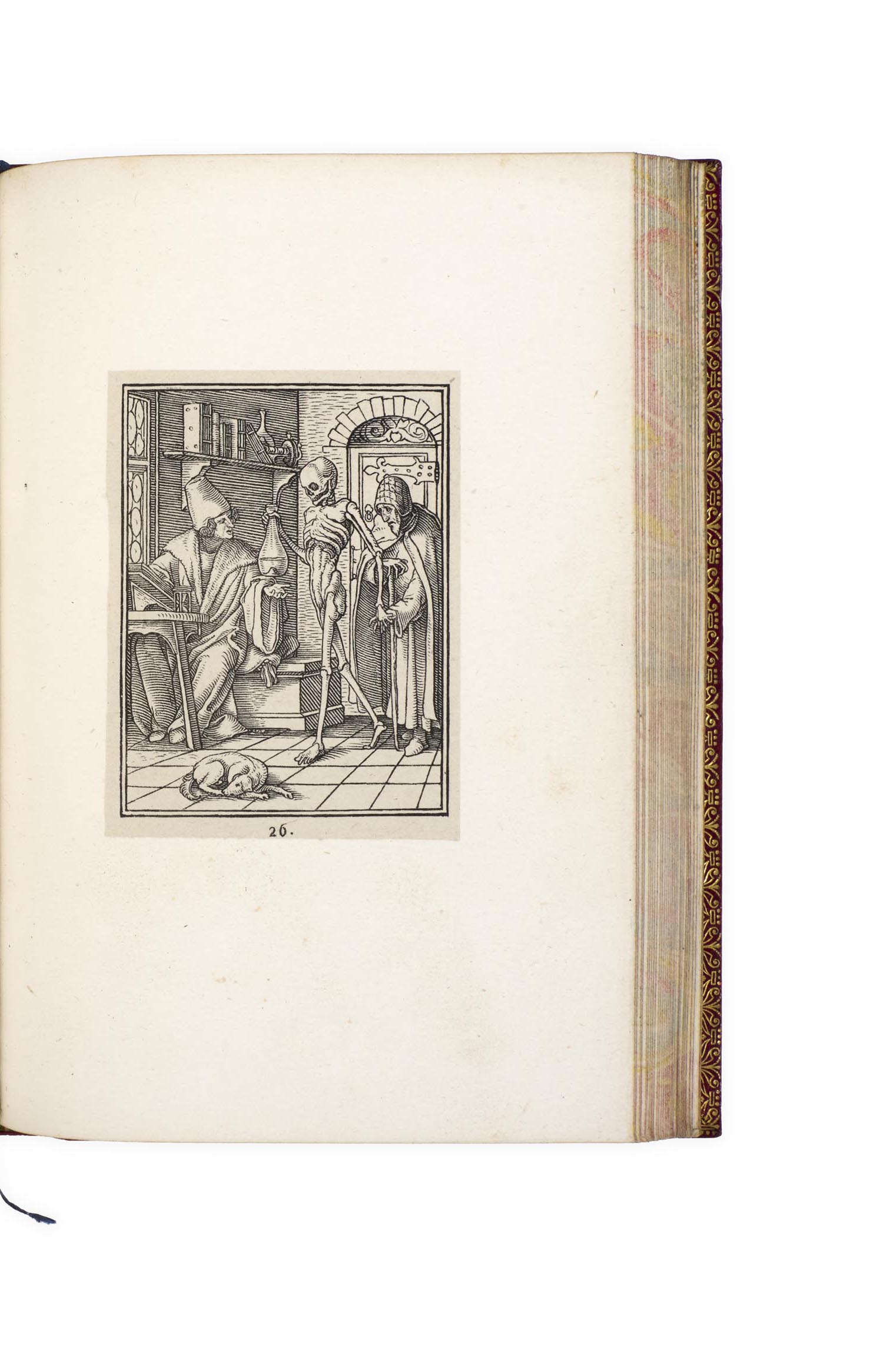
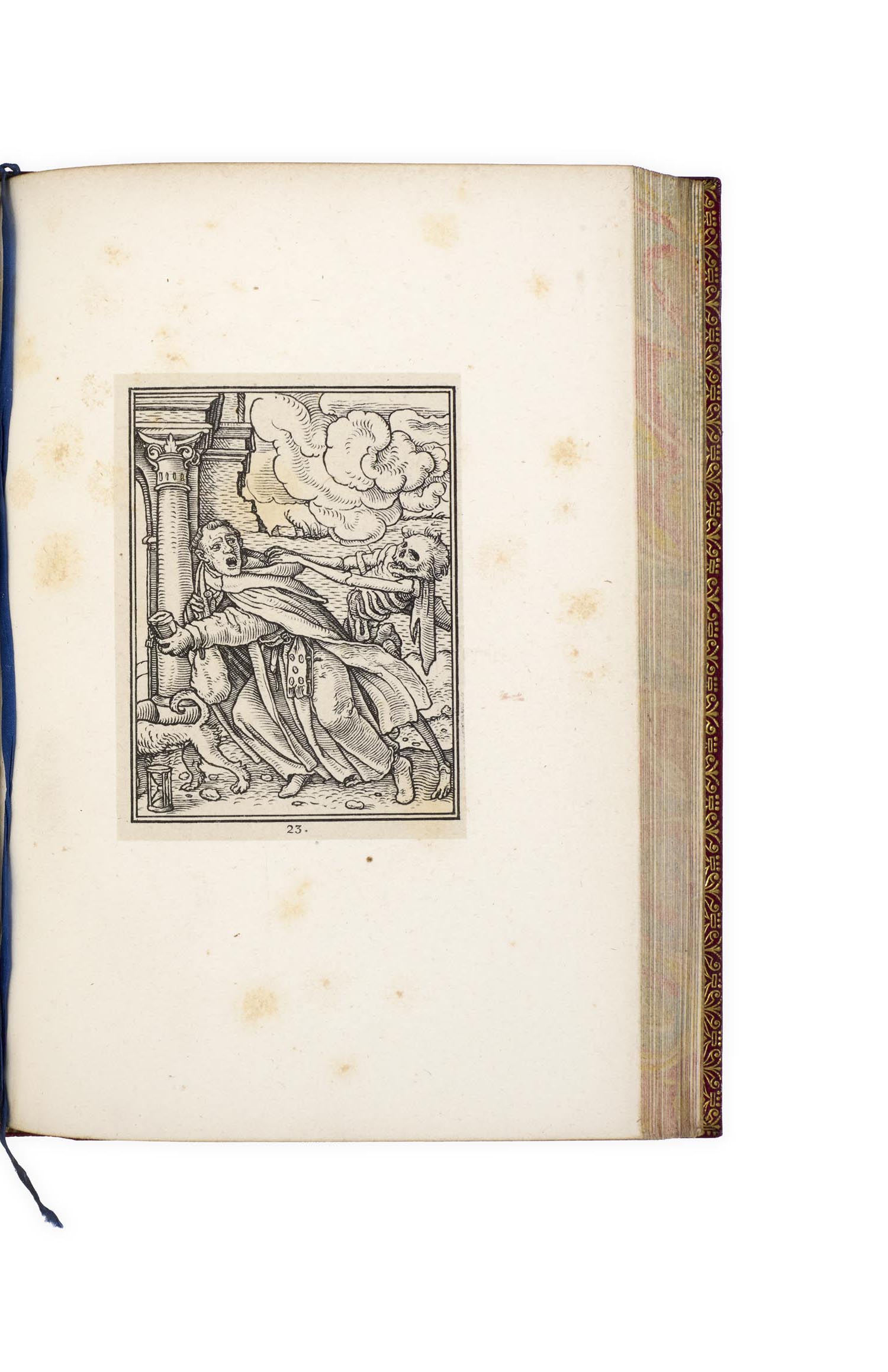
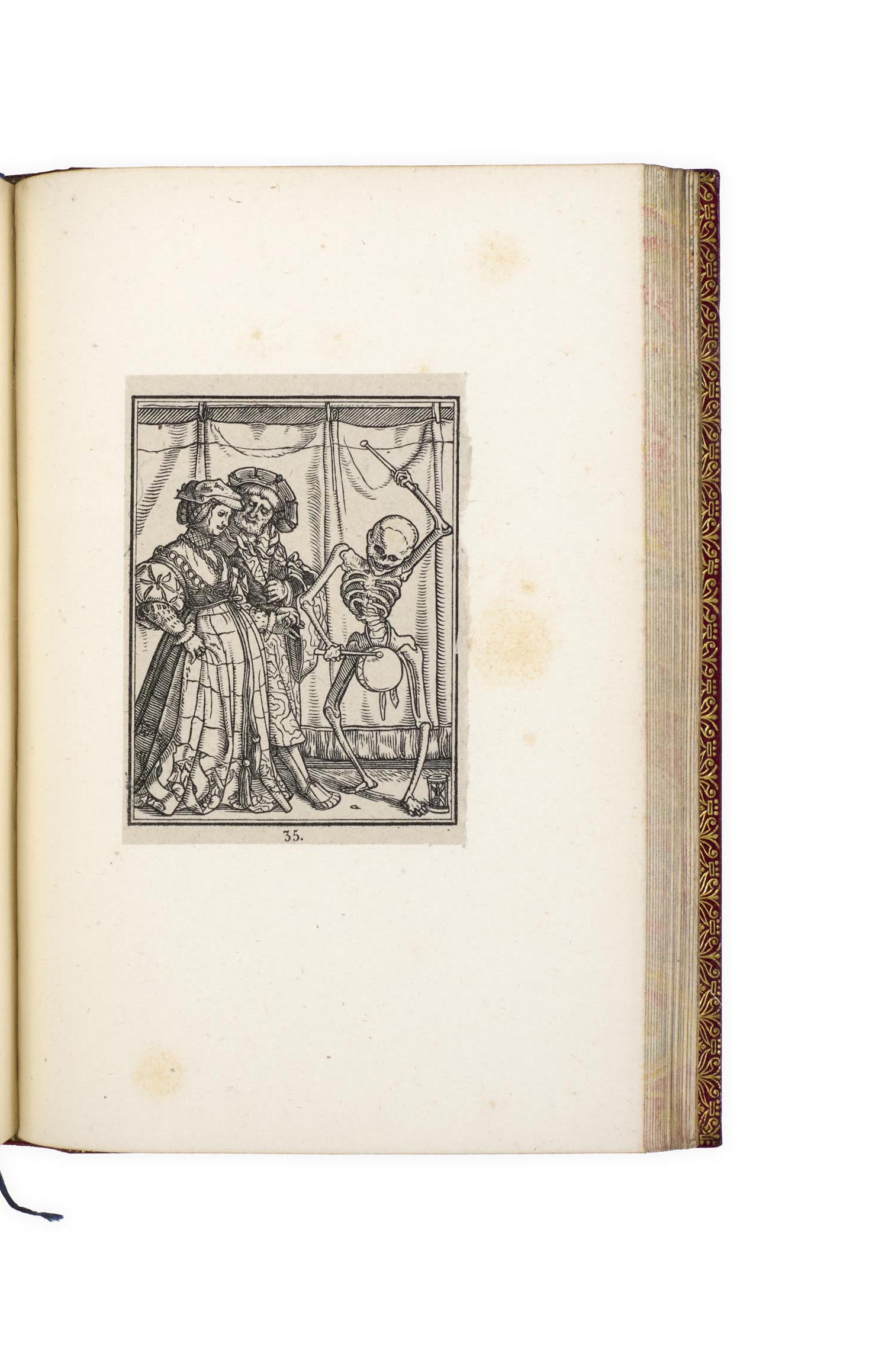
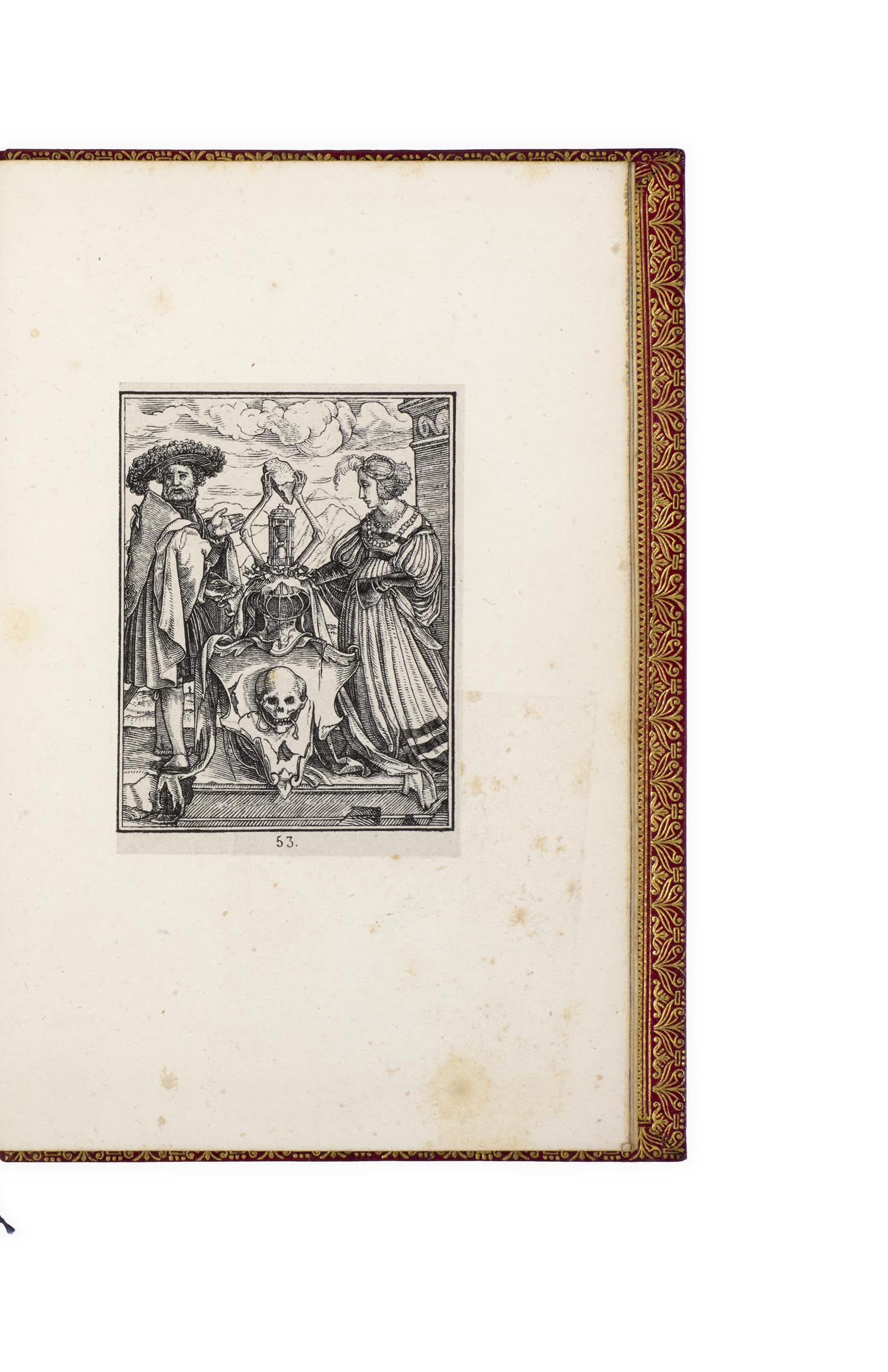
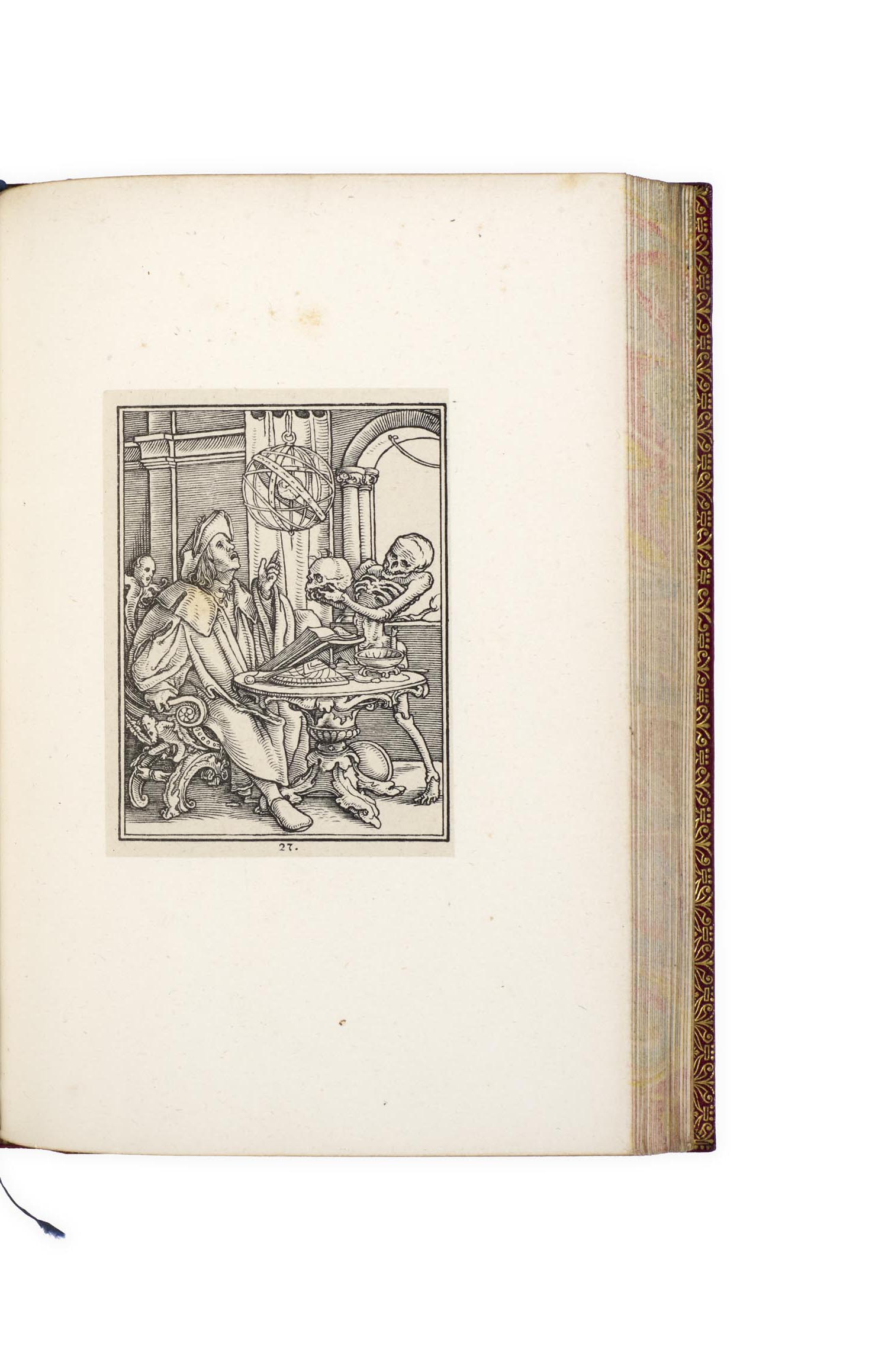
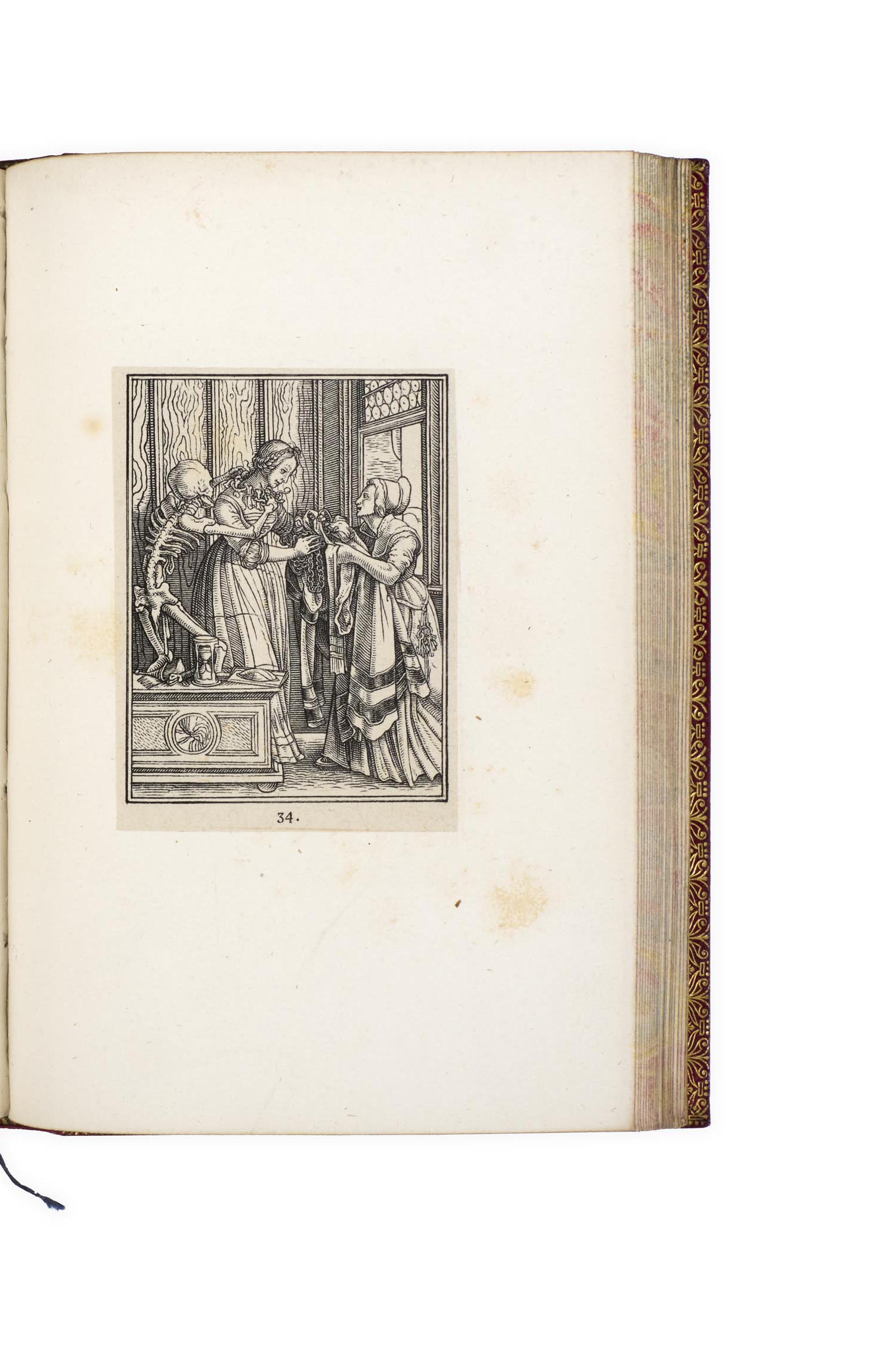
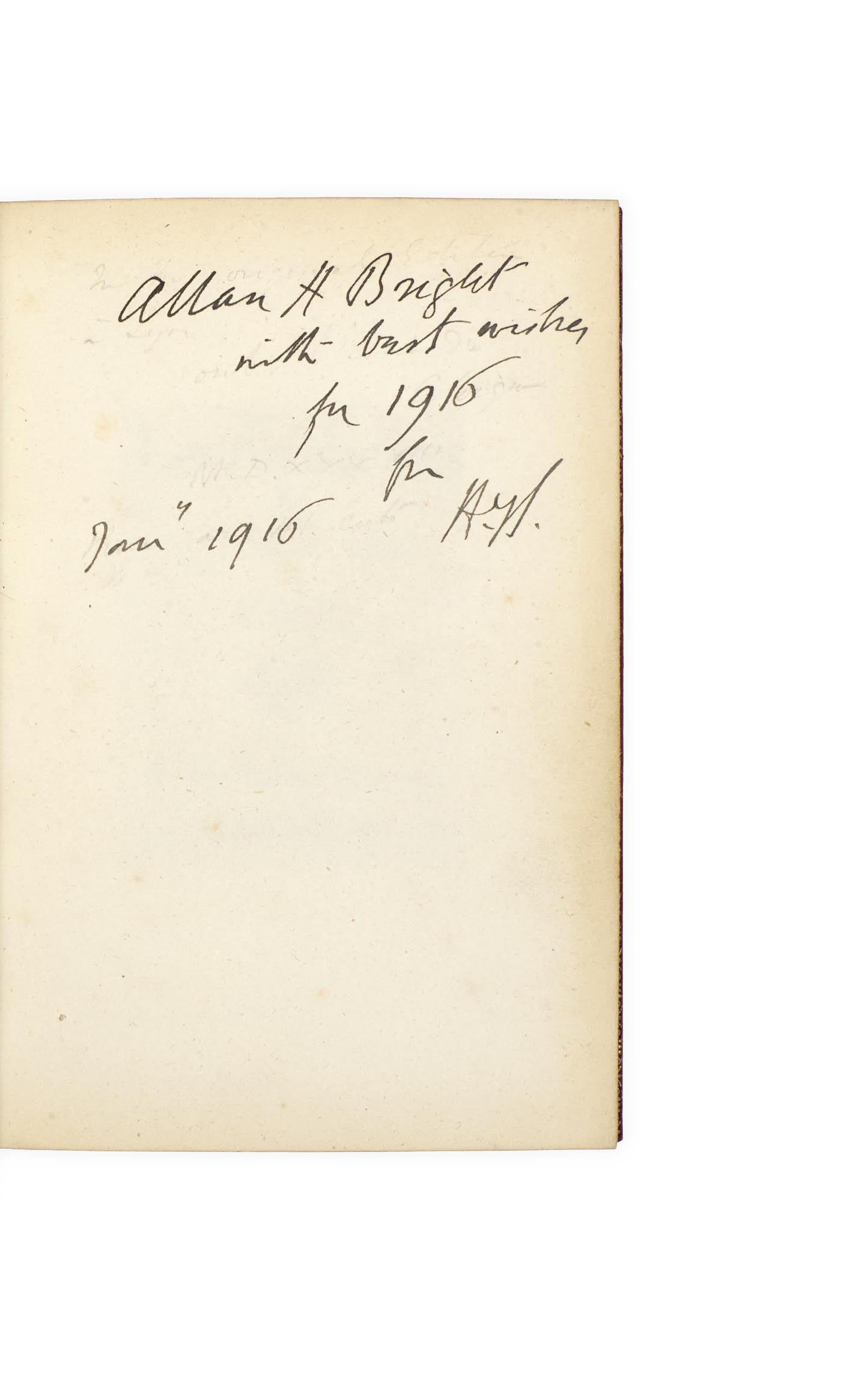
Small 8vo, ff. [54]; manuscript title and 53 numbered lithographic illustrations after Hans Holbein’s wood engravings, all on papier chine and mounted; scattered spots throughout; handsomely bound in nineteenth-century red Jansenist morocco by Duru (front free endpaper signed in black), spine lettered directly in gilt, edges marbled and gilt, marbled endpapers, blue silk place-marker; presentation inscription ‘Allan H Bright | with best wishes | for 1916 | […] | H.YT. || Jany 1916’ to front flyleaf, autograph letter ‘Dear Allan’ signed ‘H.YT.’ (London, 10 January 1916) loosely inserted (previously tipped in to rear pastedown, with some residual adhesive to blank verso), bookplate of Allan Heywood Bright to front pastedown with his pencil notes.
Added to your basket:
‘Les simulachres & historiees faces de la mort. Jouxte l’Edition de Lyon. MDXXXVIII.’
A seemingly unique set of lithographic illustrations after Holbein’s Dance of Death, evidently the unexpurgated proofs for Schlotthauer’s famous edition of 1832, with illustrious provenance from the libraries of Henry Yates Thompson and Allan Heywood Bright.
In Holbein’s ‘Dance of Death’ sequence, first published at Lyon in 1538, Death takes the form of a grinning skeleton to claim the lives of archetypal individuals from all walks of life, ranging from the richest of rulers to the humblest of peasants. Holbein’s uncanny yet commonplace representations of the inevitability of death gave rise to a myriad reproductions and interpretations, the most significant being the 1547 Basel edition, which supplemented the original forty-one woodcuts with a further twelve. It is from this edition that Prof. Joseph Schlotthauer (1789–1869) of the Münchner Königliche Akademie produced his Hans Holbeins Todtentanz in 53 getreu nach den Holz Schnitten lithographirten Blattern, a remarkable suite of lithographs widely acknowledged to be the most faithful copies and executed in ‘so beautiful and accurate a manner’ that they might be ‘mistaken for the wood originals’ (Douce, Holbein’s Dance of Death, 1858). The lithographs were first published by Schlotthauer in Munich in 1832 with explanatory text by H. F. Massman, and were subsequently reproduced in La Danse des morts (Paris, Labitte, [1842]), with commentary by Hippolyte Fortoul, and in Holbein’s Dance of Death (London, John Russell Smith, 1849).
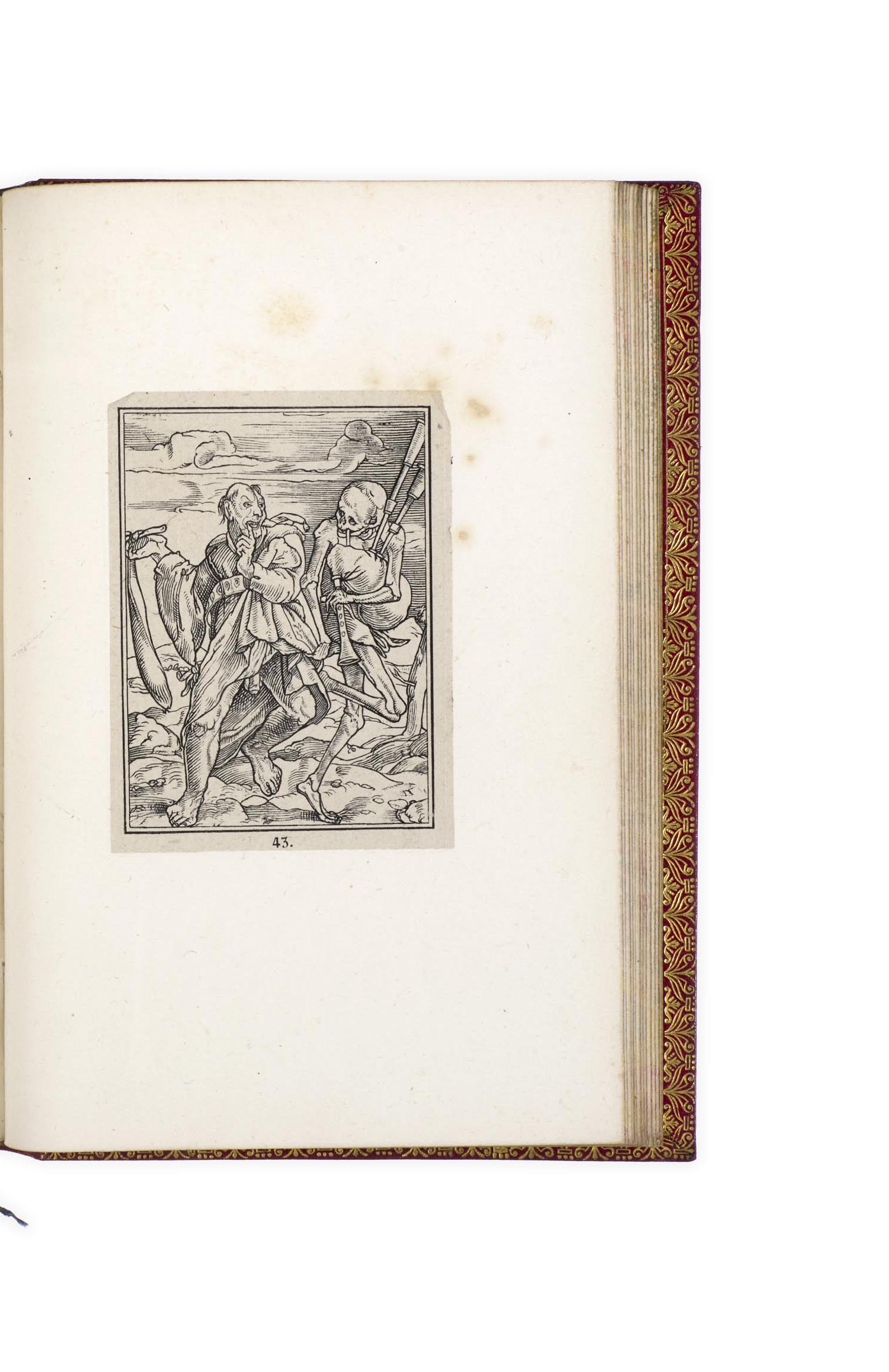
The only significant difference, however, between our impressions and those in any published Schlotthauer edition lies in illustration no. 43, in which the Fool brandishes an inflated pig’s bladder on a stick whilst Death, playing the bagpipes, pulls apart the Fool’s robe to expose his genitalia. The Fool’s penis, present in Holbein’s original woodcuts, is notably expurgated in Schlotthauer’s published editions, in what is perhaps his only discernible deviation from the originals; the expurgation of the image differs between Schlotthauer’s French and German editions – one incorporating the Fool’s anatomy into the surrounding folds of fabric, the other covering it with rather conspicuous cross-hatching – suggesting that the uncensored proofs may have been modified separately.
Provenance:
1. The French bibliophile Léon Cailhava (1795–1863), forced by financial constraints to sell much of his collection in 1845; Catalogue de la precieuse Bibliotheque de Monsieur L.C., de Lyon, 21 October 1845, lot 165 (‘Mar. rouge, tr. dor. à la Janséniste. (Duru.) Recueil avec titre ajouté des gravures sur pierre de l’edition allemande donnée a Munich en 1832 par le professeur Schlotthauer. Celles-ci sont sur papier de Chine et de tres bonnes épreuves’, 20 francs).
Cailhava’s role in the later dissemination of Schlotthauer’s lithographs cannot be understated: later reprints of Schlotthauer’s illustrations are derived not from the German edition of 1832, but directly from the ‘perhaps unique copy of Mr. Cailhava of Lyon’ (Catalogue manuscrit de Jean-François-Didier d’Attel (1858), pp. 85-86, trans.), and the originals were ‘copied from the 1554 edition belonging to M. Cailhava of Lyon’ (Bulletin du bouquiniste 7:164 (1863), no. 4380).
2. Paul, Huard, and Guillemin, Catalogue de livres rares et precieux, Paris, 1891 (‘Jouxte l’edition de Lyon, 1538, 53 pl. in-16, sur chine, mar. r. fil à fr. dent. int. tr. dor. (Duru). Réimpression moderne’).
3. Henry Yates Thompson (1838–1928), Vice-President of the Holbein Society, with a New Year’s gift inscription to Allan Heywood Bright and loosely inserted autograph letter, noting that ‘I don’t know anything about the edition but the impressions are far more fresh & beautiful than those in the editions of 1547 & 1549 which I have’.
4. Allan Heywood Bright (1862–1941), Liberal politician and bibliophile.