HOMER; Hubert VAN GIFFEN, editor.
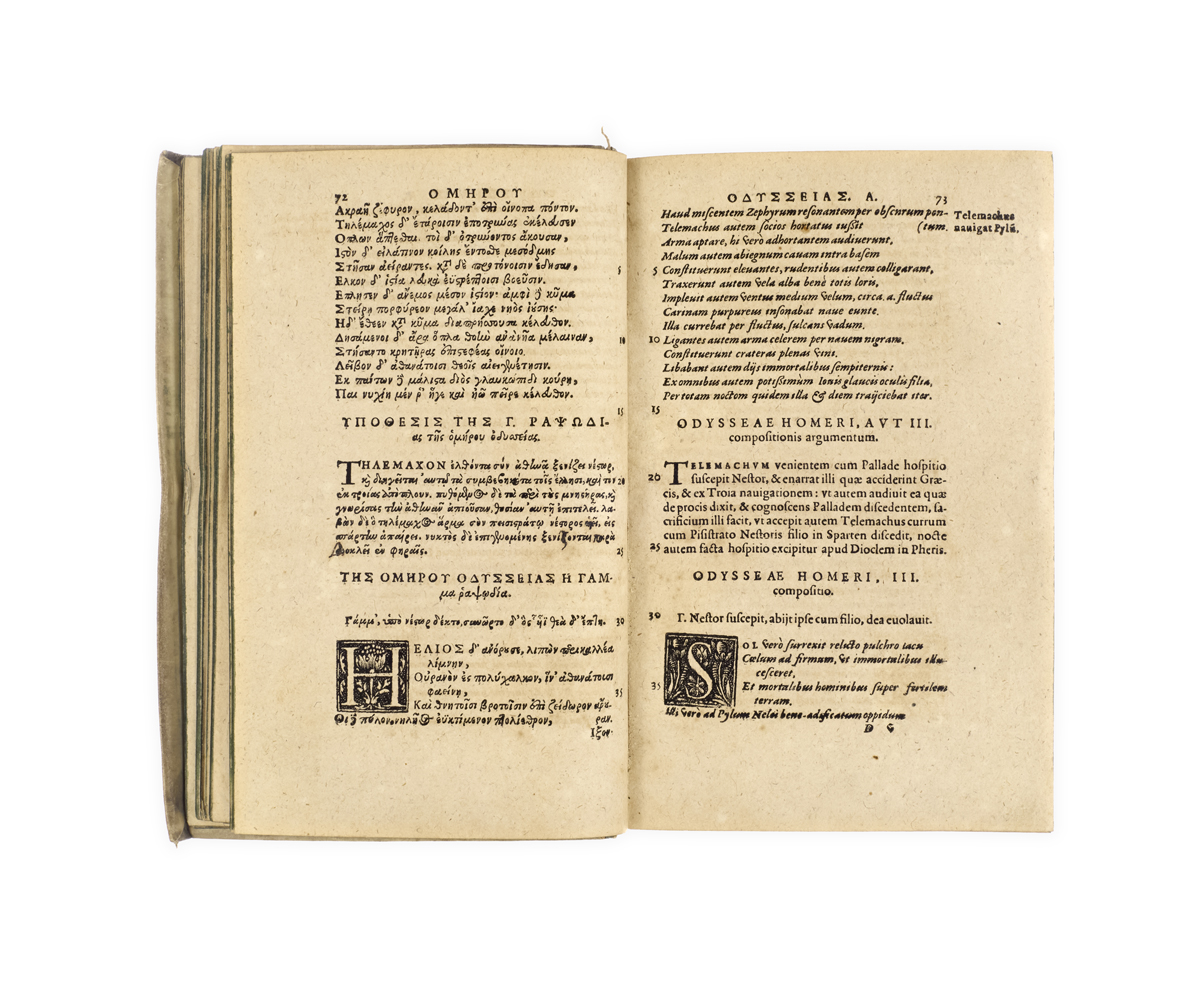
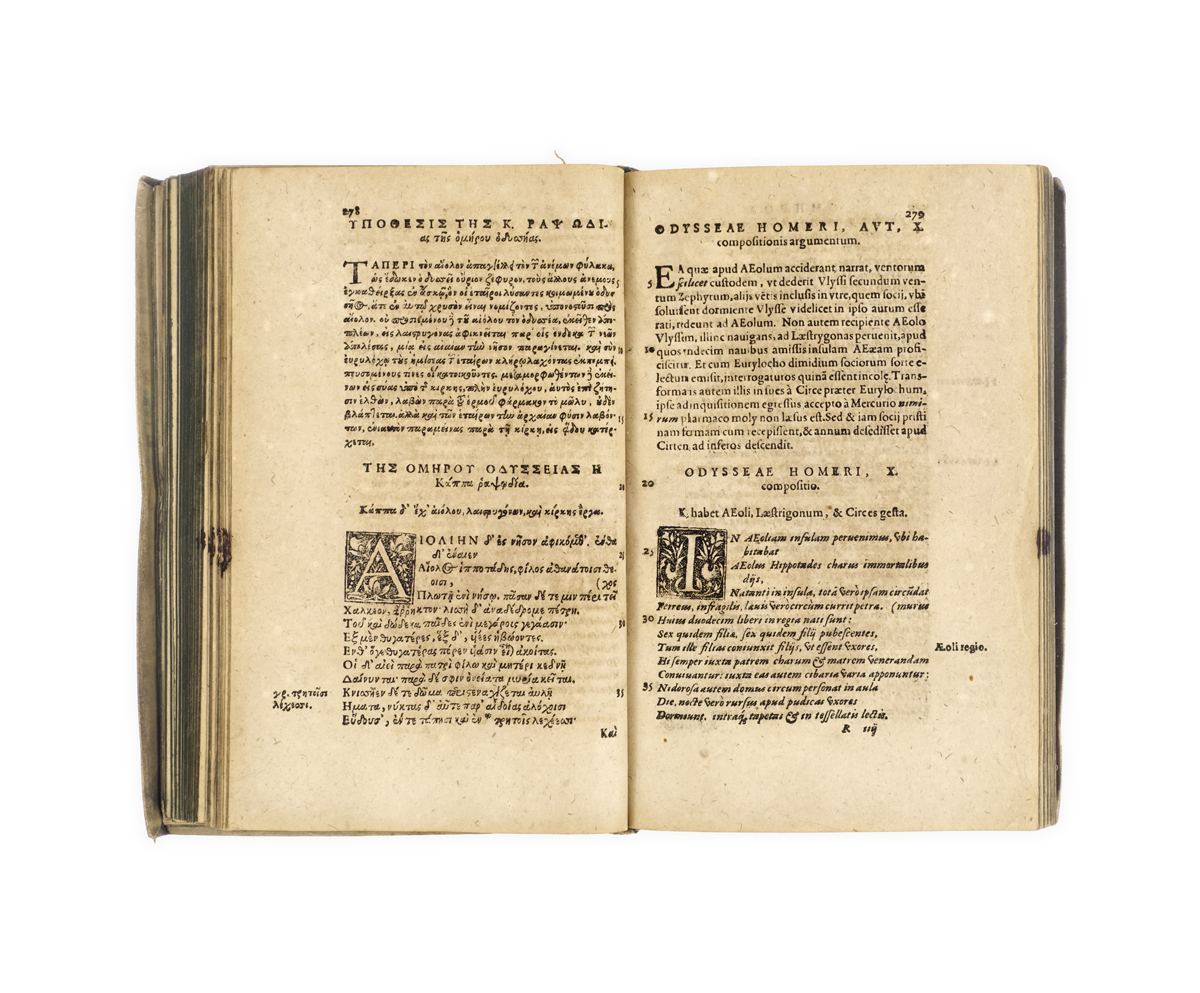
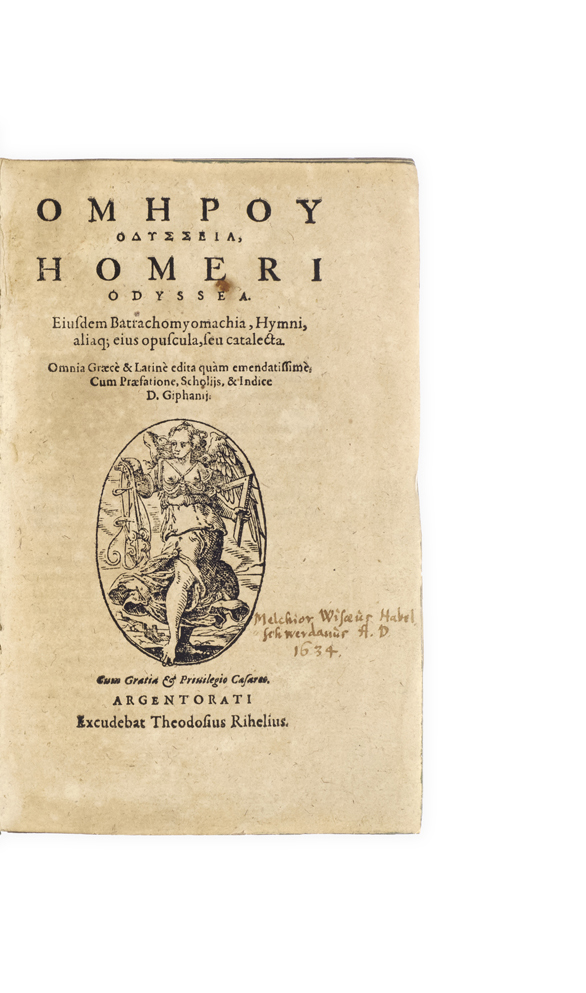
Οδυσσεια … Odyssea … Batrachomyomachia, Hymni, aliaque … opuscula, seu catalecta. Omnia Graece & Latine edita quam emendatissime. Cum praefatione, scholiis, & indice … Strasbourg, Theodosius Rihel, [1572].
8vo, pp. 827, [52], [1, blank]; printed in Greek and Latin on facing pages, woodcut printer’s device to title, woodcut initials; uniformly toned with a few scattered spots and occasional unobtrusive staining, but a good copy; bound in contemporary vellum over boards, spine blind-ruled in compartments with later manuscript lettering in ink, yapp fore-edges, edges stained blue, spine lined with printed waste in red and black on vellum; dust-stained, spine-piece defective and detached at front joint; ownership inscription ‘Melchior Wisaeus Habel Schwerdanus’ dated 1634 to title (see below), occasional early underlining, traces of a label to front pastedown.
Added to your basket:
Οδυσσεια … Odyssea … Batrachomyomachia, Hymni, aliaque … opuscula, seu catalecta. Omnia Graece & Latine edita quam emendatissime.
First Rihel edition of the Odyssey, with the Batrachomyomachia and Homeric Hymns, edited by the humanist Hubert van Giffen with a parallel Latin translation, ‘the first full modern commentary on the Homeric poems to reach print’ (Demetriou, p. 496).
The son of a Dutch landowner, Hubert van Giffen (or Hubrecht van Giffen, Latinized as Hubertus Giphanius, d. 1604) studied philology and law at Louvain, the Sorbonne, and Orleans, becoming a highly regarded jurist and classical philologist. A voyage to Italy as the tutor of three young men from the Antwerp merchant class, in 1565, inspired a successful critical edition of Lucretius’ work. His commitment to classical philology persisted and deepened during the following years, which culminated in his edition of Homer. Minute study and reconstruction of classical texts sat, in van Giffen’s mind, alongside his position in a contemporary dispute in the legal field: there he upheld the approach of ‘recovery of the original’ through historical-philological criticism of the text, a method known as ‘mos gallicus’, in contrast with ‘mos italicus’ which understood Roman law to be current and practicable.
It was only over a decade after this publication that van Giffen’s religious position, decried by his detractors as anti-Trinitarian, and his role as a figure-head for such positions within the Nurenberg Altdorf Academy coincided to jeopardise his academic prestige and his very freedom; van Giffen was replaced as professor of law at Altdorf by the student of his rival and was arrested to force the return of books he had taken on loan. Van Giffen went on to accept a professorship at Ingolstadt, stronghold of the Catholic Reformation in Bavaria, followed by a group of Altdorf students (including Rittenhausen), and converted to Catholicism. A rift with the Jesuit leadership of the University eventually led him to move to Prague, where he became an advisor to the Imperial Court, and stayed until his death.
The printer, Theodosius Rihel (fl. 1571–1597), was one of the four sons of Wendelin Rihel who continued their father’s business, followed in turn by their heirs, most of whom continued to use Wendelin’s original Nemesis icon as a device, of which several variants are known. He also published an edition of the Iliad of the same year.
Provenance:
Melchior Wisaeus, seventeenth-century author and translator of Stefano Guazzo’s Dialoghi Piacevoli, Leipzig 1625, was rector of the school in Münsterberg (today Ziębice) in Silesia.
USTC 663951; VD16 ZV 22787; Graesse III, p. 328 (with notes not supported by later work). See Davies, Devices of the early Printers, p. 640; Demetriou, ‘The Homeric Question in the sixteenth Century: Early Modern scholarship and the text of Homer’ in Renaissance Quarterly 68, no. 2 (Summer 2015), pp. 496–557.