‘A Directorship! – a Directorship! My Tea-Shop for a Directorship’
[‘HYSON, Timothy’, pseud. Thomas LOWNDES].
A Letter to Mr. Richard Twining, Tea Dealer, and One of the Candidates for the Present Vacancy in the East India Direction. London, [C. Roworth] for the author, 1827.
8vo (210 x 128mm), pp. iv, [5]-16; light offsetting in gutter and onto back free endpaper; modern grey boards, printed paper label to front board, old marbled edges; a very good copy.
Added to your basket:
A Letter to Mr. Richard Twining, Tea Dealer, and One of the Candidates for the Present Vacancy in the East India Direction.
Second edition of the Letter to Mr Richard Twining, a public denunciation of the candidacy of the tea merchant Richard Twining (1749-1824) for a directorship of the East India Company in 1810. Twining, who had already been instrumental in the development of tea prices and taxation for many years, would be elected as Director of the East India Company in that year, and remain in the office until his retirement due to ill health in 1817.
A Letter discusses the characteristics of trade with the English colonies, observing ‘little or no difference between selling tea, and selling East India muslins, saltpetre, indigo, or opium’ (p. 5) and identifying one of Twining’s most pertinent shortcomings in his quintessentially English approach to trade: according to the author, Twining is not ‘so well acquainted with the policy of India, its various governments, civil and military, its jurisprudence, and all those different species of local knowledge, which can be acquired only by having lived long in India, as your opponent candidate, Col. Taylor’ (pp. 9-10). The value of stocks in the Company, of personal concern to the author, lend further heft to the argument, as well as election procedures within the Company, which allow for the appointment of family members, most tellingly fathers and sons, with a nominal division of labour between politics and trade, but obviously joint interests in both, which carried financial implications for both parties. Notably, Richard Twining junior (1772–1857) had joined his father in the business immediately following his education, while his brother Thomas (1776-1861) had joined the Bengal service of the East India Company and caused a stir with a series of publications on ‘the danger of interfering in the religious opinions of the natives of India’ (ODNB). The Letter’s fear of repercussions from Richard Twining the elder’s potential directorship in the East India Company was, therefore, as much a reaction against a nascent tea dynasty as an attempt to retain control of the market, a need that had first become acute with the Tea Act following the Boston Tea Party almost four decades previously.
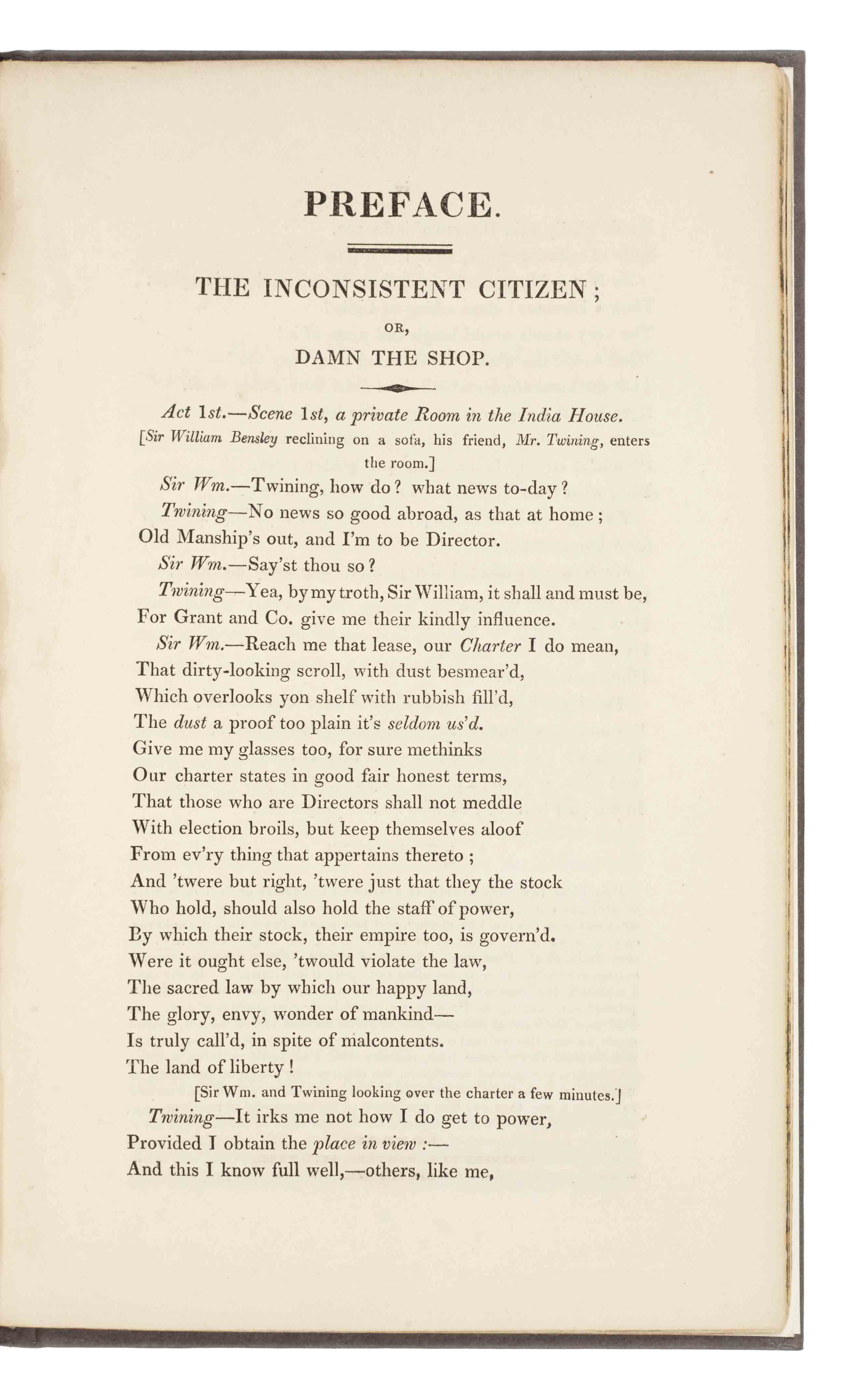
The Letter to Mr Richard Twining captures the tone in which such concerns were often communicated to the wider public in the Regency period – – and the East India Company was frequently the subject of satirical assaults. The text combines personal attacks, political rhetoric and, as a preface, a playful dramatization of a conversation between ‘Twining’ and ‘Sir William Bensley’ (modelled on a Director of the Company) – an exchange during which ‘Twining’ exclaims: ‘A Directorship! – a Directorship! my tea-shop for a Directorship’ (p. iv). It is the contrast between his eagerness for the position and public protestation of his merits and virtues that make for the most comical point of attack in the Letter.
The name appearing at the foot of the letter, one ‘Timothy Hyson, Late Supercargo and Chinese Interpreter’ of ‘Souchong-Place’ at ‘Portman-square’, appears to be a witty pseudonym: like souchong, hyson was a popular variety of tea traded to Britain at the time, and is even mentioned in the text of the preface.
An undated edition was presumably issued at the time of composition; the present second edition appears as part of Lowndes’s Tracts in Prose and Verse, Bound up together (1825), a collection of pieces seemingly printed separately, with their own title-pages, paginations and registers, and imprints dated variously between 1822 and 1827.