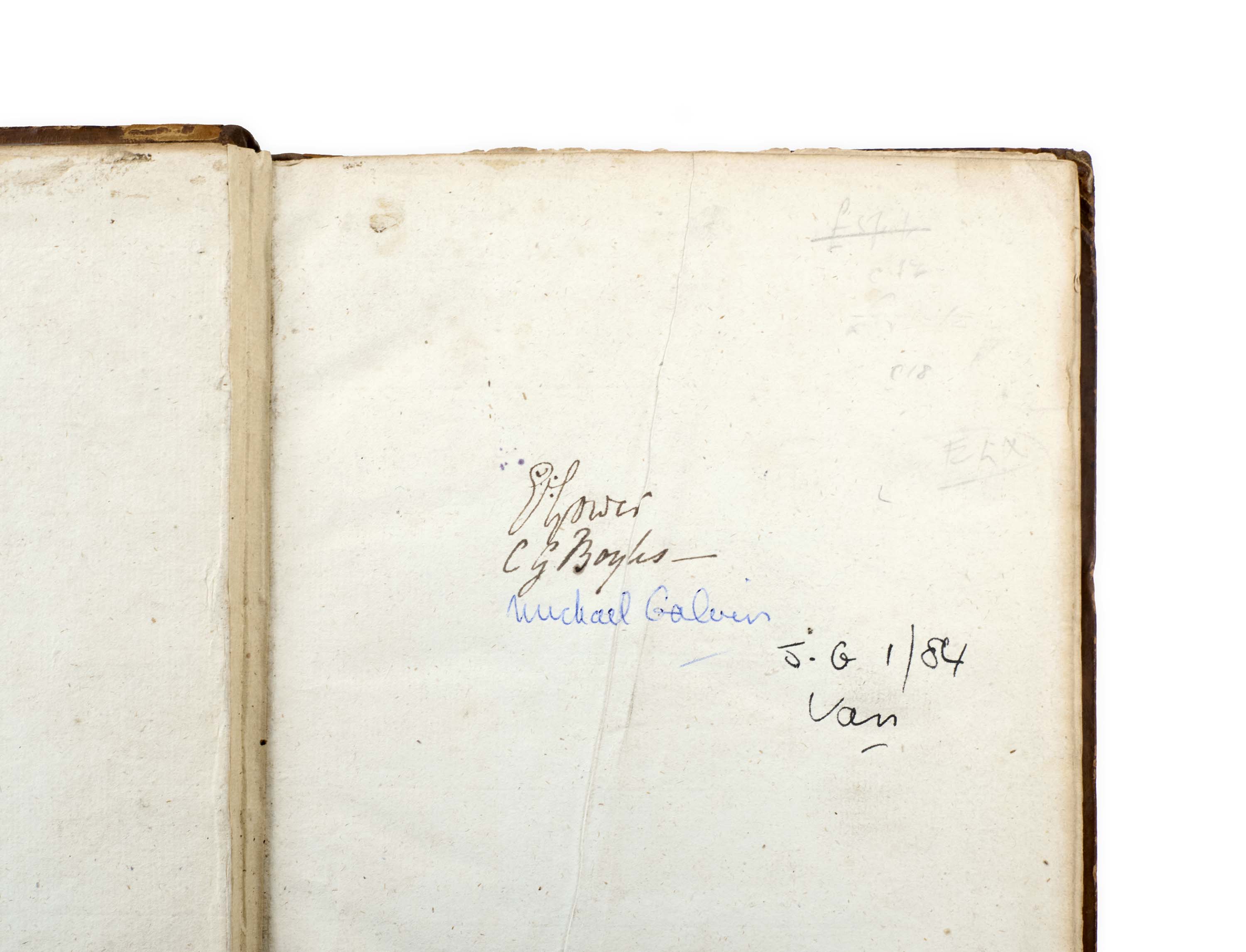
Erasmus Gower's Copy
IDES, E[vert] Ysbrants.
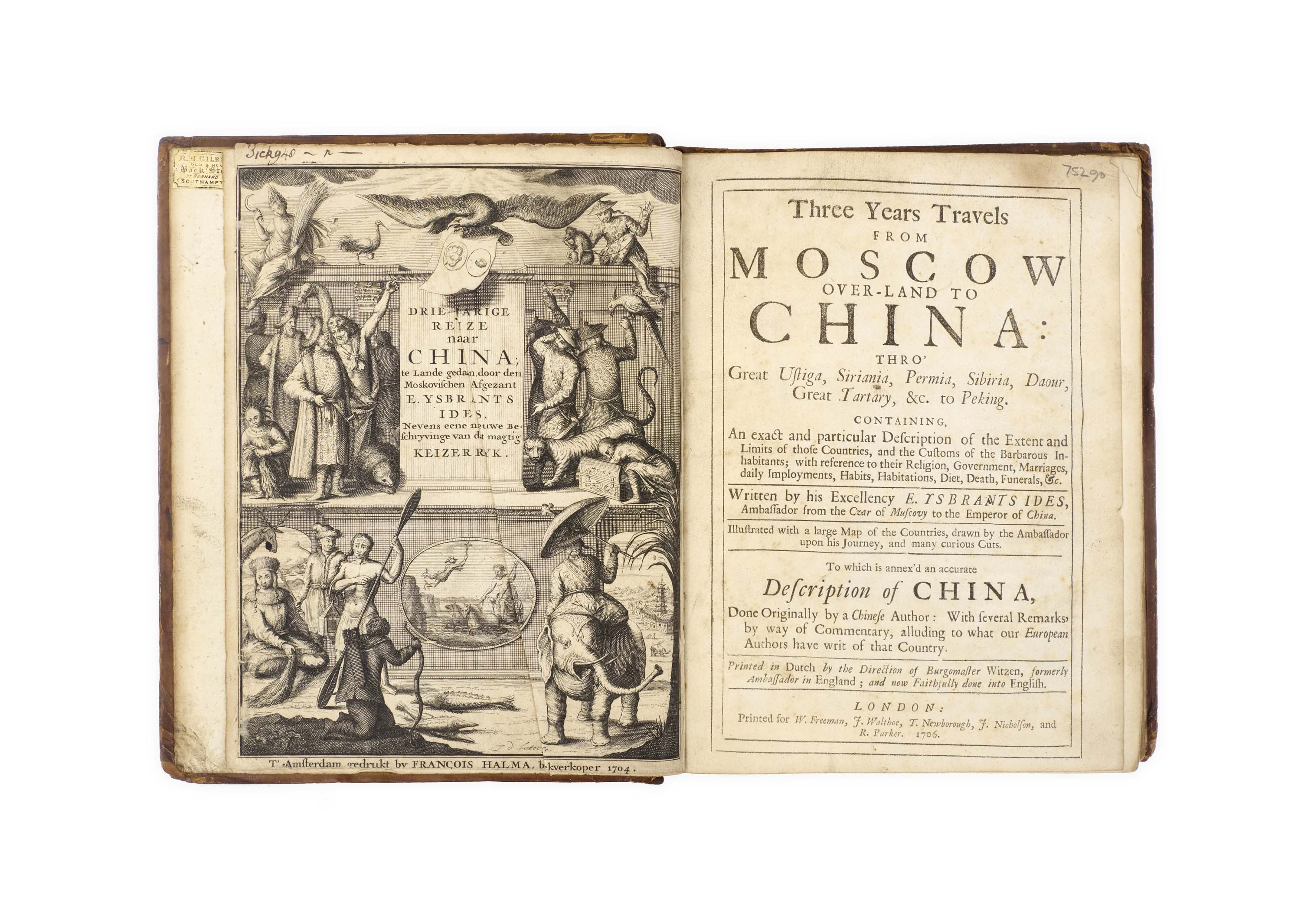
Three Years Travels from Moscow over-land to China: thro’ Great Ustiga, Siriania, Permia, Sibiria, Daour, Great Tartary, &c. to Peking. Containing, an exact and particular Description of the Extent and Limits of those Countries, and the Customs of the barbarous Inhabitants; with Reference to their Religion, Government, Marriages, daily Imployments, Habits, Habitations, Diet, Death, Funerals, &c. … London, W. Freeman, J. Walthoe, T. Newborough, J. Nicholson, and R. Parker, 1706.
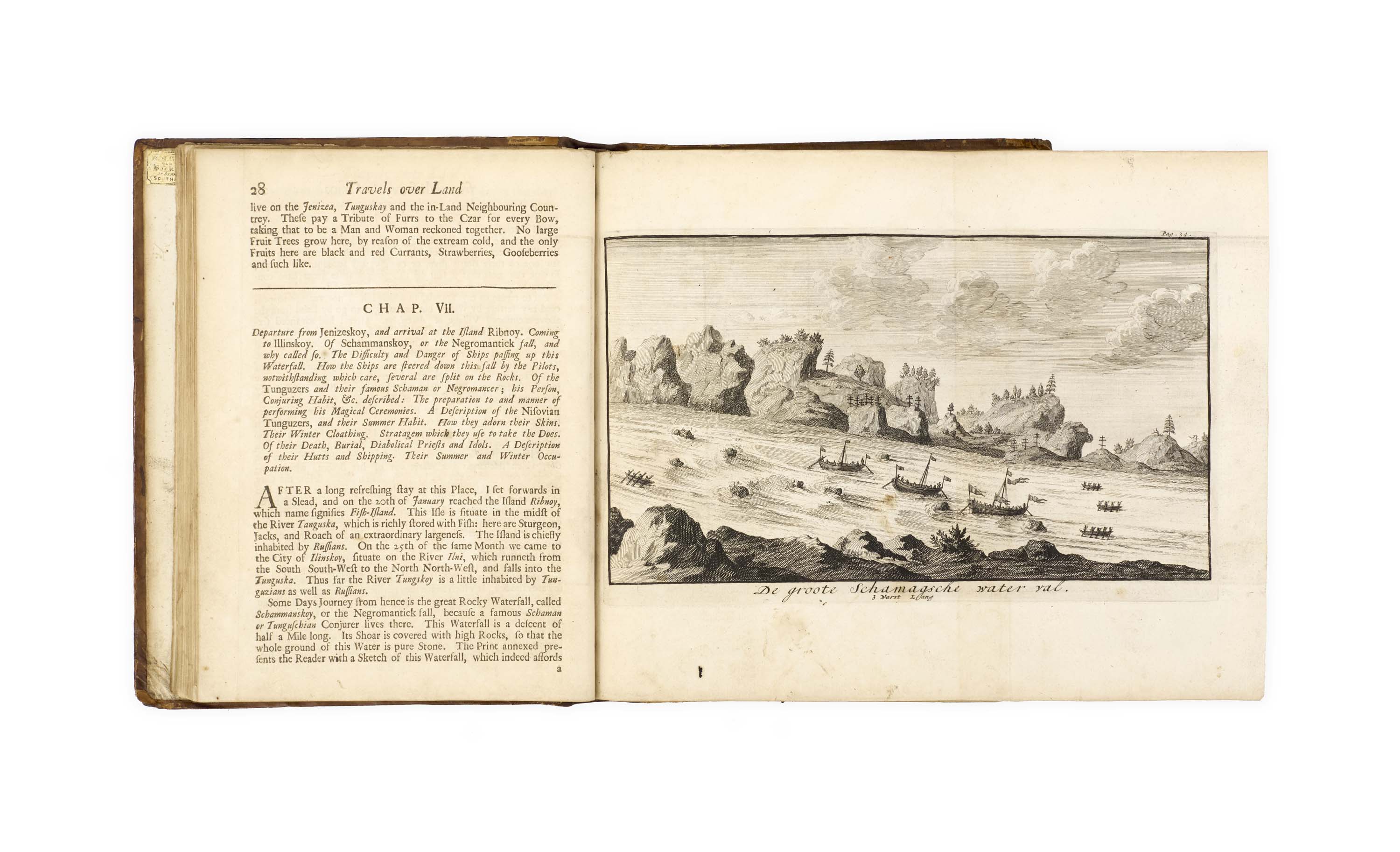
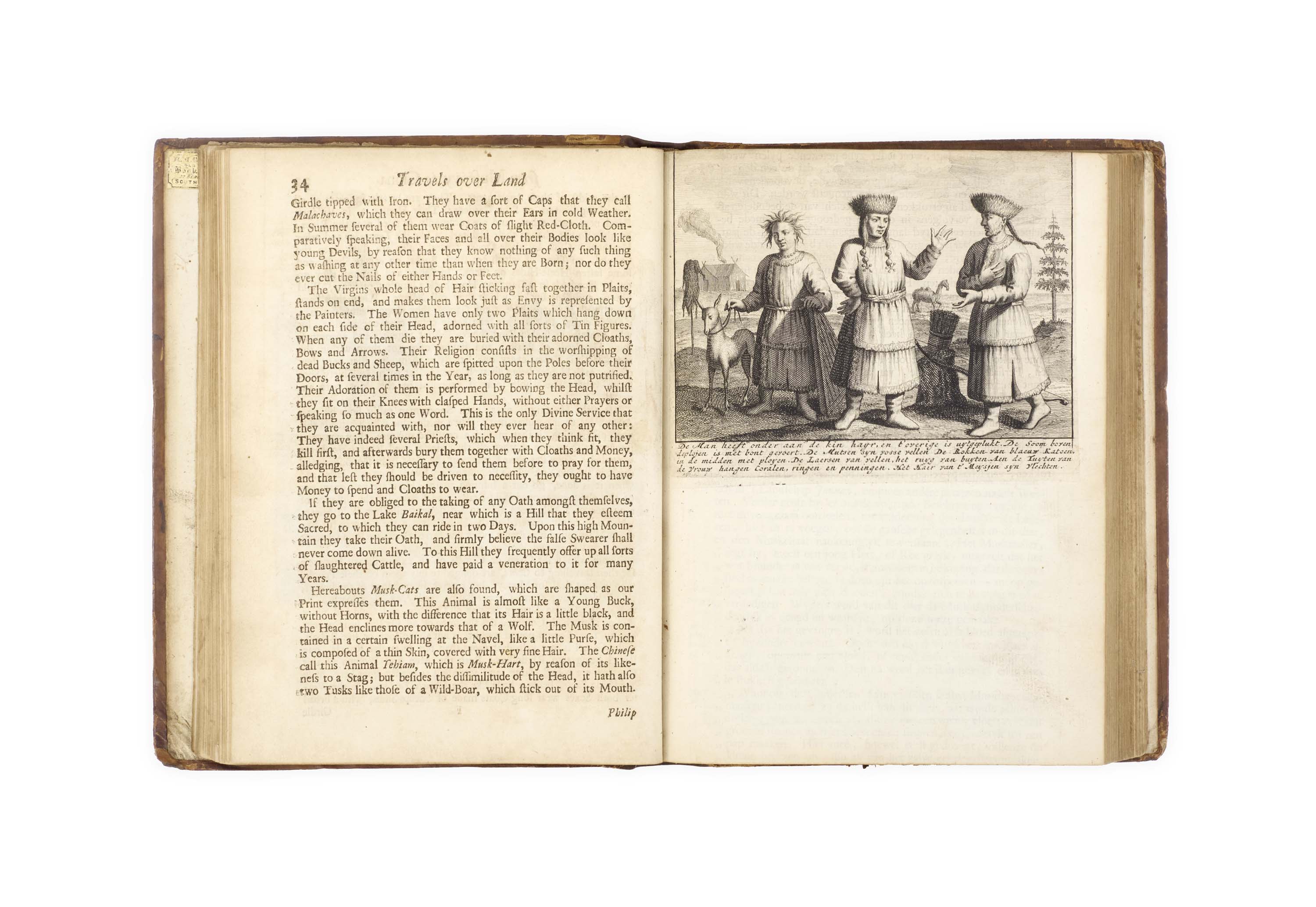
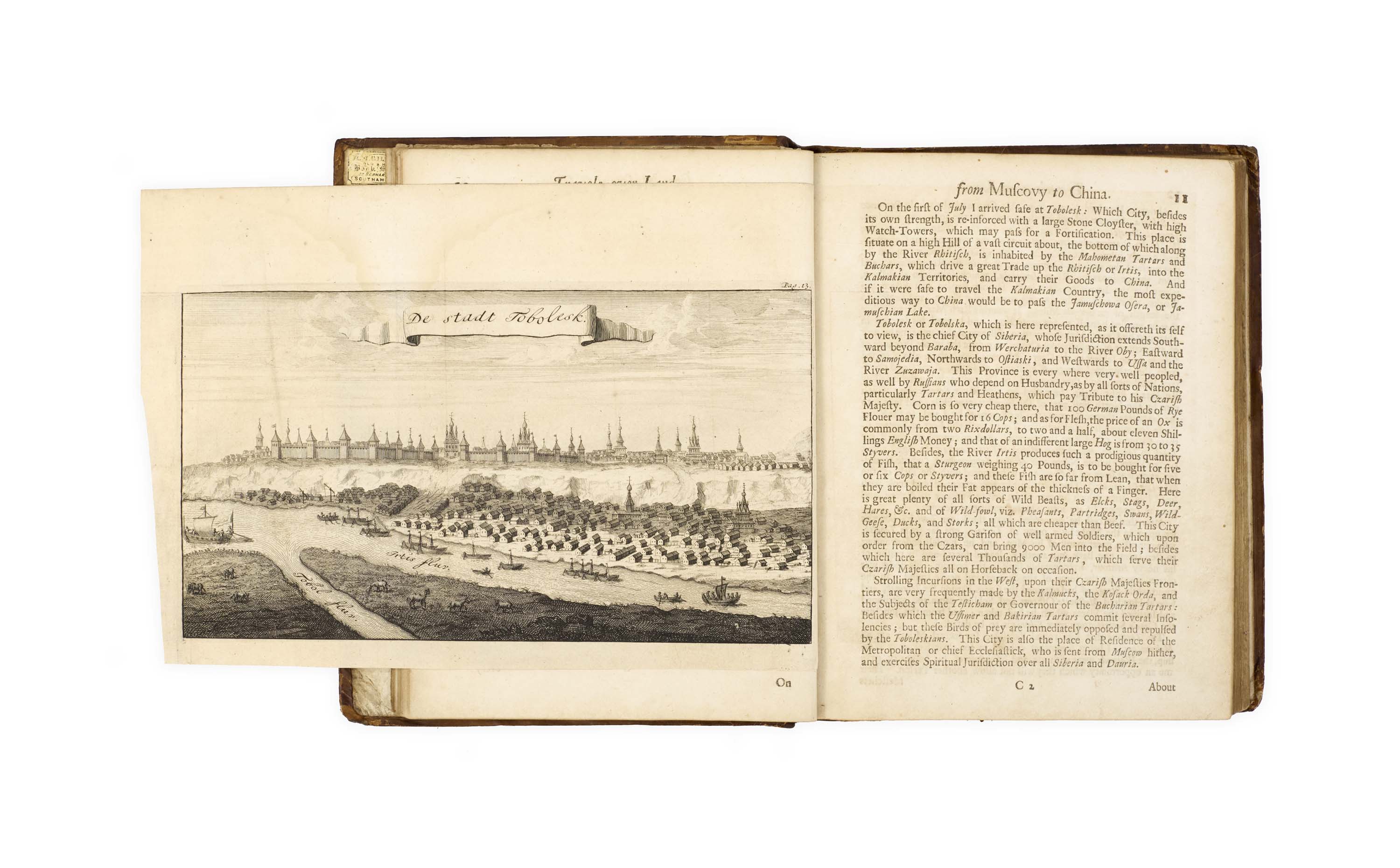
4to, pp. [12], 110, 113–‘210’ [i.e. 212], bound without the engravings for the present edition (frontispiece, folding map, and 30 other plates) and the blank P4, but with the engraved frontispiece, all 21 engraved illustrations, and 4 (of 9) engraved plates (of which 3 folding) from the Dutch edition of 1704, the illustrations cut out of that edition and mounted on blank leaves here (see below); a little browning with a few minor stains, frontispiece shaved at foot with short closed tear at fore-edge, title-page short at fore-edge, a few of the engravings trimmed with minor loss, double-sided illustrations mounted in windows cut out of blank leaves with some edges obscured by mount, wormtracks to foot of final quires affecting a word or two on some pages; bound in late-eighteenth-century English sprinkled calf, red morocco lettering-piece; rebacked with original spine laid down, corners worn, a little scuffed; ownership inscriptions ‘Er: Gower’ (see below), ‘C G Boyles’, and of two later owners to front free endpaper, later-nineteenth-century armorial bookplate of Robert William Hanbury (1845–1903) of Ilam Hall pasted over older bookplate at pastedown, ink stamp ‘E. B. H.’ (Ellen Bowring-Hanbury) to bookplate.
Added to your basket:
Three Years Travels from Moscow over-land to China: thro’ Great Ustiga, Siriania, Permia, Sibiria, Daour, Great Tartary, &c. to Peking. Containing, an exact and particular Description of the Extent and Limits of those Countries, and the Customs of the barbarous Inhabitants; with Reference to their Religion, Government, Marriages, daily Imployments, Habits, Habitations, Diet, Death, Funerals, &c. …
First edition in English of this important account of an early embassy to China, our copy from the library of Sir Erasmus Gower, commander of the Macartney Embassy, Britain’s first and pivotal delegation to the Qing Empire.
The author was a Dane in the service of Peter the Great, for whom he embarked on an embassy to Peking in 1692–5 in quest of further trade agreements, and for whom this journal (first published 1704 in Dutch) was composed. ‘Ides’[s] descriptions of the places and people he saw along the way are unusually good, and through them his readers first encountered several tribes in eastern Siberia and Mongolia. He also wrote vivid, detailed descriptions of the Great Wall, of his reception by officials there, of his introduction to Peking, the banquets and entertainments he attended, the imperial palace and the K’ang-hsi emperor himself. Appended to Ides’[s] journal is a brief description of China attributed to a Chinese Christian named Dionysius Kao. Like the Jesuit descriptions it treats each province, including Liaotung, separately before describing in general the people, their customs, their religions, the land, its fruits, neighbouring countries, and recent history. Considerable space is devoted to the history of Christianity in China, and the book ends with an adulatory description of the K’ang-hsi emperor and expressions of optimism regarding his and China’s conversion to Christianity’ (Lach and Van Kley III/1, p. 504). ‘The expedition added considerable geographical knowledge to the little that was known about Manchuria and China’ (Cox I, p. 331) and inspired some of the adventures told by Defoe in the second part of Robinson Crusoe.
The present copy was owned and inscribed by Sir Erasmus Gower (1742–1814). A Welshman of humble birth, he served the Royal Navy with distinction in the Indian Ocean and Newfoundland before being charged with ‘the commission of a lifetime’: the command of Britain’s first embassy to China, under Lord Macartney in 1792–4. ‘Despite severe illness he carried out his orders with flair and integrity, far from over-awed by his mission’ (Bates, p. 3). Apart from steering this elaborate fleet through pirates and disease, losing hundreds of men on the voyage, Gower was also entrusted with the embassy’s secret offshoot mission to Japan and the Philippines. His journal of the voyage would later supply much of the material for Staunton’s celebrated account of the embassy. ‘If the mission did not have the success hoped for, it was no fault of Gower’s’ (ODNB). He may have found some comfort in Ides’s account of another intellectually fruitful but ultimately unsuccessful mission in search of better trade relations with China.
Unusually our copy is bound with engravings from the Dutch original rather than from the English translation. The copy seems to have been issued without the latter, which were based on the original engravings but printed on leaves of their own, not as illustrations in the text like most in the Dutch edition. A late-eighteenth-century owner then seems to have cut out illustrations from a copy of the Dutch edition, pasted them on blanks, and inserted these into our then-unillustrated copy when having it put in its present binding, creating a curious hybrid edition. Given the date of the binding, this customising owner may well have been Gower himself.
English: ESTC T55175; Lowndes II, p. 1158; Cordier, Sinica, cols 2468–9; Löwendahl 294; Lust 519; Morrison I, pp. 372–3. Dutch: STCN 315204303; Cordier, Sinica, cols 2469–70; Löwendahl 282; Morrison II, p. 379.