In Praise of Germany
IRENICUS, Franciscus.
Germaniae exegeseos volumina duodecima a Francisco Irenico Ettelingiacensi exarata, eiusdem oratio protreptica, in amorem Germaniae, cum praesentis operis excusatione, ad illustriss. principis Palatini Electoris Cancellarium Florentinum de Pheningen, utriusque censurae Doctorem. Urbis Norinbergae descriptio, Conrado Celte enarratore. [(Colophon:) Hagenau, Thomas Anshelm for Johann Koberger, August 1518.]
[bound with:]
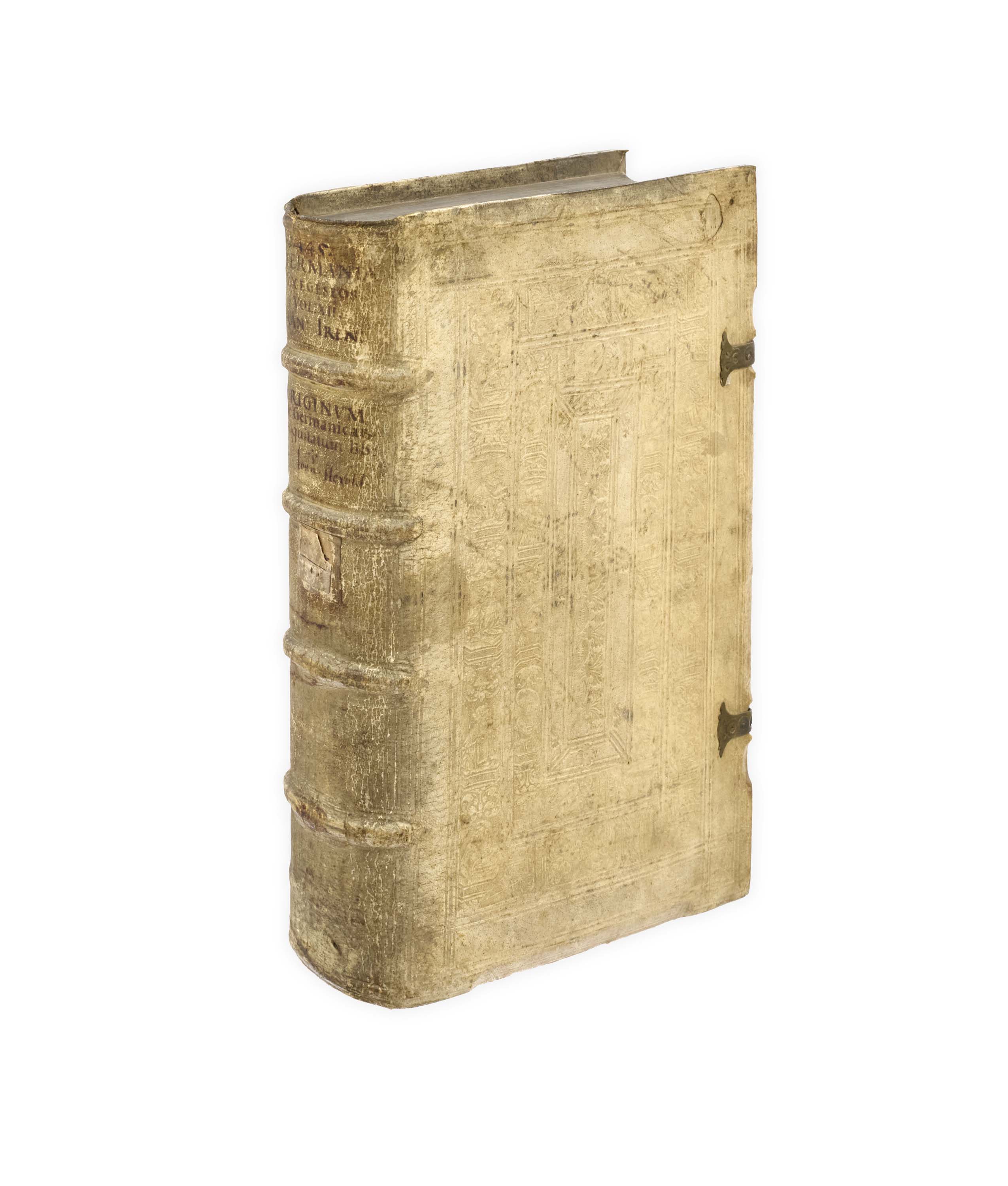
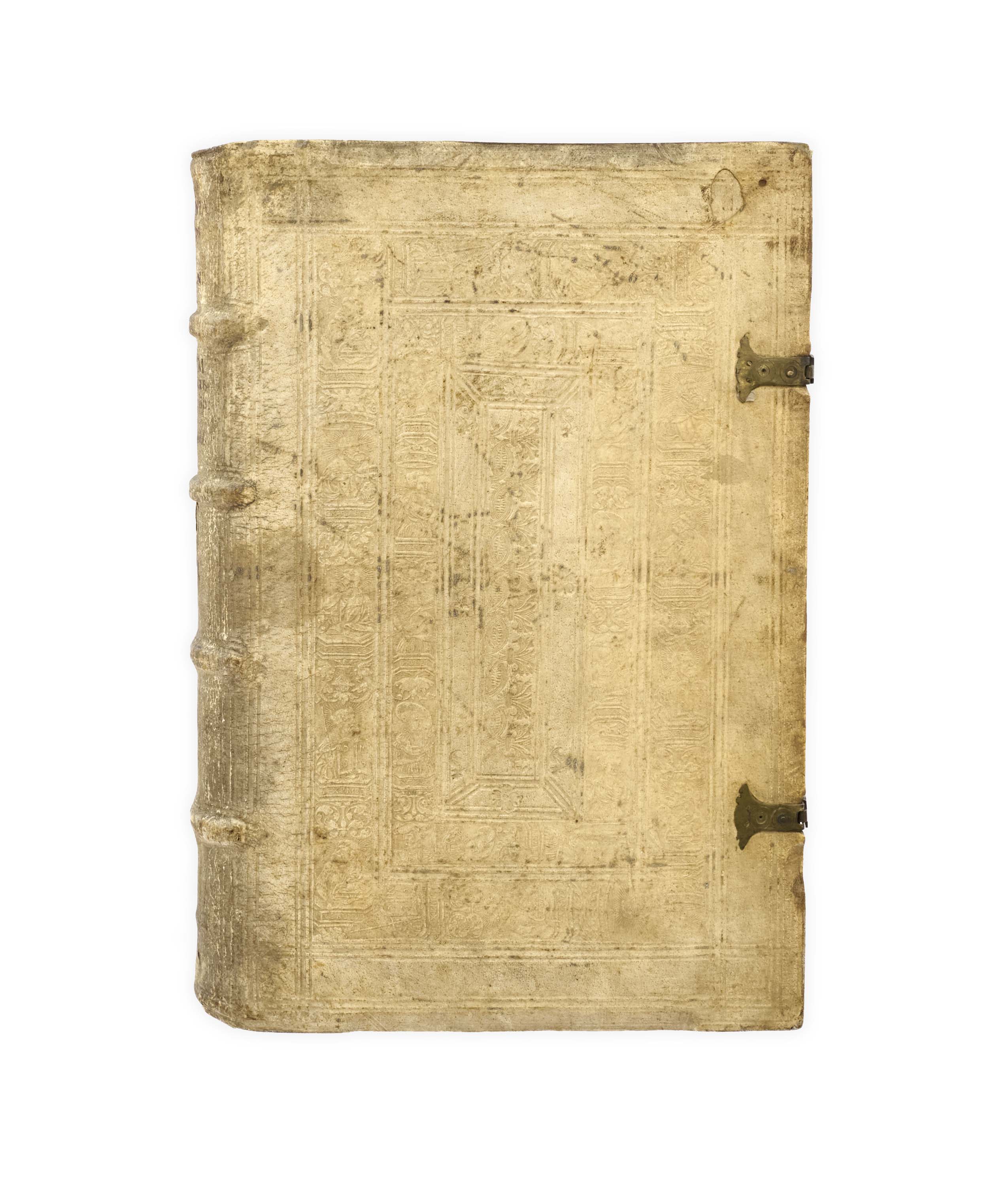
HEROLD, Basilius Joannes. Originum ac Germanicarum antiquitatum libri, leges videlicet Salicae, Allemannorum, Saxonum, Angliorum, […] opus certe pietatis, nec non veteris venerandaeqe illus vere Francicae maiestatis plenum … Basel, Henricpetri, [(colophon:) September 1557].Two works in one vol., folio, I: ff. [vi], ’CCXXI‘ (recte 231), [29]; roman letter with some sections in Greek, woodcut initials, 17 woodcut genealogical diagrams with letterpress headings (some full-page), 7 folding letterpress and woodcut genealogical tables, large woodcut Anshelm device to colophon; II: pp. [20], 347, [1]; woodcut initials, woodcut printer’s device to colophon verso; small marginal repair to f1, else a very good copy; bound by Konrad Kühne of Stuttgart in contemporary blind-stamped pigskin over bevelled wooden boards, two frames composed of inhabited roll tools, one dated 1535 and the other 1536, central panel with a vertical line of palmettes, two clasps, manuscript lettering to head of spine; spine darkened, a few small tears to binding, lower cover somewhat stained; large engraved armorial bookplate of the Elector of Bavaria to front pastedown.
Added to your basket:
Germaniae exegeseos volumina duodecima a Francisco Irenico Ettelingiacensi exarata, eiusdem oratio protreptica, in amorem Germaniae, cum praesentis operis excusatione, ad illustriss. principis Palatini Electoris Cancellarium Florentinum de Pheningen, utriusque censurae Doctorem. Urbis Norinbergae descriptio, Conrado Celte enarratore.
First editions of a pair of sixteenth-century German antiquarian works in a contemporary binding by Konrad Kühneof Stuttgart from the library of the Elector of Bavaria.
Irenicus’ Exegesis was composed as an historical study of Germanic culture, language, and history against the prevailing humanist assumption that it was somehow inferior and ‘barbarian’ compared to Italian or French. Irenicus (1494–1553) quotes classical writers such as Plutarch and Florus who denigrate his country by comparison with the culture of Greece and Rome, which contemporary Italian writers claimed as their superior inheritance. At the time of writing, the Holy Roman Empire was ruled by Maximilian I, who championed German culture and history, and many contemporary writers used the Germania of Tacitus to justify the imperial inheritance of Germany. Irenicus ensured, however, that Christianity was central to his particular view of the ancient Germanic people, and he dwelled at length on the implications of the coronation of Charlemagne by the Pope, with the associated transfer of imperium from Rome to Germany.
The work is divided into two sections, the first half containing ethnologico-historical information about the German people, the second half describing geography and topography. The information was compiled from a vast array of sources, and was perhaps more of a compilation of extracts rather than a single narrative. Appended to the Germaniae exegesis is a speech by Irenicus to Florentius de Venningen, declaring his patriotic zeal in the writing of the work, and responding to criticisms already made about his work by Willibald Pirckheimer (who nonetheless provided a preface to the work) and his old classmate Philipp Melanchthon. The description of Nuremberg included with Irenicus’ work is by Conrad Celtes (1459–1508), a prominent humanist and a leading promoter of Germanic culture who produced an edition of Tacitus’ Germania.
Johann Herold (1514–1567), a scholar who worked mostly for the printing trade in Basel, promoted the Roman heritage of Germany in his works. This compilation of ancient Germanic laws was intended to be part of a larger historical survey of German lands; it now contains the primary source for Frisian customary law as recorded in the late eighth century, the Lex Frisionum, as Herold’s manuscript exemplar is now lost. The two works were often bound together, particularly as Irenicus’s work was reprinted in Basel in 1567, perhaps as a companion volume to Herold’s.
The binding can be attributed to Konrad Kühne, active in Stuttgart between 1536 and 1571 (EBDB w004343). The same tools are found on a binding in Munich on the 1555 Rome edition of Olaus Magnus.
I: USTC 659621; VD16 F 2815; II: USTC 681740; VD16 H 2549.