

The First Great English Dictionary
JOHNSON, Samuel.
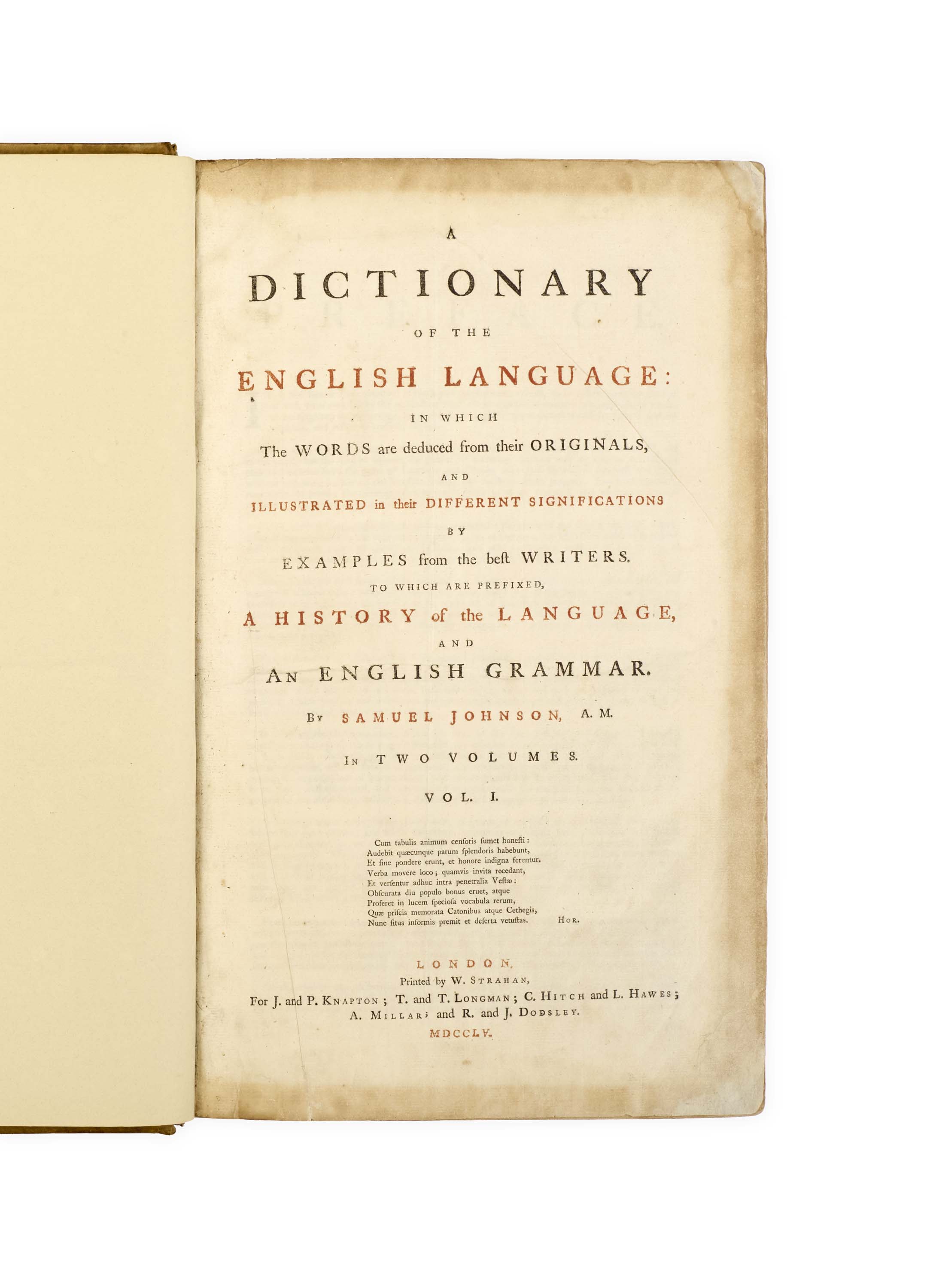
A Dictionary of the English Language: in which the Words are deduced from their Originals, and illustrated in their different Significations by Examples from the best Writers. To which are prefixed, a History of the Language, and an English Grammar. London, W. Strahan for J. and P. Knapton, T. and T. Longman, C. Hitch and L. Hawes, A. Millar, and R. and J. Dodsley, 1755.
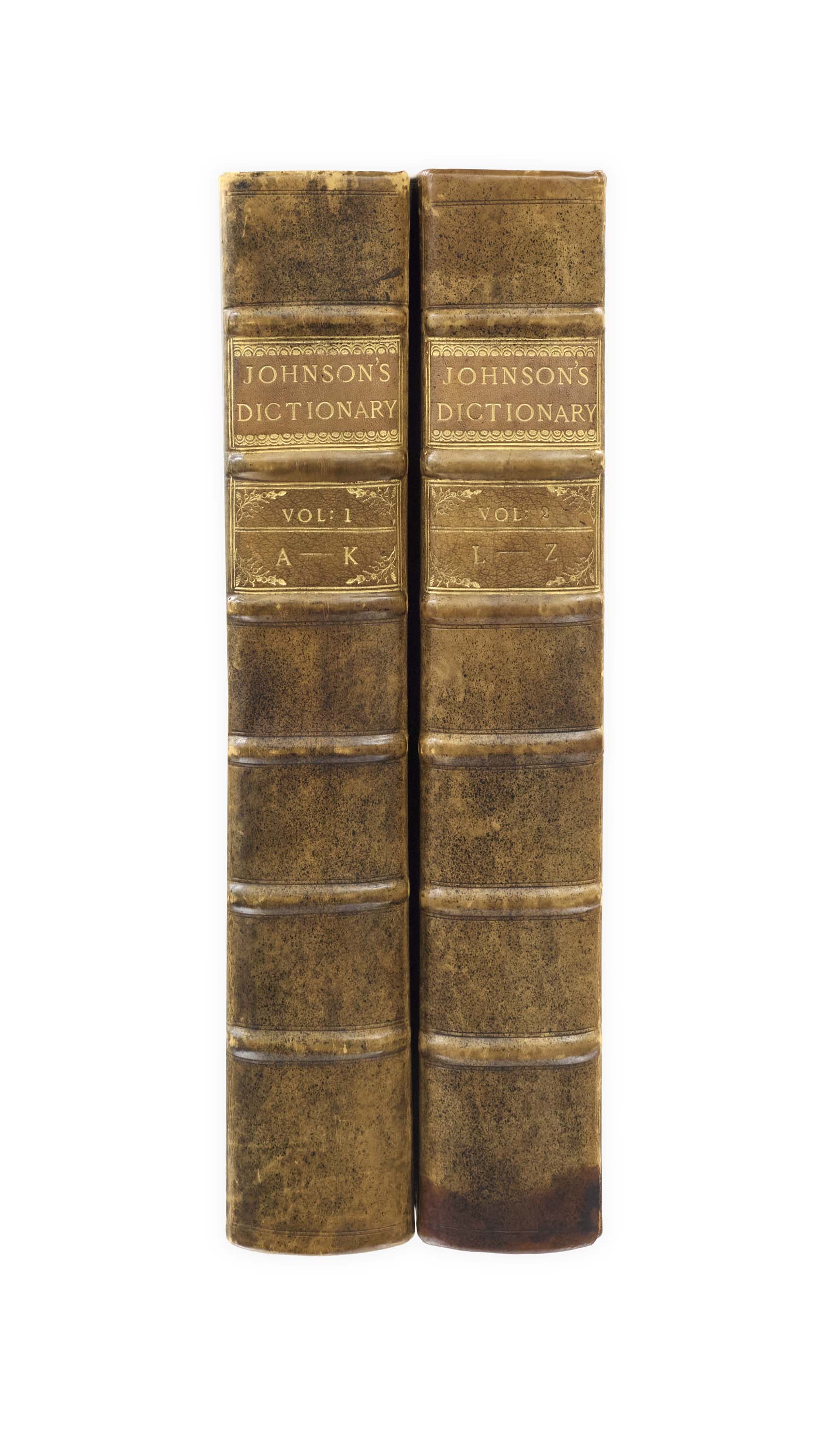
Two vols, folio, pp. I: [1160], II: [1160]; titles printed in red and black; 12P signed ‘16P’ as sometimes, 19D and 24O both in setting (a) (see below); browning to edges of titles, neat repairs to corners of vol. I title, light foxing to vol. II title, scattered foxing and browning elsewhere as often, a few minor smudges and stains, occasional closed marginal tears, a handful of tears with small loss to margins (none affecting text), small wormtracks to tail margins of first quires of both volumes, repaired at πB1 and π1–15A1; else a good copy in modern Cambridge-panelled calf, gilt citron morocco lettering-pieces; slightly rubbed and scuffed.
Added to your basket:
A Dictionary of the English Language: in which the Words are deduced from their Originals, and illustrated in their different Significations by Examples from the best Writers. To which are prefixed, a History of the Language, and an English Grammar.
First edition of ‘the most amazing, enduring and endearing one-man feat in the field of lexicography’ (PMM), this copy preserving 19D and 24O both in the first state.
The labour of nine years, Johnson’s Dictionary contains over 40,000 words defined and 114,000 illustrative quotations. ‘The Dictionary left an immense mark on its age. It soon became recognized as a work of classical standing, and in spite of some minor blemishes it has never lost its historical importance as the first great endeavour of its kind. Notable above all for definitions of pith and occasional wit, the dictionary was even more original in the way in which every word, as Johnson put it, had its history. Each entry is organized under the headword to exemplify graduated senses of a term, a procedure which redirected the course of English lexicography. Further, the quotations used to exemplify the usage of a given word combined to form an anthology of moral sayings and helped to define the canon of literature’ (ODNB). ‘[D]espite the progress made during the past two centuries in historical and comparative philology, Johnson’s book may still be consulted for instruction as well as pleasure' (PMM).
The first edition has two sheets in variant settings – 19D and 24O – both preserved in their original state here, a combination highly uncommon according to Todd. The resetting of these sheets introduced some ninety variants, most of which depart from Johnson’s copy-texts.
ESTC T117231; Fleeman 55.4D/1a; Alston V, 177; Chapman & Hazen, pp. 137–8; Courtney & Nichol Smith, pp. 54–5; Grolier Hundred 50; PMM 201; Rothschild 1237. See William B. Todd, ‘Variants in Johnson’s Dictionary, 1755’, The Book Collector 14/2 (1965).