A Playwright’s Jonson
JONSON, Benjamin.
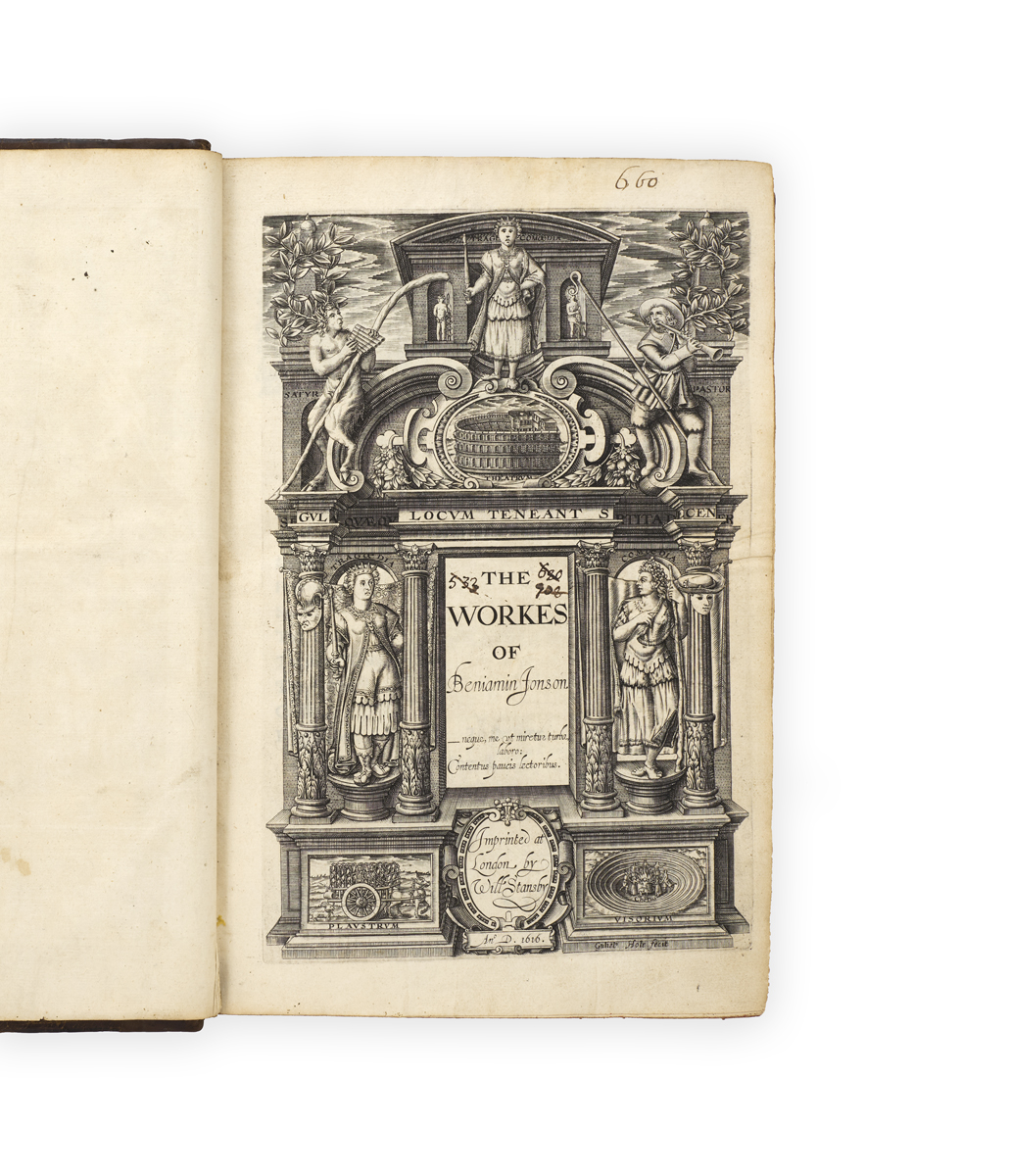
The Workes … London, Will Stansby, 1616.
[Offered with:]
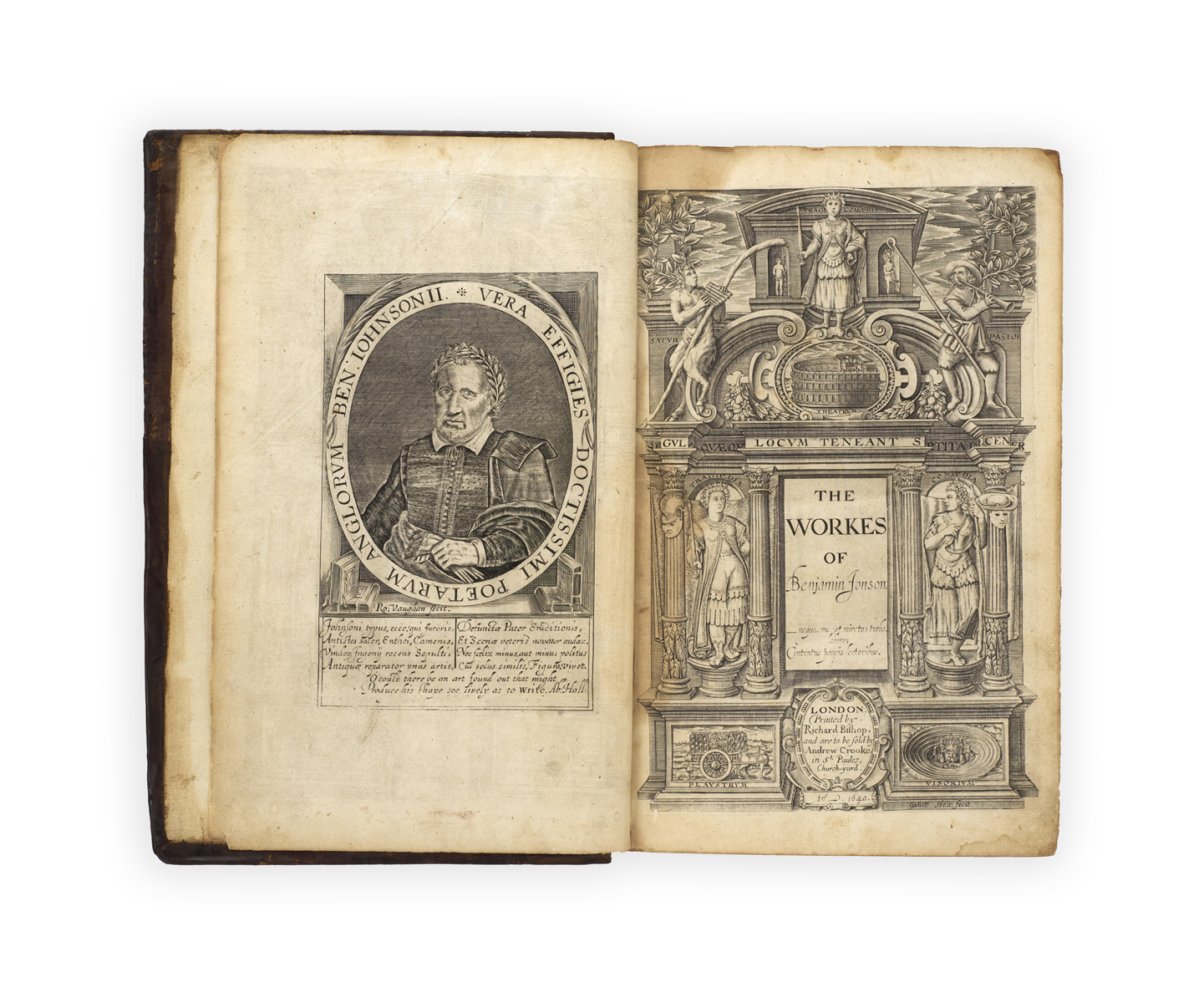
JONSON, Benjamin. The Workes … [– the second Volume] … London, Richard Bishop, and are to be sold by Andrew Crooke [– London, Richard Meighen], 1640 [– 1631].
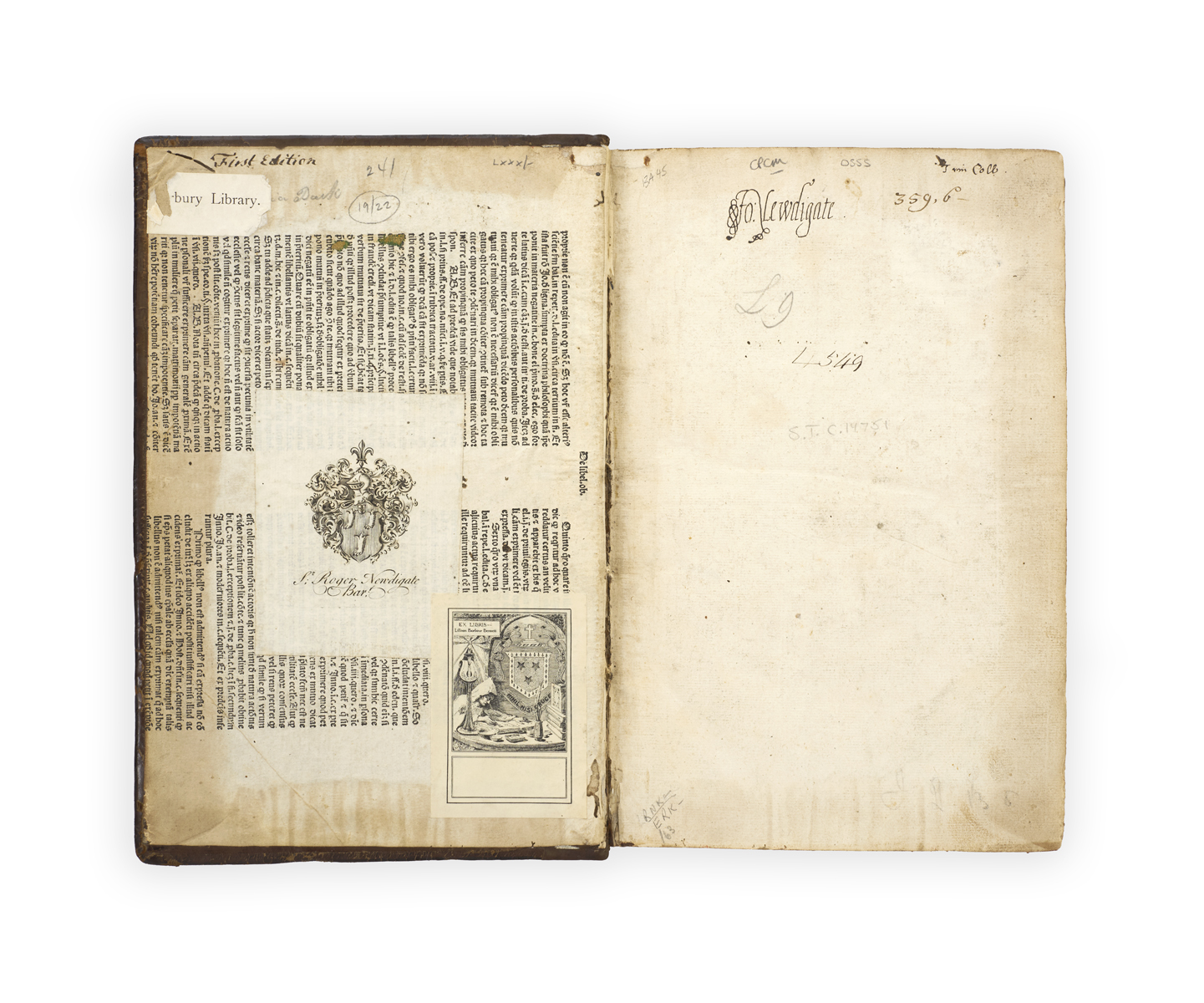
1616: Folio in sixes, pp. [12], 1015, [1 (blank)], including the engraved title by William Hole (in Pforzheimer state C, mostly associated with large paper copies) and the rare initial blank; E6 partly loose because of a paper flaw; a fine, crisp copy with generous margins, in contemporary blind-stamped calf, border and central lozenge of roll tools, neatly rebacked, ties wanting, red edges, with pastedowns of printer’s waste from two sixteenth-century works; contemporary ownership inscription of John Newdigate (1600–1642) to front free endpaper, with scattered marginal markings in pencil and pen throughout but particularly in Catiline, where there is also one annotation; later armorial bookplates of Sir Richard Newdigate (to title verso) and Sir Roger Newdigate (to front pastedown), modern bookplate of Lillian Barbour Bennett; in folding cloth box.
1640–31: Two vols, folio in sixes, I: [12], 668, 228, with the engraved portrait of Jonson by Vaughan, and the engraved title-page, II: pp. [12], 88, 75, [2], 93–170, 292, 155, [1] 132, with Meighen’s 1640 title-page cancelling the initial blank [A1] of the three plays that had been printed in 1631 (slightly browned); The Staple of News is bound after Bartholomew Fair, as stated on the title-page but not as printed; pale marginal dampstain to first third of vol. I and towards the end of vol. II, but a good copy in contemporary panelled calf, rebacked; ownership inscription ‘J. Perfect’s book’; slipcases.
An excellent set of the canonical Ben Jonson, the first collection of English plays in the proud format of a folio and the direct fore-runner of Shakespeare’s folios, here found with both the first (1616) and the corrected second editions (1640) of Volume I, and the first edition of Volume II[-III] (1631–40).
The copy of Workes 1616 offered here bears the large ownership inscription of the playwright John Newdigate (1600–1642) from his time at Trinity College, Oxford (1618-20). Newdigate is the probable author of the plays Glausamond and Fidelia (later revised as Ghismonda and Guiscardo), The Twice Chang’d Friar, The Emperor’s Favourite, and The Humorous Magistrate, which appear among other manuscript plays in his library. He ‘attended a steady stream of plays at various theatres during his time at Oxford and the inns of court … The Newdigate account books detail purchases of printed play texts [including Jonson quartos] and the presence in library catalogues of both manuscript and printed dramatic works reveals Newdigate’s encompassing interest in the theatre’ (Inglis and Johnstone). ‘Oxford … fostered Newdigate’s musical and literary interests; he played the lute, wrote verse, and gathered a collection of plays in manuscript … A commonplace book containing the paradoxes of John Donne [as well as original compositions influenced by Donne], and several volumes of sermon notes in his hand … reveal Newdigate to have been an earnest moderate in religion’ (History of Parliament). His only published work was a poetic contribution to The Wearie Souls Wish (1650), published in tribute to Jane, Lady Burdett, in whose literary circle he had mixed alongside William Dugdale. Newdigate’s plays, connections and the Arbury MSS feature largely in a special issue of Early Theatre (14:2, ‘Circles and Circuits: Drama and Politics in the Midlands’, 2011).
Newdigate’s reading of Jonson would have been particularly relevant for The Emperor’s Favourite, probably written in the 1620s or 30s, which follows Jonson’s Sejanus in employing classical models (in this case the rise and fall of Crispinus) to critique the Stuart court (and the career of the Duke of Buckingham). The character of Datus, a ‘court actor and playwright who finds himself in trouble with Nero after performing a speech castigating the emperor’s crimes … appears to be partly based on another well-known contemporary, Ben Jonson’ (Keenan).
The plays collected in Jonson’s 1616 Workes include The Alchemist, Volpone, and Every man in his Humour, which was first performed in 1598 by the Lord Chamberlain’s men, its list of ‘principall comœdians’ headed by ‘Will. Shakespeare’. There are masques as well, including the masque Of Blacknesse, epigrams, and the collection of poems called ‘The Forrest’. The second edition of 1640 ‘shows evidence of revision by someone familiar with Jonson’s methods of punctuation, and may contain some posthumous corrections of his own’ (Greg, III, 1074). It also adds the famous portrait of Jonson by Robert Vaughan which was first published as a separate broadside c. 1625.
The first part of ‘the second volume’ comprises the sheets of three plays printed in 1631 by John Beale for Robert Allott, Bartholemew Fair, The Staple of News, and The Devil is an Ass; these were probably intended to be sold as a supplement to the 1616 Workes (there are individual title-pages dated 1631 but no general title-page was issued at the time). Before his death in 1640 Jonson delivered manuscripts of his unpublished late plays (The Magnetick Lady, A Tale of a Tub, and The sad Shepherd), masques, The Under-woods and other poems, and a few other pieces not before printed to Kenelm Digby, who entrusted them to the publisher Thomas Walkley. These pieces form the second, third, and fourth parts of ‘The second Volume’, and are usually referred to collectively as ‘volume III’. By now Richard Meighen owned the uncirculated stock of the three 1631 plays, and he joined them with Walkley’s larger text, having prefixed a 1640 general title-page.
Provenance:
1. The Workes 1616 with the inscription of John Newdigate (1600–1642) MP, thence by descent within the family, with the bookplates of his nephew Sir Richard Newdigate (1644–1710) (dated 1709), and the latter’s grandson Sir Roger Newdigate (1719–1806).
2. With a series of Arbury shelfmarks on the title-page and fore-edge, early twentieth-century ‘Arbury Library’ booklabel; lot 164 in the Arbury sale of 22-23 January 1920 at Sotheby, Wilkinson & Hodge, the library bought en bloc by G.D. Smith and many items sold to Huntington.
3. Lillian Barbour Bennett.
4. Christopher Foyle, purchased along with Workes 1631–1640, with eighteenth-century ownership inscription in each volume ‘J Perfect’s Book’.
STC 14751, 14753, and 14754; Greg, III, 1073-1081; Pforzheimer 559 and 560. See Inglis and Johnstone, ‘“The pen looks to be canoniz’d:” John Newdigate III, Author and Scribe’; and Keenan, ‘Staging Roman History, Stuart Politics, and the Duke of Buckingham: The Example of The Emperor’s Favourite’, both in Early Theatre 14:2 (2011).