Almanacks as Educational Tools for Tots
[JUVENILE.]
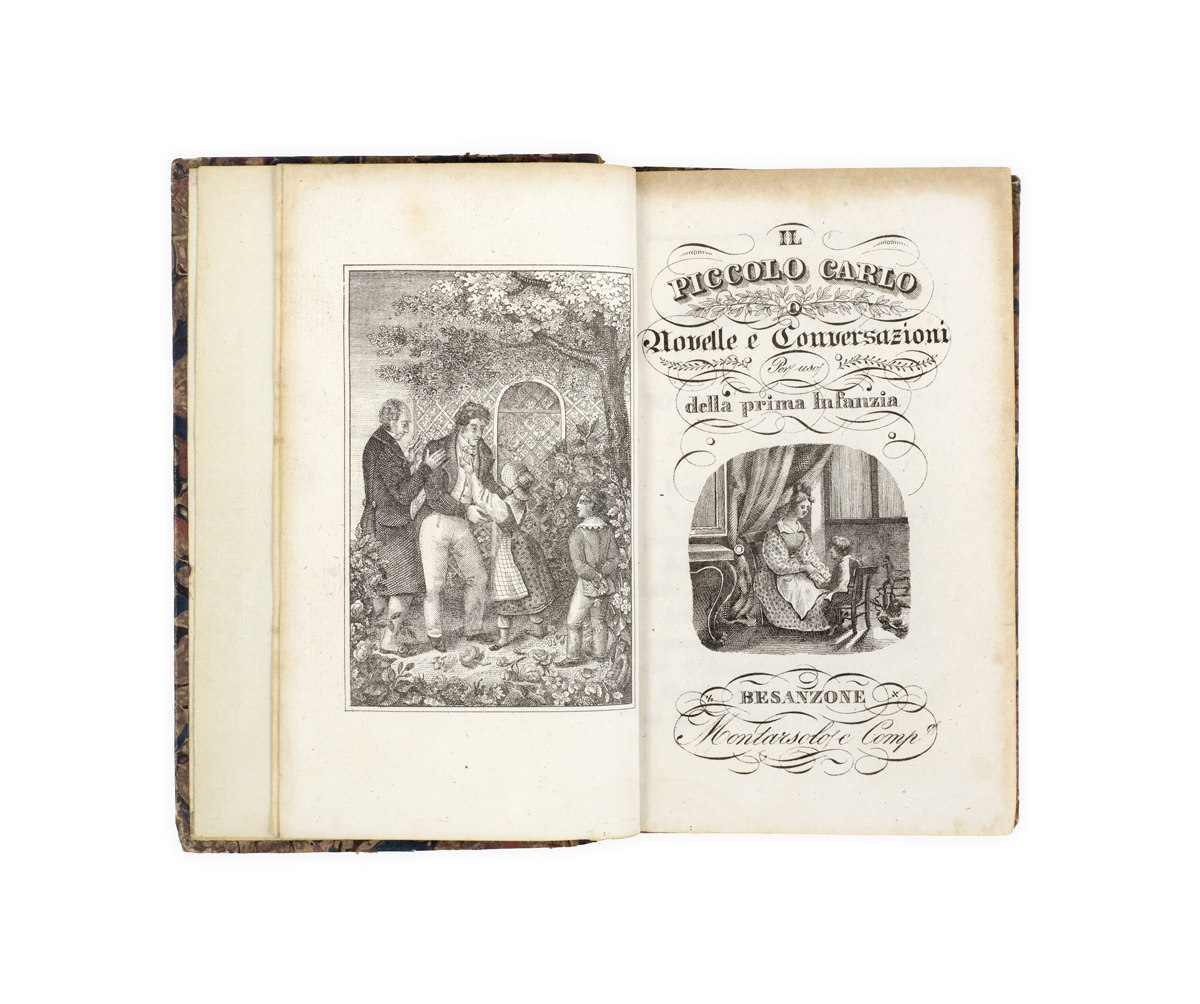
Il piccolo Carlo, o novelle e conversazioni della prima infanzia. Besançon, [Antonio] Montarsolo e Comp., [c. 1830].
8vo, pp. [vi], 155; engraved frontispiece and title, 3 full-page engravings, the second signed 'Rambert', slightly foxed, and a little toned at edges, but a good copy; bound in contemporary roan-backed boards with marbled sides, spine in gilt ruled compartments, title lettered in gilt directly to second compartment; somewhat scuffed and rubbed at edges; with presentation inscription in Italian to Georgiana Martin, from her father, dated 9 May 1837.
Very rare Besançon-printed edition of these moral tales for children framed within the context of a parent–child dialogue, our copy presented by a father to his daughter.
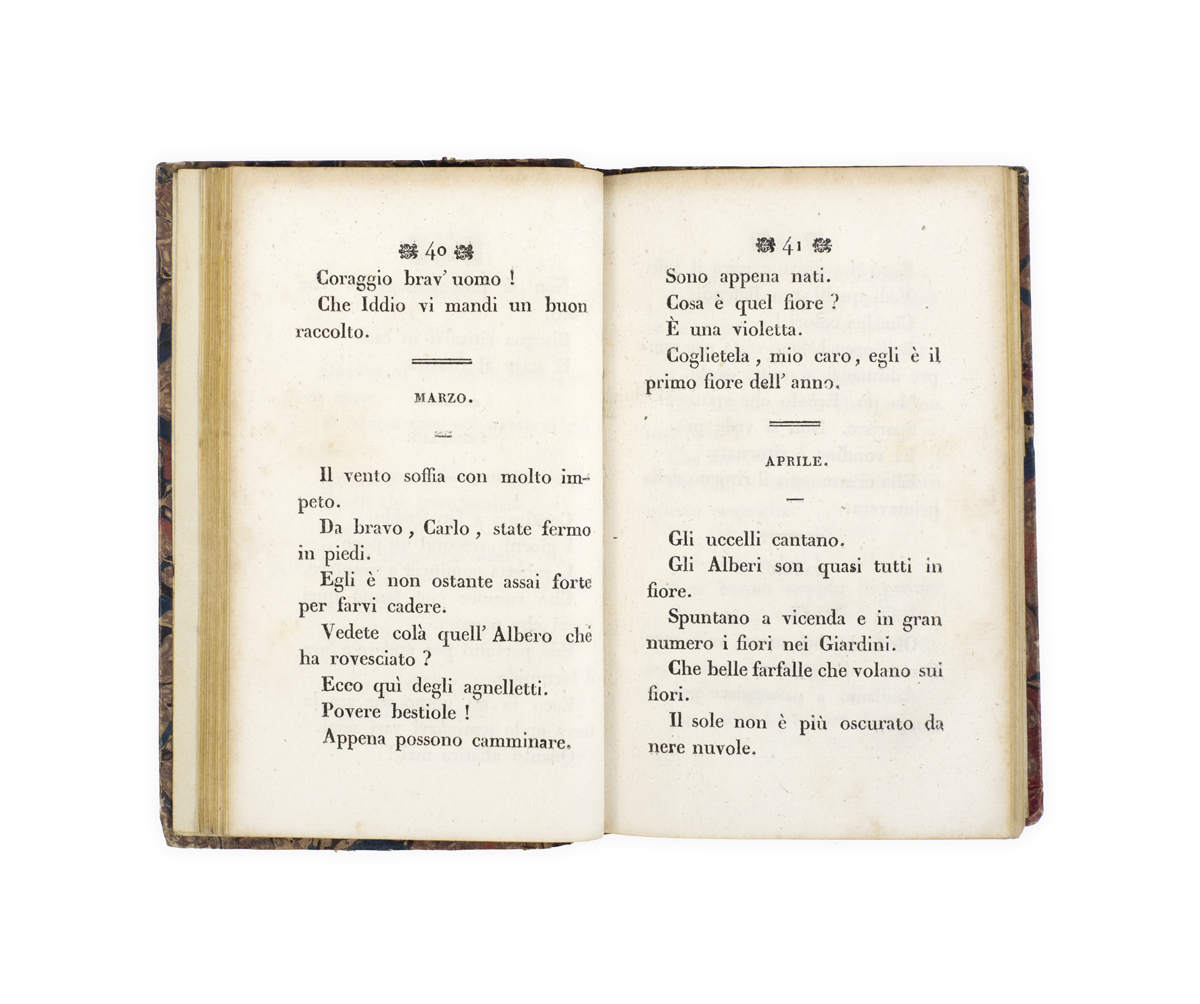
The first fifty-seven pages, in infantile speech, introduce young readers to parts of the body, natural phenomena, animal sounds, and more, in the form of discussions between the young Carlo and his parents: he plays games of peekaboo, learns to share and to gently stroke the family cat, observes worms, snails, and butterflies in the garden, plays pretend with his father, and is comforted after hitting his head on a table. His mother then takes out her almanack for the year, using it as an educational instrument for the young Carlo. She first describes the seasons before providing immersive, month-by-month descriptions in which Carlo sees lambs born in April and picks the first violets of the season; eats fresh strawberries from the garden in June; and observes the vendemmia on a distant hill in September. By December, his mother believes that he has learnt enough to read on his own, and introduces the moral tales which follow: ‘Here is a new book I’m giving you as a gift. The stories in this one are a little bit longer. All the tales are about boys your age. Some are good, and some are bad. You will see how happy and well-liked the good boys are, and how hated and unhappy the bad boys are. I am sure, my dear Carlo, that you will imitate the good so that you can be as happy as they are’ (p. 56, trans.).
Located less than fifty miles from Switzerland and less than 220 miles from Italy, Besançon had been an important hub for Genoese trade since the sixteenth century, and large communities of masons emigrated from Savoy in the seventeenth and eighteenth centuries, and from Ticino in the first half of the nineteenth; waves of migration from Italy continued well into the twentieth century.
Provenance:
Presentation inscription to title ‘Georgiana Martin, dal suo carissimo Padre’, dated 9 May 1837.
OCLC finds only three copies, two in the US (attributed to c. 1800), at Simmons and the Free Library of Philadelphia, and one at the BnF. ICCU records only one copy, at the Biblioteca comunale Carlo Negroni in Novara. Not in Library Hub.
On the Italian community of Besançon, see Spagnoli, ‘La longue histoire de la presence italienne à Besançon et son influence sur la ville’, in Quaestiones Romanicae VIII (2020), pp. 264–271.