
Convincingly Attributed to Thomas Heywood
K[IRKE], J[ohn].
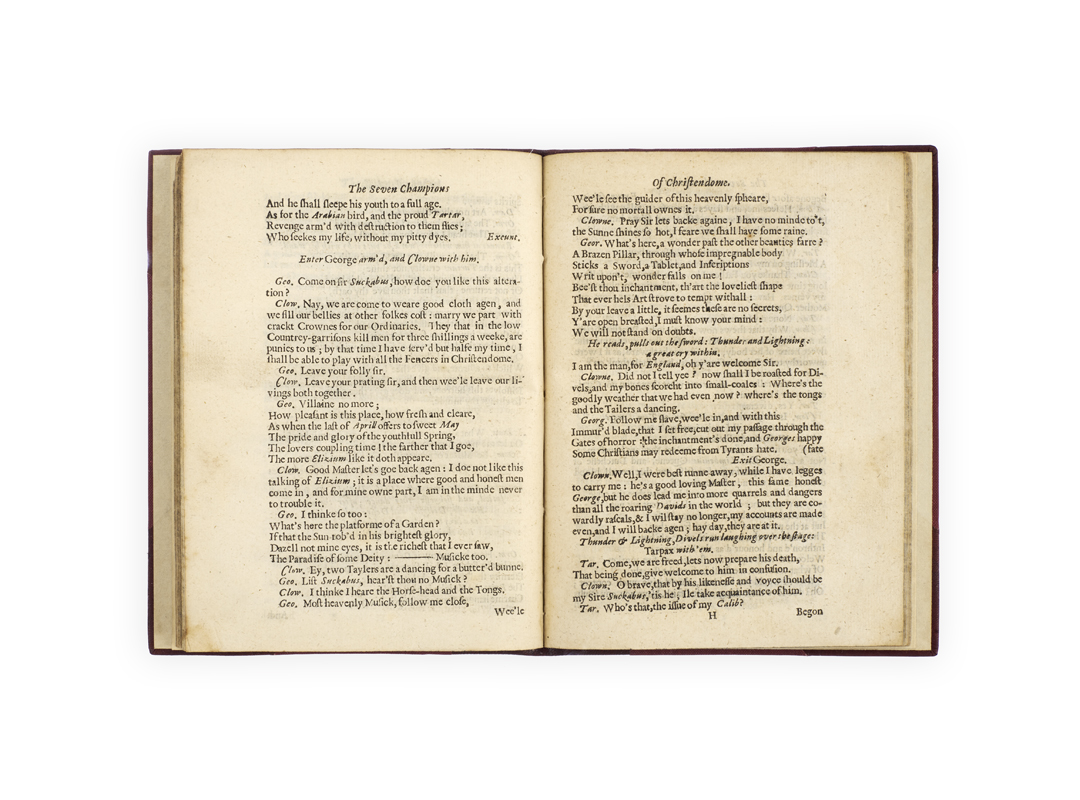
The Seven Champions of Christendome. Acted at the Cocke-pit, and at the Red-Bull in St. Johns Streete, with a generall liking. And never printed till this Yeare 1638 … London, J. Okes, and are to be sold by James Becket, 1638.
Small 4to, pp. [88], complete with the initial and terminal blanks A1 and L4; a fine copy, with generous margins, not washed or pressed; bound in modern half red morocco with cloth sides.
Added to your basket:
The Seven Champions of Christendome. Acted at the Cocke-pit, and at the Red-Bull in St. Johns Streete, with a generall liking. And never printed till this Yeare 1638 …
First edition of this play based on Richard Johnson’s popular romance of 1596, characteristic of the spectacle-dramas staged at the Red Bull, where John Kirke was an actor.
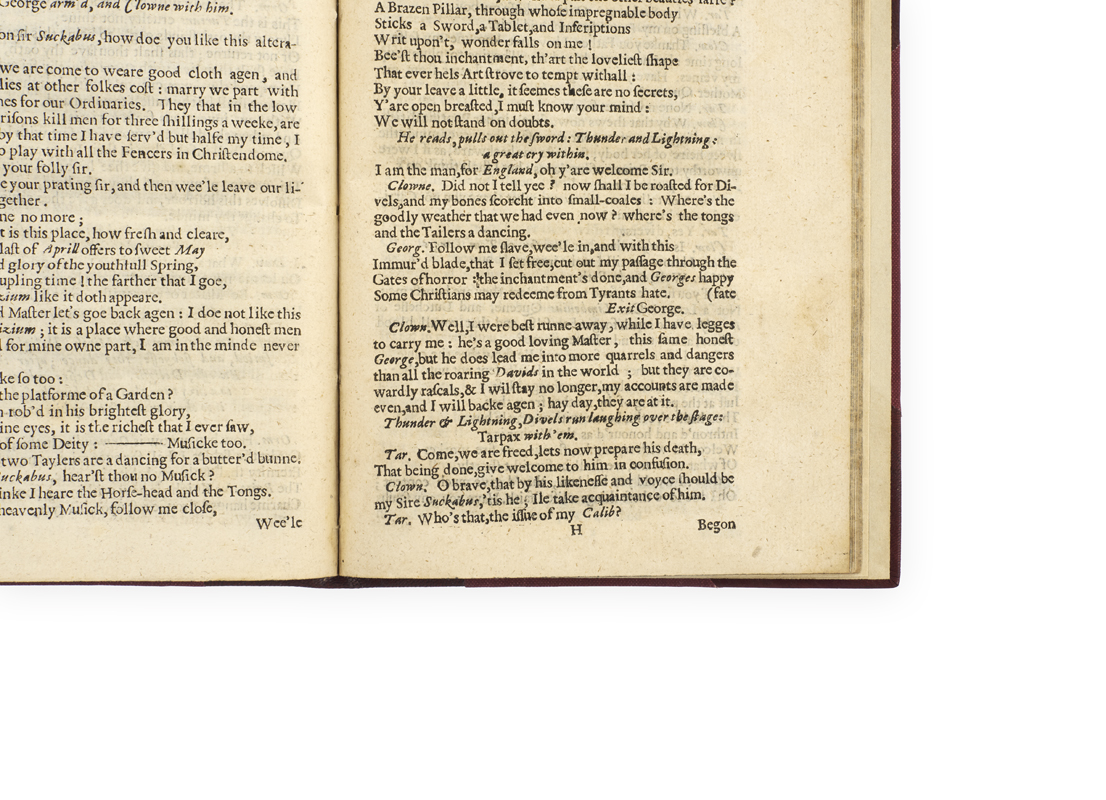
Despite this, and the unequivocal attribution to Kirke in the printed text, the authorship has puzzled commentators because of a persistent vein of allusion to events c. 1613–14, a date much too early for Kirke. Paul Merchant has reviewed the evidence that Kirke was revising an earlier play, and he argues plausibly that Thomas Heywood was the original author (The Library, September 1978). In the first place, the only major character not found in the prose source – and the most brilliant figure in the whole play – is Suckabus the Clown, the son of Calib the Witch (there is much here about the Lancashire witches); and Suckabus is not only ‘reminiscent of Heywood’s clowns’, but ‘in one speech, at the opening of Act V, even shows familiarity with the True History of Lucian, an author translated by Heywood’.
There are further parallels in Calib and the Chorus, and these are reinforced by such stylistic features as a penchant for compound adjectives, persistent classicism, and one instance of Heywood’s distinctive spelling of ‘ey’ for ‘aye’. Add to this that The Seven Champions is apparently Kirke’s only play, and that in the same year he sold it to Okes he also sold Okes The Martyr’d Souldier, a play by the unfortunate Henry Shirley, then a decade in the ground, which had been an early favourite at the Cockpit.
The play is full of thunder and lightning, and the large cast, which would have required much doubling, includes, besides all seven Champions, a magician, a giant, a priest of Pan and three ghosts. ODNB remarks on influence from the The Winter’s Tale and The Tempest.
Many of Heywood’s plays are known to have been lost: by his own testimony he had a ‘maine finger’ in 220 plays to 1633 (see The English Traveller), but only some thirty acknowledged plays and civic pageants survive. Both in style and content, The Seven Champions seems a convincing addition to the canon.
ESTC S109282; STC 15014; Greg, II, 545; Pforzheimer 574.