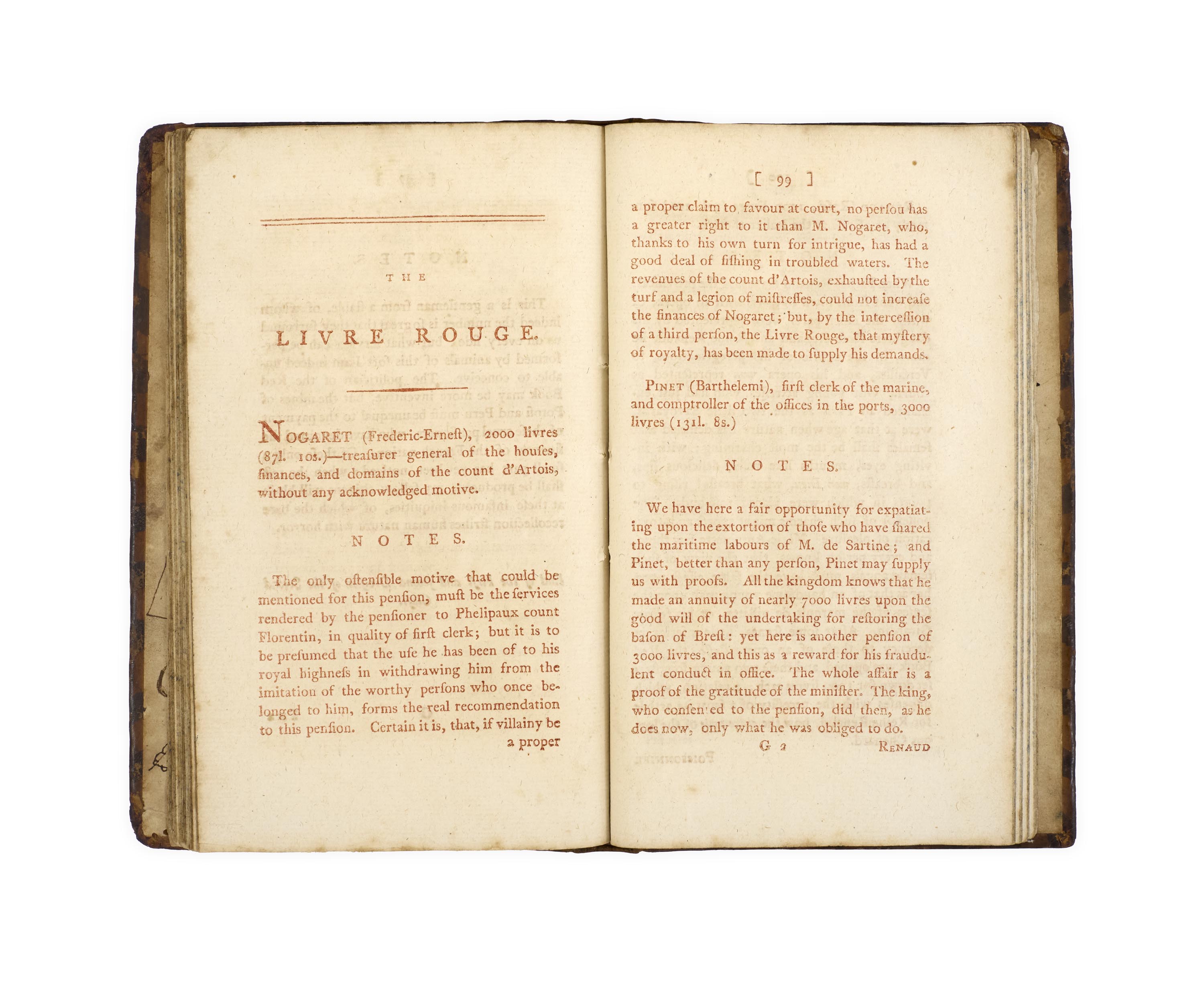
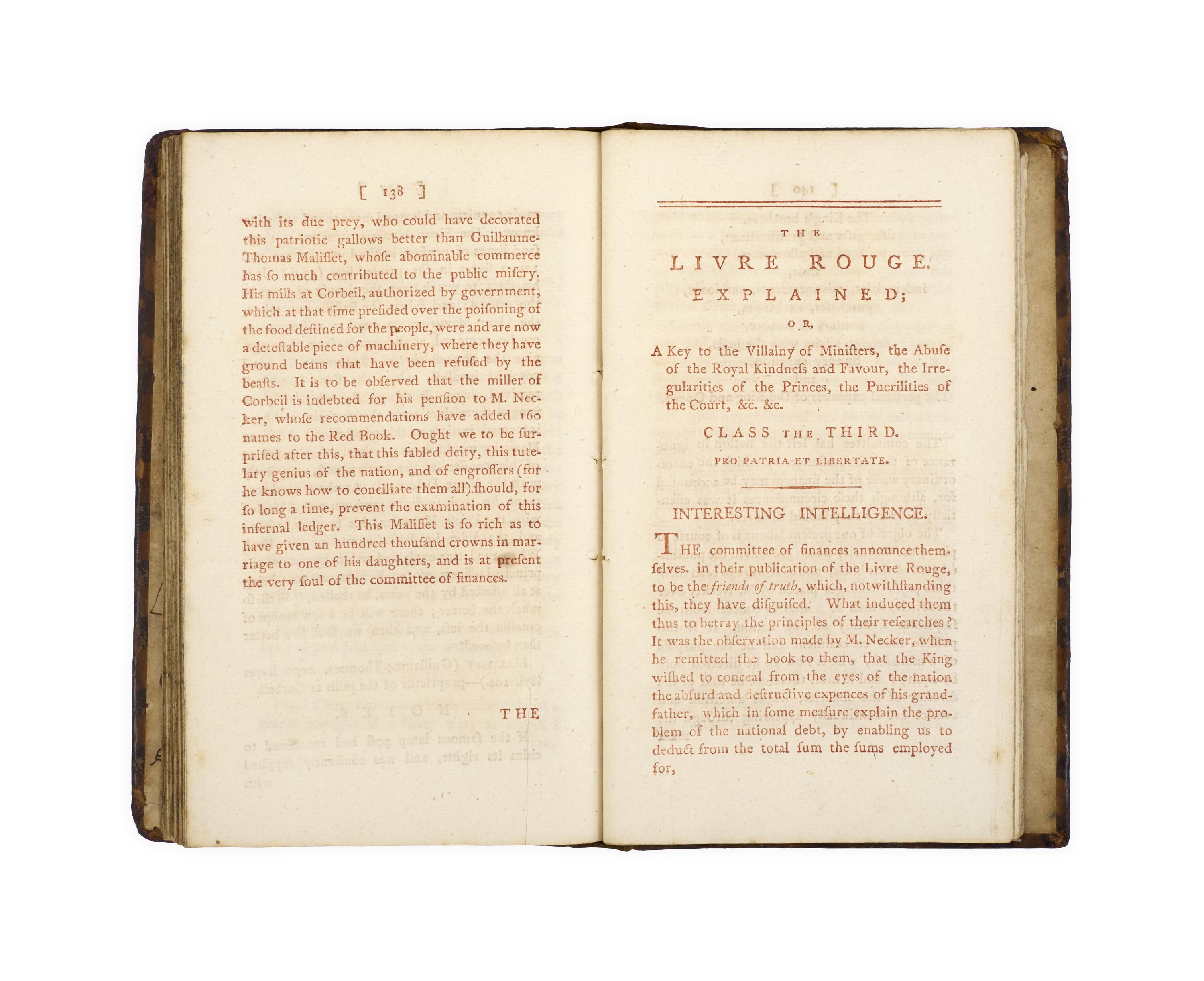
Blue-Blooded Bribes Printed in Red
[LA REYNIE DE LA BRUYÈRE, Jean-Baptiste-Marie-Louis.]
The Livre rouge, or Red Book: being a List of secret Pensions, paid out of the public Treasure of France; and containing Characters of the Persons pensioned, Anecdotes of their Lives, an Account of their Services. And Observations tending to shew the Reasons for which the Pensions were Granted. Translated from the eighth Paris Edition. Dublin, Patrick Byrne, 1790.
8vo, pp. 160; printed in red throughout; a little foxed, more heavily to earlier leaves; else a very good copy in contemporary mottled calf, edges sprinkled green; neatly rebacked, somewhat scuffed; early inscription ‘No 2 / Henry Waterfield’ to rear pastedown, early children’s doodles of a house and of people to front and rear pastedowns, list of numbers in pencil to rear free endpaper.
Added to your basket:
The Livre rouge, or Red Book: being a List of secret Pensions, paid out of the public Treasure of France; and containing Characters of the Persons pensioned, Anecdotes of their Lives, an Account of their Services. And Observations tending to shew the Reasons for which the Pensions were Granted. Translated from the eighth Paris Edition.
Rare Dublin edition of this English translation of the Livre rouge, a French Revolutionary indictment of the corruption of the Ancien régime, printed entirely in red by the radical printer–bookseller and United Irishman Patrick Byrne.
A purported exposé of the old regime’s system of secret pensions, this scurrilous work was first published at Paris in 1790. The title nods both to the striking typography and to the characteristic red bindings of the French government’s secret account books.
Translated and printed at London the same year, the work was swiftly pirated in two Dublin editions, of which the present is one (and the other one likewise scarce). Our printer Byrne (1740/1–1814) operated ‘probably the largest [bookselling business] of its kind in Ireland in the eighteenth century’ (DIB). One of the first Catholics admitted to the stationers’ guild after the Catholic Relief Act of 1793, he was also a member of the United Irishmen from 1792 and was the printer of three of Wolfe Tone’s works. It was he who unwittingly introduced the radical Sheares brothers to the informer John Warneford Armstrong, on whose testimony both brothers were hanged for treason and Byrne himself imprisoned without trial for two years. On release he emigrated to Philadelphia, where he continued his trade and died in 1814.
ESTC N11153.