
The Sorrows of Young Sophie
[LA ROCHE, Sophie von.]
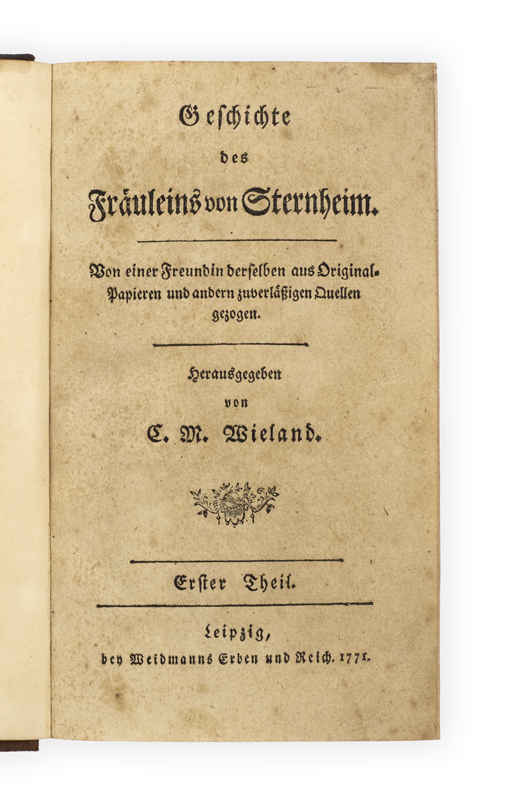
Geschichte des Fräuleins von Sternheim. Von einer Freundin derselben aus Original-Papieren und andern zuverlässigen Quellen gezogen. Herausgegeben von C. M. Wieland. Erster [– Zweyter] Theil. Leipzig, bey Weidmanns Erben und Reich, 1771.
Two volumes bound in one, small 8vo, pp. I: xxii, [2 (blanks)], 367, [1 (blank)], II: [2], 302; lightly browned throughout with contemporary ink annotations to a couple of leaves, a good copy in contemporary half calf over boards, spine ruled gilt with a gilt morocco lettering-piece, lower joint cracked, cords holding firm; spine and one corner chipped with loss; several marks to the boards and some faded notes in blue ink in the hand of the book’s 1834 owner; neat ink ownership inscription dated 1834, to the front free endpaper and the note ‘Began Torquay 20 Oct 1836’, pencil landscape to the lower pastedown.
Added to your basket:
Geschichte des Fräuleins von Sternheim. Von einer Freundin derselben aus Original-Papieren und andern zuverlässigen Quellen gezogen. Herausgegeben von C. M. Wieland. Erster [– Zweyter] Theil.
First edition of Sophie von La Roche’s (1730–1807) bestselling epistolary novel, a bestseller featuring kidnapping, travels from Germany to Scotland, and a false wedding ceremony, a direct forerunner to Goethe’s Werther.
Orphaned at the age of eighteen, Sophie von Sternheim is taken in by her aunt, who hopes to arrange an introduction to the prince; she falls in love with the visiting English diplomat, Lord Seymour; the rakish Lord Derby gains Sophie’s favour, marries her in a ceremony which is later revealed to be a hoax, and kidnaps her to Scotland before she ultimately reunites with Lord Seymour. The Geschichte des Fräuleins von Sternheim was published anonymously, and edited by La Roche’s cousin Christoph Martin Wieland, who provides an introduction. The two were briefly engaged in 1750 when Wieland was seventeen and Sophie nineteen, but were dissuaded from marriage by their families; they corresponded for the rest of their lives. In 1783, continuing in her efforts to foster women’s intellectual development, La Roche published the first German journal for women to be written by a woman, the Pomona für Teutschlands Töchter.
The novel, which predates Werther by three years, was instrumental in establishing the genre of the epistolary novel in Germany. Goethe himself was a friend of La Roche’s, and travelled to Ehrenbreitstein to visit the La Roches immediately after leaving Wetzlar in 1772; there, he was introduced to La Roche’s literary contacts and regularly frequented her salons, in which letters written by notable individuals were frequently read aloud and discussed. In January 1774, La Roche visited Goethe in Frankfurt, and he began working on Werther the day after her departure; he would subsequently send her the first part of Werther in manuscript for her perusal as well as a printed copy of the final work (see Piel, ‘La Roche and Goethe: Gender, Genre, and Influence’ in Goethe Yearbook 30 (2023), pp. 41–62).
Goedeke IV/1, 592, 1; Wilpert/Gühring 1.