

Chivalry Illuminated: a Royal Commission?
[LA VIGNE, André de, and Octavien de SAINT-GELAIS.]
Le vergier dhonneur nouvellement imprime a Paris. De lentreprise et voyage de Napples. Auquel est compris commant le roy Charles huitiesme de ce nom a banyere desployee passa et rapassa de iournee en iournee depuis Lyon iusques a napples et de napples iusques a Lyon. E[n]semble plusieurs aultres choses faictes et composees par reverend pere en dieu monsigneur octovie[n] de sainct Gelais evesque da[n]golesme et par Maistre Andry de la vigne secretaire de monsieur le duc de Savoye avec aultres. [Paris, Pierre le Dru and Jean Petit, 1503.]
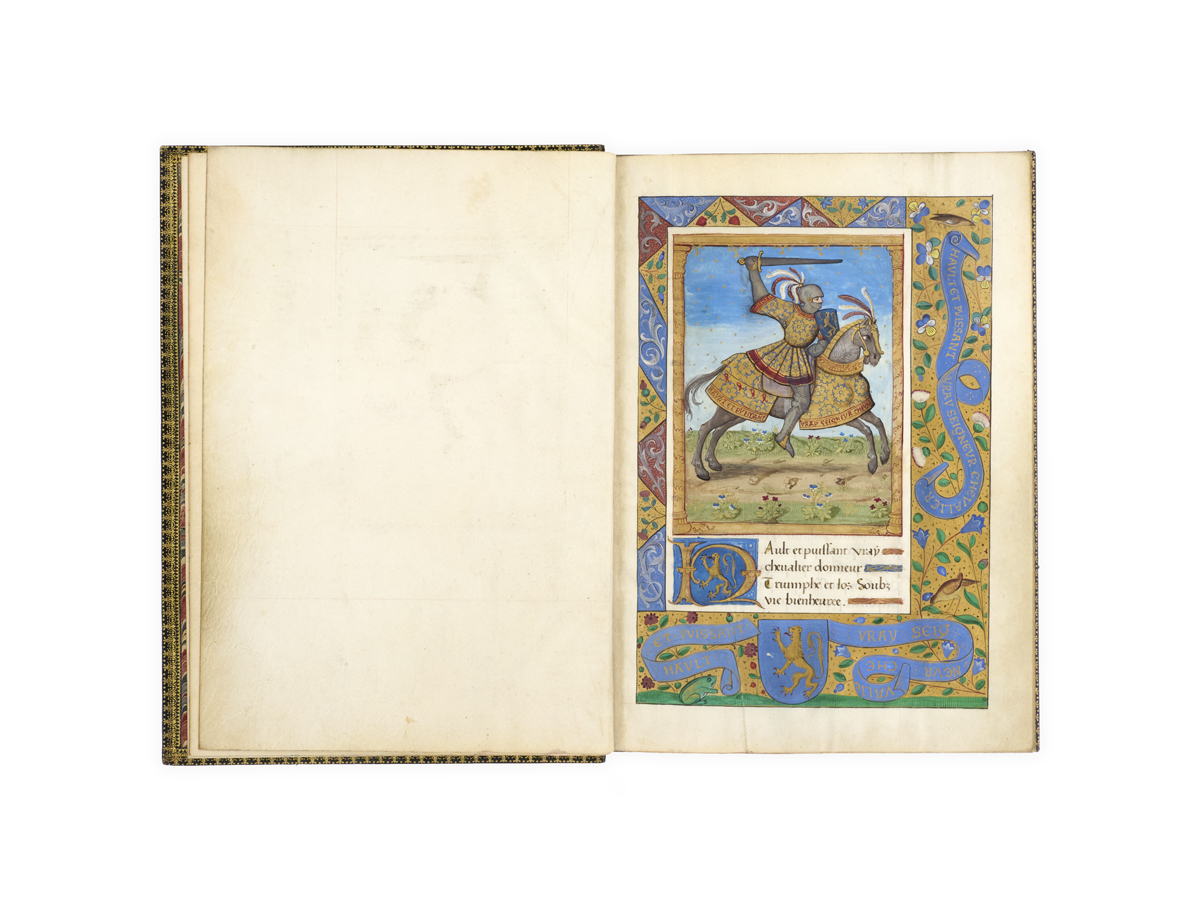
Folio, ff. [209]; without final blank P6; printed in lettres bâtardes, numerous woodcut illustrations, some full-page, woodcut initials, with an additional four vellum leaves bound at front, the first blank, the second containing a miniature of an elaborately dressed knight on a richly caparisoned horse charging with his sword raised, within a full illuminated border inhabited by flowers, birds and lettering on banderoles, with a coat of arms at foot, illuminated initial containing the same coat of arms, followed by four pages of manuscript verse in a French humanistic bookhand with illuminated initials on blue or red grounds and red and blue gilt line fillers, the final verso blank; a beautiful copy bound in nineteenth-century green morocco gilt by Koehler, covers gilt-tooled in period style to an interlaced cartouche (found on fine mid-sixteenth century Parisian bindings), spine similarly gilt-tooled in compartments and directly lettered in gilt, edges gilt; extremities very slightly rubbed.
Added to your basket:
Le vergier dhonneur nouvellement imprime a Paris. De lentreprise et voyage de Napples. Auquel est compris commant le roy Charles huitiesme de ce nom a banyere desployee passa et rapassa de iournee en iournee depuis Lyon iusques a napples et de napples iusques a Lyon. E[n]semble plusieurs aultres choses faictes et composees par reverend pere en dieu monsigneur octovie[n] de sainct Gelais evesque da[n]golesme et par Maistre Andry de la vigne secretaire de monsieur le duc de Savoye avec aultres.
Extremely rare first edition of the Vergier d’Honneur, a celebration of the expedition of Charles VIII to Italy; a remarkable copy preceded by three leaves of illuminated manuscript containing unrecorded verse and a spectacular miniature of a knight on horseback.
The numerous woodcuts include an illustration of the author in his study on the verso of the title-page, scenes of battles, courts, and sea journeys, episodes of martyrdom and the Crucifixion, hangings and funerals, and a full-page woodcut (repeated several times) of Charles on horseback arriving at a castle and being presented with a book. Some of the woodcuts of people contain banderoles with varying letterpress captions (or no caption at all), and the figures are often arranged in different combinations to fit the text.
The printed text describes the momentous battle of Fornovo (6 July 1495), with allegorical interpretations, followed by a poetic anthology of verses, ballads, and acrostics, an epitaph of the king (who died in 1498), and a morality play. While the text is ascribed to the churchman, poet, and translator Octavien de Saint-Gelais (1468–1502), it is more likely that the greater part of it was composed by André de La Vigne (1470?–1526?), secretary to the queen of France, in support of Charles’s Italian expedition, in which he himself had taken part. Saint-Gelais was the author only of the ‘Complainte et epitaphe du feu roi Charles dernier trespassé’ (M2–N4). Parts of the text had been printed in Angoulême in the late fifteenth century (surviving in fragments only), where Saint-Gelais was archbishop, which explains the ‘nouvellement imprime a Paris’ stated on the title-page here. The typeface is that of Pierre le Dru, and some of the illustrations were also used by Antoine Vérard. Le Dru also printed a quarto version shortly afterwards (Bechtel V-55).
The manuscript verse exhibits many of the rather ostentatious traits associated with the group of French poets known as the ‘rhétoriqueurs’. It may plausibly also be the work of La Vigne, traditionally considered one of their number (as is Saint-Gelais). It comprises six stanzas of varying length (11, 12, 12, 12, 12, and 6 lines respectively), each with a comparably rich rhyme scheme. The first stanza begins by praising the addressee as ‘Hault et puissant vray chevalier dhonneur’ and refers to his ‘virginale humblesse / Le hault tresor damour en amouree’. The second stanza is boldly alliterative (‘Pareil aux preux per sans per imperant / Patron piteux des pers proche parant / Prise par tout par postillation […]’), while the third refers to ‘le bon roy charles’ and the ‘bon voyaige de napples ou sans cesse vos haulx exploicts fistes si bien sentir’. The fourth lauds the addressee’s role in the battle of Fornovo itself (‘Lheur de fournoue en tous cas vous sublime / Et la victoire du camp pusillanime […]’), while the fifth seems to make specific reference to the grimmer aspects of the campaign: ‘Pour voir illec tant de testes coppees / Tant de personnes de mort enveloppees […]’ (following a preliminary skirmish on 1 July the Italian League’s soldiers had withdrawn with many enemy heads fixed on their spears or hanging from their saddles). The sixth stanza enjoins the ‘prince et seigneur’ to disport himself in the following book (‘sil vous plaist en ce livre vous esbatrez’). All six stanzas are unified by the same concluding line: ‘Le paranimphe de royalle noblesse’.
To whom is this verse addressed? Clearly the man in question was a participant in the Italian campaign who particularly distinguished himself at the battle of Fornovo. ‘Paranymphe’ had the literal meaning of ‘best man of the bridegroom’ at a wedding, so perhaps the dedicatee had played a part in the wedding ceremony of Louis XII and Anne of Brittany (Charles VIII’s widow) which took place in Nantes on 7 January 1499. The arms depicted on f. 2 appear to be those of the counts of Brienne, and the addressee was also apparently a prince. One possible candidate is Louis de Luxembourg-Saint-Pol (1467–1503), duca d’Andria e di Venosa, principe d’Altamura and comte de Ligny et Vanquerre, whose father Louis de Luxembourg (1418–1475) had carried the title of Comte de Brienne (amongst others). The younger Louis had become Comte de Ligny in 1475 and had participated in Charles’s Italian campaign, where the celebrated Chevalier de Bayard (Pierre Terrail, known as the ‘le chevalier sans peur et sans reproche’) had fought under his command. Furthermore, the comte de Ligny appears among the list of witnesses in the marriage contract of Louis XII and Anne of Brittany (BnF, Fonds français 2832, f. 102; see Morice, Mémoires pour server de preuves à l’histoire ecclésiastique et civile de Bretagne, vol. 3 (1746), cols. 813–5). Louis died on 31 December 1503, making it just possible that this exceptional volume was presented to him before his death.
Everything about the manuscript points to a commission at the very highest level of the French court. The French humanistic script here is very close to that found in, for example, Bodleian Library MS. Douce 92, a copy of Brief recit des roys de France probably commissioned by Louis XII’s adviser Cardinal Georges d’Amboise c. 1510 and containing miniatures attributed to Jean Pichore (fl. 1492–1520). The miniature and border illumination, with its angry birds, endearing frog, and stylised acanthus and flowers set against speckled shell gold or parti-coloured grounds, may also be attributed to the large workshop of Pichore, one of the most sought-after Parisian illuminators of the early sixteenth century. Compare, for example, Octavien de Saint-Gelais’s own Breviary, datable to c. 1494 (see König, Das Brevier des Dichters Octovien de Saint-Gelais. Versuch über das Phänomen Jean Pichore in Paris 1490–1520, 2014).
Only six other copies of the Vergier d’honneur are recorded. One of the copies in the Bibliothèque nationale de France has a variant title-page, with a woodcut of the French royal arms below the title.
Provenance:
1. Possibly Louis, Comte de Ligny (1467–1503, see above).
2. Catalogue of Exceedingly Choice Books … the Property of an Eminent Collector … from Paris (Leigh, Sotheby, & Co., 24 May 1848, lot 156).
3. Bought at the Sotheby’s sale by Joseph Lilly for £12-5s, and subsequently sold by him for £16-16-0.
USTC 57041 (five copies only, four of which in France and one at the Library of Congress, although the latter copy apparently collates differently); ISTC il00106500 (adding the Walters Art Museum); MacFarlane, Vérard 280; Bechtel, Gothique françaises V-54; French Vernacular Books 47177.