Dutch Devotion: Morality for the Layman in the Vernacular
[LAURENTIUS, Frater; Jan van BREDERODE, translator.]
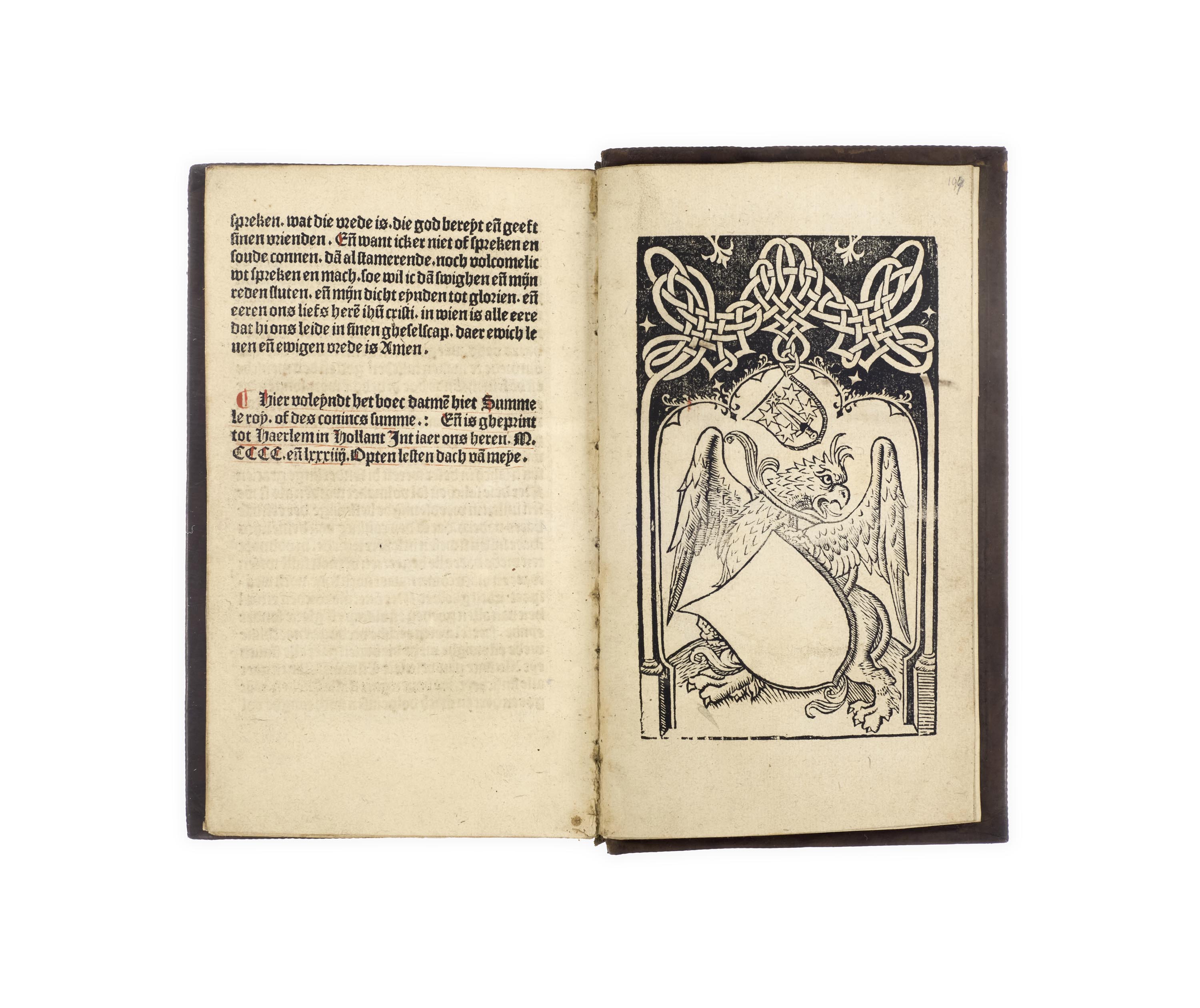
[Summe le roy of des conincs summe.] [(Colophon:) Haarlem, [Jacob Bellaert], 31 May 1484].
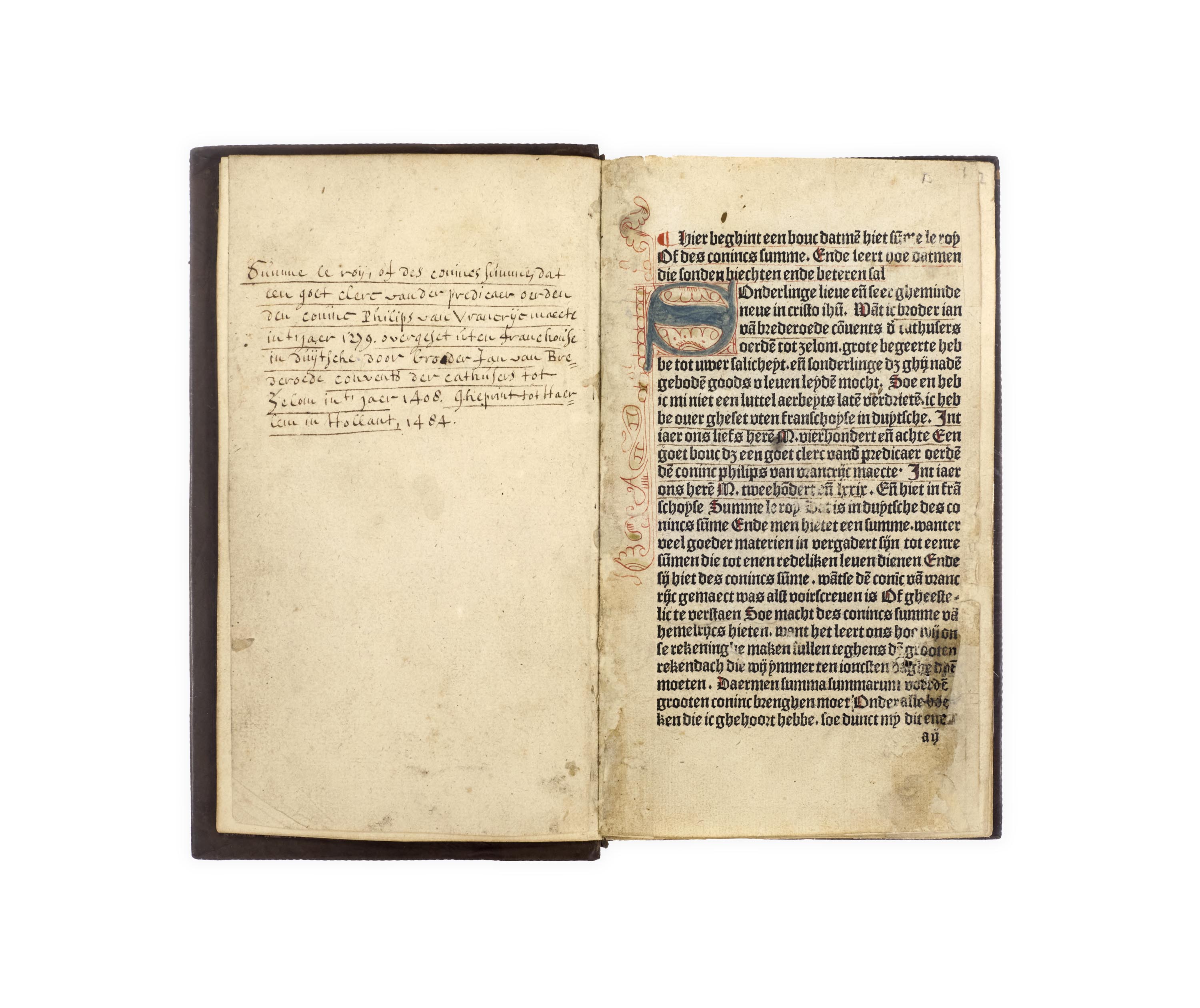
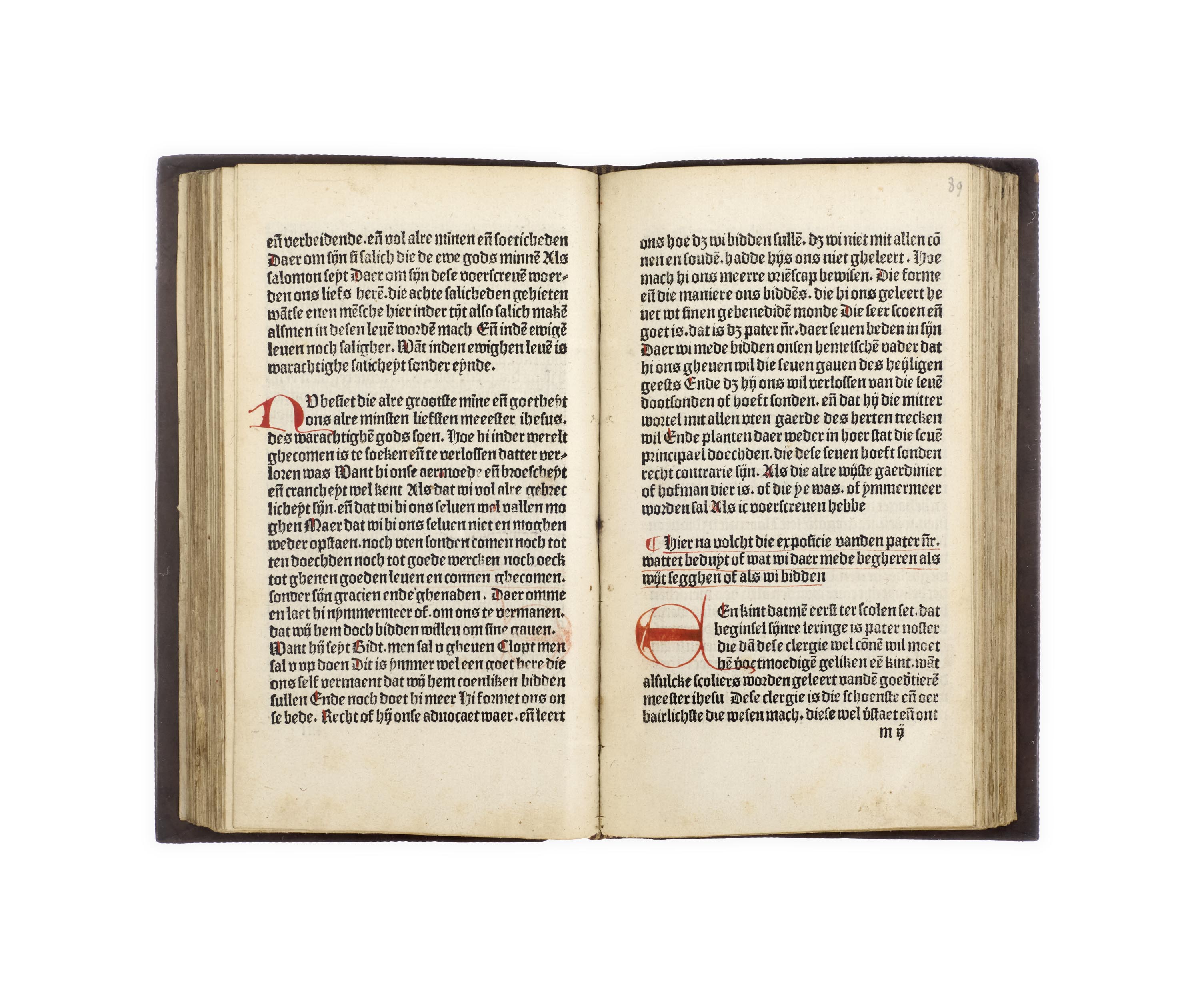
4to, ff. [199] (of 200); a–r8 [r]8 ſ8 s–y8 (without initial blank a1); textura letter, large woodcut printer’s device to final leaf, first initial in blue with red penwork decoration, other initials in red, red paraphs, underlining, and initial-strokes; small losses to a2 and old repairs to lower outer corners of quires a–d (occasionally affecting a few characters), old repairs to lower outer corners of i1–6, c. 20 leaves strengthened along inner margin, final leaf laid down, but a good copy; bound in late nineteenth-century calf, spine tooled in compartments in gilt and blind and lettered directly in gilt, marbled endpapers; very slightly rubbed with a few slight scuffs, corners a little bumped; eighteenth-century note in Dutch to verso of old front flyleaf, armorial bookplate of John Vertue (1826–1900) to front pastedown, paper shelf label to front board.
Rare early edition in Dutch (first Delft 1478), preceding the first edition of the original French text, of what is perhaps the most significant treatise on Christian morality for the laity from the later thirteenth century. This edition was produced in the first printshop in Haarlem.
The author, also known as Laurent d’Orléans, was a Dominican priest and confessor to Philip III of France, for whom he composed this vernacular treatise of Christian moral behaviour in 1279. His Somme des vices et vertus aimed to encourage the reader to examine their sins in detail in preparation for confession; after two sections on the Ten Commandments and the Creed, Laurent describes the vices and virtues along with the seven deadly sins; to conclude, he sets the seven heavenly virtues against the seven deadly sins. Unusually, he drew on contemporary secular and chivalric literature as well as the more usual Christian and biblical sources, another indication that he was writing for the laity, not for fellow clerics.
The translation was partly by Jan van Brederode, and partly by an anonymous translator; this is the fourth Dutch printing, after editions in Delft (1478 and 1482) and Hasselt (1481). It was subsequently translated into English by William Caxton and printed in Westminster in c. 1486, though the original French text was first printed by Antoine Vérard in only c. 1488.
Jacob Bellaert was the first printer in Haarlem, active between 1483 and 1486; he had previously worked for Gerard Leeu in Gouda, whose output similarly focused on illustrated works in the Dutch vernacular. Bellaert is known to have printed sixteen books in Dutch and two in French, including several translations of works that were in circulation at the Burgundian court, including Guillaume de Digulleville’s Pelerinage de la vie humaine and Raoul Lefèvre’s L’Histoire de Jason and Recueil des histoires de Troie. The latter two were printed in both Dutch and French by Bellaert, and he may have done some translation himself; this provides another connection with William Caxton, who was simultaneously producing his own translations of these works (probably from both French and Dutch versions) for the English market. Caxton, however, seems to have found a larger market for his works than Bellaert, who ceased production after just a few years, likely because Haarlem did not provide a sufficient number of buyers for his more expensive books.
The rubrication was most likely carried out in the printshop, as it is identical to the rubrication found in other copies of this edition.
ISTC lists only eighteen holding institutions, of which only one in the US (Brown) and three in the UK (BL, Bodley, CUL).
HC 9952; BMC IX 114; GW M17243; Goff L90; ILC 1413; BSB-Ink L065; Bod-inc L-048; ISTC il00090000. See de Bruijn, Vernacular books and their readers in the early Age of Print (c. 1450–1600) (Leiden, 2023), p. 229 ff.