A Quintet of Saints
[LECTIONARY.]
Northeast Spain?, 2nd half of the 12th century.
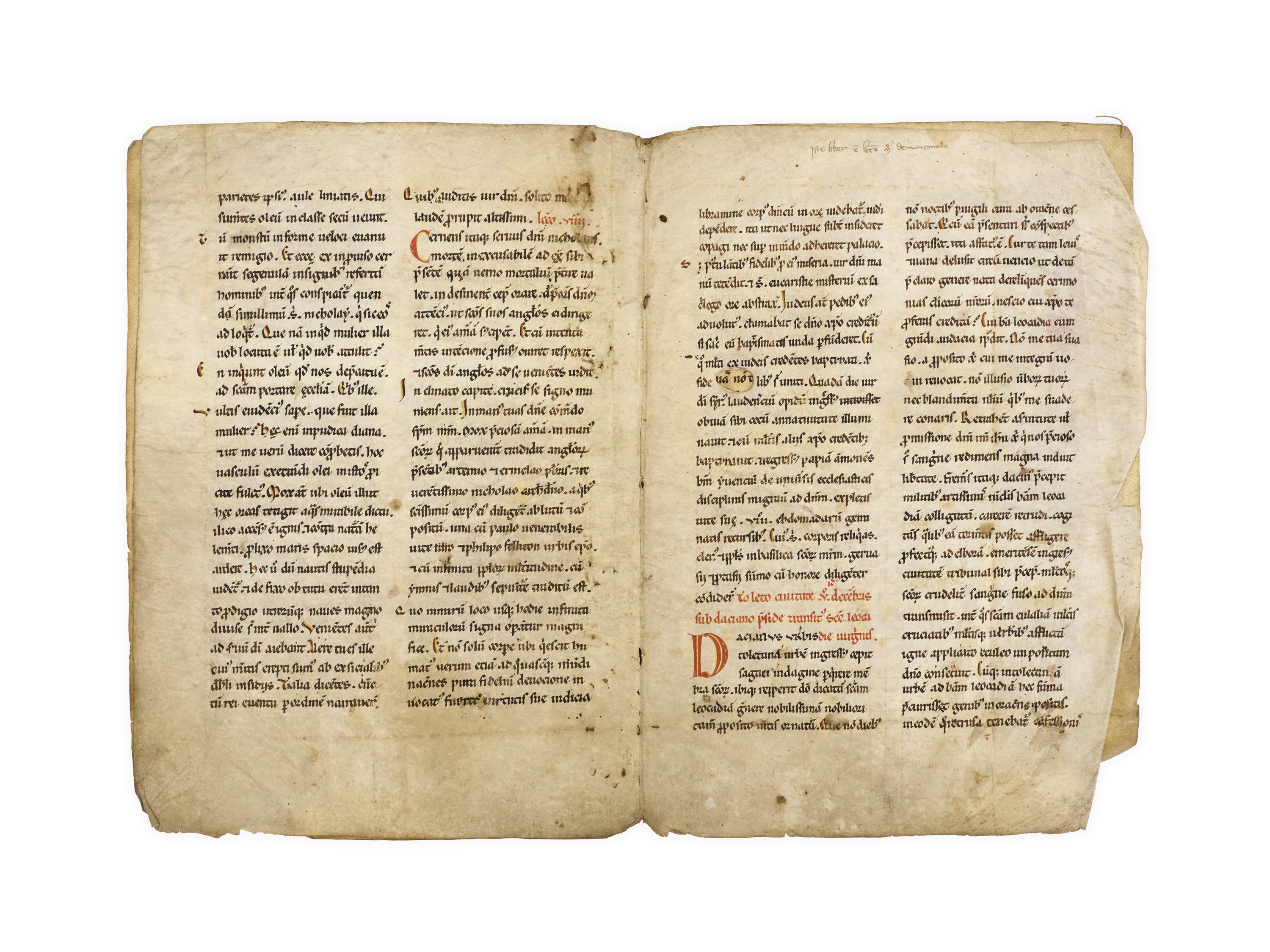
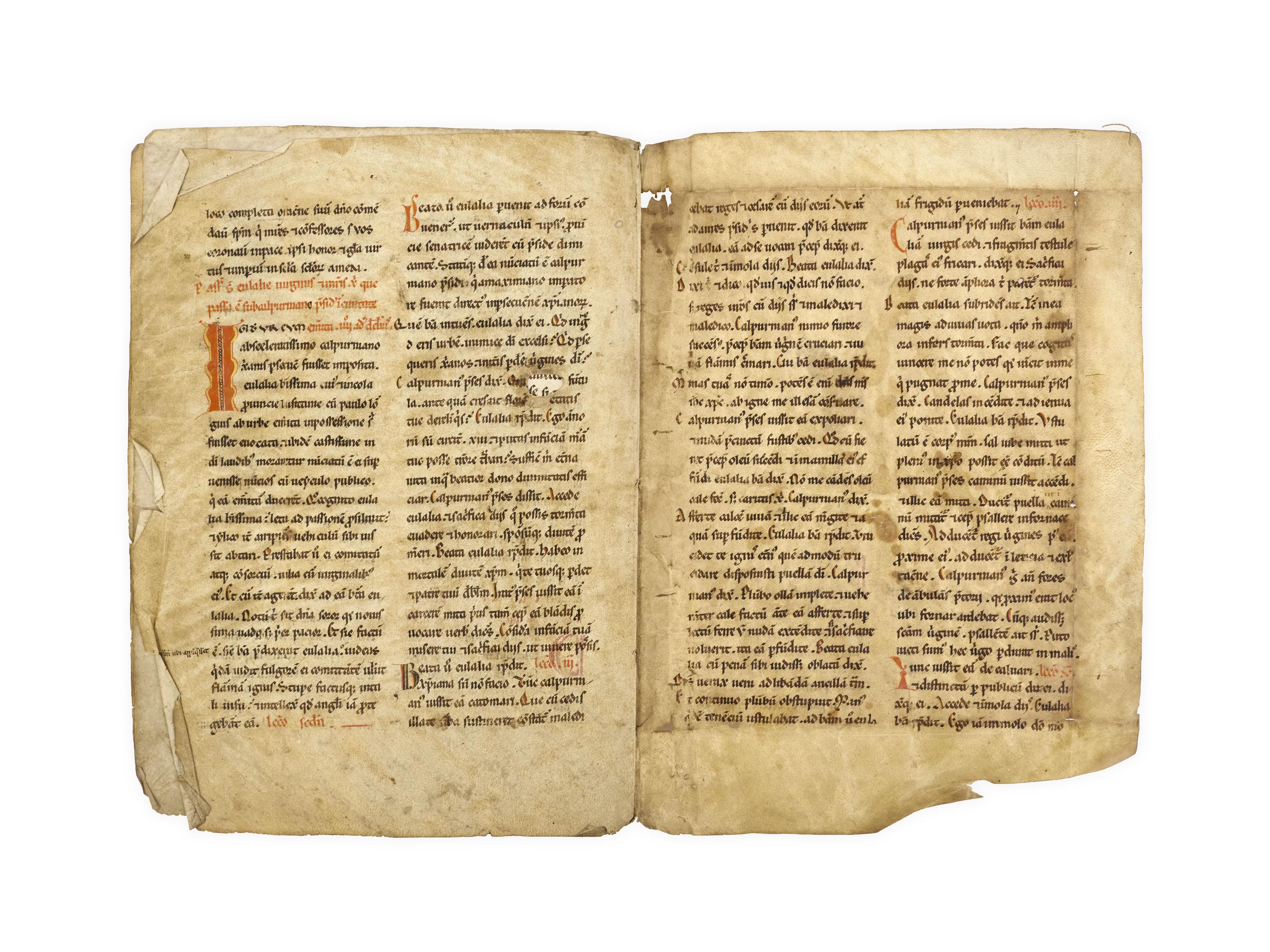
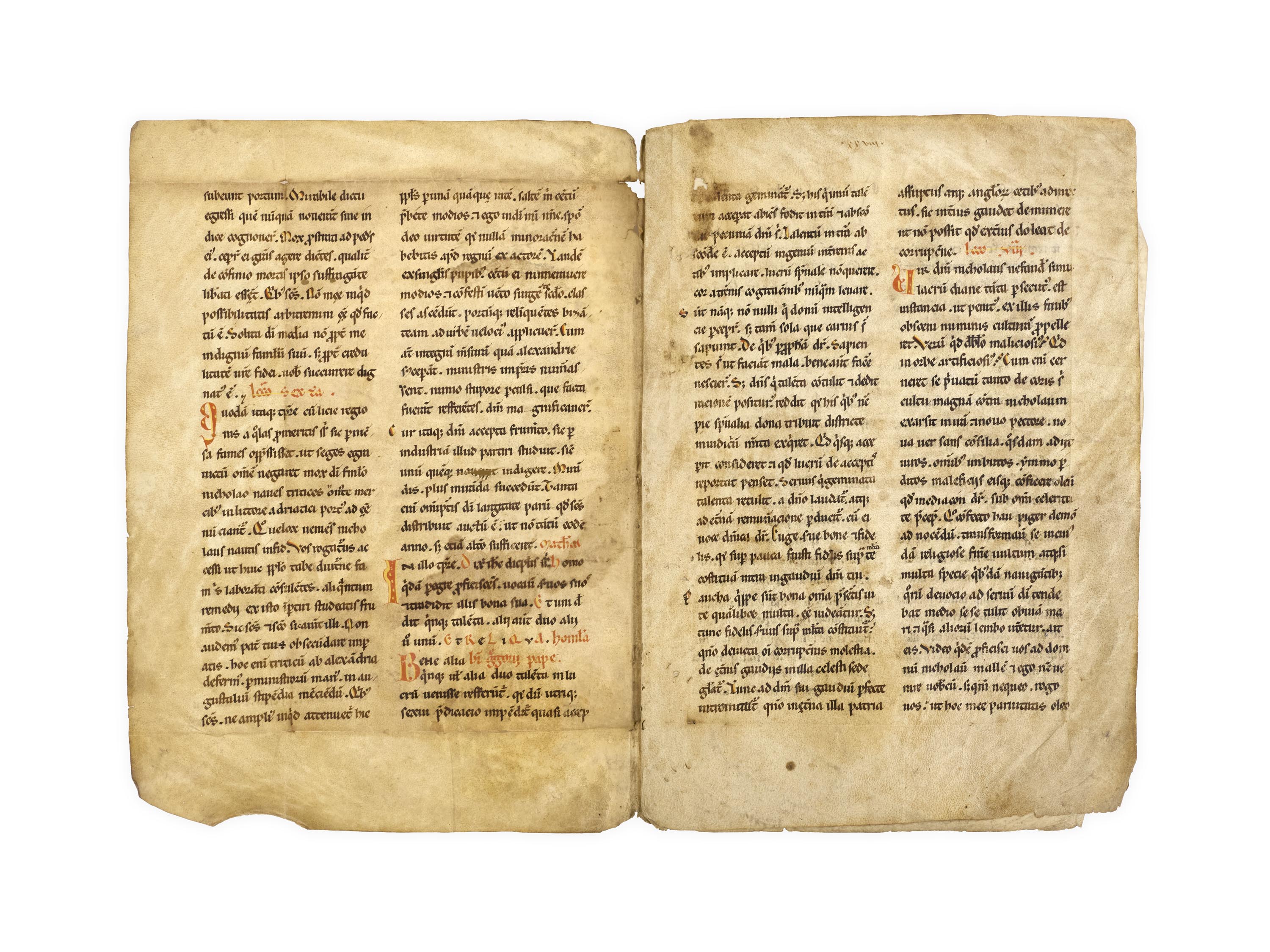
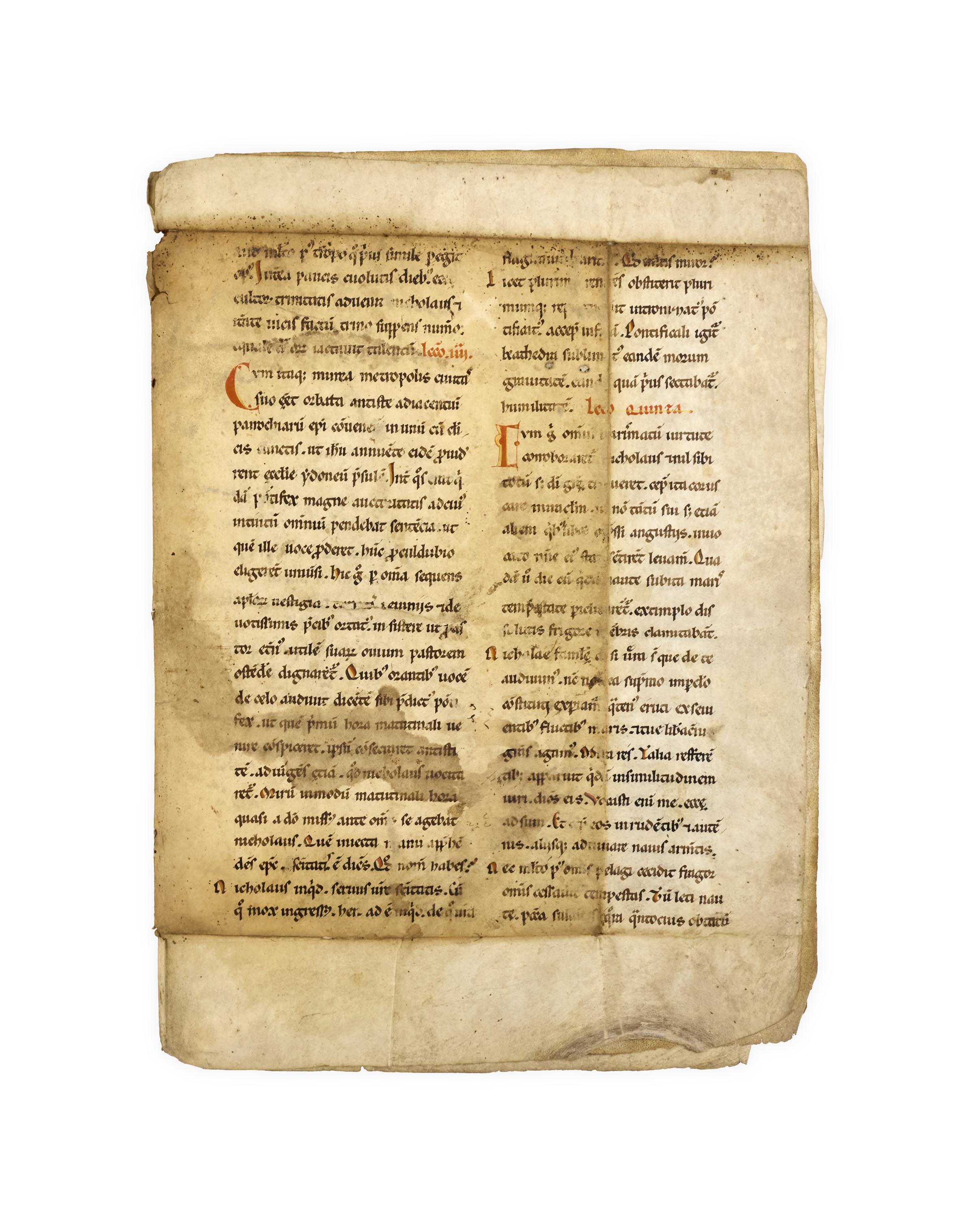
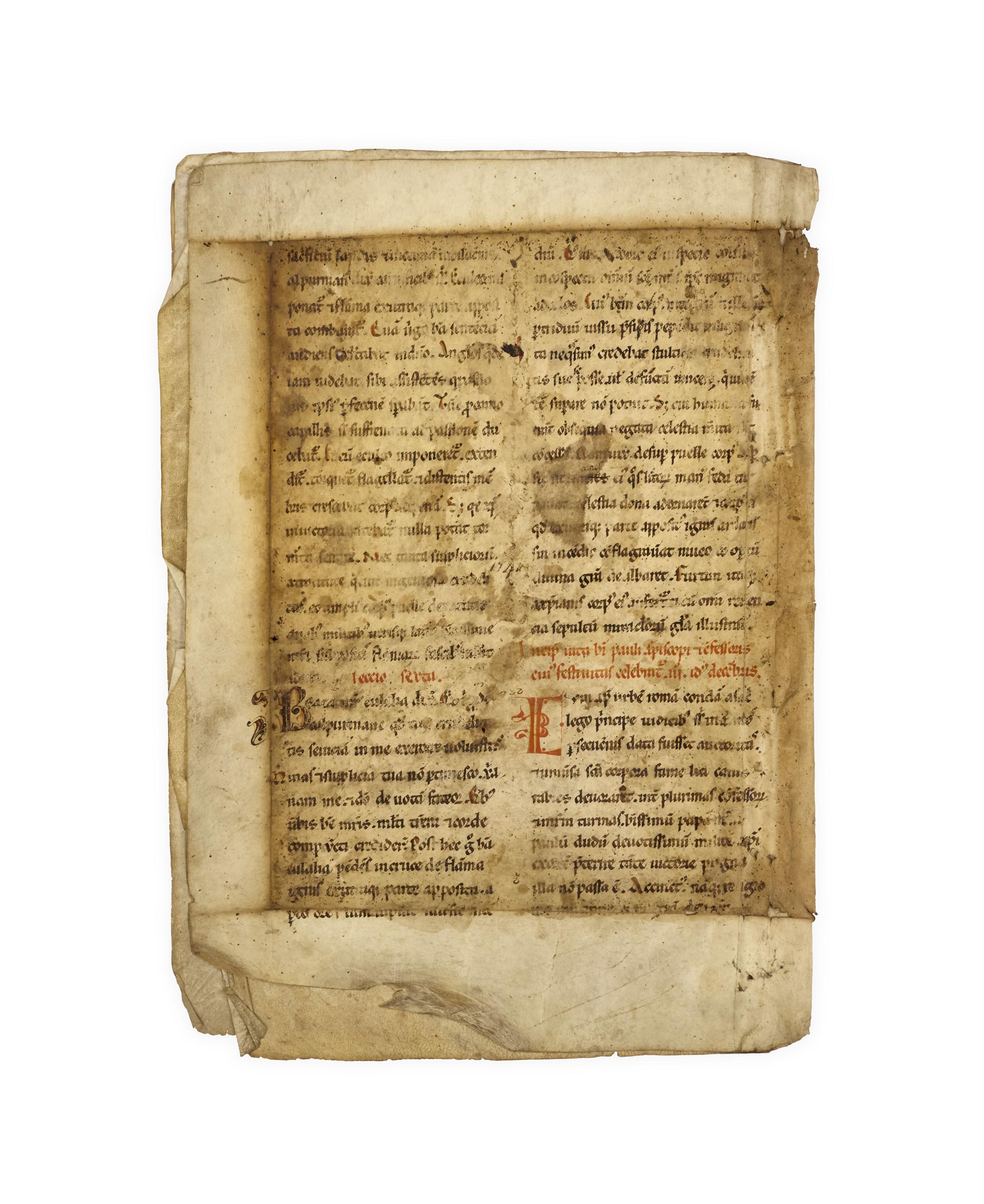
Two complete bifolia i.e. 4 leaves (leaf size c. 410 x 295 mm, text area c. 310 x 230 mm), the first two and the second two leaves consecutive, written in double columns of 28 lines in dark brown and red ink in a fine protogothic hand, ruling not evident but pricking visible to some margins, 1 five-line initial, 2 three-line initials, and 10 two-line initials in red and yellow, 2 further two-line initials in brown and red, smaller initials set out into margins, capitals touched in red and yellow, rubrics, a few rustic capitals; recovered from use as a wrapper, the outer pages browned and with some damp-stains, the last page rubbed, some creasing from folding, small holes and marginal tears, oval paper-flaw to third leaf; overall well preserved; fourteenth-century(?) ownership inscription at head of third leaf ‘Iste liber e[st] b[ea]te m[ari]e demartruolo(?)’ (Martorell perhaps?), foliation to second leaf in the same hand ‘xxviii’, faint eighteenth-century inscription to central margin of last page.
Four leaves from a large and handsome twelfth-century lectionary with readings from the lives of St Nicholas, St Ambrose, St Leocadia of Toledo, St Eulalia of Mérida, and St Paul of Narbonne, whose feasts fall between the 6th and the 11th of December.
The passages on St Nicholas come from the late ninth-century biography of John the Deacon of Naples and describe two miracles attributed to the saint. In the first, Nicholas teleports to the aid of a group of sailors caught in a raging storm; and in the second he supplies life-saving wheat to the inhabitants of famine-hit Lycia, the sailors whom he convinced to donate it later finding their cargoes miraculously replenished; small wonder he is the patron saint of sailors. These readings flank part of Gregory the Great’s homily on the Parable of the Talents in Matthew 25.
Two Spanish female saints follow, firstly St Leocadia of Toledo (feast 9 December), who was martyred during Diocletian’s persecution by the prefect Dacianus, and secondly St Eulalia of Mérida (10 December), the account of her martyrdom opening here with a striking five-line initial ‘I’ (Igitur) in red and yellow. The text describes how the thirteen-year-old repeatedly refused to renounce her Christian faith despite the brutal tortures inflicted upon her by Calpurnianus and his soldiers, throughout which she taunted her tormenters. The final reading describes how a dove flew from her mouth as she expired, a miraculous snow falling to cover her injured body.
The other two saints briefly represented here are St Ambrose of Milan (7 December) and the less well-known St Paul of Narbonne, whose feast day is here assigned to 11 December.
Notable features of the script include the consistent use of the Tironian ‘et’ sign in close proximity to the following word. Distinctive spellings include ‘kathedra’, ‘paucha’, and ‘veyculo’.