Santa Claus Burned as Heretic
LEVI-STRAUSS, Claude.
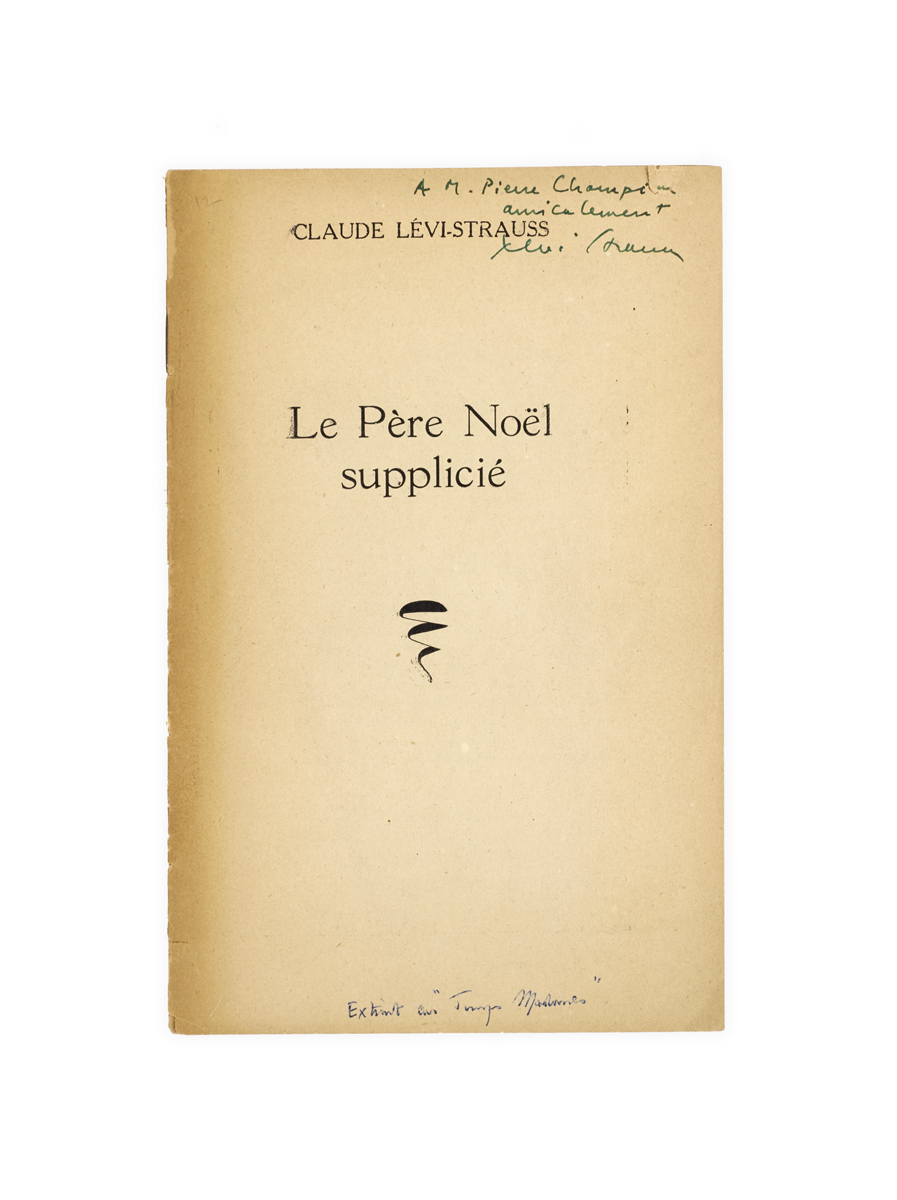
Le Père Noël supplicié. [Paris, Chantenay, 1952.]
8vo, pp. 21, [3]; light uniform browning; stapled as issued in the original printed wrappers; a few chips to spine and upper corner, front cover partially detached; manuscript correction in green ink to p. 19, presentation inscription to title ‘A M. Pierre Champier amicalement’, signed ‘Levi Strauss'.
Rare first separate appearance, a presentation copy, of Lèvi-Strauss’s article ‘Father Christmas tortured’, an ethnological analysis of French ecclesiastical authorities’ disapproval of the ‘paganisation’ of Father Christmas, describing the hanging and burning of an effigy at Dijon just before Christmas in 1951.
‘Le Père Noël supplicié’ first appeared in Les Temps modernes 77 (1952), pp. 1572–1590. In 1951, the press was awash with articles about the concerns of the Church over the growing importance placed on Father Christmas, arguing that making him the focal point of the holiday season distracted from the Christian significance of Christmas. Lèvi-Strauss (1908–2009) includes an extract from the France-Soir despatch at the time: ‘Father Christmas was hanged yesterday afternoon from the gates of Dijon Cathedral and burned publicly in the square. This spectacular execution took place in the presence of several hundred children from the parish youth groups … He had been accused of paganising the Christmas celebration and of having established himself within it like a cuckoo … He is especially guilty of having infiltrated public schools, from which nativity scenes are strictly banned’ (trans.).
Lèvi-Strauss discusses the impact of capitalism on Christmas festivities in post-war France – here seen as a direct consequence of the influence of the United States – and assesses the history of the Christmas tree, mistletoe, and other phenomena now associated with the holiday. Father Christmas ‘is not a mythical being … nor is he a legendary figure … This supernatural and immutable being, eternally fixed in form, belongs more to the family of deities; he is, moreover, worshipped by children at certain times of the year in the form of letters and prayers; he rewards the good and punishes the wicked … The only difference between Santa Claus and a true deity is that adults do not believe in him, although they encourage their children to believe in him and maintain this belief through a great many mystifications’ (trans.).
No copies traced in the US or the UK. OCLC records only two copies, at the Universidad de Deusto in Bilbao and the Institut d’ethologie in Neuchâtel.