Lucian for Jesuit Schoolboys
LUCIAN of Samosata; Étienne MOQUOT, editor.
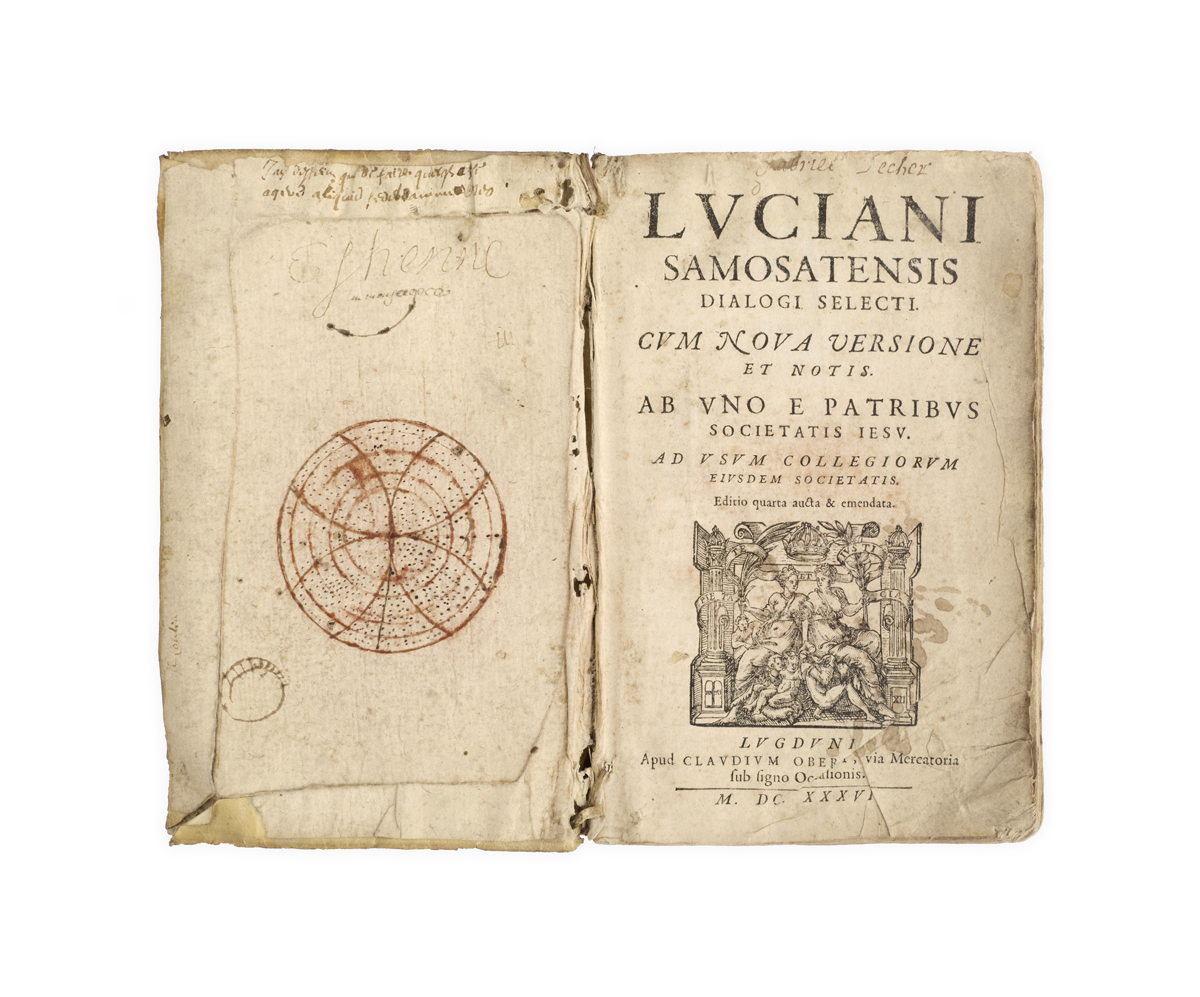
Luciani Samosatensis dialogi selecti. Cum nova versione et notis. Ab uno e patribus Societatis Iesu. Ad usum collegiorum eiusdem Societatis. Editio quarta aucta et emendata. Lyons, Claude Obert, 1636.
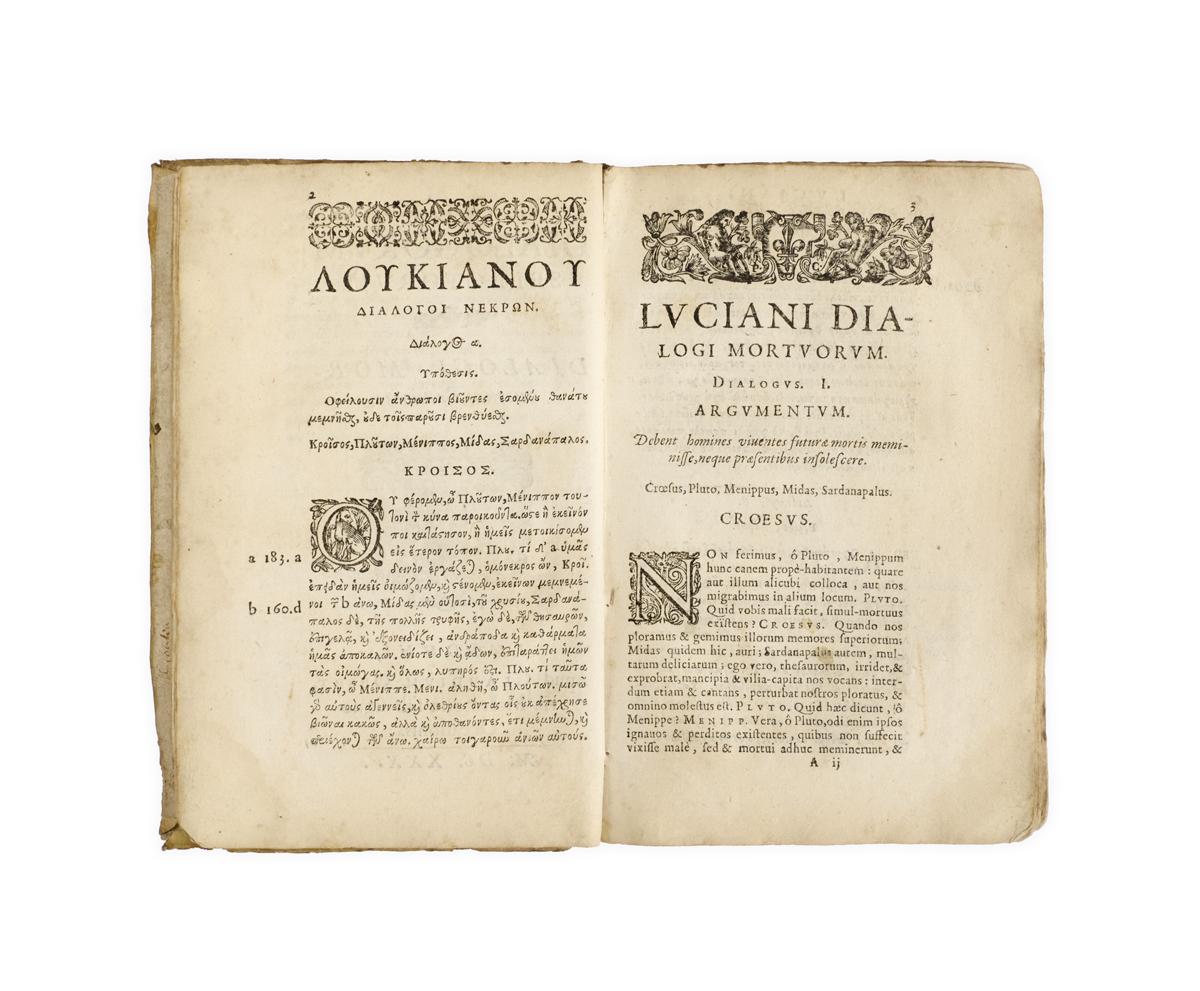
8vo, pp. [2], 5–16, 93, [4], 96–483, [5], [2 (blank)], wanting preliminary blank A1; printed in parallel Greek and Latin on facing pages; woodcut device to title, woodcut initials, head-, and tailpieces, divisional titles dated 1635; title-page creased and marked, small loss to lower margin of pp. 239–240, some light foxing and marginal dampstaining, some creasing to corners, a few small ink stains; bound in contemporary limp vellum; somewhat worn and marked; early ownership inscriptions of ‘Gabriel Lecher’ and ‘E. J. Henne’, some notes and circular drawings to endpapers, ‘Lechier’ written and burnt into top-edge.
Added to your basket:
Luciani Samosatensis dialogi selecti. Cum nova versione et notis. Ab uno e patribus Societatis Iesu. Ad usum collegiorum eiusdem Societatis. Editio quarta aucta et emendata.
Uncommon parallel Greek and Latin edition of selected dialogues by the second-century satirist Lucian, edited by the French Jesuit Étienne Moquot (1570–1625?) for use in Jesuit schools.
A native of Nevers, Moquot was apparently the first Jesuit to come from the town. He was particularly well versed in Greek and Latin and vocal against heretics. In addition to his Lucian (first published in 1621), which ran through numerous editions, he published a Greek grammar.
The text is arranged in three parts, comprising the Dialogues of the Dead (on the vanity of human wishes), Dialogues of the Gods (a reductio ad absurdum of traditional mythology), and selected other pieces, including some of his best-known works.
In this third part we find: Necyomantia/Menippus (the Cynic philosopher goes to the underworld); Charon (the ferryman of the dead comes up to earth to see what the life of man is like); The Downward Journey (a scene in the realm of Hades, showing that cobblers fare better there than kings); Timon the Misanthrope (a satirical look at wealth and the problems it brings); The Dream, or the Cock (a Cynic sermon in praise of poverty); Icaromenippus (Menippus goes up to heaven to learn the truth); How to Write History (the most extensive surviving work from antiquity on the theory of historiography); and Slander (on not being quick to put faith in it).
Outside continental Europe, we find two copies in the UK (BL, Glasgow) and two in North America (Thomas Fisher Library, Wofford College).
USTC 6904515; Sommervogel V, 1272.