
Renouard’s Copy
LUCIAN of Samosata.
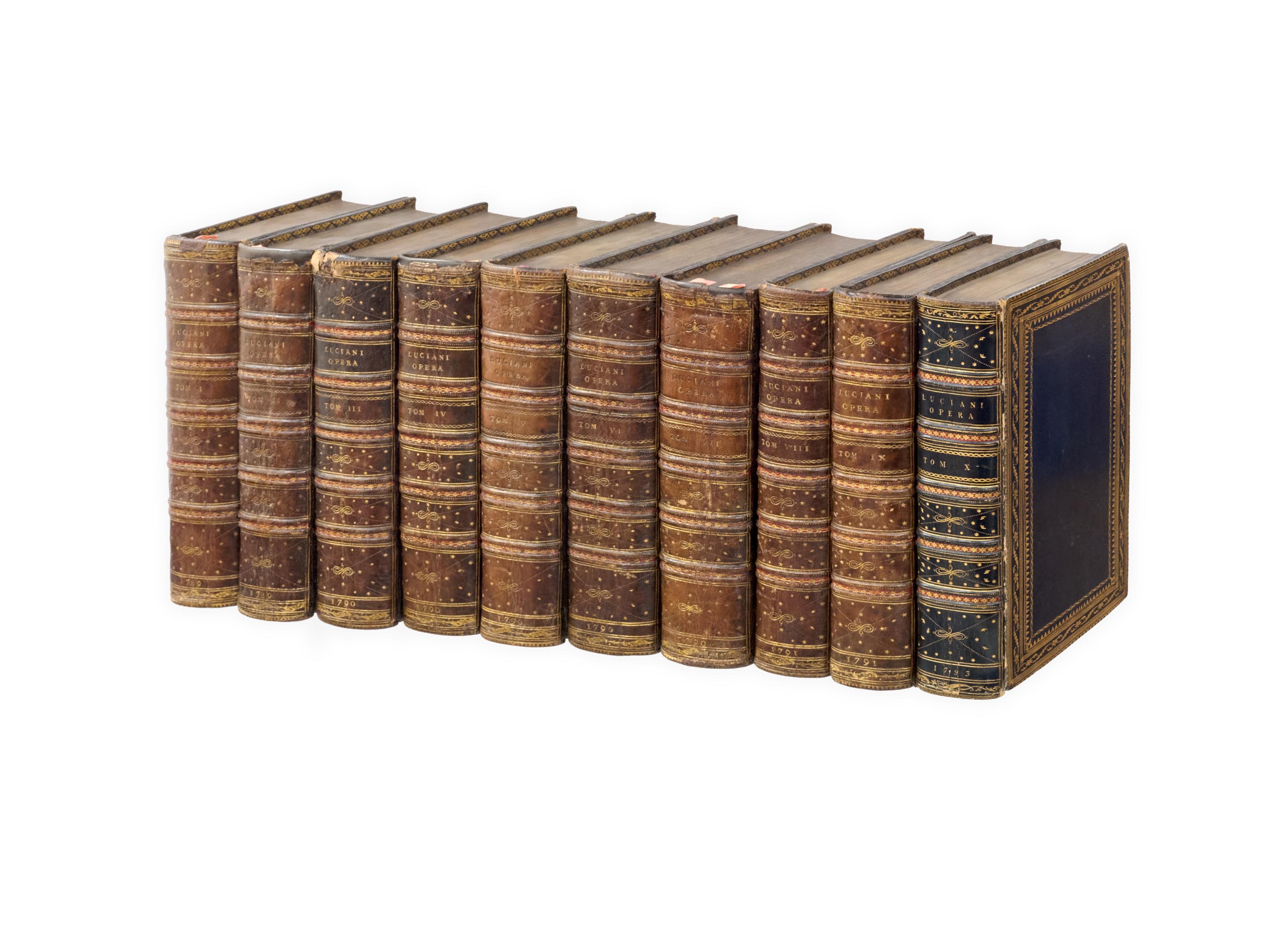
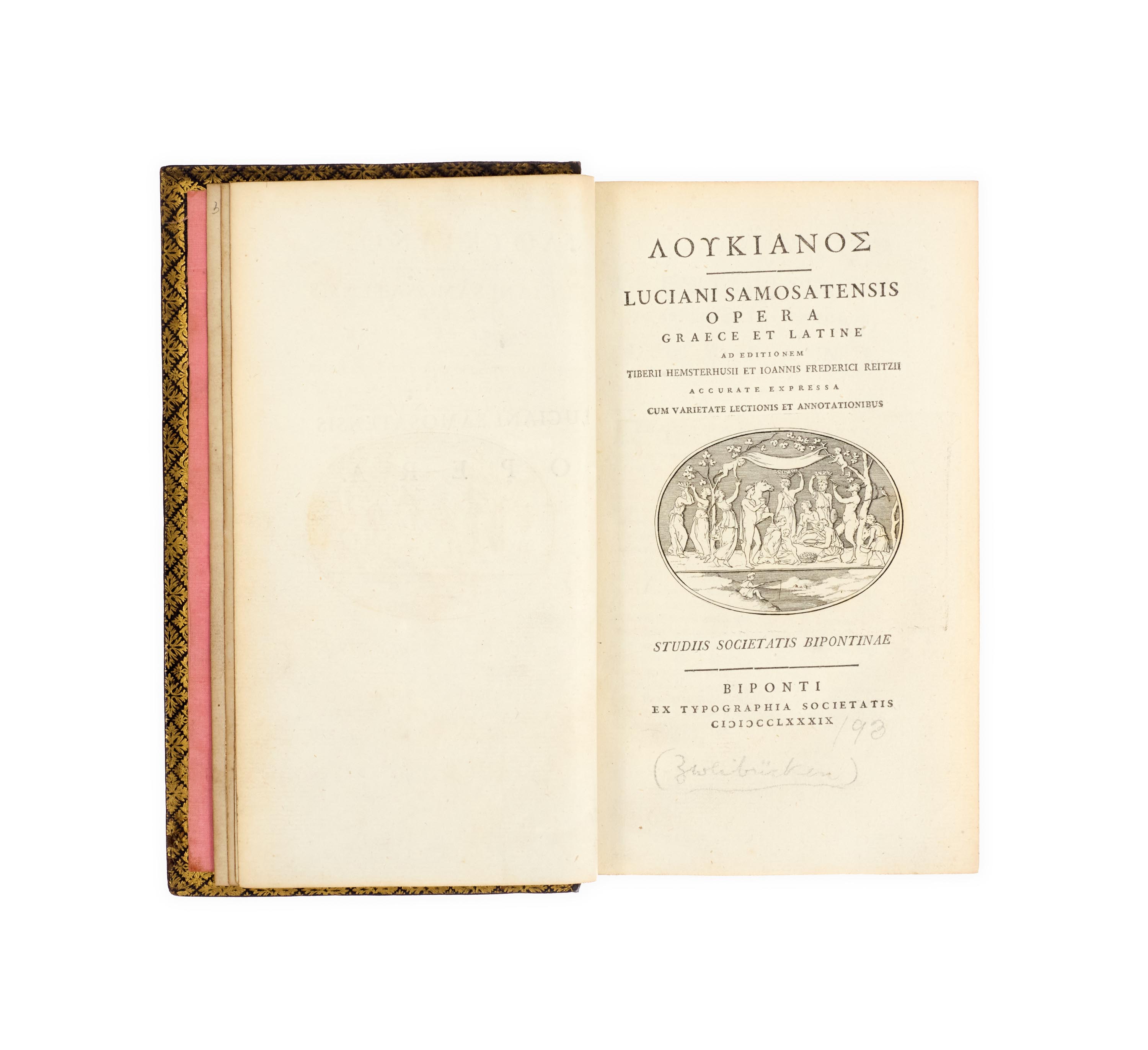
Opera graece et latine ad editionem Tiberii Hemsterhusii et Ioannis Frederici Reitzii accurate expressa cum varietate lectionis et annotationibus [– Accedunt variae lectiones MSS. Parisiensum]. Zweibrücken, Typographia Societatis, 1789–1793.
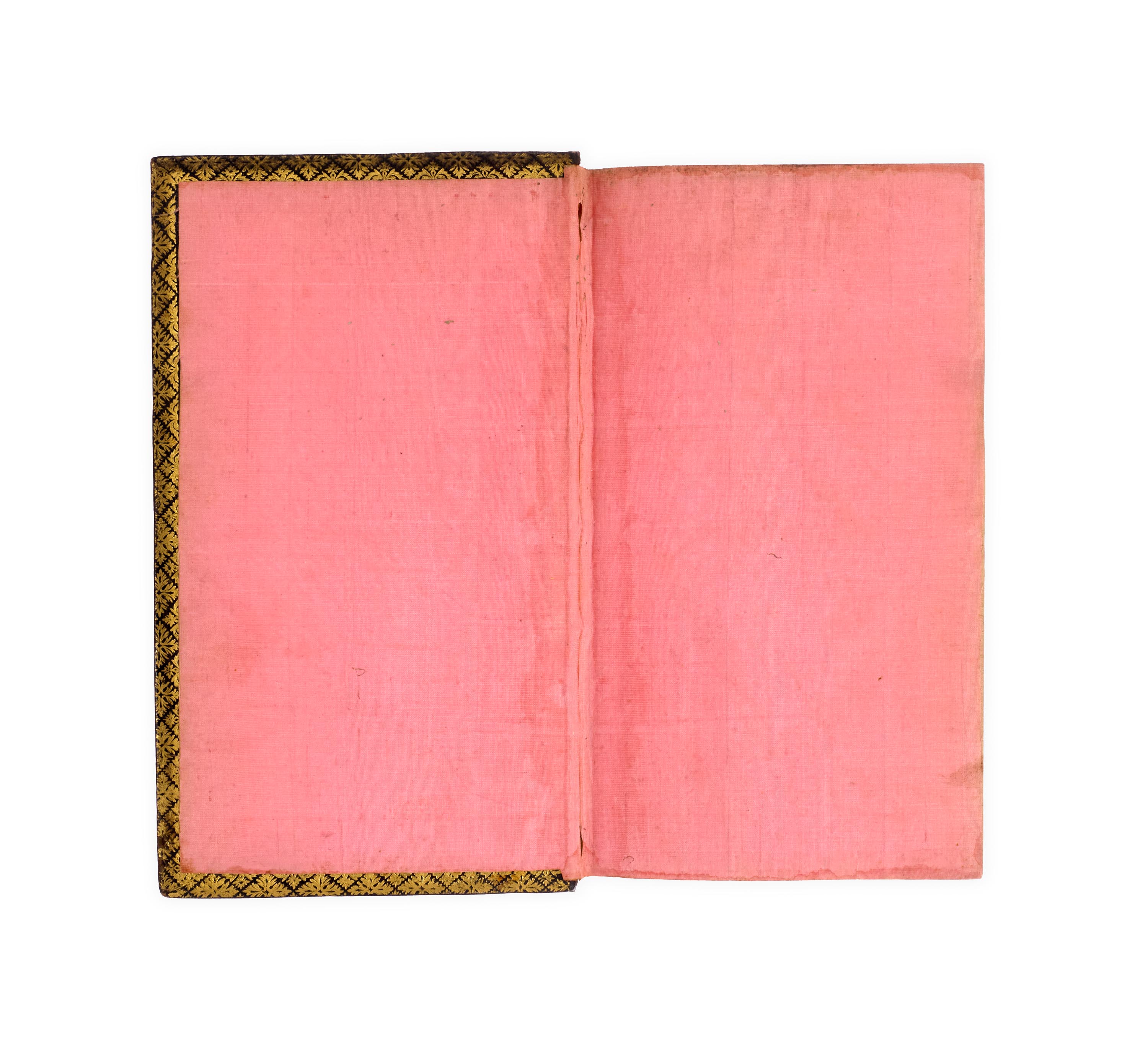
Ten vols, 8vo; text printed in Greek types, all apparatus in roman types, engraved Neoclassical medallions to the titles of vols I–IX; slight toning to titles, else an exceptionally clean, attractive set; vols I–IX bound in strictly contemporary dark blue morocco for A. A. Renouard, front boards lettered ‘Renouard’ in gilt within elaborate roll-tooled borders, spines gilt in compartments and lettered directly in gilt, gilt red morocco onlays between pairs of bands, board-edges and turn-ins gilt, edges gilt, pink silk endleaves and vellum flyleaves, pink silk placemarkers, volume X bound very slightly later (likely at the time of publication) to match vols I–IX and therefore in slightly different leather, all edges gilt; spines a little sunned, occasional light rubbing at extremities, repairs to headcaps of vols I–IV, VII, and IX and several headbands damaged (one renewed).
Added to your basket:
Opera graece et latine ad editionem Tiberii Hemsterhusii et Ioannis Frederici Reitzii accurate expressa cum varietate lectionis et annotationibus [– Accedunt variae lectiones MSS. Parisiensum].
Renouard’s copy of the Bipontine Lucian, the finest instantiation of the Hemsterhuys-Reitz edition, ‘the most accurate and complete edition of Lucian that has ever been published’ (Dibdin), made more accurate and extensive through reference to Parisian manuscripts which had never been published before.
Bipontium was the Latin name of Zweibrücken (or ‘Deux Ponts’), in the Rhineland-Palatinate. There in 1779 a society of editors and scholars led by Friedrich Christian Exter and Georg Christian Crollius began a series of publications which soon acquired renown as fine, correct, and endowed with generous apparatus.
A prodigiously inventive writer and a sceptical, powerful master of mockery, Lucian was immensely popular in antiquity and met with renewed popularity in the Renaissance through to the Enlightenment when his work – in Greek and then in vernaculars – began to be studied widely. He appears to have invented the genre of the comic dialogue; his satire A True Story is sometimes regarded as the earliest known work of science fiction, whilst his dialogue Lover of Lies, a critique of belief in the supernatural, is the oldest known version of the Sorcerer’s Apprentice. Read by early modern writers Europe-wide, his work exerted a profound influence on Erasmus, Thomas More (his Utopia in particular), Shakespeare (Timon of Athens), Voltaire, Rabelais, and Swift (Gulliver’s Travels).
Brunet III, col. 1208; Brunet, Supplément de Géographie, p. 187; Graesse IV, 278 (‘Exacte réimpression de l'édition de Reitz (1746), mais accompagnée d’un Index à la place d’un lexique et avec des variantes tirées des Mss. de Paris par Belin de Ballu’); Quérard V, 389; Renouard, Catalogue des livres de fonds, 466.