Charity Is Luxury. Interest as an Argument for Frugality
MACKENZIE, George.
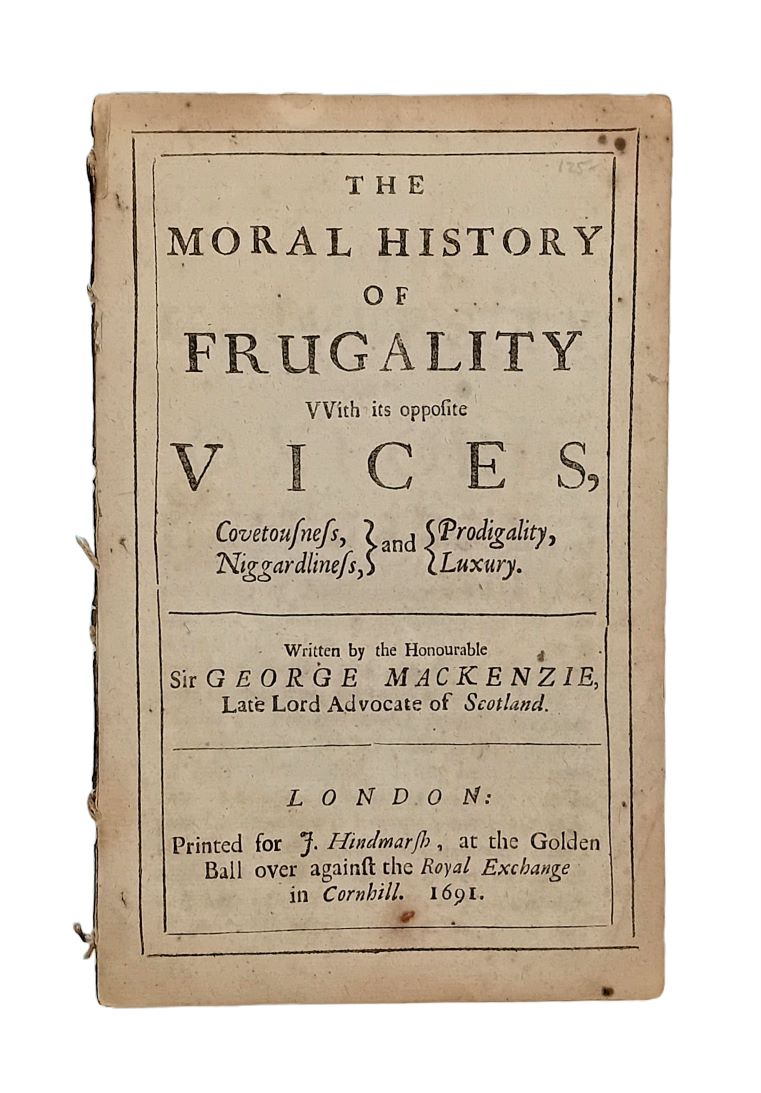
The moral history of frugality with its opposite vices, covetousness, niggardliness and prodigality, luxury. London, Hindmarsh, 1691.
8vo, pp. [8], 95, [1, advertisements]; preliminary imprimatur leaf loose but present, a few leaves coming loose; extremities toned, spotted in places, else a good copy, trimmed and disbound.
Added to your basket:
The moral history of frugality with its opposite vices, covetousness, niggardliness and prodigality, luxury.
First edition, rare; an Edinburgh edition followed in the same year. Mackenzie settled in Oxford before dying in 1691, and this posthumous work opens with his paean to the University and the Bodleian. It concludes with Thomas Glegg’s Latin epitaph.
Mackenzie’s treatise is in the simplest terms an argument against overspending, whether this be by private individuals or governments, with a view to sound investment. If a man goes beyond his means by slight luxuriousness he loses far more than he initially might think; the accrual of interest on the small amount he has misspent means that in a number of years that small loss will have grown into a significant one. Mackenzie applies this to property: a man who thinks his house proportionate to the size of his estate will find that in ten years the house has grown in value to equal the capital of the entire estate. The moral flipside of this argument is Mackenzie’s study of selfishness and charity, which he counts as just another symptom of luxury. He warns that would-be philanthropists must only give away money they can afford to spare, and almost begrudgingly praises Oxford for its voluminous but careful beneficence: ‘I know that you of all men, with greatest reason, think yourselves rather stewards than proprietors of benefits, being you reckon the wants of those who are in distress among your principal debts … and after I had calculated what you have of late bestowed upon the exiled French Protestants, the fugitive Irish, and the starving clergy of your own profession in Scotland … I could not but admire how even frugality itself could have made you live with that neatness I observed among you’.
Ferguson 54; Wing M 179; Goldsmiths’ 2913.