[MAILLY DE NEELE, Charlotte de, Princess of Nassau-Siegen.]
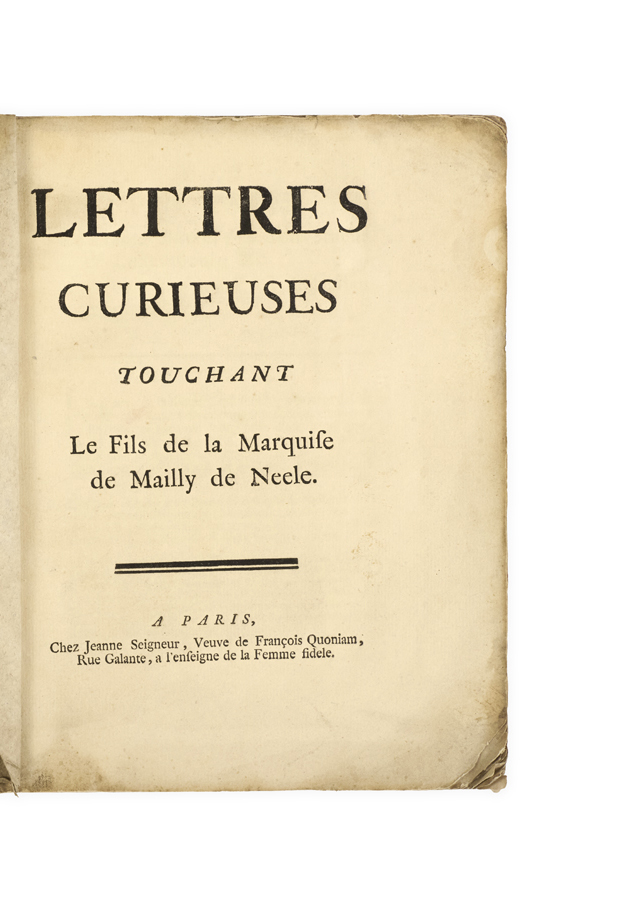
Lettres curieuses touchant le fils de la marquise de Mailly de Neele. ‘Paris, Jeanne Seigneur, veuve de François Quoniam, rue Galante, a l’enseigne de la femme fidele’, [not before 1753].
4to, pp. 32; corners worn and creased with small losses to first leaves, occasional light marks and some browning to edges, but a very good copy; stab-stitched in contemporary marbled wrappers, small paper label to front wrapper; wrappers worn and frayed.
Added to your basket:
Lettres curieuses touchant le fils de la marquise de Mailly de Neele.
Rare collection of letters and documents concerning the scandal surrounding the allegedly illegitimate son of Charlotte de Mailly-Nesle, Princess of Nassau-Siegen, with the false imprint of an unfortunately named widow.
Charlotte de Mailly-Nesle (1688–1769) was married in 1711 to Prince Emmanuel Ignatius of Nassau-Siegen (1688–1735), a Knight of the Order of the Golden Fleece who had served in the Spanish army and later became a colonel in the Austrian army, and separated from him in 1716. She moved to Paris and, in 1722, gave birth to Maximilian William Adolph, a son whom Emmanuel Ignatius initially recognised as his own but later rejected as illegitimate, accusing his wife of adultery from his deathbed. The dispute over his legitimacy continued for over two decades, even after Maximilian’s death in 1748: Charlotte succeeded in having her son recognised by Clement XII – appealing to his concern that Nassau-Siegen would otherwise fall to a Protestant line – and by the French court, but the claim was rejected by the Holy Roman Emperor and ultimately failed.
The present work gathers various documents relating to the case, including the correspondence of Emmanuel Ignatius with his relative the Count of Autel regarding his plans to disinherit Maximilian, a letter from the Holy Roman Emperor and the Resolution of the Aulic Council rejecting the claim of Maximilian, his (several) baptismal certificates, and the declaration of Emmanuel Ignatius that he had left no legitimate child upon his death. It appears under a fittingly false imprint, as ‘Jeanne Seigneur, widow of Francis Quoniam, on Flirtation Road, at the sign of the faithful woman’ (loosely trans.). Although a Latin word with learned associations, ‘Quoniam’ took on the same meaning in French as in English (cf. Chaucer’s Wife of Bath), appearing in Le Roux’s slang dictionary as ‘Mot inventé, pour signifier à mots couverts la nature d’une femme, & est fort usité à Paris’ (vol. II, p. 373).
OCLC does not record any copies outside the Netherlands and Belgium.
Not in Brunet, Imprimeurs imaginaires. See Le Roux, Dictionnaire comique, satyrique, critique, burlesque, libre et proverbial (1786).