The Pursuit of Private Interests Creates Social Benefits – or Does It?
MANDEVILLE, Bernard.
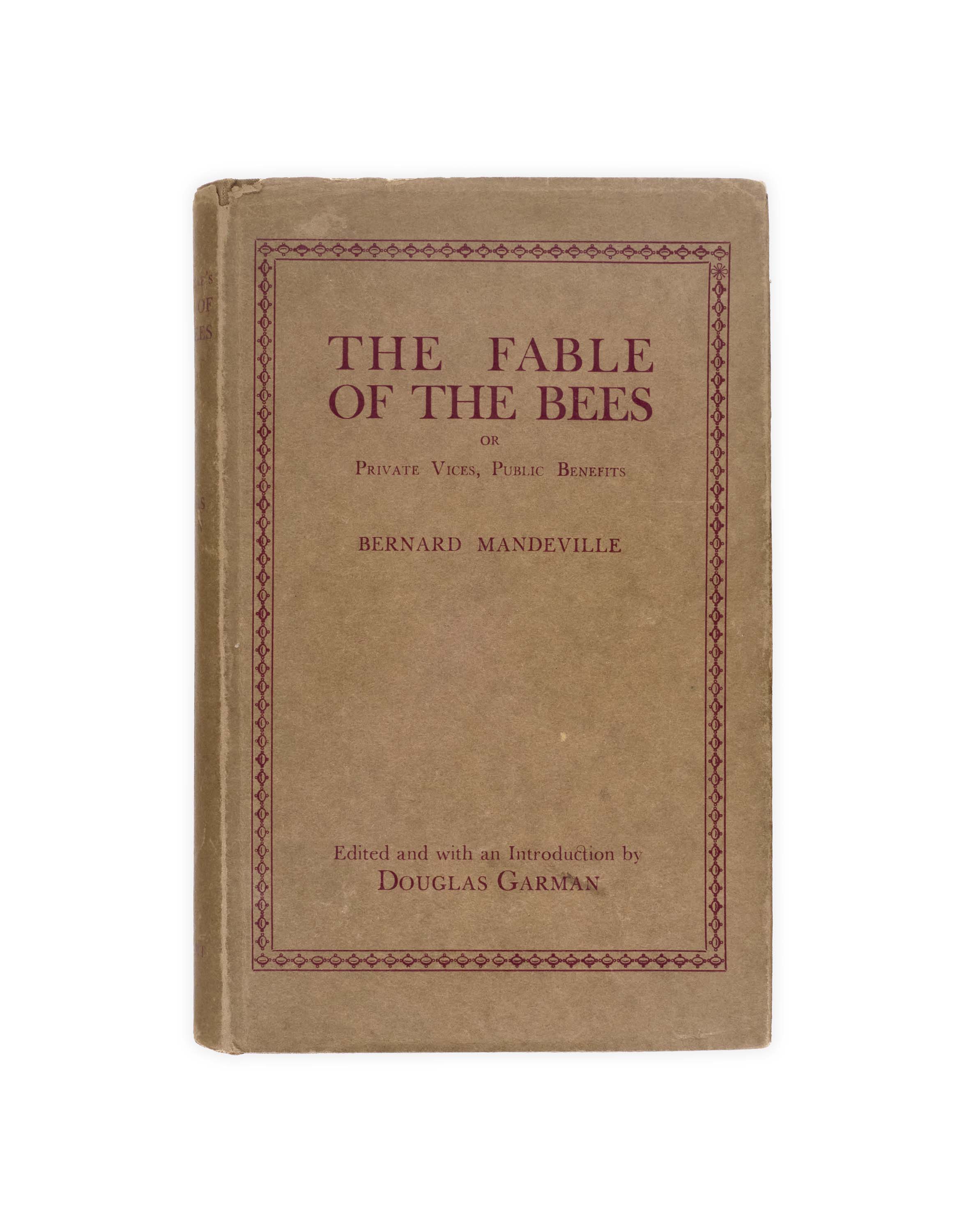
The Fable of the Bees, or Private Vices, public Benefits. Edited and with an Introduction by Douglas Garman. London, Wishart and Co., 1934.
8vo, pp. [viii], 256, [2, blank]; edges and endpapers a little foxed, but a very good copy in the original publisher’s beige quarter cloth preserving the original dust jacket; dust jacket with very minor chips at head of spine; ownership inscription to front free endpaper (Tony Inglis, Sussex 1965); a few very light pencil marks to the text.
Added to your basket:
The Fable of the Bees, or Private Vices, public Benefits. Edited and with an Introduction by Douglas Garman.
First edition thus. Mandeville’s Fable of the Bees was first published as a poem in 1705, entitled The Grumbling Hive, or Knaves Turned Honest, which is printed in this edition as first text, and later expanded into a prose work entitled The Fable of the Bees; or, Private Vices, Publick Benefits. Mandeville establishes an analogy between human society and a beehive, to illustrate a core contention that ‘private vices’, such as self-interest or greed, can lead to public benefits and contribute towards a flourishing society. This was a radical overturning of the notion of virtue, and caused controversy. Yet Mandeville’s work influenced thinkers such as Francis Hutcheson, David Hume and Adam Smith, leading to the development of ideas about division of labour and free market.
Douglas Garman was educated at Gonville & Caius College, Cambridge. He spent the 1920s between London and Paris and was in Leningrad in 1926. ‘From 1930–1940 he worked for the publishers Lawrence and Wishart, including a period as editor of The Modern Quarterly. He had strong left-wing sympathies, and from 1940 to 1950 held the position of head of the Communist Party’s education programme. His opinions came to be in disagreement with the Communist Party, and he retired to a farm in Dorset, where he continued to write and translate’ (University of Nottingham Mss. and Special Collections).