'Go and Work in the Stables!'
Rhyming Rivals and the Power of the Poet
MARINO, Giambattista; Gasparo MURTOLA.
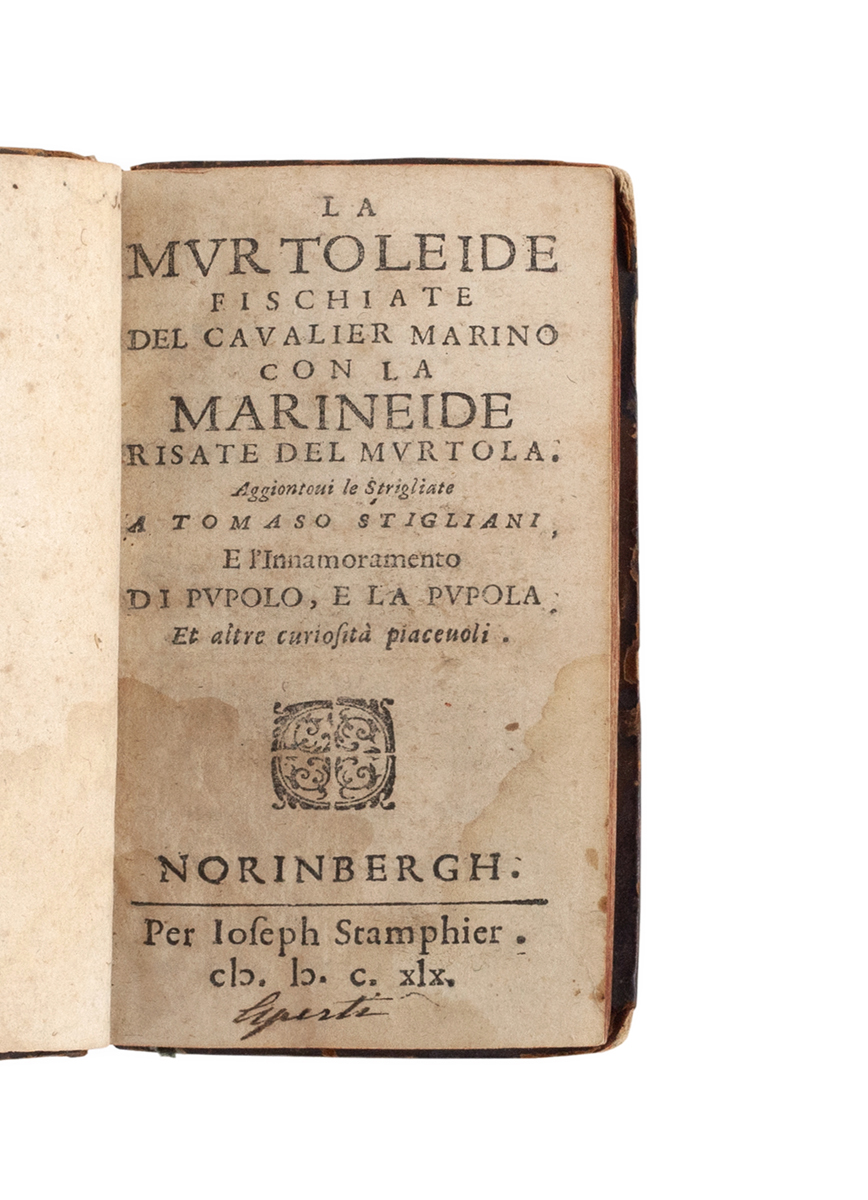
La Murtoleide fischiate del cavalier Marino con la Marineide risate del Murtola. ‘Norinbergh’ [i.e. Venice], Ioseph Stamphier, 1619.
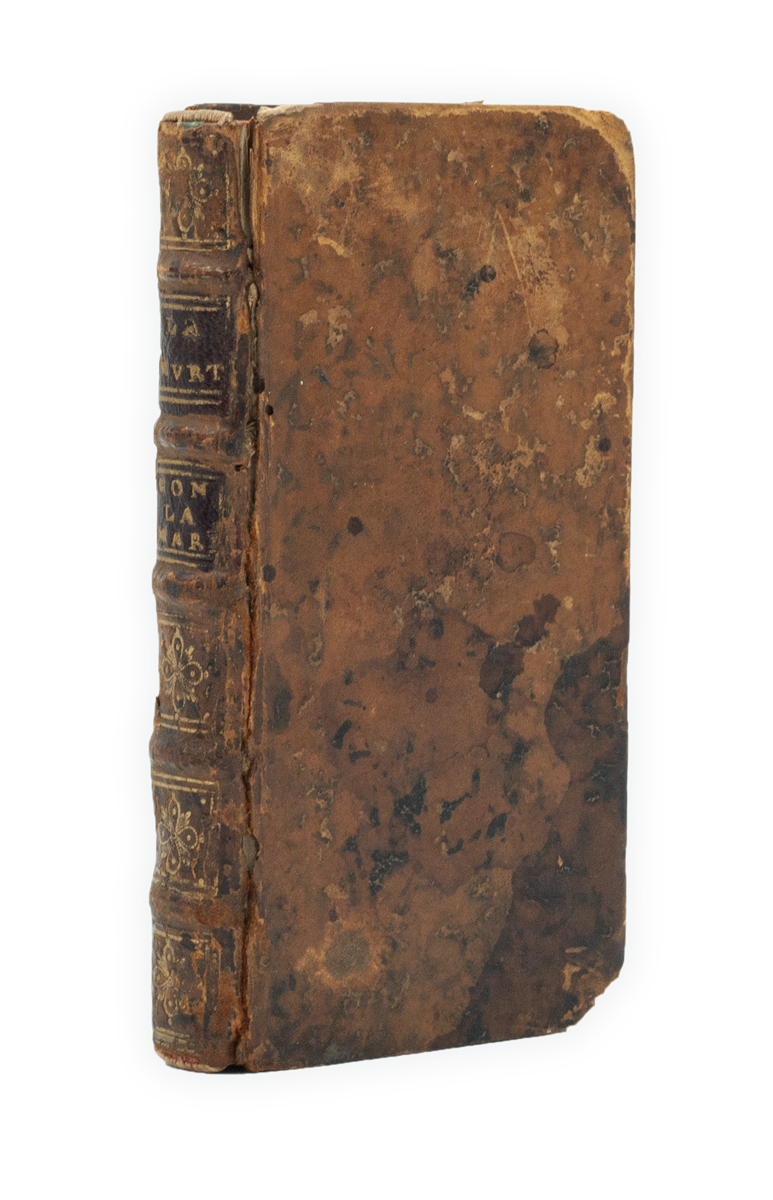
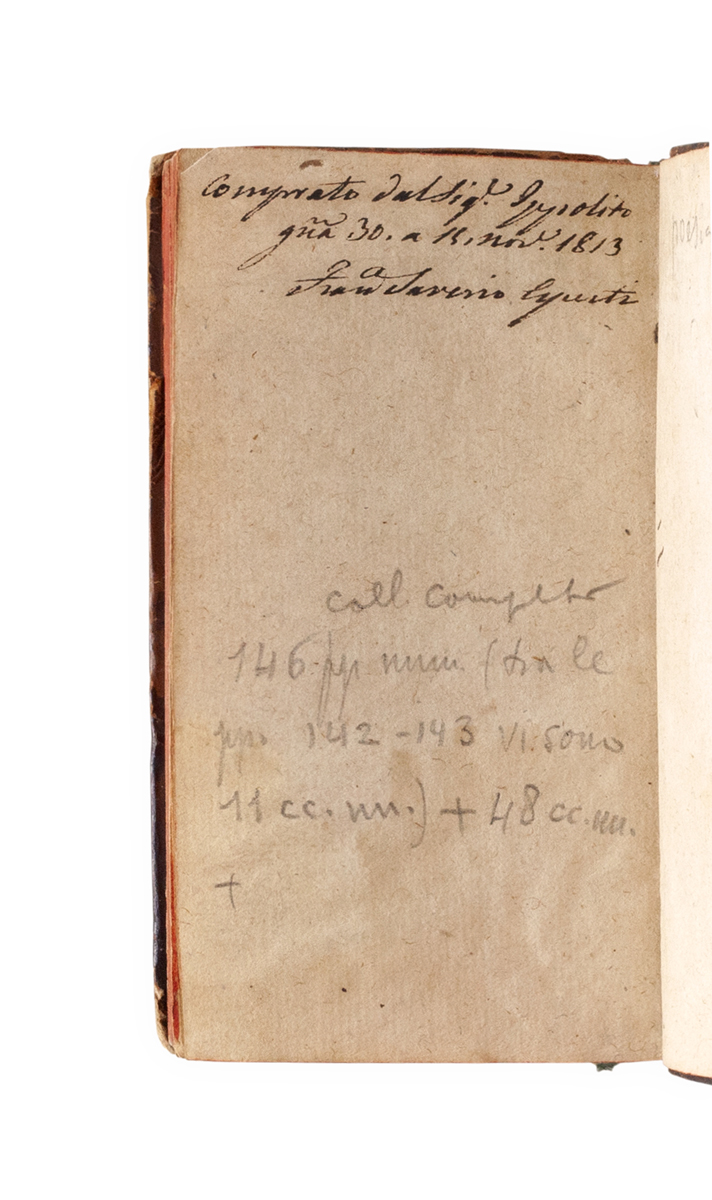
12mo, pp. 142, [22], 143–146, [96]; bound without the separately registered ‘Capitoli burlsechi [sic] di Gierolamo Magagnati’ at end (2A–C12); small typographical ornament to title; a little uniform browning and some light waterstaining to the lower portion of sheets; bound in contemporary mottled calf, spine gilt in compartments, red morocco lettering-pieces; joints cracked but holding, spine end a little chipped, corners worn, some rubbing and abrasions to the surface; eighteenth-century note ‘Satire veramente scritte con penna Aretinesca, e piene del tutto il fiel d’Ipponatte’, purchase note of Francesco Saverio ?Liputi dated 1813 to rear endpaper and his ownership inscription to title.
Added to your basket:
La Murtoleide fischiate del cavalier Marino con la Marineide risate del Murtola.
Rare first edition of these Baroque burlesque sonnets presenting both sides of the bitterly satirical literary feud between the leading Italian Baroque poet Giambattista Marino and his adversary, Gasparo Murtola, containing Marino’s celebrated argument that the aim of the poet is to inspire wonder.
Marino (1569–1625), who thrived in his notoriously misbehaving public persona, had been banned from several courts, while his opponent Murtola (1570–1625) had enjoyed a formal position with the Savoy and, indeed, used it to have Marino jailed (Murtola had also served his time, narrowly avoiding the death sentence after shooting Marino in the street in 1609). Released through the offices of several influential friends in 1615, Marino took refuge in France. His collection of scathing anti-Murtola verse, La Murtoleide, circulated widely in manuscript before appearing in print for the first time in the present edition. Murtola’s in-kind reply, the Marineide, asserted the latter’s position immediately and was published alongside it.
The Murtoleide is articulated in a series of fischiate, or ‘whistles’, in verse. It is in the thirty-third fischiata mocking Murtola that we find a tercet that has since been seen as the manifesto of Italian baroque poetry: ‘È del poeta il fin la meraviglia | (parlo de l’eccellente e non del goffo): | chi non sa far stupir, vada alla striglia!’ (‘The aim of the poet – I speak of the excellent, not of the clumsy – is to arouse wonder. He who cannot astonish: go and work in the stables!’) (p. 35).
No copies traced in the US or the UK. OCLC finds four copies only, all of which in continental Europe.
USTC 4011740; VD17 12:636496G; Graesse IV, p. 401; Vinciana, 2965 (‘prima ediz. assai pregiata); Gay III 295. Not in BM STC Italian (see p. 542 for later editions) or Brunet.