Marmontel’s Morals in Morocco
MARMONTEL, Jean-François.
Contes moraux … Paris, J. Merlin, 1765.
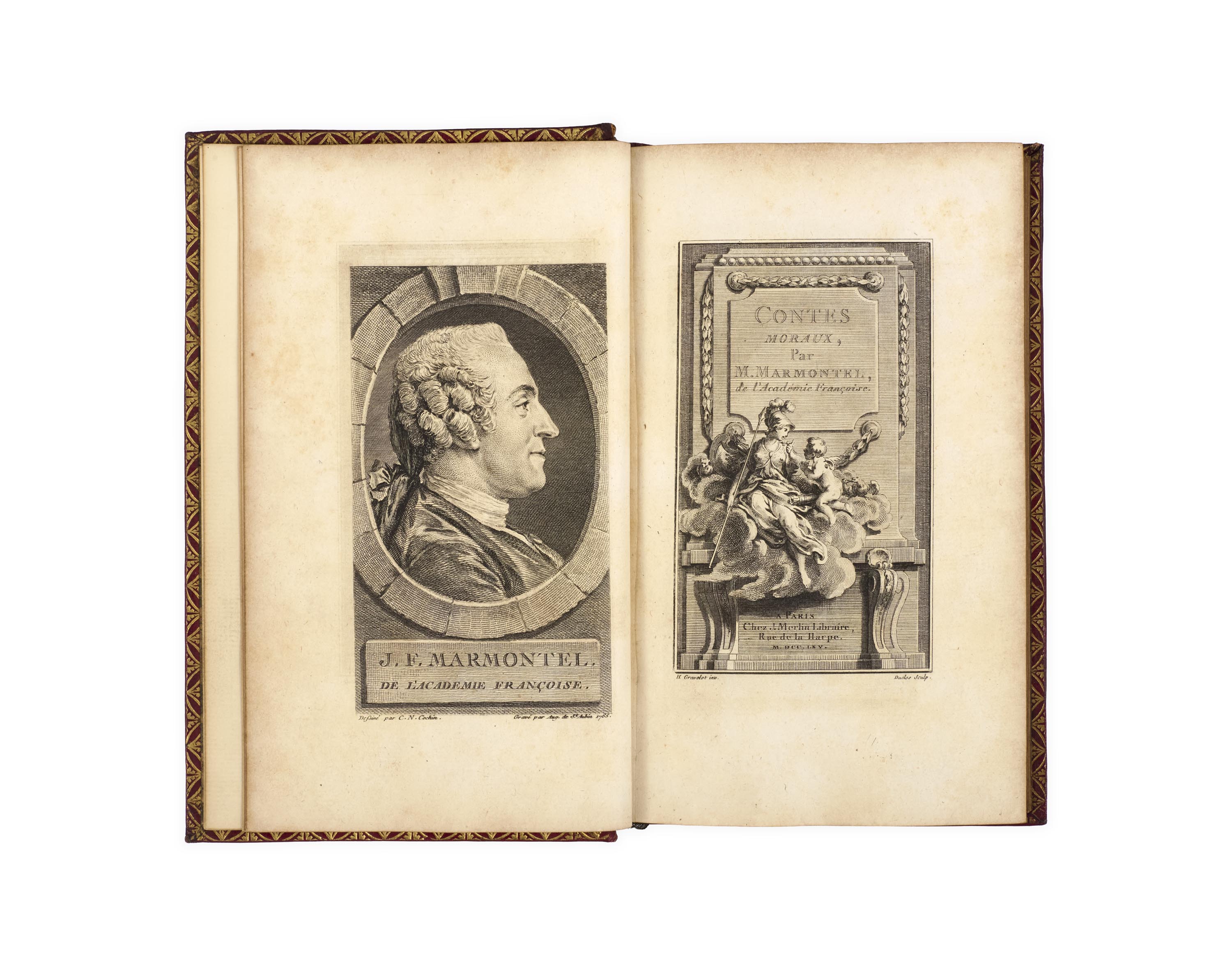
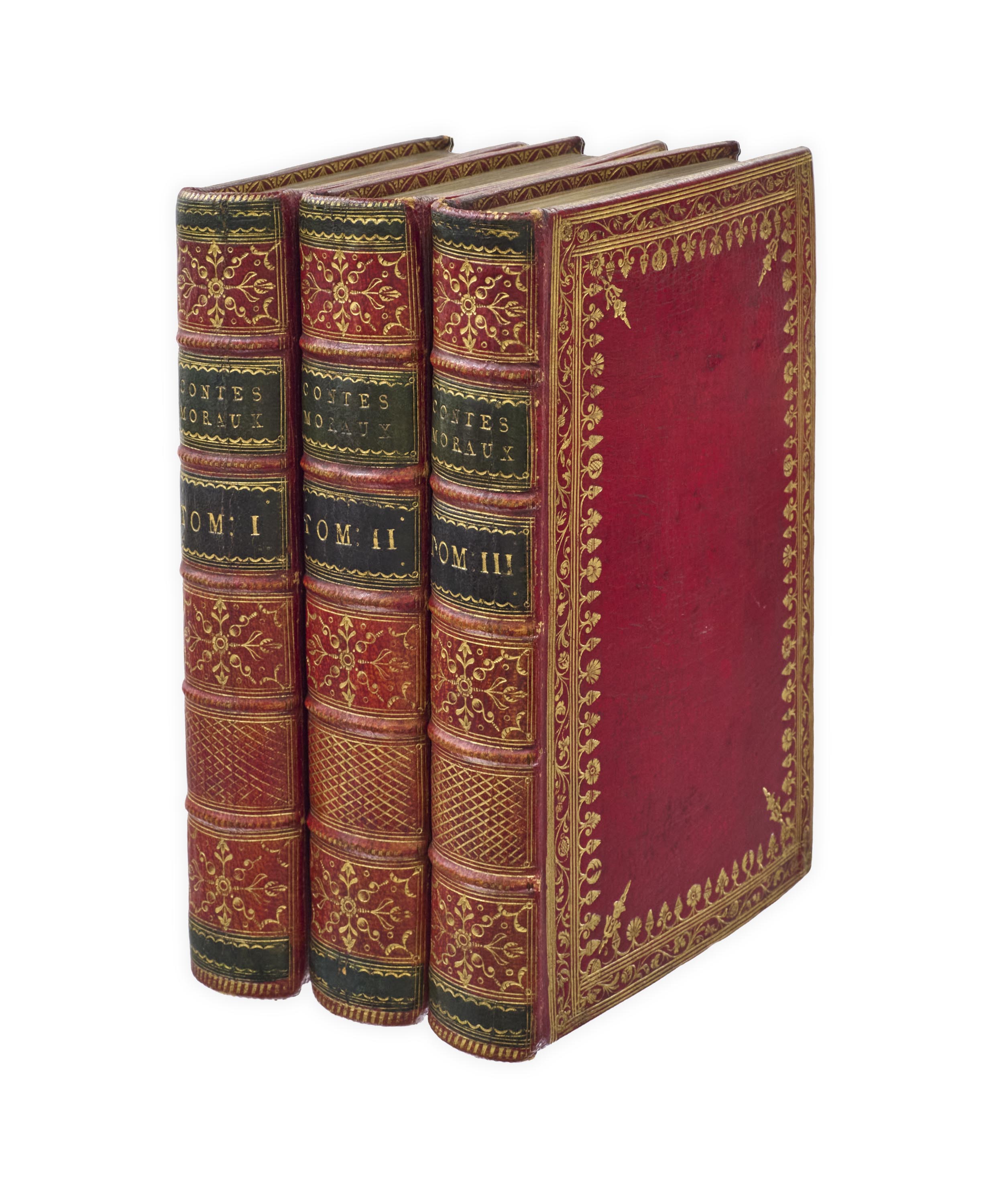
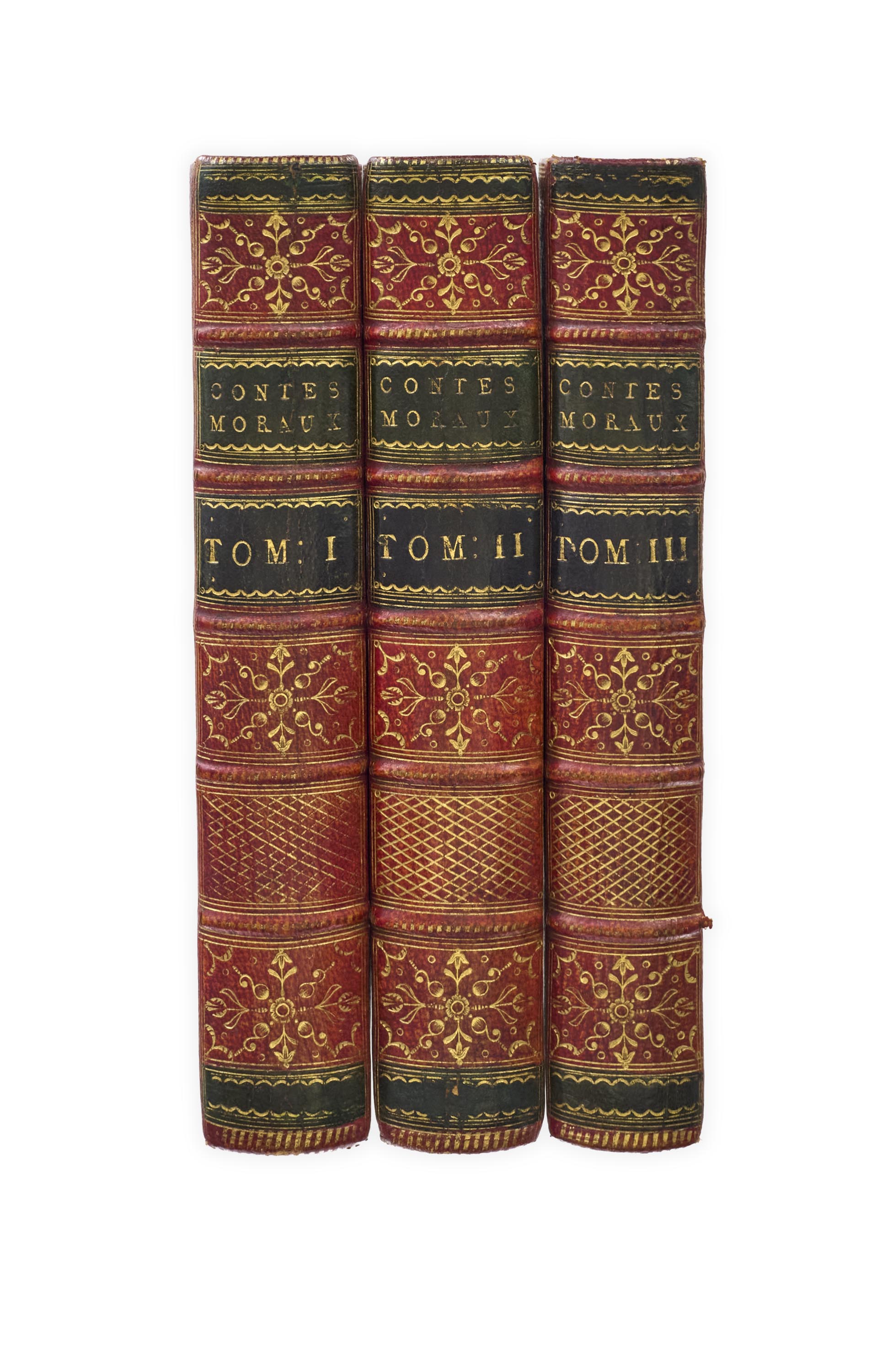
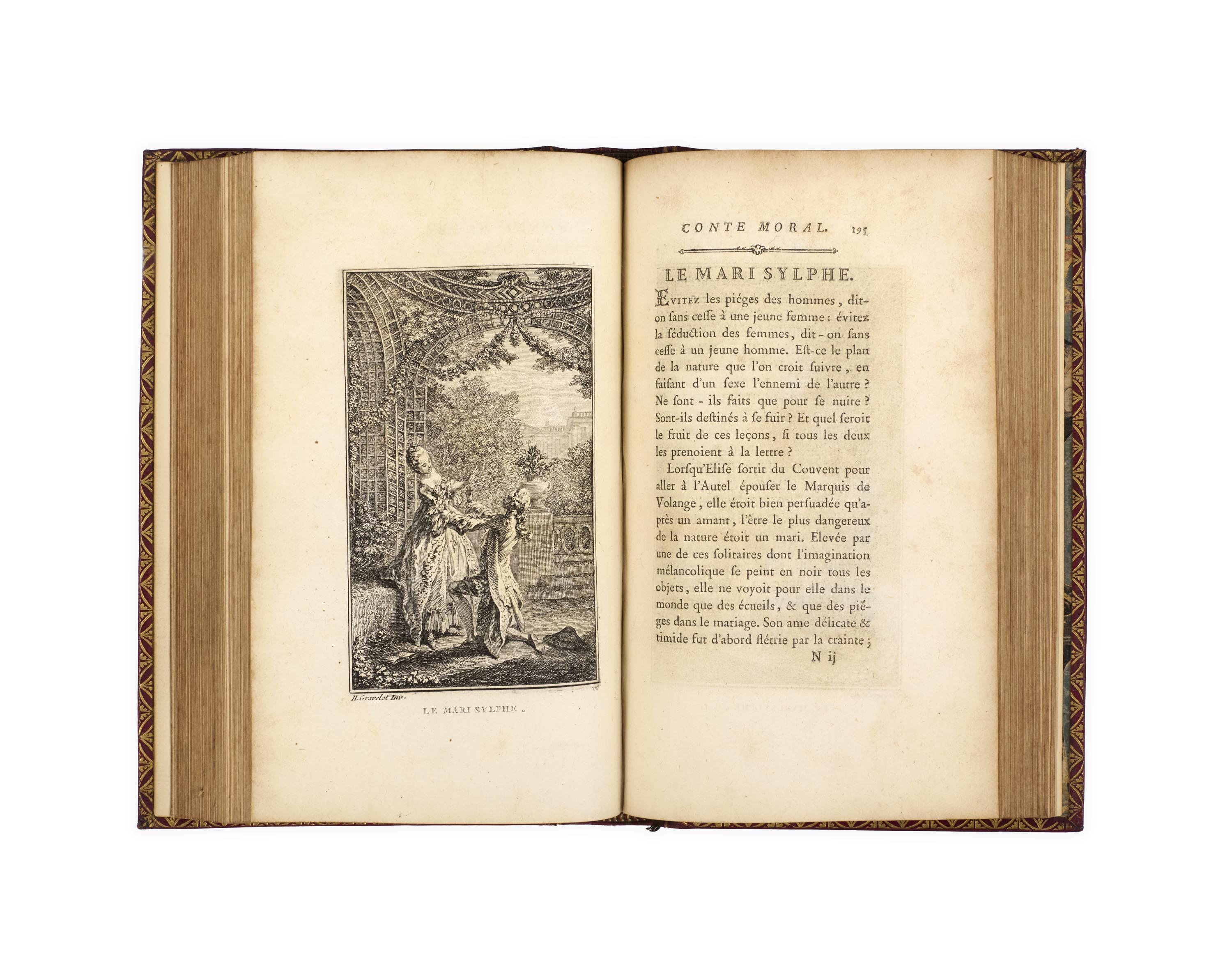
Three vols, 8vo, pp. I: [iv], 346, II: [iv], 376, III: [2], xvi, [6], 312, with engraved title after Gravelot to each vol., frontispiece portrait by Saint Aubin after Cochin to vol. I, and 23 engraved plates after Gravelot; preface misbound in vol. III; occasional light foxing (heavier to first two quires of vol. I and to last few leaves of vol. III), slight toning throughout; handsomely bound in contemporary provincial English red morocco gilt, borders roll-tooled in gilt with gilt corner-pieces, spines gilt in compartments with gilt navy morocco lettering-pieces and onlaid gilt morocco panels at head and foot, edges gilt, marbled endpapers, green silk place-markers; extremities very slightly rubbed; armorial bookplates of Ragley Hall to front pastedowns, modern private collector’s bookplate to front free endpaper of vol.'I.
Expanded edition, with a new suite of illustrations by Gravelot, of this collection of moral tales by Jean-François Marmontel, a close friend of Voltaire, in handsome contemporary English morocco.
Brought to Paris by Voltaire in 1745, Marmontel (1723–1799) was eventually named one of forty ‘immortals’ of the Académie Française in 1763 and appointed secrétaire perpétuel de l’Académie twenty years later. His Contes moraux were first published serially in the Mercure de France, which he edited from 1758 to 1760, and although a collected edition was published in 1761, it only included eighteen of the twenty-three stories present here. This edition is enhanced with the addition of twenty-three illustrations by Gravelot, considered ‘the most beautiful that this master has produced’ (Cohen–De Ricci, trans.).
Marmontel’s twenty-three stories invariably feature happy endings – reunions of parents and children, reconciled couples – and shed light on the relationships between families, lovers, and the citizen and the national community in relation to Enlightenment thought. The narrator’s intimate tone appeals to the shared cultural reference points and values of Nature, Sentiment, and Reason, and maintains an intimate second-person address to the reader throughout. Among the four stories omitted from the first collected edition is ‘Le misanthrope corrigé’, a continuation of Molière’s Misanthrope.
This is the first of two issues, with the errata at the foot of each volume’s contents-page.
Provenance:
1. From the library of the Seymour-Conway Marquesses of Hertford at Ragley Hall, Warwickshire. Renowned acquirers of art and fine objects, some of their collections went on to form the Wallace Collection after the extinction of their branch with the death of the fourth Marquess, Richard Seymour-Conway, in 1870.
2. Sold as the property of Mrs Corinna Kavanagh, Buenos Aires, at Sotheby’s, 16 December 1963, lot 129 (£68 to Thorp).
Cohen-De Ricci 686-7. See Astbury, The Moral Tale in France and Germany (2002); Haskell, ‘Arts and Games of Love’, in Ordering Emotions in Europe, 1100–1800 (2015).