Down with the Kirk, Up with John Law, and Out with the Witches of Calder
MITCHEL, William.
A tract volume of fifteen works, including five very rare broadsides. Edinburgh and Glasgow 1711–1720.
Ten 4to pamphlets and five folio broadsides, bound together; somewhat toned throughout from poor quality paper, occasional pen-trials or manuscript marginalia, the broadsides folded in half and bound in along the upper left-hand edge, trimmed close below, somewhat thumbed; withal, generally in very good condition, some lower edges untrimmed, bound together in late eighteenth- or early nineteenth-century half calf and marbled boards, covers detached (the first and last leaves in the volume consequently detached).
Added to your basket:
A tract volume of fifteen works, including five very rare broadsides.
A fabulous tract volume of works by the ‘odd half-crazy varlet of a tinsmith’ and pamphleteer William Mitchel (1670–1740?), author of some fifty ‘books’ sold from his shop in Edinburgh (and briefly, in 1719, Glasgow). Of the fifteen works here, ten are known in three copies or fewer in ESTC. Only two are recorded outside the UK.
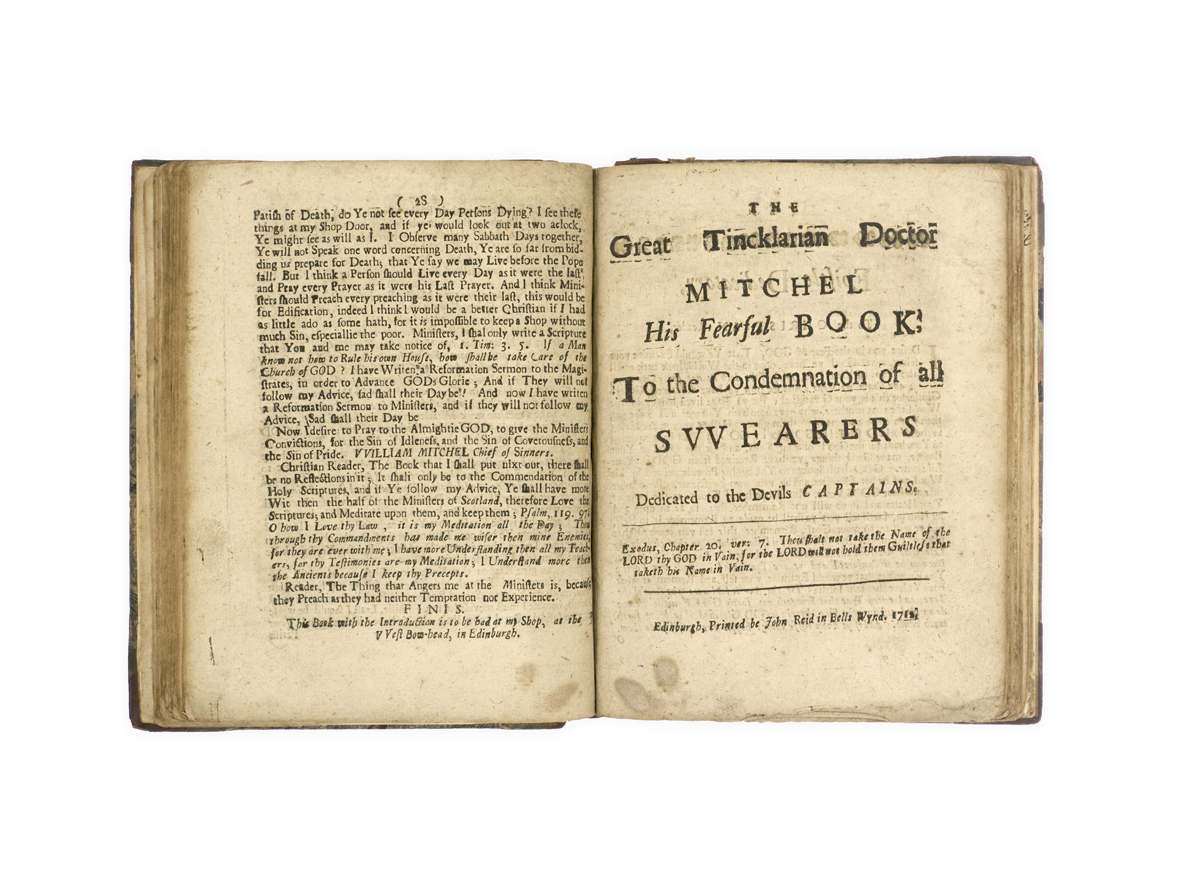
From obscure origins, Mitchel moved to Edinburgh in 1696, and earned a living as a tinsmith and superintendent of the town lamps. ‘He occasionally preached on the streets but was better known for writing over fifty pamphlets and broadsheets on diverse subjects but concerned mainly with church government and what he considered to be the religious derelictions of his time. These barely literate writings were badly printed on shabby paper and were sold in his shop. They contain a “strange mixture of fanaticism, humour and low cunning” (ibid. [Chambers], 53) and are full of characters, both real and fictitious, who speak in glowing terms of the author or, on occasions, are used to advertise his wares’ (ODNB). Most are published under his self-assumed title The Tinclarian Doctor (‘tinkler’ being a Scottish variant of ‘tinker’).
Apart from the Kirk and the abuses of its ministers, Mitchel’s recurring bugbears include his own bad luck (the loss of his house and money in a fire) and ill-treatment (by deacons, magistrates, tradespeople); the Devil and his cohorts (out to bring Mitchel down with the use of various Edinburgh citizens); Quakers; and women who wear wide ‘fart-ing-gales’. His printed output included numerous open letters to public figures (Queen Anne, George I, the King of France, and John Law feature here), which often tread an odd line between satire and bizarre, messianic self-aggrandisement.
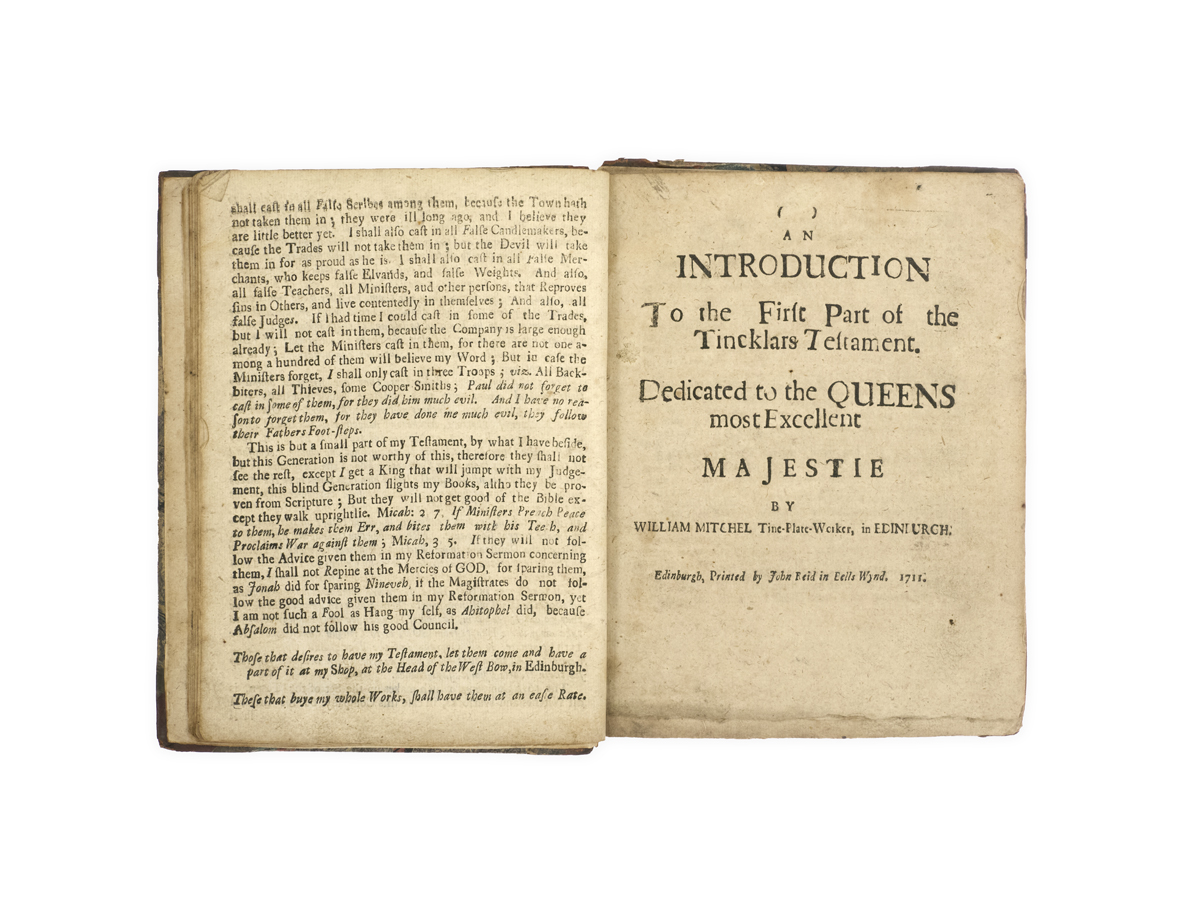
The present collection covers the first ten years of Mitchel’s writing career, from his earliest works - An Introduction to the first Part of the Tincklars Testament and A Part of the first Part of the Tinklars Testament (both 1711) - up to his brief stay in Glasgow in 1719 and return to Edinburgh in 1720. The Introduction sets the scene - dedicated to Queen Anne it laments Mitchel’s lack of funds to print the Testament itself due to the afore-mentioned house fire. The Testament, ‘which I wrote long ago; I have a mind to Print … in small pieces, for Love to the Poor’. Execrations against the Kirk ministers give way to the airing of more personal grievances: ‘The Laird of Cramond hath laid down a great Kearn of Stones before my Shop door, which takes away my Light, they have lyen near these two Years, (because he is Rich,) upon the High Street’. In The third Addition of the Tincklars Religion inlarged Mitchel describes the sixteen companies of the Devil’s army: swearers, the proud, drunkards, the envious, the lustful, the unclean, liars etc etc. The 16th company is of ‘Witches and Warlocks’, but also false scribes and false candle-makers, ‘All Back-biters, all Thieves, some Cooper Smiths’.
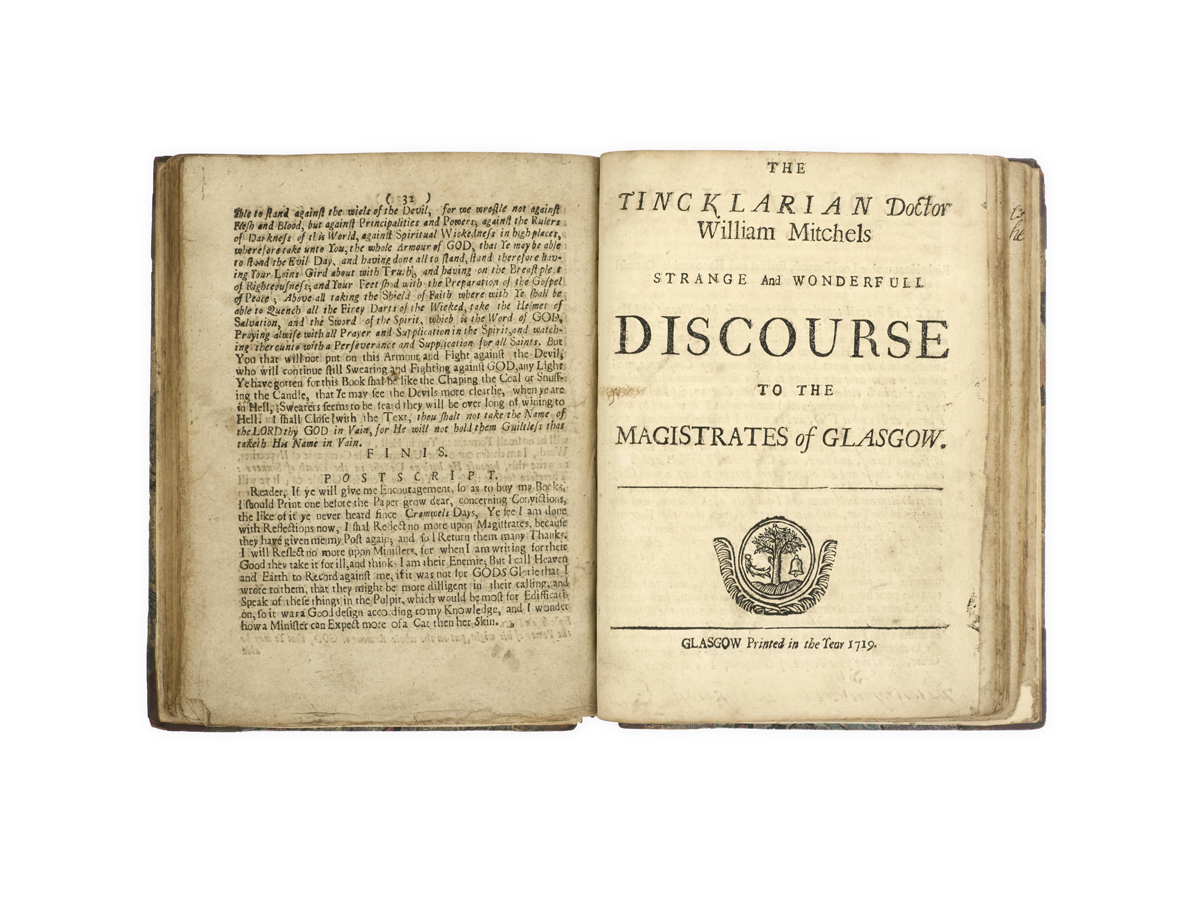
In 1719, Mitchel left his wife and children behind and relocated to Glasgow. His very rare Strange and wonderfull Discourse to the Magistrates of Glasgow, apparently his only work printed and in Glasgow and sold from his shop in the Calton without the Gallowgate Port, contains extravagant praise of his new home city and an explanation for the move: ‘the Reason I came from Edinburgh was because of Oppressions’: due to a pact with the Devil with ‘that man in Cannongate … I was laid in Prison, only upon his Word, no other Accusers nor Witnesses to be seen. Our Deackon sicklike threatened me to Prison, and fined me, and took my Goods from me, all upon a Womans Word … When they laid me in Prison, all the Crime that I was guilty of at that Time, if it be a Crime (for saying that Womans Fart-ing-gales was Whorish like) but she was a Ministers Daughter’. But Glasgow was not the Utopia Mitchel imagined and three months later he was back in Edinburgh, cursing the Glaswegians in his True Discription of the People of Glasgow concerning Justice: ‘some of them Stole my made Work, and some of the Robed me of it; Some of them Stole my Lantron Horns, and some of them Robed me of all my Brandy …’. The printers claimed they had no paper for him but were happy to reel off ballads, and the town called his ‘Strange and Wonderful Discourse’ blasphemy. ‘I think the People of Glasgow hath as much Wit as I had when I was eight Years of Age’.
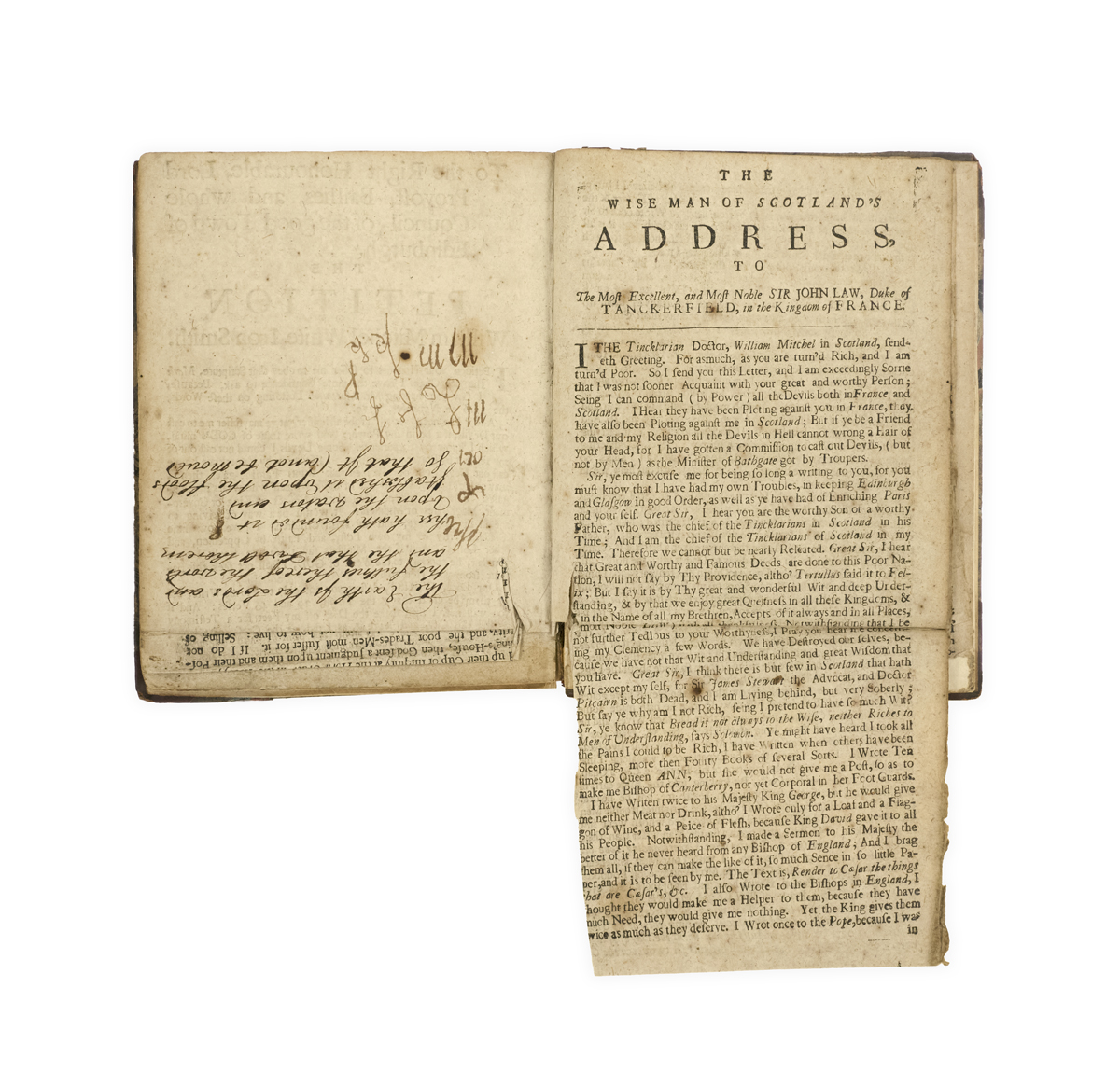
In two fascinating and very rare broadsides, written December 1719 and January 1720, The Wise Man of Scotland’s Address to the most excellent, and most noble Sir John Law and The Tincklarian Doctor Mitchel’s Letter, to Mr. Humphry Calchoun of Tillihewn, Mitchel addresses his more successful countryman the economist John Law, who was at the peak of his early reputation in France. Mitchel sees Law, ‘whom I reckon the rising Sun in Europe’, as a kindred spirit (Law’s father was a goldsmith), equally ignored by his fellow Scots, and imagines them walking and talking together. ‘I Wrote ten times to Queen Ann, but she would not give me a Post, as as to make me Bishop of Canterberry, nor yet Corporal in her Foot Guards … Solomon says, Money answers all things … So Lend me as much as you Please, I shall pay it back when every my Work is wrought with double Interest …. I am a little black man, dull like, & two Scors in my Brow, & a Mole on my right Cheek, & my lodging is in the head of the West-Bow in Edinburgh’.
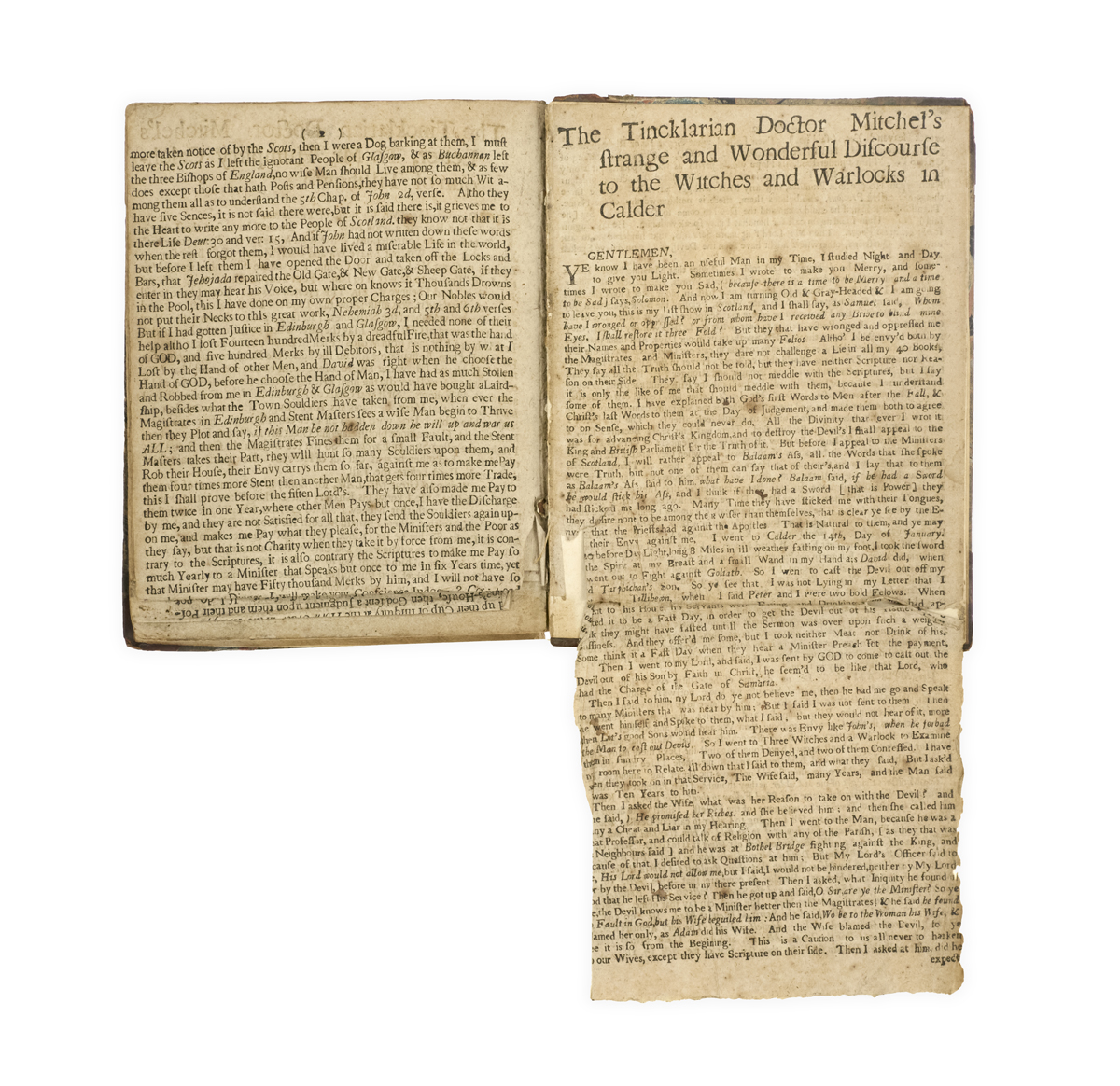
The penultimate work in the collection is The Tincklarian Doctor Mitchel’s strange and wonderful Discours to the Witches and Warlocks in Calder (January 1720), in which he recounts a trip to Calder ‘before Day Light, long 8 Miles in ill weather fasting on my foot … to cast the Devil out off my Lord Tarphichan’s Son’. The said unfortunate, the twelve-year old Patrick Sandilands, was said to have been bewitched into trances by some locals. Having earlier launched a petition To the Right Honourable, Lord Provost, Baillies, and whole Council of the good Town of Edinburgh to let him to cast out Devils, Mitchel hoped to cure the boy; he met and conversed with two witches and a warlock, who confessed to him their affiliation with the Devil.
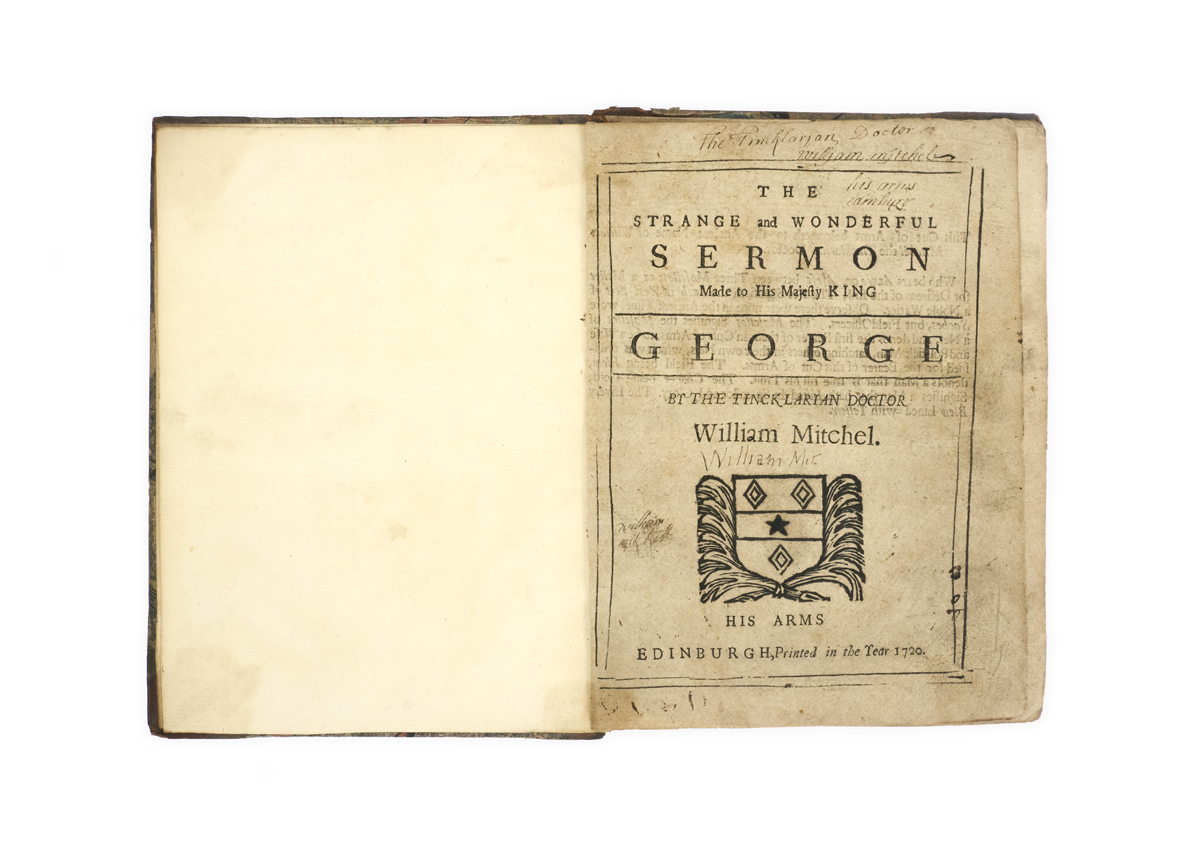
Bound first in the volume, though printed last is Mitchel’s Strange and wonderful Sermon made to his Majesty the King George (1720), which also includes letters to the Duke of Argyle and to Parliament, as well as a complaint ‘That my Woman Barbary Polston (who was born a Sutor’s Daughter in Inverness,) has run away with a great Cargo of Money of mine’.
All of Mitchel’s publications, poorly printed, given away nearly free, and ephemeral in nature, are scarce or rare, his broadsides particularly so. ESTC lists only three locations which hold more Mitchel pamphlets than are found here (BL, NLS, and Advocates Library); and a total of only thirteen examples in the USA.
A complete listing is available on request.