The Third and Best Utopia
MORE, Thomas, Sir.
De optimo reip. statu deque nova insula Utopia libellus vere aureus, nec minus salutaris quam festivus … Epigrammata clarissimi disertissimique viri Thomae Mori, pleraque e Graecis versa. Epigrammata Des. Erasmi Roterodami. Basel, [(colophons:) Johann Froben, March 1518].
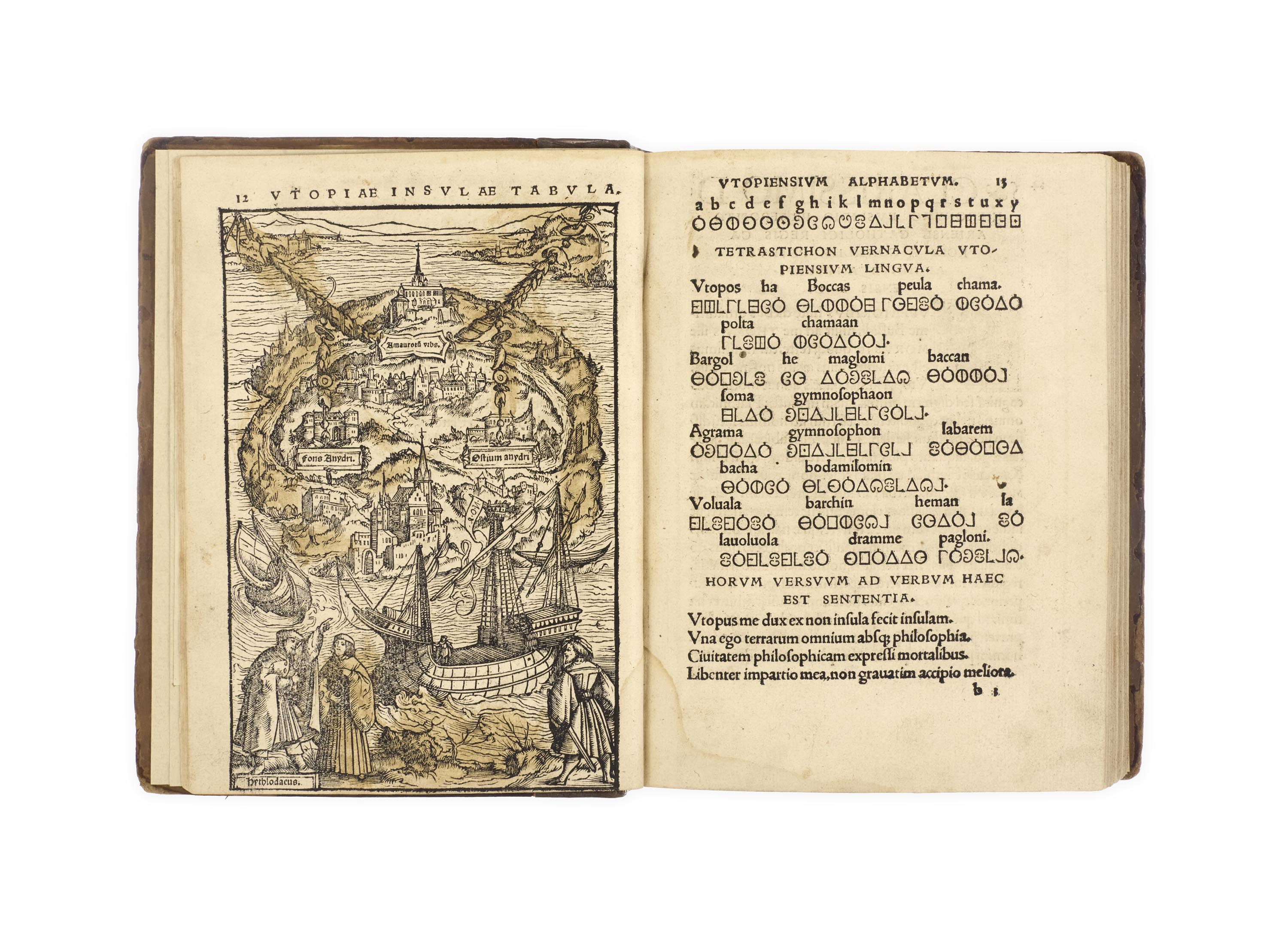
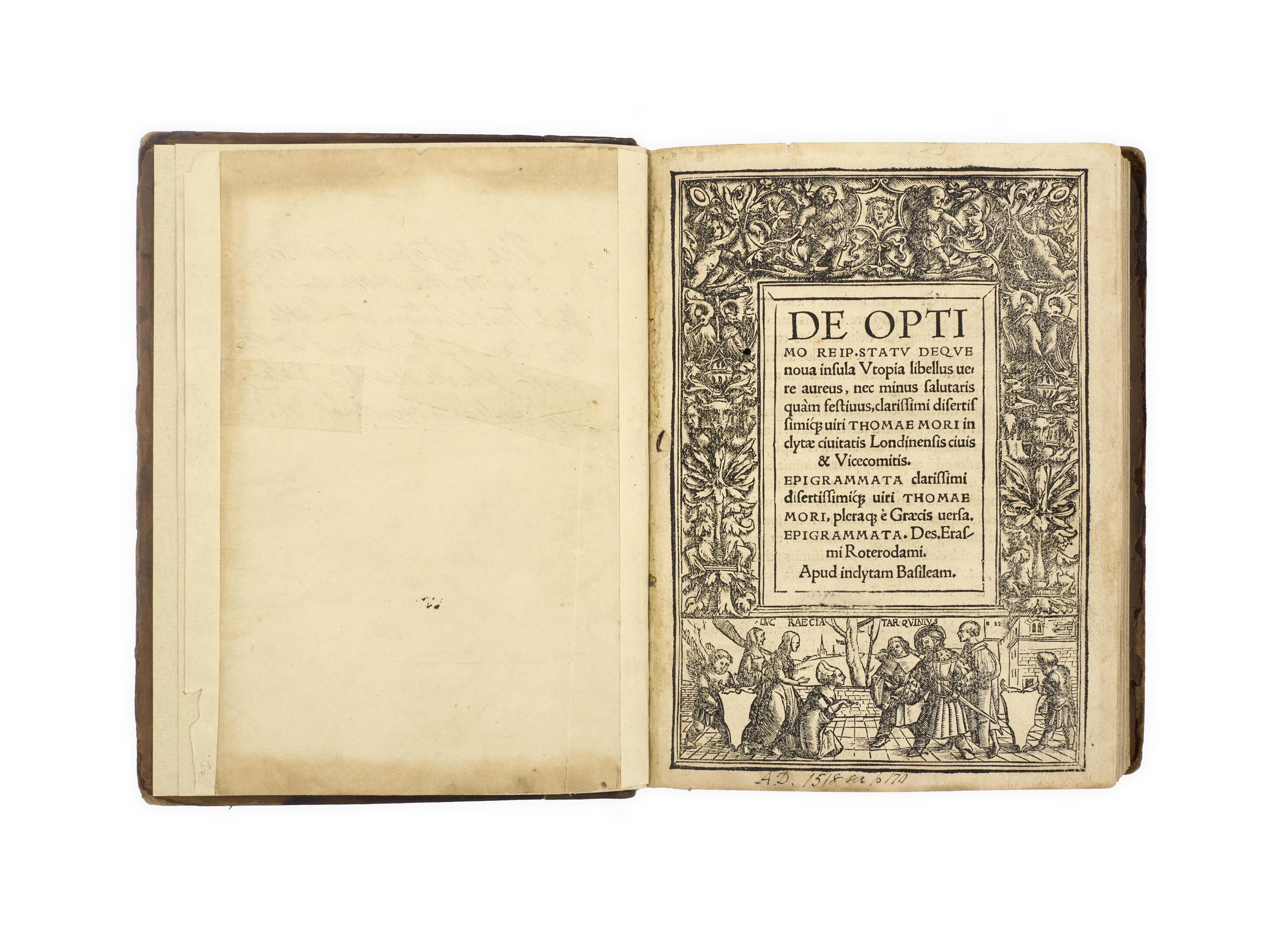
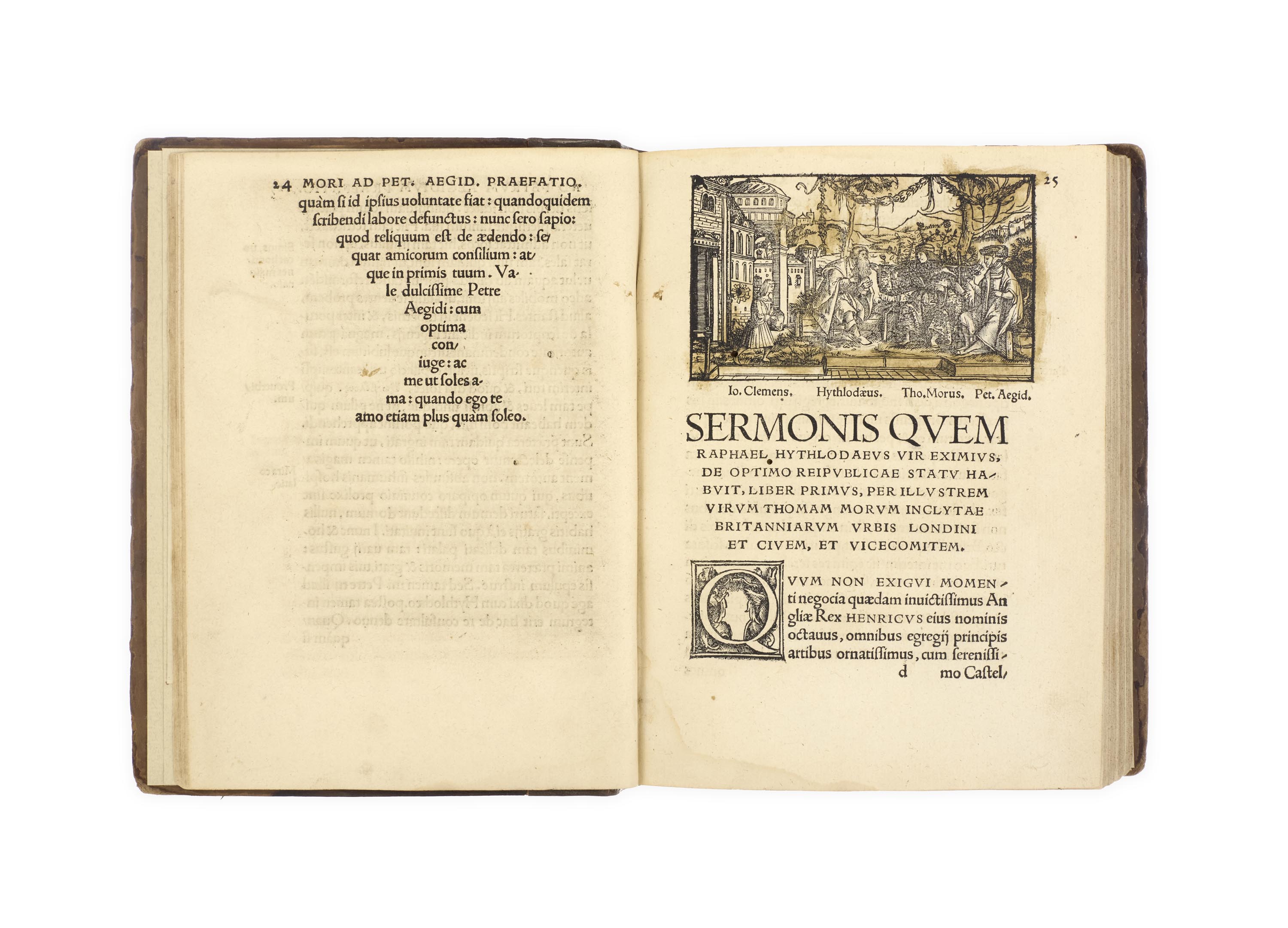
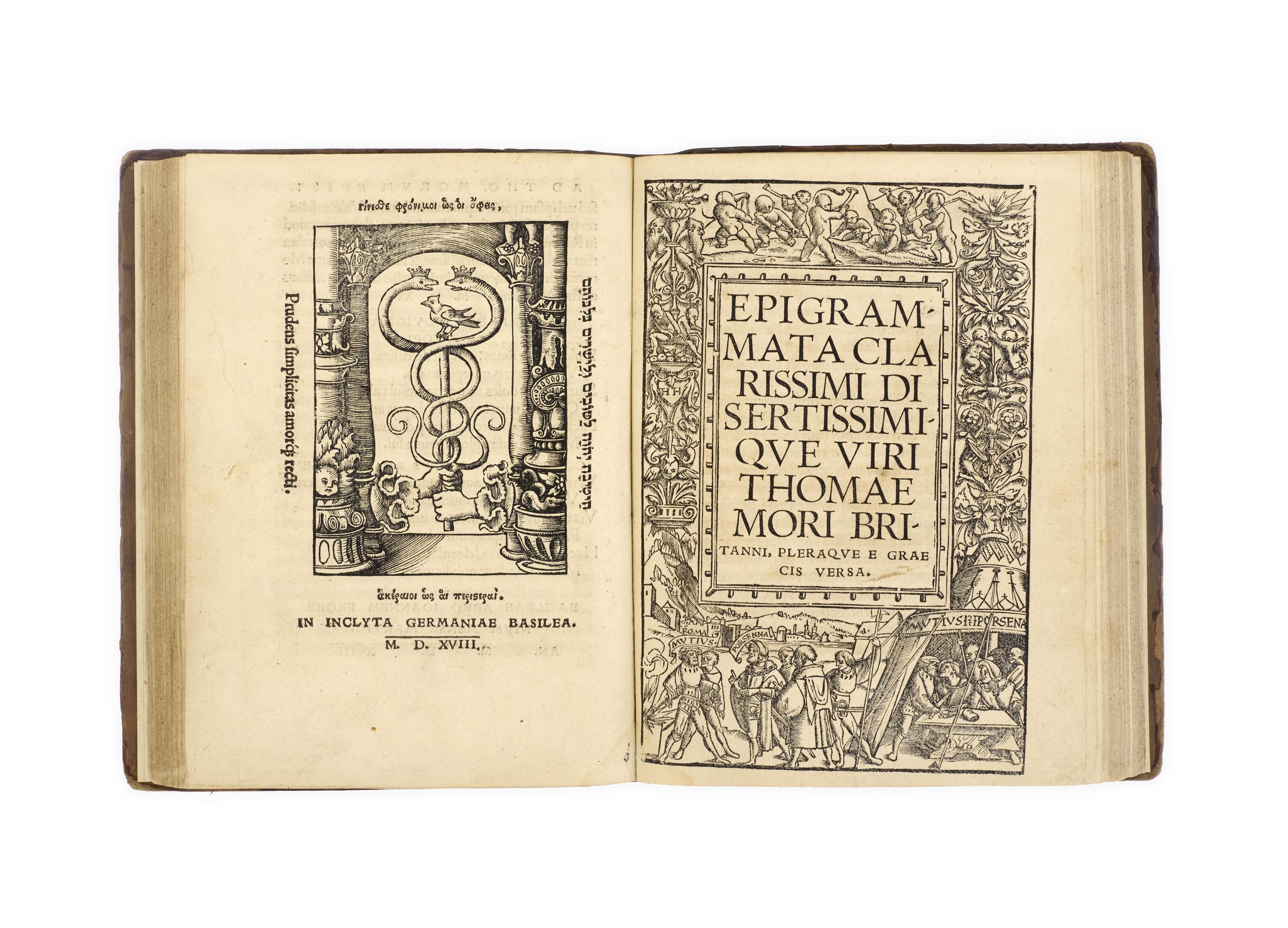
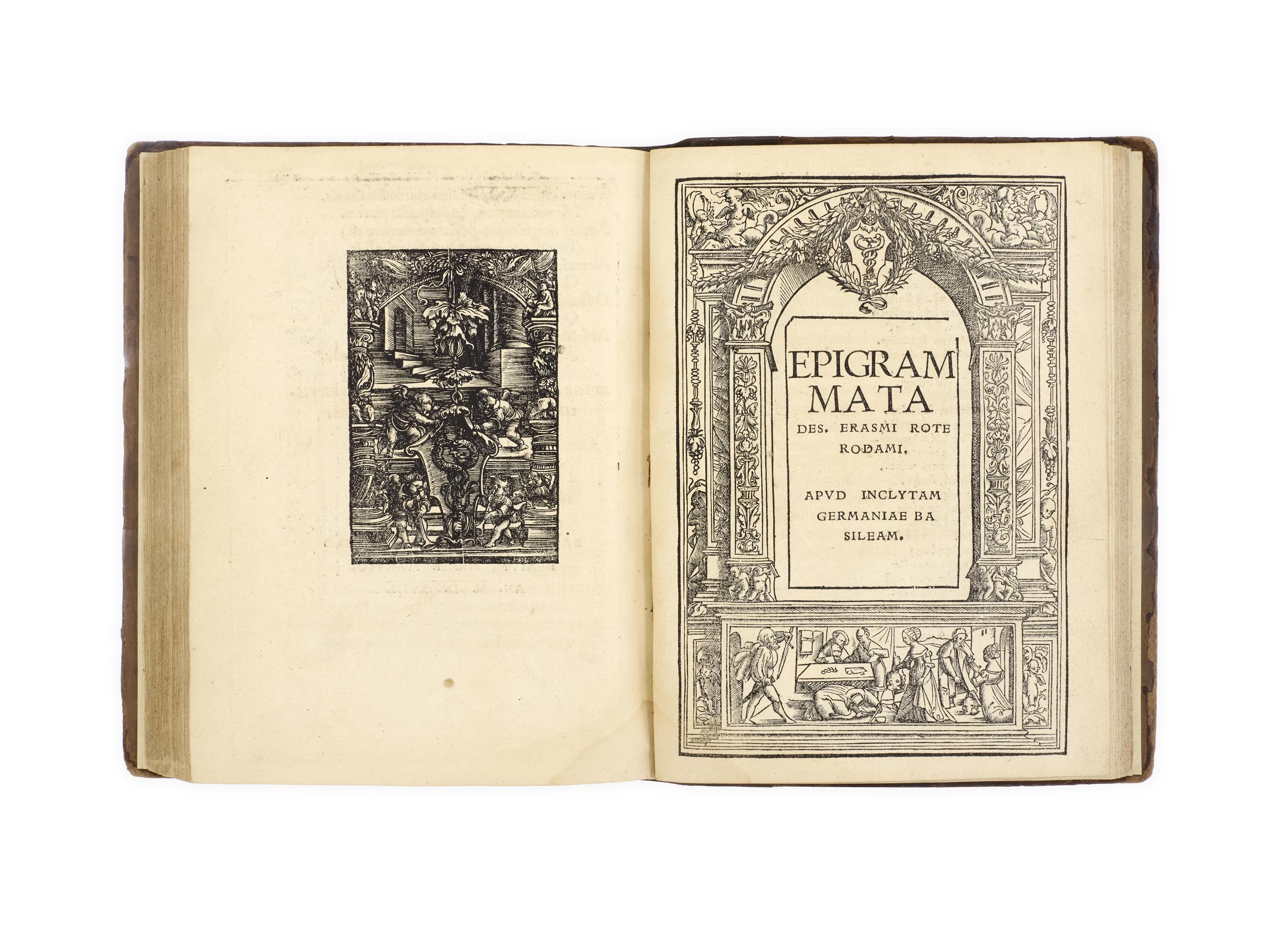
Three parts, 4to, pp. ‘355’ (recte 359), [1]; first title within woodcut border depicting Tarquin and Lucretia, woodcut initials, full-page woodcut illustration by Ambrosius Holbein of the island of Utopia with letterpress captions, text on p. 13 partly printed in Utopian characters, start of dedication on p. 17 within an architectural woodcut border by Hans Holbein, p. 25 with inhabited woodcut headpiece by Ambrosius Holbein depicting John Clement, Raphael Hythloday, Thomas More and Pieter Gillis in a garden, three different woodcut Froben devices to final verso of each section, title to More’s Epigrams within a woodcut border by Hans Holbein depicting Mutius Scaevola and Lars Porsenna, title to Erasmus’ Epigrams within an architectural woodcut frame incorporating Froben’s device; occasional light staining (to foot of first few leaves, and to inner margin and foot of last few quires, heavier in last few leaves with tiny chips at foot), a few woodcuts with areas of a faded colour wash, map of Utopia cut close at foot, two tiny wormholes in text, final quires R–V with a few more tiny wormholes, final leaf strengthened along gutter; otherwise a very good copy, bound in eighteenth-century speckled calf, edges speckled; rebacked with black leather lettering-piece, new endpapers, corners slightly bumped; minor sixteenth-century annotations or markings in a north European hand to c. 7 pp., a few pages of Utopia with pencil notes, nineteenth-century bibliographical note in English to old front flyleaf (slightly browned at edges and repaired along outer margin).
Added to your basket:
De optimo reip. statu deque nova insula Utopia libellus vere aureus, nec minus salutaris quam festivus … Epigrammata clarissimi disertissimique viri Thomae Mori, pleraque e Graecis versa. Epigrammata Des. Erasmi Roterodami.
Third edition of More’s Utopia, including his revisions and corrections and adding his and Erasmus’s Epigrammata for the first time; this is the culmination of the text as it evolved from More’s hand with the intercession of Erasmus. As the last edition in which More is likely to have been directly involved, it was used by the Yale editors as the basis for their modern critical edition.
Sir Thomas More entrusted the publication of the original edition (Louvain, 1516) to his friend Erasmus, who by early 1517 was discussing the possibility of a new and revised edition. Later in 1517 a second edition appeared at Paris, but this was prepared without Erasmus’s involvement and he told More that it was ‘printed ... full of mistakes’; it lacks both the map and the Utopian alphabet. Erasmus himself took charge of this third edition, incorporating More’s revisions and corrections, and adding More’s Epigrammata, which had apparently been in Erasmus’s possession since 1516 and may at one stage have been considered for inclusion in the original edition of Utopia. Erasmus also added his own Epigrammata, a collection of his poems, seven previously unpublished (initially a joint volume of the writings of More and Erasmus, including further pieces by Erasmus, had been envisaged, but it grew too large, so it was decided to issue Utopia and the two sets of Epigrammata as a separate volume). A complete and close resetting of the present March edition, with a few minor textual changes and some alterations in the arrangement or design of the woodcuts, was printed in November–December 1518. Froben, the printer of both these editions, was the foremost publisher of works by Erasmus, who became in effect his general editor and literary advisor. Perhaps more than any others, Froben’s editions emphasise the collaborative intellectual context of Utopia, uniting More’s literary efforts with Erasmus and issuing from the press most closely associated with Erasmus. As Erasmus remarked in his prefatory address to Froben, printed on the verso of the title-page: ‘Such is the reputation of your press that, if it is known that a book has come from the house of Froben, that is enough to have it please the learned world’.
This edition is further distinguished by its fine woodcuts. The borders to the first page of the preface and to the divisional title of More’s Epigrammata are by Hans Holbein; and both the map and the illustration of the interlocutors – Clement (tutor to More’s children), the fictional narrator Hythloday, More himself, and the dedicatee Gillis – in the garden are by Ambrosius Holbein, both appearing here for the first time (Holbein’s map is similar in conception to that in the original Louvain edition, but is more refined in detail). The first title-page border has been attributed both to Ambrosius and to Hans Holbein; Gillis was instrumental in introducing Hans Holbein to More and therefore to England.
USTC 630792; VD16 M 6299; Gibson, More 3; cf. PMM 47 (1516 edition); Both Epigrams: Fairfax Murray, German 303; Erasmus: Bezzel 912.