Health and Nursing Revolution
NIGHTINGALE, Florence.
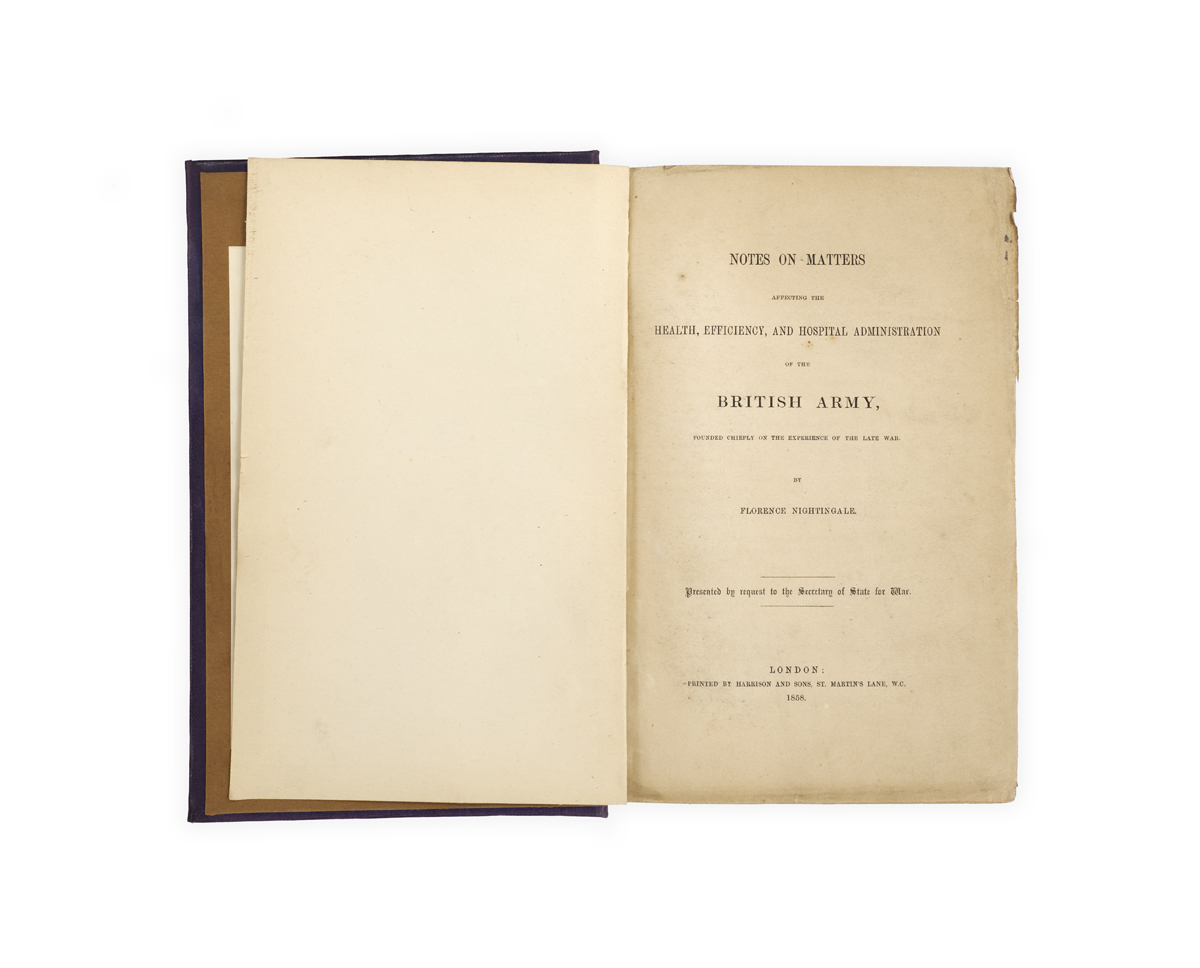
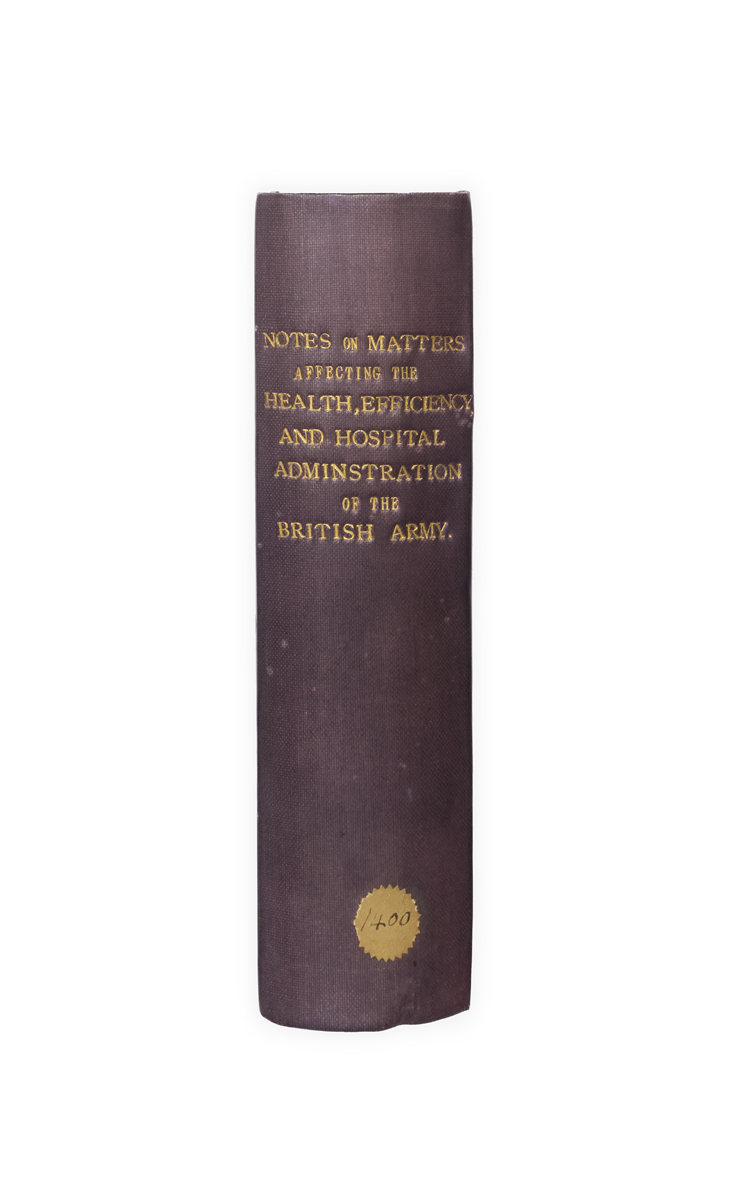
Notes on Matters affecting the Health, Efficiency, and Hospital Administration of the British Army. London, Harrison and Sons, 1858.
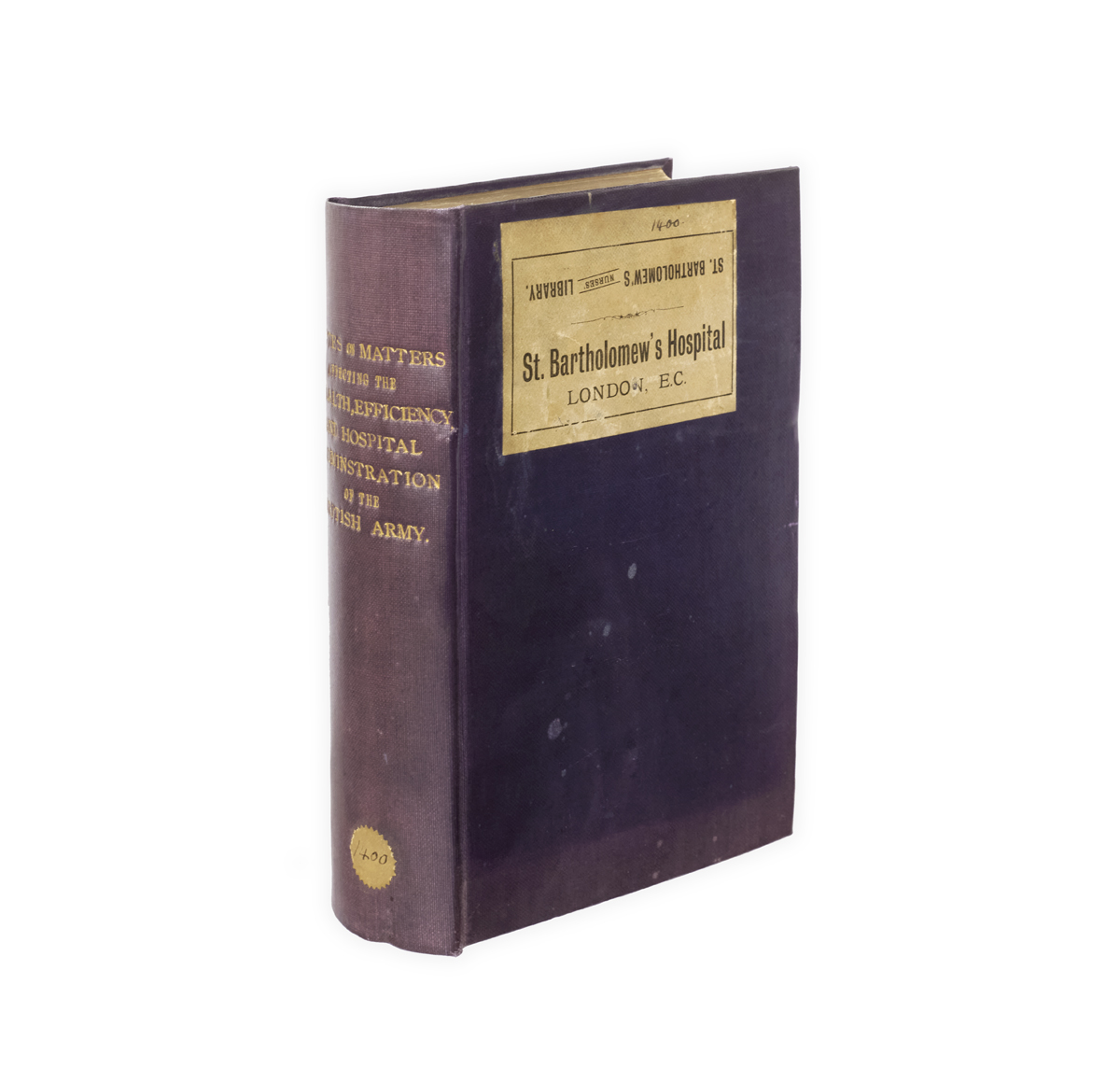
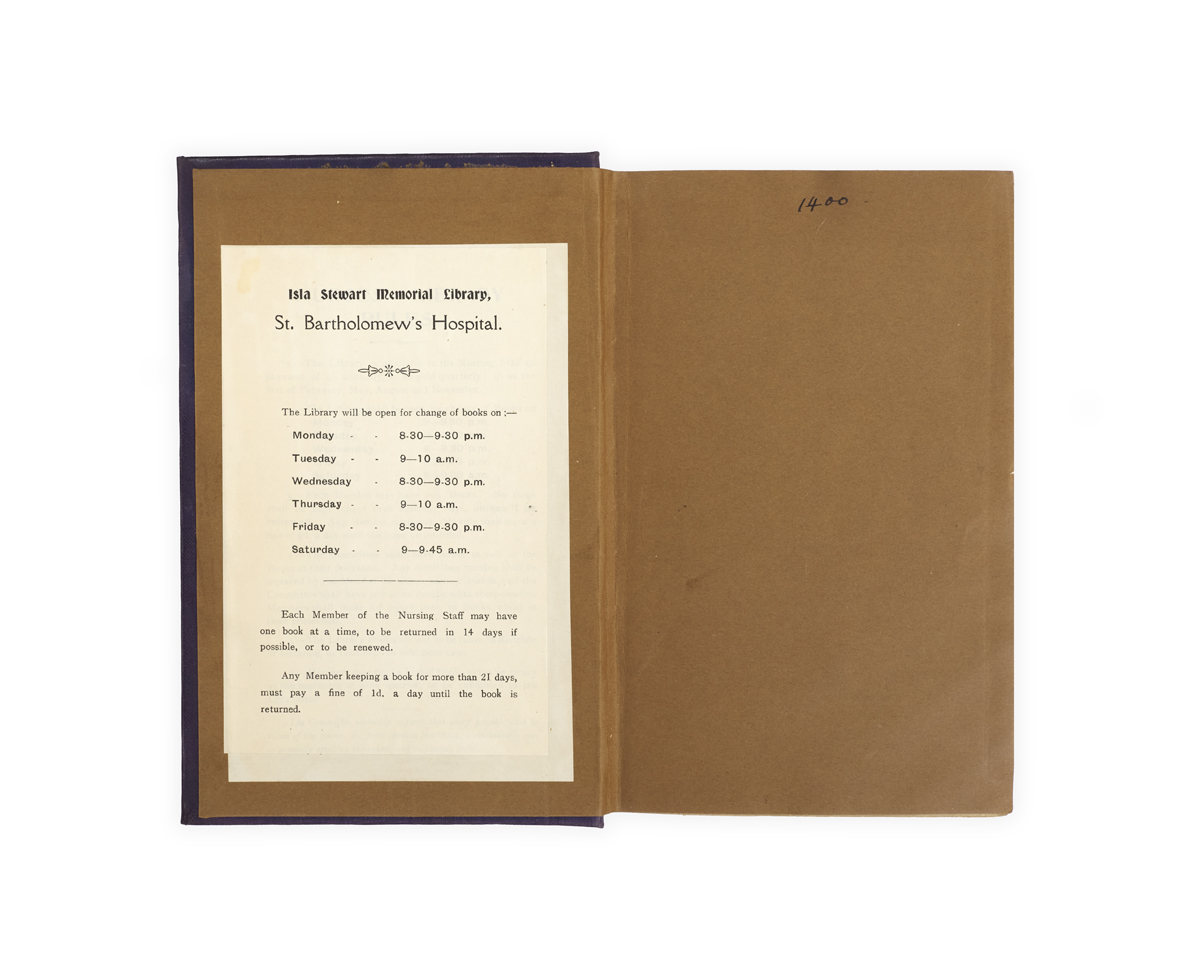
8vo, pp. [2], iv, [2], [2 (blank)], vi–xix, [1], 12, 2, xxx, 66, xlvii, [1], iv, 67–80, xxxiv, [2], 81–176, [2], 177–234, xliv, 235–332, xxvii, [1], 333–556, lviii, 557–567, [1]; with 6 plates, of which 5 folding, ‘Diagram of the Causes of Mortality in the Army in the East’ coloured; bound without half-title; plates of the ‘Paris Hopital de Lariboisière’ and ‘Plan of Skutari’ with short closed tear in the inner margin, without loss, a very good, remarkably clean copy; bound in purple cloth c. 1900, spine lettered directly, plain brown endpapers, spine lightly sunned, some discoloration to covers; ‘St. Bartholomew’s Hospital Nurses’ Library’ label to front board, bookplate of the ‘Isla Stewart Memorial Library’, with opening hours and rules, pasted over an earlier bookplate with the ‘Nurses’ Library’ rules, to front pastedown.
Added to your basket:
Notes on Matters affecting the Health, Efficiency, and Hospital Administration of the British Army.
First edition, printed for private circulation only, of Florence Nightingale’s pioneering report on the sanitary condition of the British Army, resulting in a radical reform of the administration, sanitation, and nursing practices at large, this copy with remarkable nursing association.
Having met Lord Panmure, the Secretary of War, in November 1856, Florence Nightingale (1820–1910) managed to convince him to appoint a Royal Commission on the British Army, with her choice of Sidney Herbert as Chairman. Nightingale was to prepare a report of her own experience and observations of hospital life, which included the shocking statistic that 16,000 of the 18,000 deaths in the Crimean War were not due to battle wounds but to preventable diseases spread by poor sanitation. Her report was ready for press by August 1857, but was not published at once, as it was not considered suitable that the Nightingale Report should forestall the Report of the Royal Commission itself.
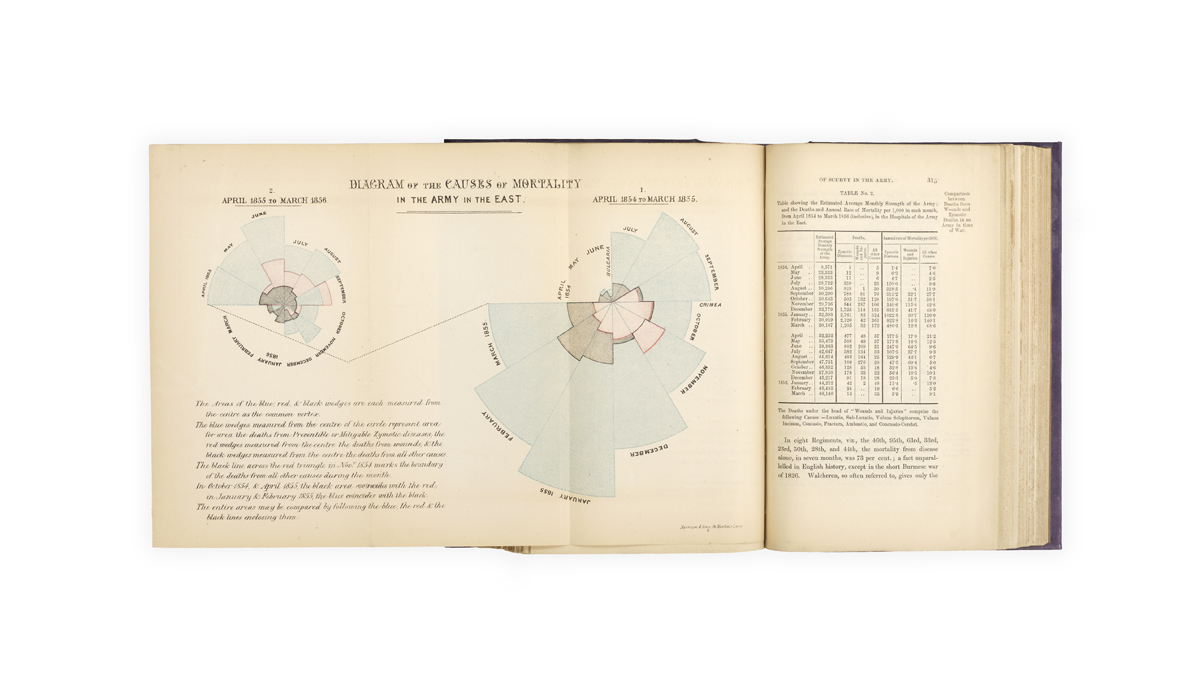
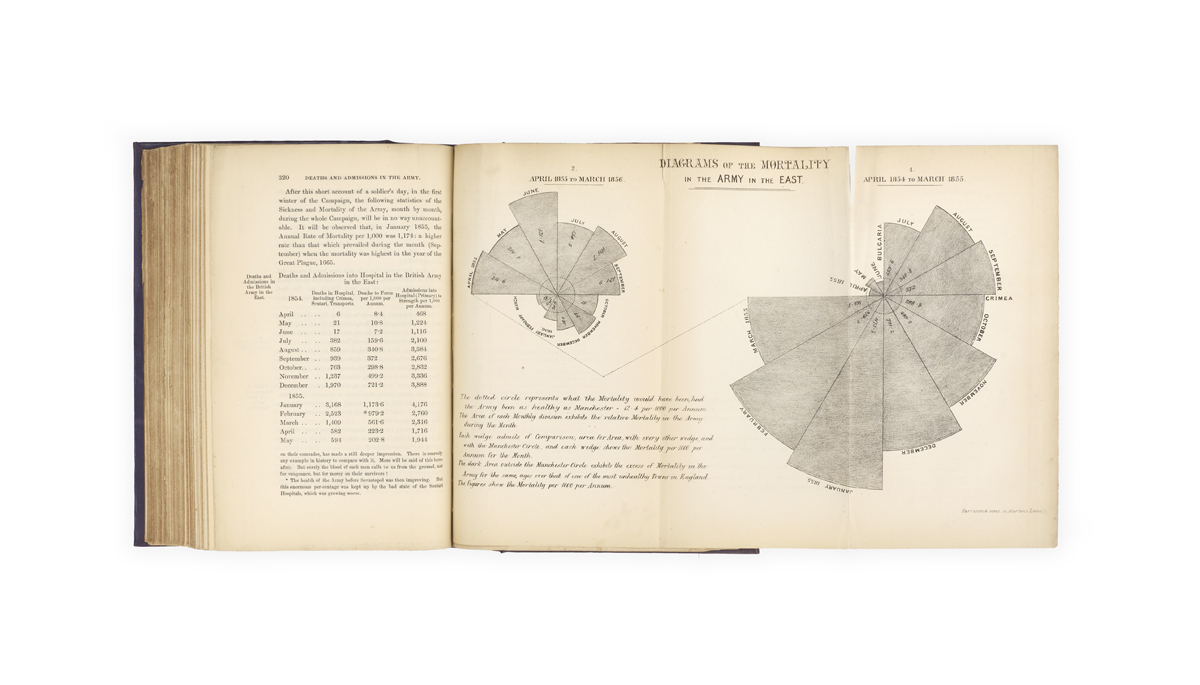
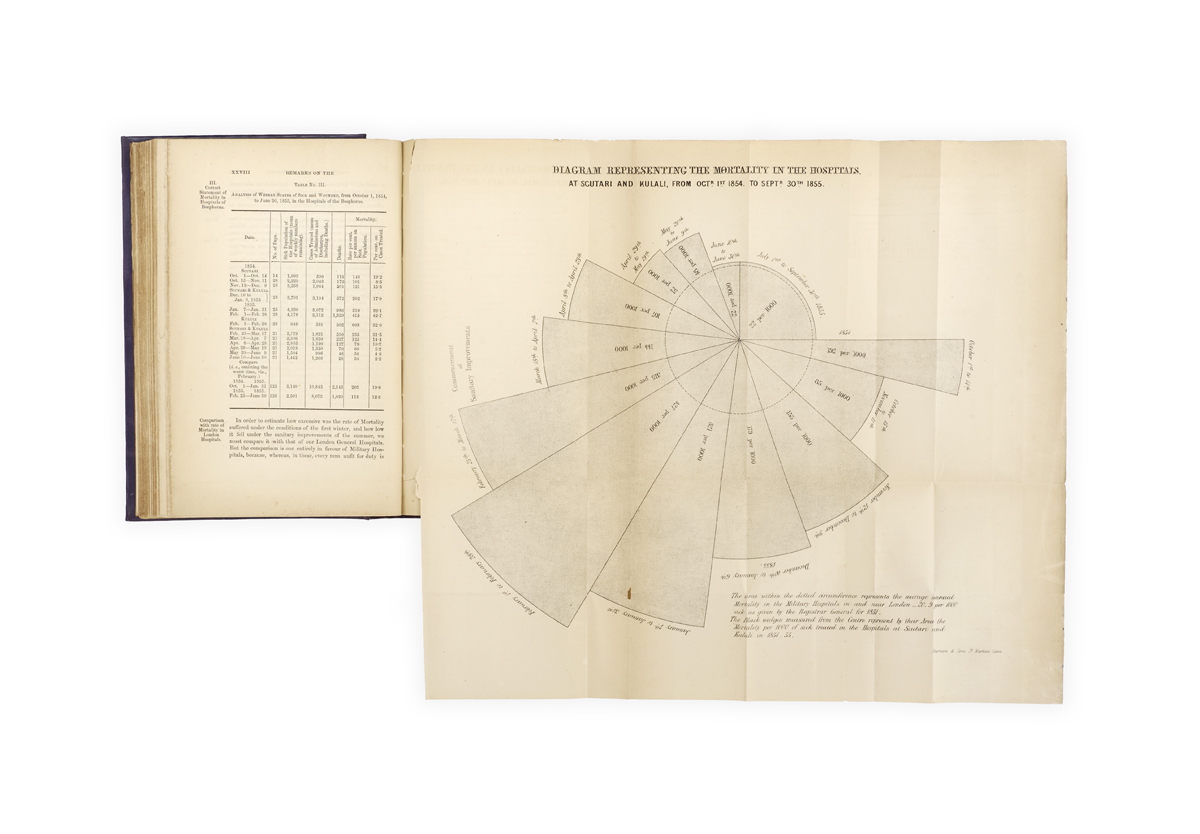
‘When the latter did appear in January 1858 it contained an appendix with a mass of official correspondence on the care of the sick and wounded on the Crimean War which Miss Nightingale eagerly seized on for incorporation in her own Notes … The last-minute incorporation of this material explains the erratic pagination of the work, the pages bearing Roman numerals representing the additions’ (Bishop and Goldie). The result was also a pioneering work in data visualisation and statistics applied to medicine (Nightingale was the first female member of the Royal Statistical Society). Her ‘Cover Polar Area’ or ‘Rose’ diagram of the cause of mortality of the Army in the East represented the death toll in a revolutionary, intuitive way, showing a sharp decrease in fatalities following the work of the Sanitary Commission (a fall by 99% in a single year).
‘There is not a grievance, nor a defect of the system (or lack of it), nor a remedy that is overlooked. An introduction deals with army health in earlier campaigns. The first six chapters are concerned with the ghastly medical history of the Crimean War. This is followed by extensive and detailed recommendations on hospital organization. The rest of the book ranges far and wide over matters of army life, from sanitary requirements to the pay of private soldiers. Because the Royal Commission produced results, this massive report was not generally issued, but circulated only to a few friends and people of influence. Yet its existence was not only responsible for the setting up of the Royal Commission but also for the nature of most of its recommendations. The reforms thus instituted, moreover, spread far beyond the confines of the British Army and have revolutionized hospital practice throughout the world’ (PMM).
Provenance: Isla Stewart (1855–1910) entered St Thomas’s Hospital, London, in 1879 as a special probationer in the Nightingale Training School for Nurses, before being appointed Matron at St Bartholomew’s Hospital in 1887, where she remained until her death. She was a pioneer of State Registration of Nurses and campaigned for a formal education and training, setting up a four-year training system for nurses-to-be, as outlined in her work Practical Nursing, written in conjunction with Dr Hubert Cuff and published in 1899. She founded the League of St Bartholomew’s Nurses in 1899 and was a founding member of the Royal British Nurses’ Association. Following her death in 1910, the League decided to set up a fund as a memorial, which was used to provide a library for nurses – the Isla Stewart Memorial Library. In 1930 it was agreed to use the income from the fund to provide travelling scholarships and bursaries for League members. (See British Journal of Nursing, vol. XLIV (1910), p. 202; St. Bartholomew’s Hospital Journal (1910), p. 104; League of St Bartholomew’s Nurses, online).
Bishop and Goldie 50; PMM 343.