‘Farewell to One Who Has Grown Grey in Doing Good to Us’
[NORTON, John Bruce.]
‘The Hon’ble J. B. Norton’. [Madras, c. 1871].
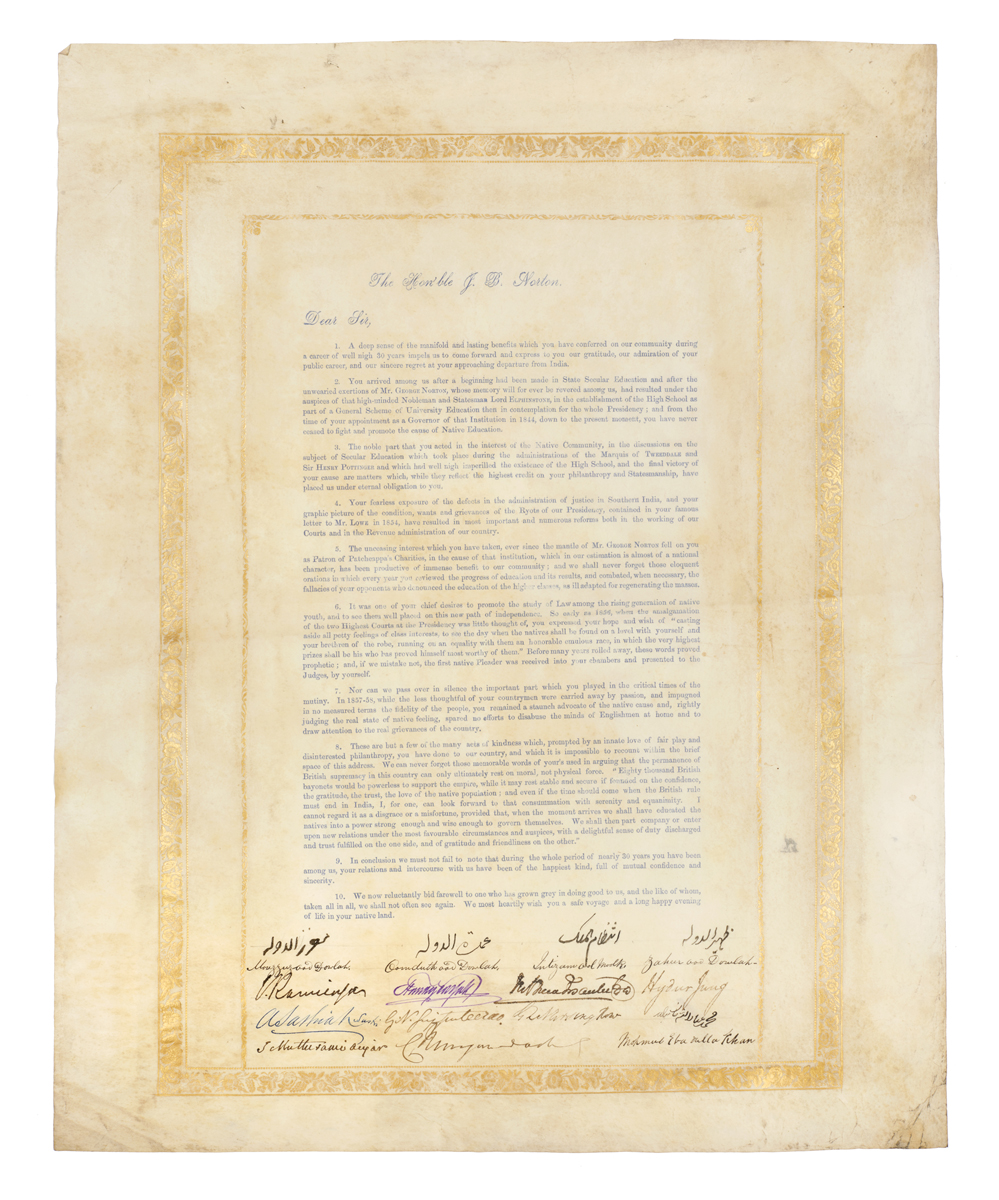
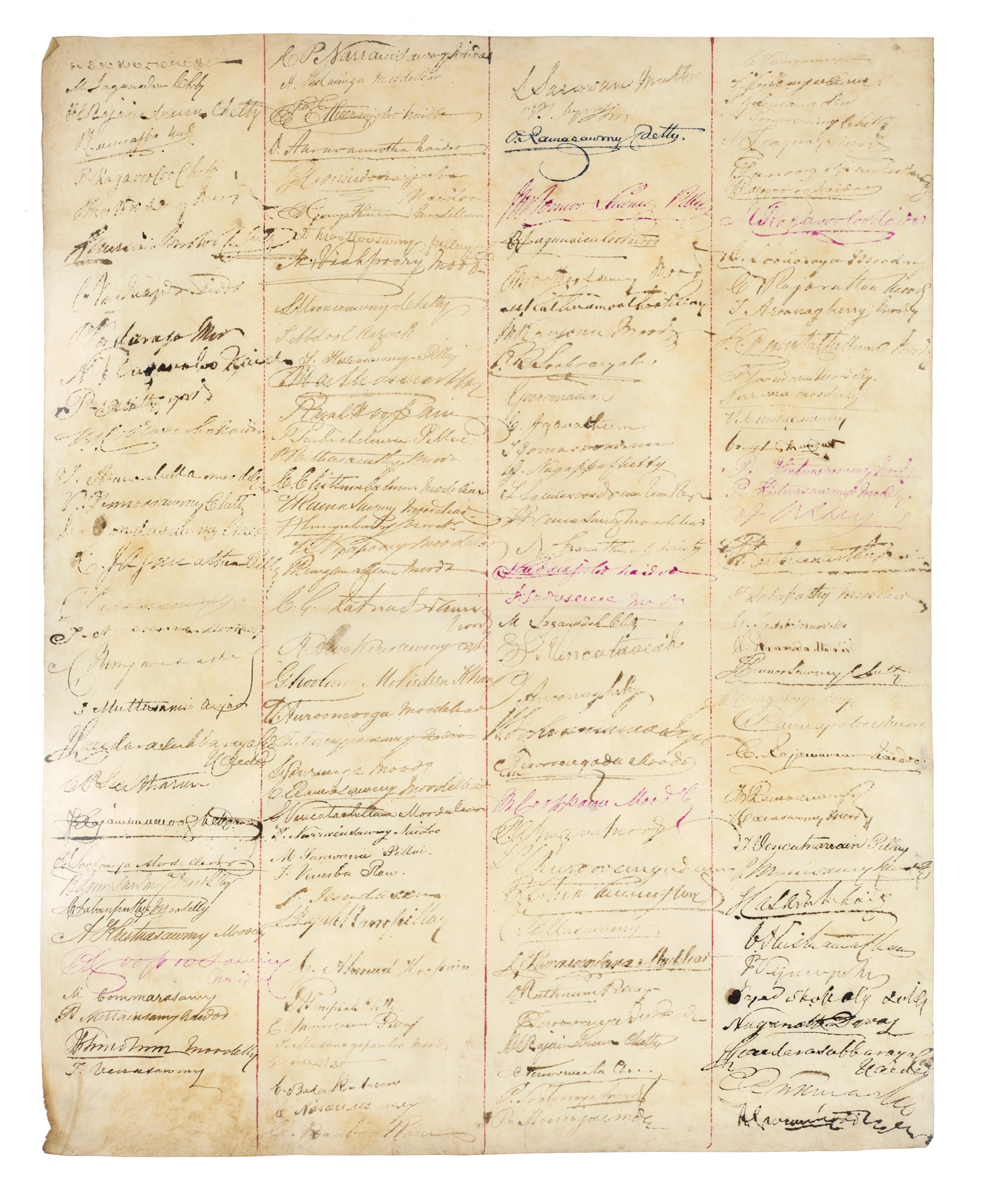
Large folio (59.5 x 47 cm), 7 loose leaves with text to rectos only, the first leaf comprising 55 lines of text printed in blue ink, with signatures at foot, within elegant gilt floral border, the following 6 leaves bearing hundreds of signatures arranged in 4 columns per page; creased, some light marks, slightly rubbed in places.
An extraordinary and striking testimonial presented to the influential Madras-based judge and educator John Bruce Norton (1815-1883) prior to his return to England in 1871, signed by hundreds of his Indian colleagues, expressing their ‘deep sense of the manifold and lasting benefits ... conferred on our community during a career of well nigh 30 years’.
Educated at Harrow and Merton College, Oxford, Norton went to Madras in 1842, serving as sheriff and then as clerk of the crown in the supreme court. His 1853 attack on the East India Company’s judges and the Madras government, entitled The Administration of Justice in Southern India, sparked a long process of legal reform in which he played a prominent role. In 1855 he became the first professor of law at Presidency College ‘and thus became the architect of formal legal education in south India’ (ODNB). In 1863 he was made acting advocate-general of Madras, remaining in post until his resignation in 1871.
The printed text of this unique testimonial, arranged in 10 paragraphs, praises Norton’s contributions to native education and to the administration of justice, as well as his work as a patron of Pachaiyappa’s high school and a supporter of Indian lawyers. Interestingly reference is also made to his contribution to the debate surrounding the Indian mutiny (‘In 1857-58, while the less thoughtful of your countrymen were carried away by passion ... you remained a staunch advocate of the native cause and ... spared no efforts ... to draw attention to the real grievances of the country’), and to his views on future Indian independence (he is quoted as saying, ‘if the time should come when the British rule must end in India, I, for one, can look forward to that consummation with serenity and equanimity’). The text ends charmingly, ‘We now reluctantly bid farewell to one who has grown grey in doing good to us, and the like of whom, taken all in all, we shall not often see again’.
The hundreds of signatures that follow the text – in Roman, Urdu, Devanagari, and Tamil scripts – represent an exceptional record of the community of Indian administrators and lawyers with whom Norton worked during almost three decades.