Relating All Forms of Knowledge
PACE, Giulio.
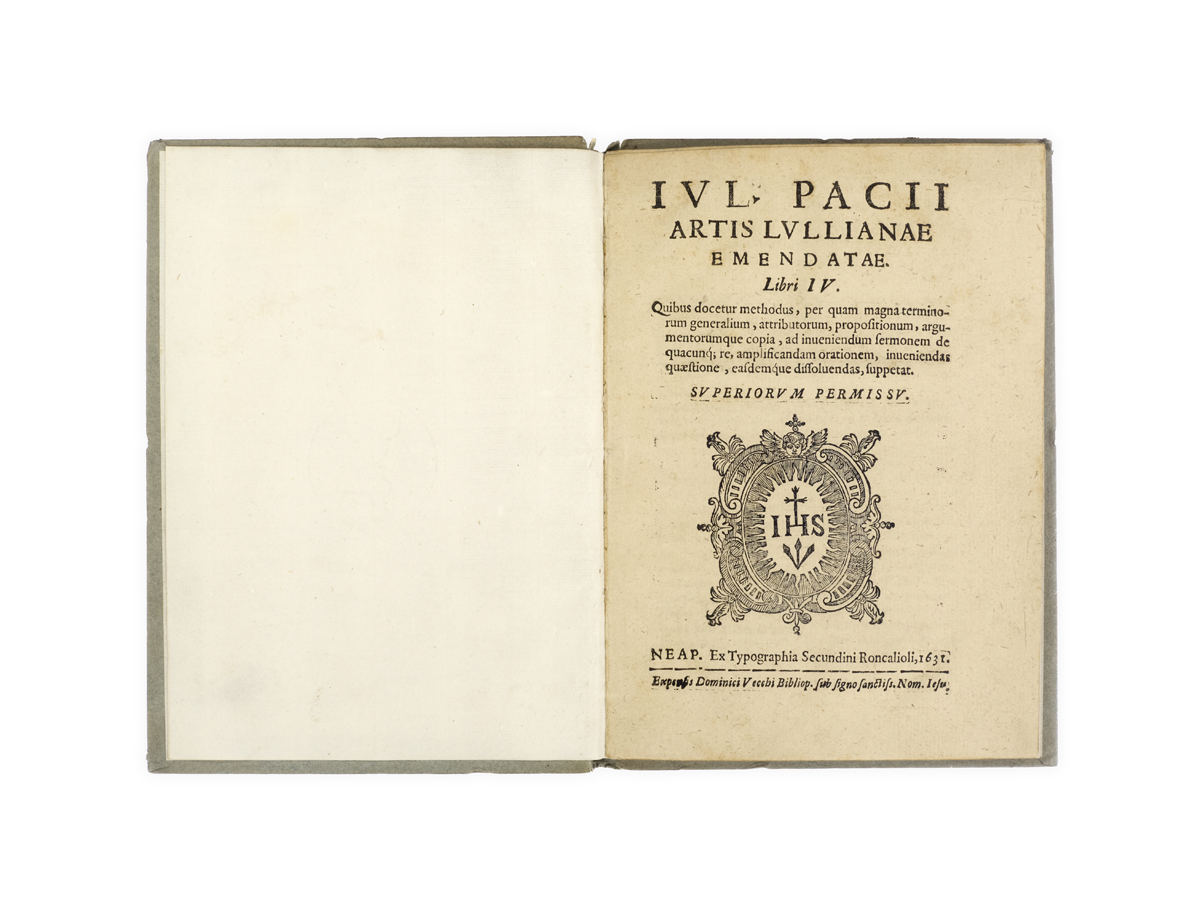
Artis Lullianae emendatae libri IV. Quibus docetur methodus, per quam magna terminorum generalium, attributorum, propositionum, argumentorumque copia, ad inveniendum sermonem de quacunque re, amplificandam orationem, inveniendas quaestione, easdemque dissolvendas, suppetat. Naples, Secondino Roncagliolo, 1631.
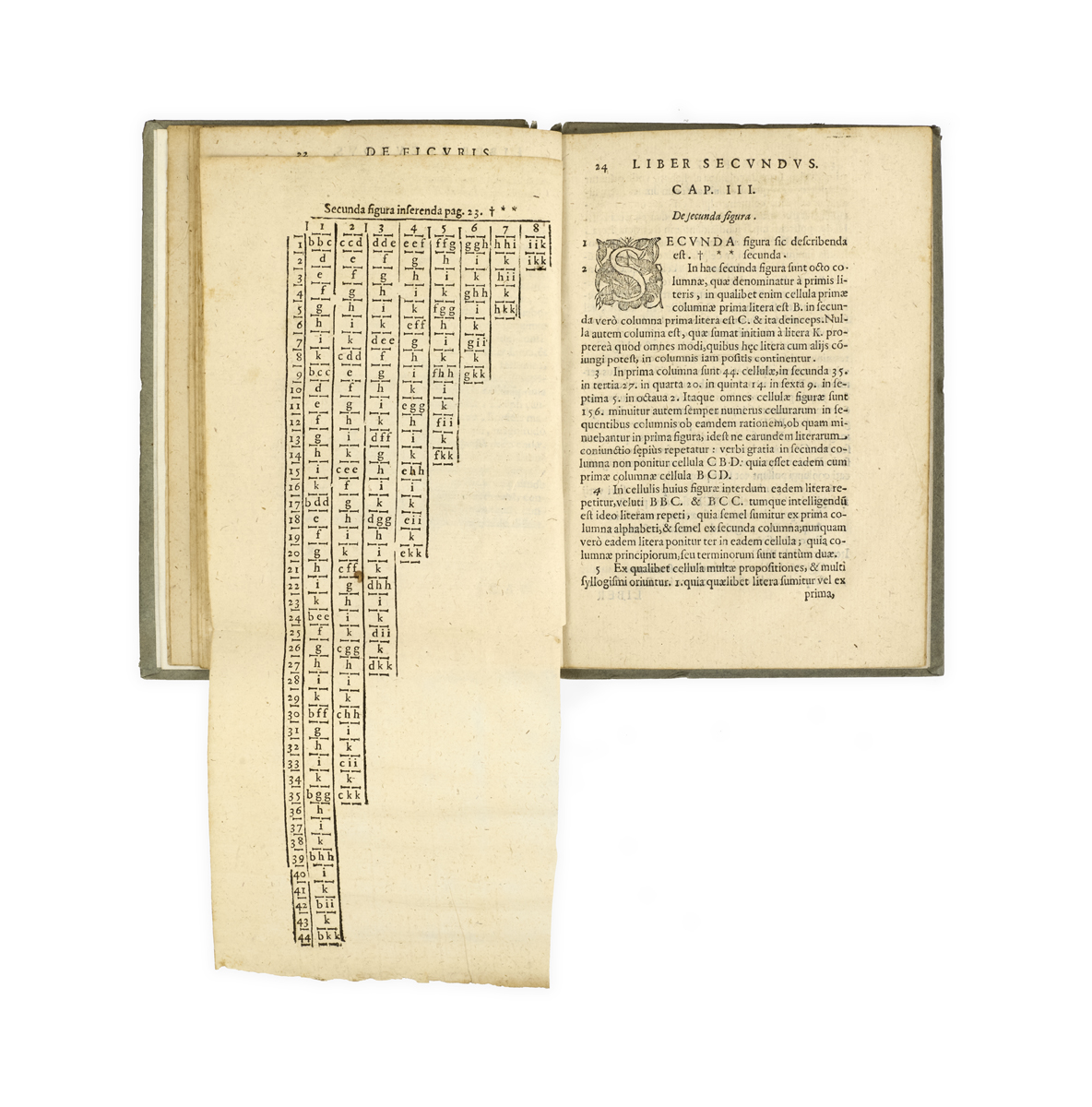
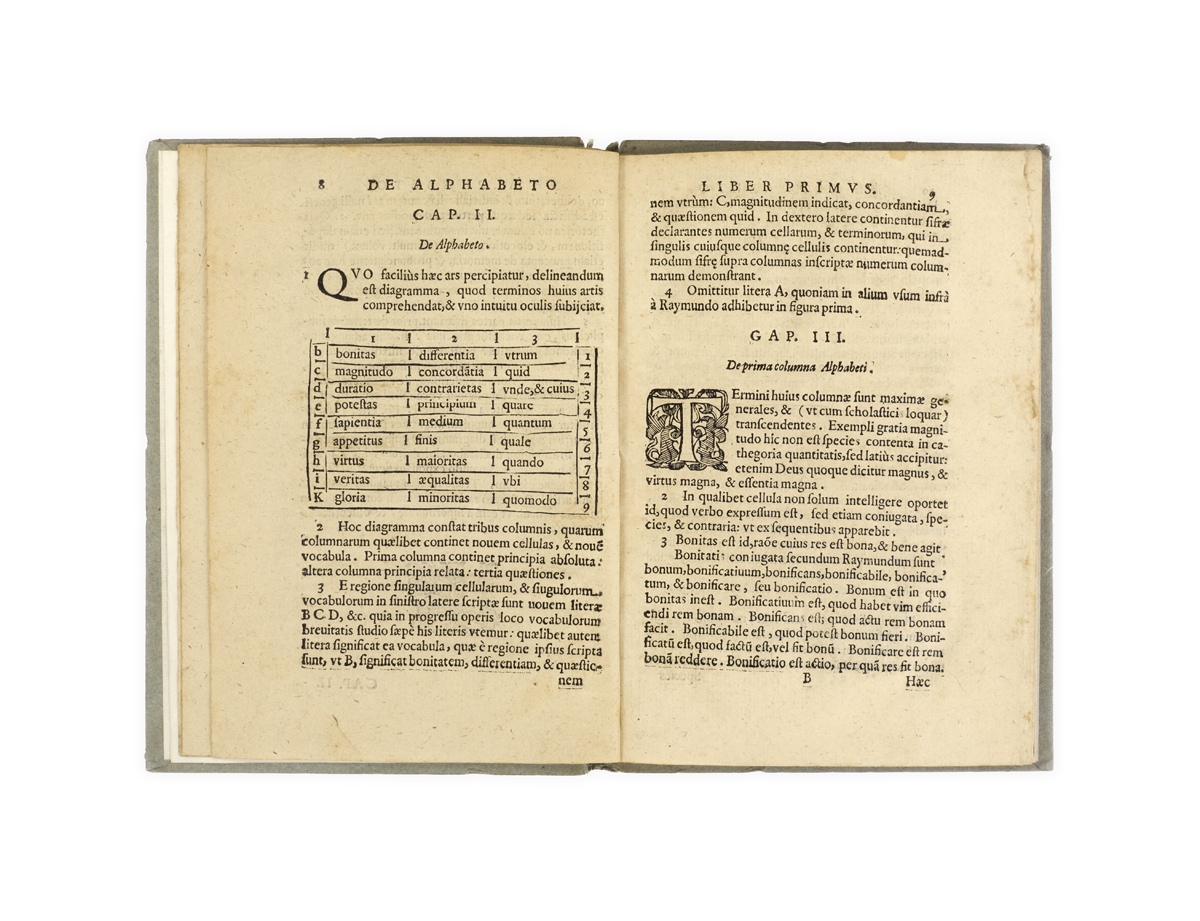
4to, pp. 43, [1 (index)], with a folding table at p. 23; woodcut Jesuit device to title, woodcut initials and tailpieces, two letterpress diagrams in the text; lightly toned, a little cockling and slight marginal foxing, otherwise a very good copy; bound in mid-nineteenth-century blue-grey boards, shelflabel to foot of spine.
Added to your basket:
Artis Lullianae emendatae libri IV. Quibus docetur methodus, per quam magna terminorum generalium, attributorum, propositionum, argumentorumque copia, ad inveniendum sermonem de quacunque re, amplificandam orationem, inveniendas quaestione, easdemque dissolvendas, suppetat.
Rare third edition (first 1618) of this concise summary of Ramon Lull’s (c. 1232–1316) highly influential Ars Magna by the famous Protestant Italian Aristotelian scholar and jurist Giulio Pace (1550–1635), whose edition of the Organon was for a long time the standard edition of Aristotle’s works on logic.
After a mystical experience on the mountain of Puig de Randa on Mallorca, ‘in which Llull related seeing the whole universe reflecting divine attributes, he conceived of reducing all knowledge to first principles and determining their convergent point of unity … Llull used logic and complex mechanical techniques involving symbolic notation and combinatory diagrams to relate all forms of knowledge, including theology, philosophy, and the natural sciences as analogues as one another and as manifestations of the godhead in the universe’ (Encyclopaedia Britannica).
Pace (1550–1635) studied philosophy and law at the University of Padua, then a hub of Protestant ideas with numerous German students, and fled across the Alps after difficulties with the Inquisition, whereupon he converted to Protestantism. Peiresc obtained a position for him at Valence in southeastern France (1616–20). The present work dates from Pace’s time in Valence, and is considered somewhat exceptional among seventeenth-century interpreters of Lull in avoiding digressions into alchemy, cabalism and magic, and in sticking more closely to Lull’s traditional interests (Hillgarth, Ramon Lull and Lullism in fourteenth-century France (1971), p. 294).
OPAC SBN finds only three copies in Italy; outside continental Europe, we find two copies in the UK (both at Bodley), and none in the US.
USTC 4010340; Palau 208041; Rogent and Duran, Bibliografía de les impressions Lullianes 203; not in BM STC Italian.