Unpublished Protofeminist Drama
[PAOLINI] MASSIMI, Petronilla.
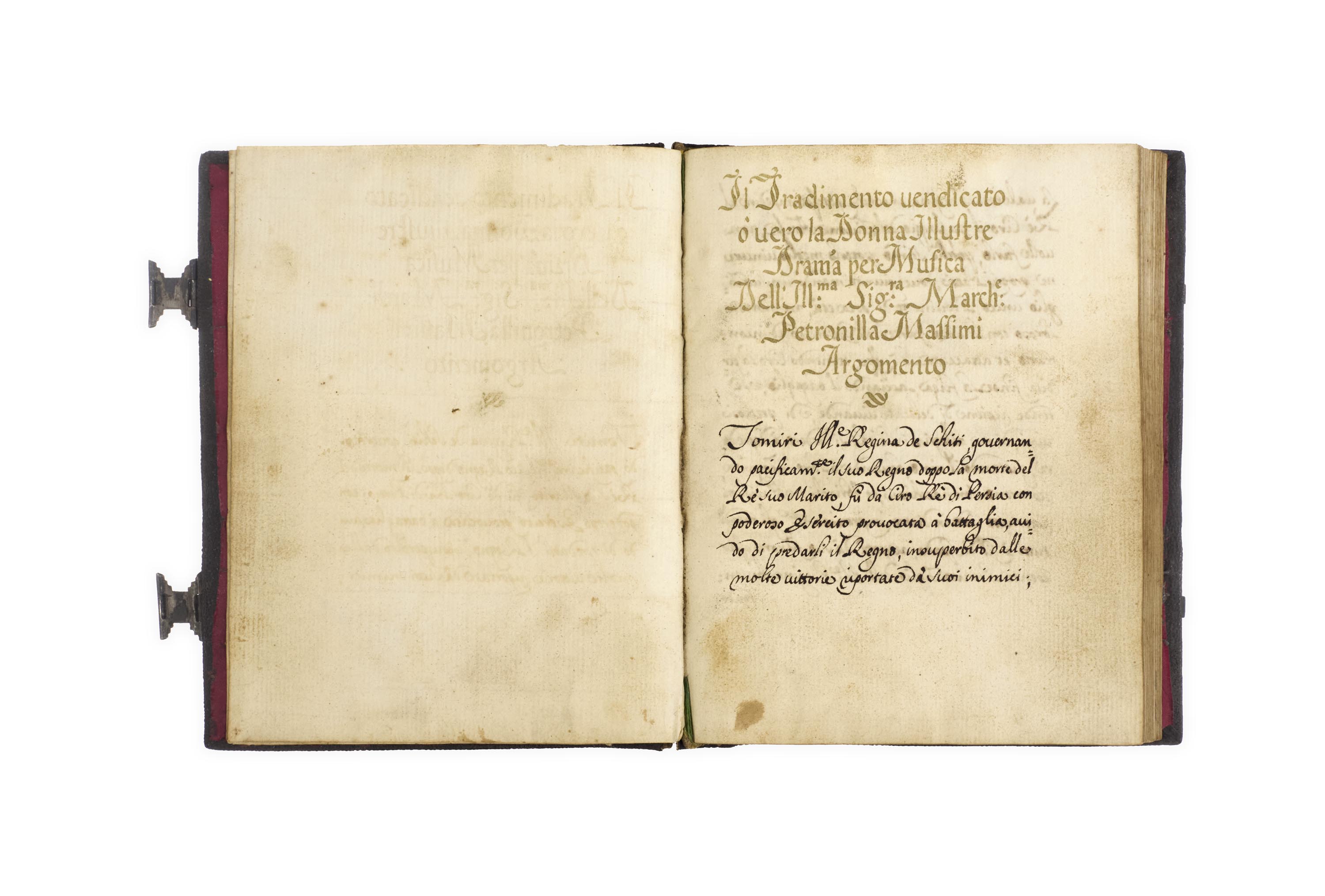
‘Il Tradimento vendicato o[v]vero La Donna illustre dram[m]a per musica’. [?Rome, late seventeenth–early eighteenth century.]
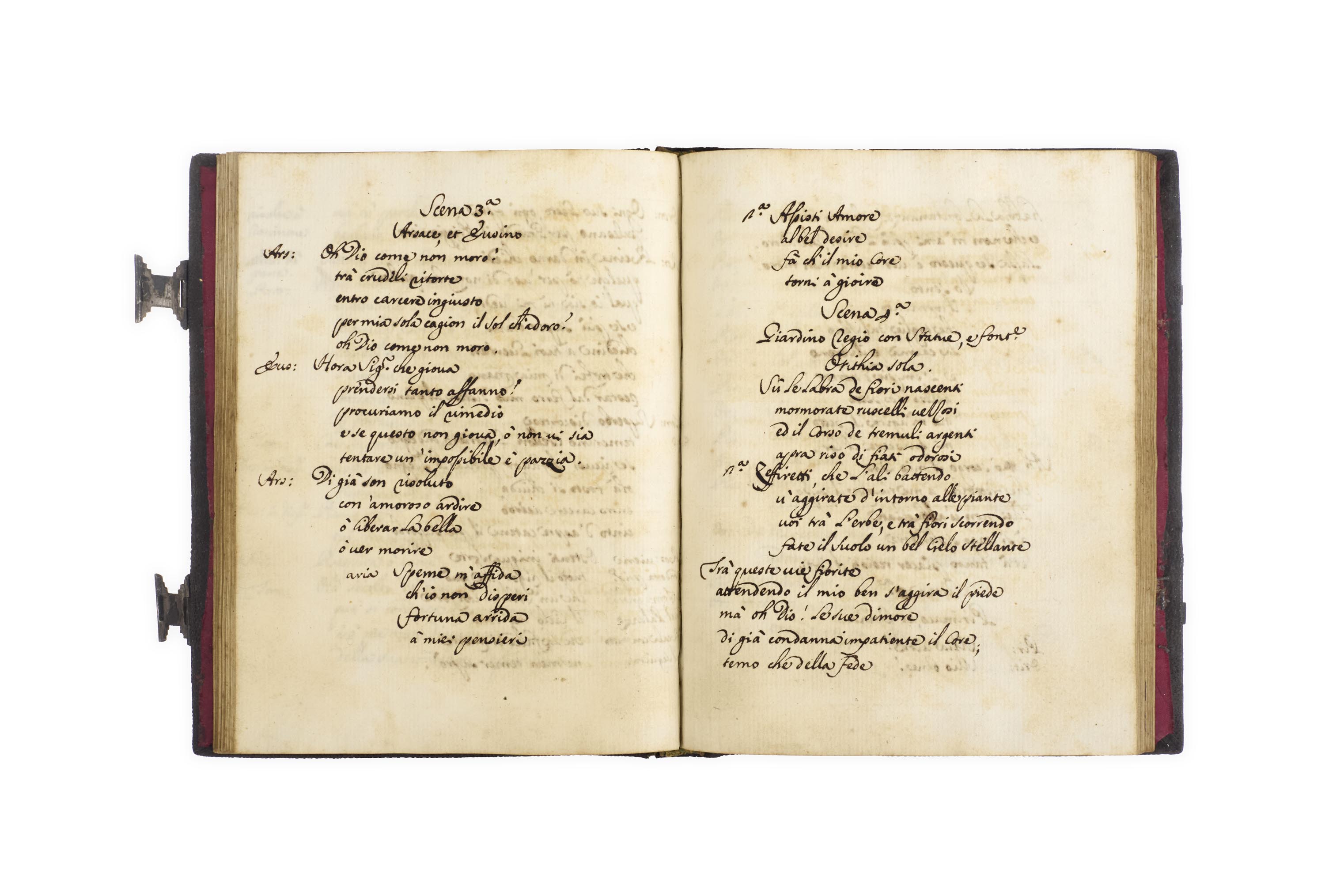
Manuscript on paper, 4to, ff. [ii], 55, [2 (blank)]; written in a single hand in brown ink, approximately 21 lines to a page, title in gold ink; ink slightly showing through, but in very good condition; bound in contemporary blind-tooled shagreen over bevelled wooden boards, silver clasps to fore-edge, edges gilt, red silk pastedowns; early numbering (776) to the front free endpaper.
Added to your basket:
‘Il Tradimento vendicato o[v]vero La Donna illustre dram[m]a per musica’.
Rare complete manuscript witness of a ‘dramma per musica’ by the Italian noblewoman Petronilla Paolini Massimi (1663–1726), known in Arcadia as Fidalma Partenide. Like her best-known works (mostly canzoni), this piece of drama, which to our knowledge was never put to music or printed, is poignantly rooted in the many sorrows which she experienced.
Petronilla Paolini Massimi was educated at the Convent of the Holy Spirit in Rome, until at the age of only ten, she was induced to marry a much older suitor, Marquis Massimi d’Aracoeli. A relative of Pope Clement X, he was believed to have commissioned the murder of her father to secure possession of her inheritance, and imposed on Petronilla a solitary life in Castel Sant’Angelo, then a prison, which her husband managed. Her writing was strongly affected by her exposure to many episodes of violence and oppression, victim of a husband who denied her means and freedom for education and even for the assistance of her own children (one of whom died young). Petronilla found her voice in verse, and eventually succeeded in challenging her husband in court, and winning her freedom and access to her inheritance.
In 1698 Petronilla was elected to the Accademia degli Arcadi with the pastoral name Fidalma Partenide, and she was soon welcomed into the literary academies that flourished in eighteenth-century Rome, Siena, Perugia, and Foligno. There she freely composed baroque-style verses, both religious and occasional, and most remarkably, autobiographical lyrics, and verses decrying the plight of many contemporary women. Some of her poems were published in the Rime degli Arcadi (1716–1722); many, however, only circulated in manuscript. When her husband died in 1709, she returned to the convent of her early childhood and dedicated two years to writing and to the study of philosophy.
Though listed in repertoires of her work, this dramma never appears to have been published. It is set in the exotic lands of the Scythians and in the remote era of Cyrus of Persia, drawing upon Herodotus. The central character of Queen Tomyris, the proud defeater of Cyrus, celebrates the rejection of traditional female social roles, whilst at the same time offering affecting moments of meditation on personal sacrifice, and deep pathos connected with the theme of the loss of a son: a gracefully veiled yet unmistakeable alter ego of Petronilla herself.
Not in Corago, Repertorio e archivio di libretti del melodramma italiano dal 1600 al 1900. See Natali, Storia letteraria d’Italia. Il Settecento (1936), p. 149, and most recently Di Matteo, Arcadia al femminile (2017), with a table listing all of Paolini Massimi’s publications.