A Seventeenth-Century French Scholar Reads the Satyricon
PETRONIUS.
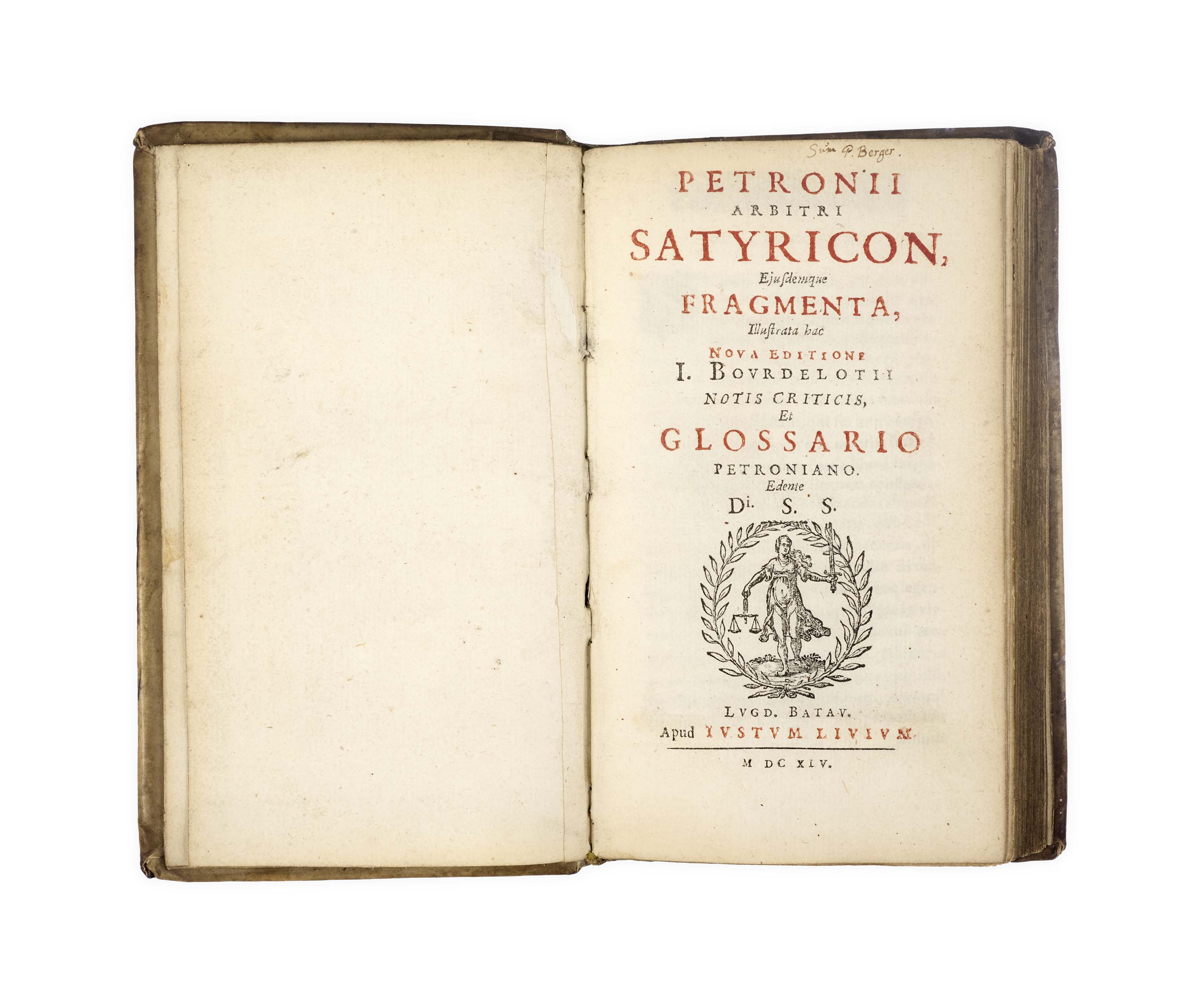
Satyricon, eiusdemque fragmenta, illustrata hac nova editione I. Bourdelotii notis criticis, et glossario petroniano edente Di. S. S. Leiden, Justus Livius, 1645.
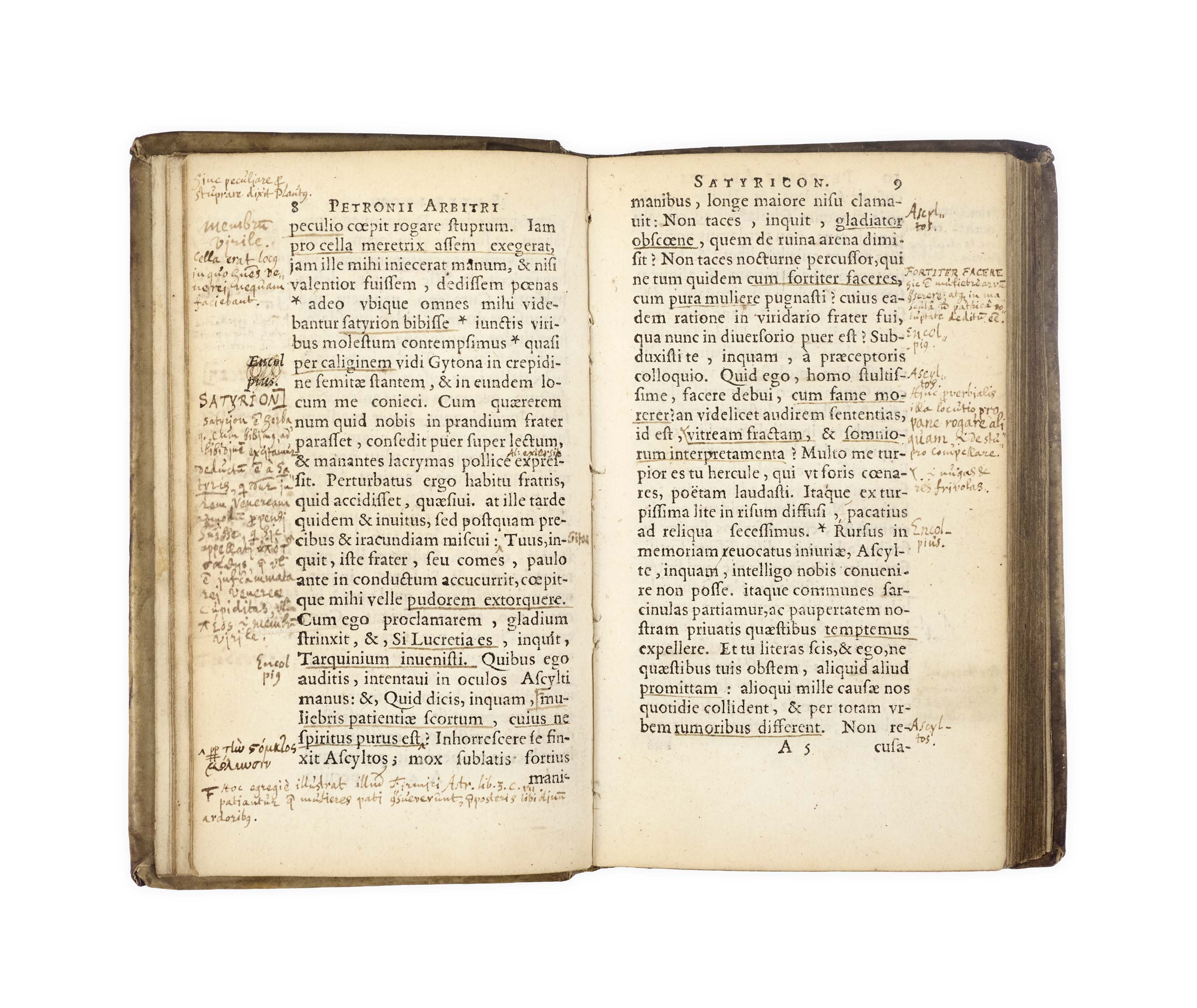
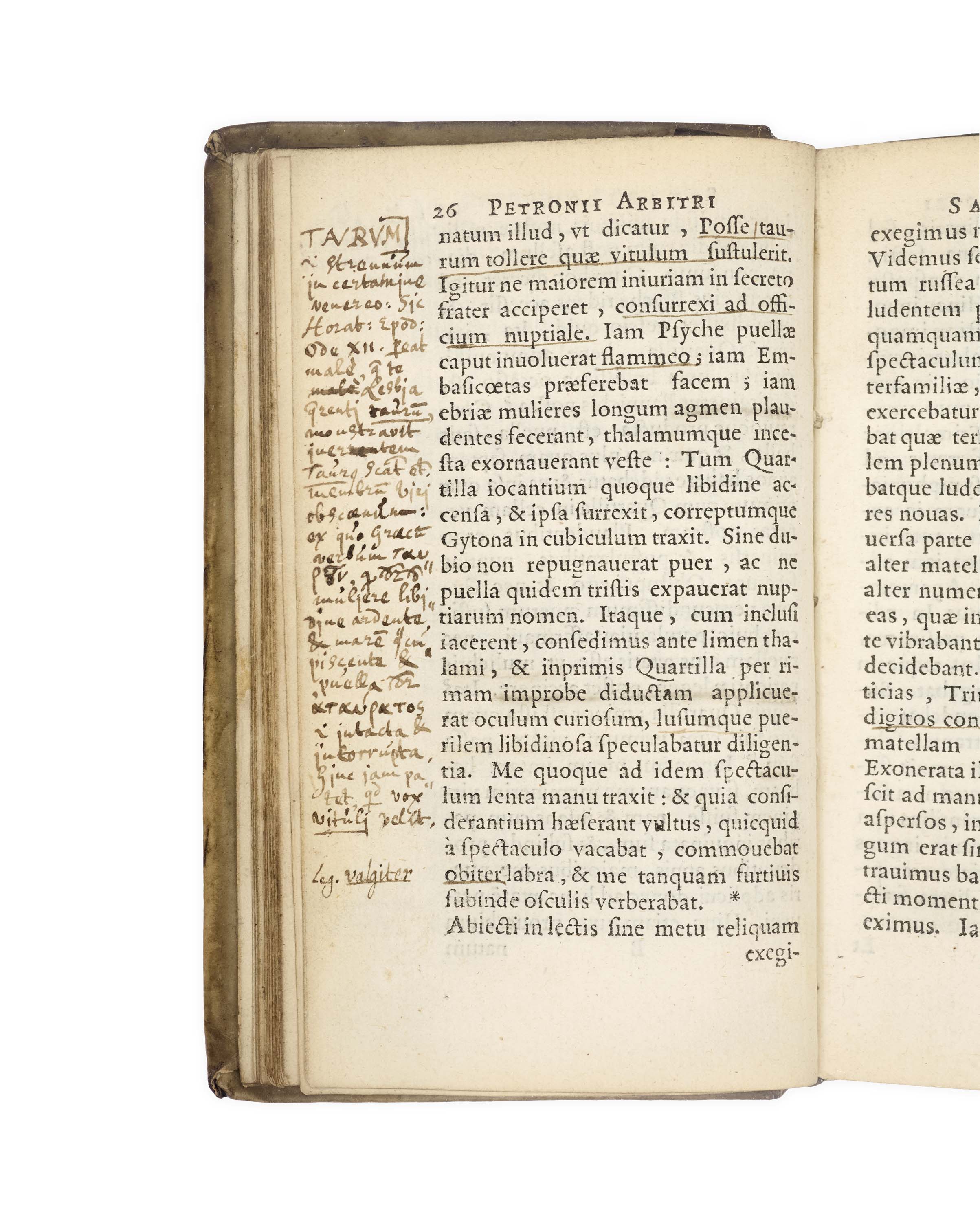
12mo, pp. [xii], 199, [1, blank], 200–251; title printed in red and black, woodcut printer’s device to title, woodcut initials and headpieces; minute marginal paper-flaw to lower outer corner of A6, but a very good, clean copy; bound in contemporary vellum over boards, later manuscript lettering in ink to spine, sewn on 3 parchment thongs laced in; a few small stains to front board, corners bumped; contemporary ownership inscription ‘Sum P. Berger’ to title, numerous marginalia in Latin and occasionally Greek to the initial 26 pp. and occasionally thereafter, all in the same contemporary hand; ownership inscription of Penrhyn George Edward Chave (1890–1961) to front free endpaper.
Added to your basket:
Satyricon, eiusdemque fragmenta, illustrata hac nova editione I. Bourdelotii notis criticis, et glossario petroniano edente Di. S. S.
Third edition of the Satyricon as edited by the French scholar Jean Bourdelot (first published in 1618), accompanied by a glossary, an editorial preface and an extract of Justus Lipsius’ Epistolicis Quaestionibus (lib. III, epist. 2) with an appraisal of the literary value of the Satyricon.
The early reader of this copy, ‘P. Berger’, gives thorough attention to the first 26 pages, up to the beginning of the episode of the Cena Trimalchionis, but his reading continues, with meaningful underlining and occasional notes, through to the end. The first episode commands Berger’s full engagement as a reader/annotator: Encolpius’s witnessing of a debate about the bombastic style and irrelevant content of the first-century school curriculum. This is a topic that would have resonated with seventeenth-century French scholars, themselves engaged in far-reaching debates over the value of classical literature as supreme model of literary excellence (canonised further in the Jesuit ratio studiorum of 1599), in relation to the rise of philosophy, new science and changes in literary taste championed by contemporary writers – a debate known as the ‘Battle of the Books’.
The notes indicate a philological interest, with references to editors (e.g. Henri Estienne, p. 5) and with inclusion of variants (e.g. ‘minimum’ for ‘nimirum’, p. 3; ‘valgiter’ for ‘obiter’, p. 26), suggesting a cross-edition approach to this text. The reader is also interested in vocabulary, with idiosyncratic terms typical of Petronius’s language given a synonym in more standard Latin, and sometimes a longer explanatory note; he investigates the cultural and social details relating to the underworld of sexual commerce in Rome, and evokes references to the poetry of the Golden Age, such as Catullus and Horace.
USTC 1028471; Schweiger 753; Schmeling and Stukey 57.