Murdered Monarchs in Mourning Morocco
PITOU, Louis-Ange.
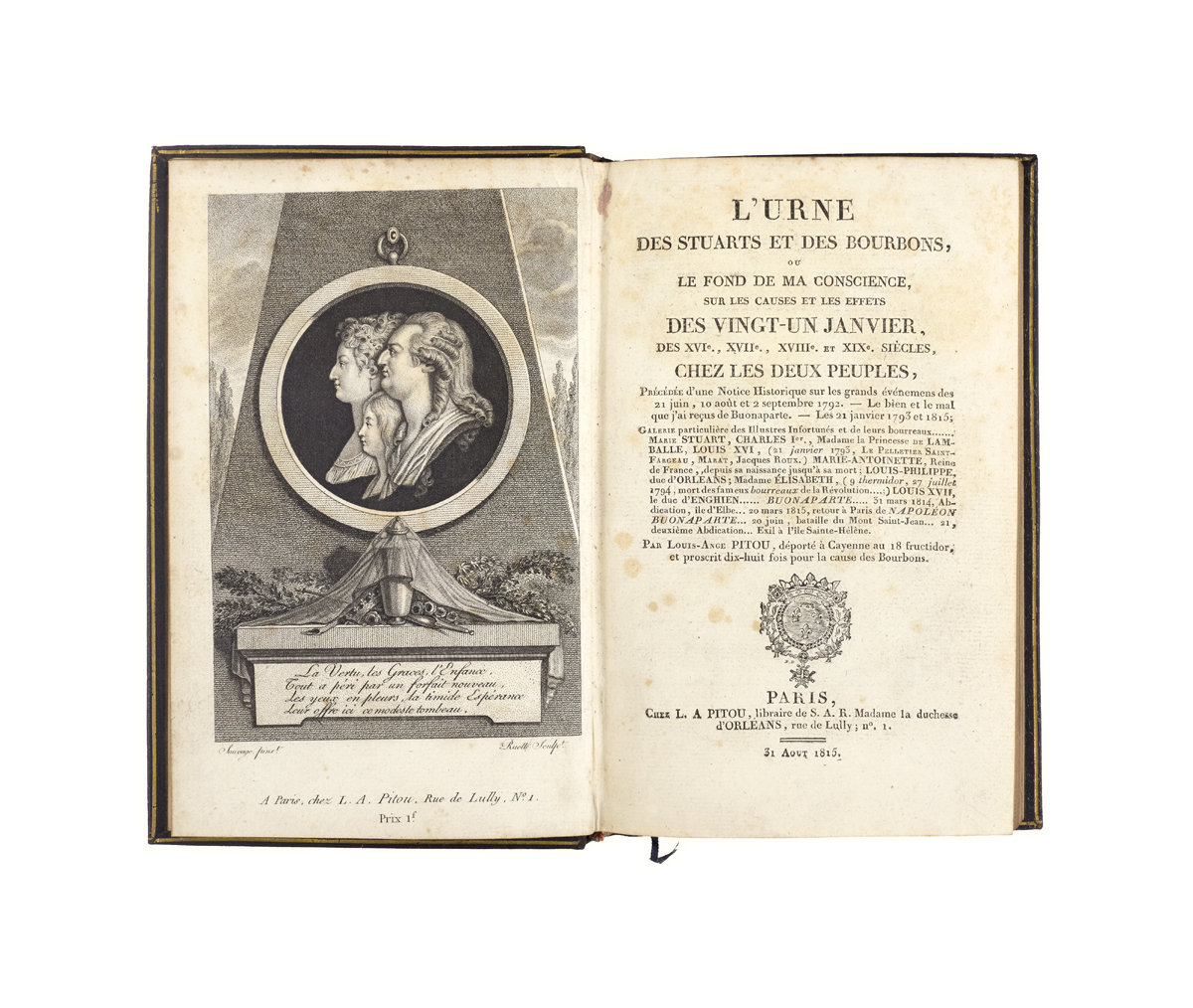
L’Urne des Stuarts et des Bourbons, ou le fond de ma conscience, sur les causes et les effets des vingt-un Janvier, des XVIe, XVIIe, XVIIIe et XIXe siècles, chez les deux peoples… Paris, [Beraud for] L.A. Pitou, 31 August 1815.
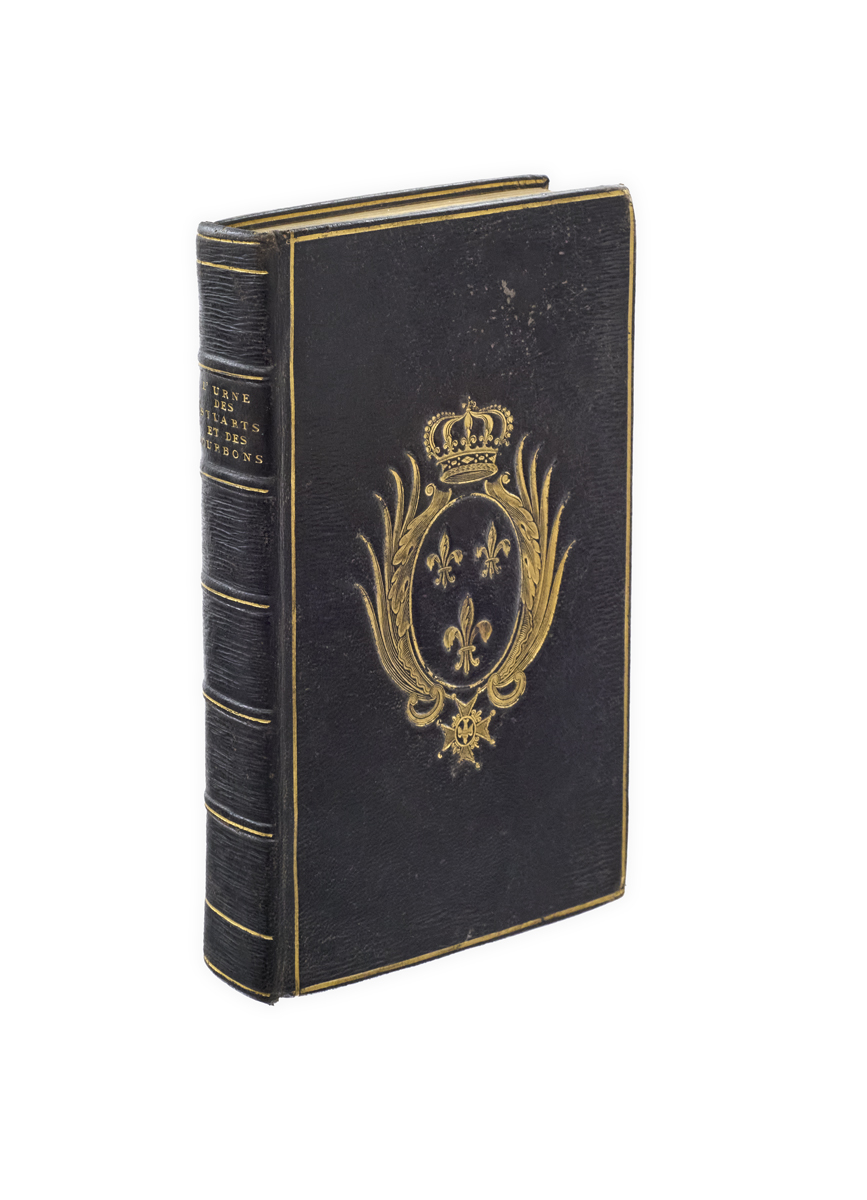
8vo, pp. [4], xxiv, [5]–52, ‘51–430’ (i.e. 53–432), [2 (errata)], with stipple-engraved frontispiece by Ruotte after Sauvage; quire b misbound around quire a (as in other copies), a few errors in pagination; a few inconsequential spots, occasional light toning, small paperflaw to lower margin of f. b3, nonetheless a very good copy; bound in contemporary black straight-grained morocco, boards blocked in gilt with the arms of Louis XVIII, borders, edges, and turn-ins filleted in gilt, spine gilt-ruled in compartments and lettered directly in gilt, edges gilt, green endpapers, blue ribbon place-marker, green endpapers; a little rubbed, corners slightly bumped; armorial bookplate of Lord Ashburton to upper pastedown (see below).
Added to your basket:
L’Urne des Stuarts et des Bourbons, ou le fond de ma conscience, sur les causes et les effets des vingt-un Janvier, des XVIe, XVIIe, XVIIIe et XIXe siècles, chez les deux peoples…
First and only surviving edition of this account of executed royals from England and France by the royalist publisher and propagandist Louis-Ange Pitou (1767–1846), published on the return of Louis XVIII to Paris after the Hundred Days.
The text begins with brief lives of the executed Stuarts Mary, Queen of Scots, and Charles I, who serve as parallels to the victims of the French Revolution. There follow accounts of the deaths of Louis XVI, Marie-Antoinette, Louis XVII, Louis Philippe II, duc d’Orléans, and Madame Élisabeth, and of Lepelletier, Marat, Robespierre, and other revolutionaries, woven together into a potted and partisan history of the Revolution and the Terror, up to the Bourbon Restoration, the transfer of Louis XVI and Marie-Antoinette’s ashes to St Denis, and – no doubt added in haste – the Hundred Days.
The text is prefaced by smatterings of autobiography, Pitou’s best-rehearsed material, recounting both his education and early career, including his famous exile to Guyana, and his activities during the Hundred Days, fleeing Paris to join royalist forces. He complains of the doubled costs of publishing the Urne, claiming to have completed printing for the first time on 20 March and had to pulp it on Napoleon’s return.
The funereal allusions of the title are continued in the frontispiece, depicting a funerary monument to Louis XVI, Marie Antoinette, and the young Louis XVII; the present copy is bound in striking and suitably mournful black straight-grained morocco with the French royal arms.
Provenance:
From the library of the banker, politician, and diplomat Alexander Baring, first Baron Ashburton (1774–1848). Although best-known for his activities in America, he was closely involved with France: in 1803 he negotiated the financing of the Louisiana Purchase, in 1815 he financed British war effort, and after Napoleon’s defeat at Waterloo he financed France’s reparations to the victorious powers; he was a friend of Talleyrand and a longstanding ally of Wellington.
Library Hub finds only three copies in the UK (BL, NLS, Manchester) and OCLC only three in the US (Michigan, UCLA, Washington).