The First Complete Plato
PLATO; Jean DE SERRES, translator and commentator; Henri ESTIENNE, editor.
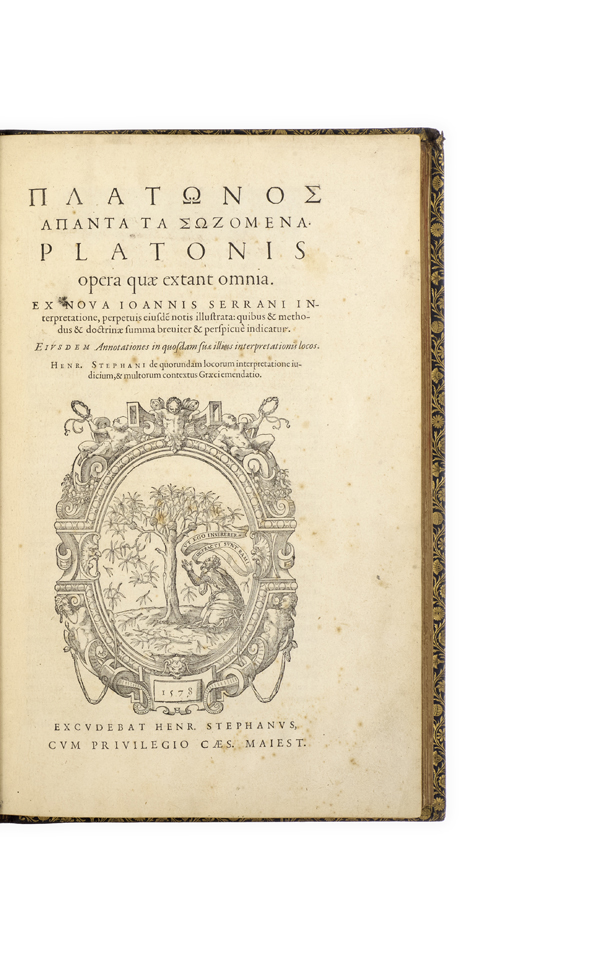
Απαντα τα σωζομενα … Opera quae extant omnia … [Geneva], Henri Estienne, 1578.
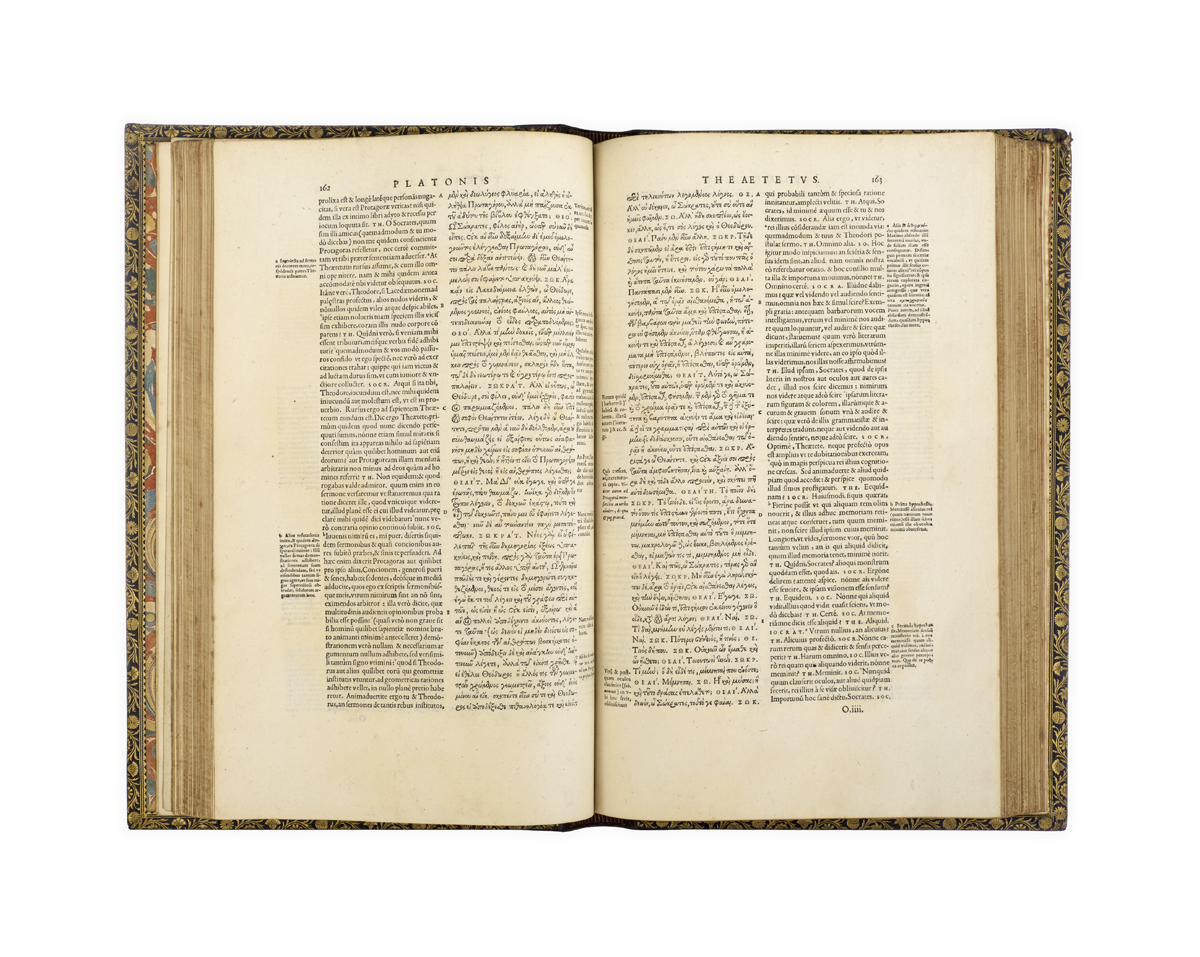
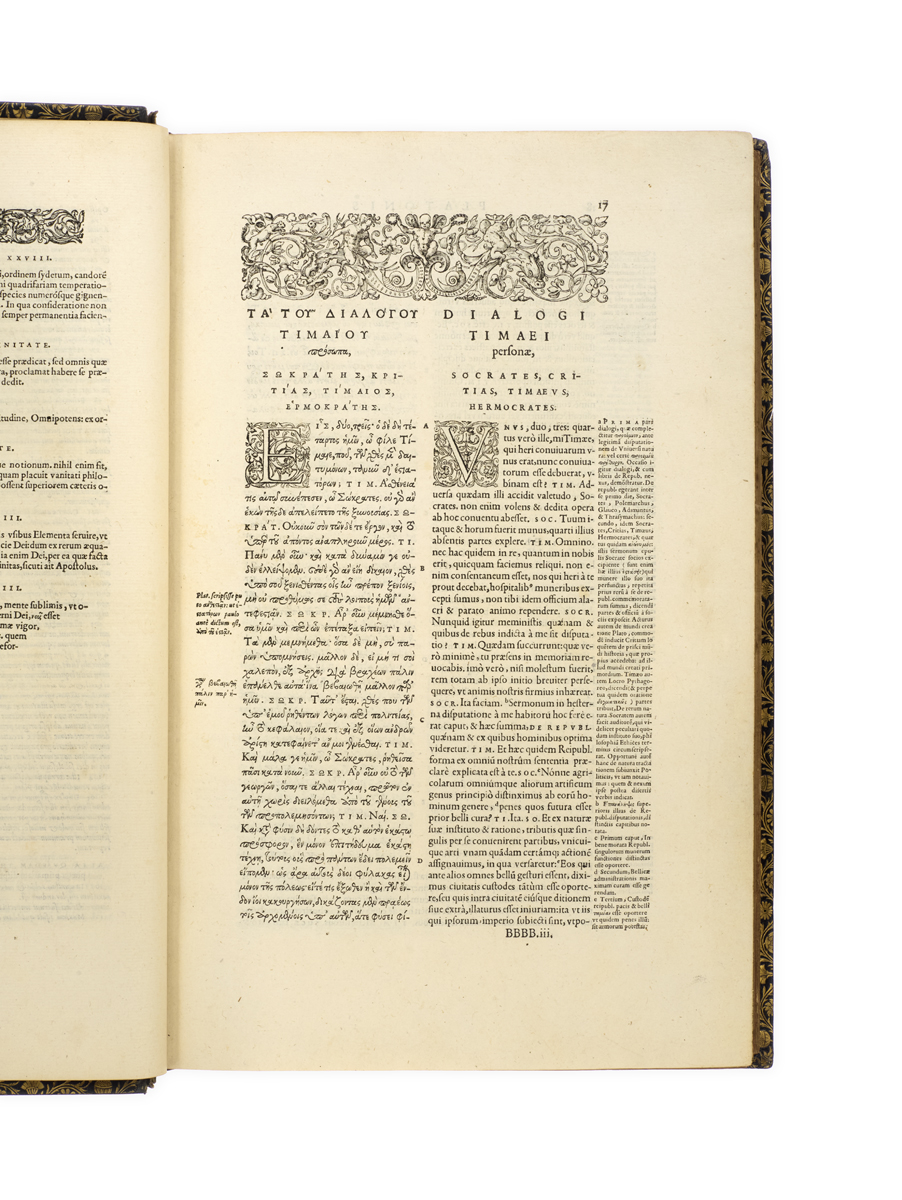
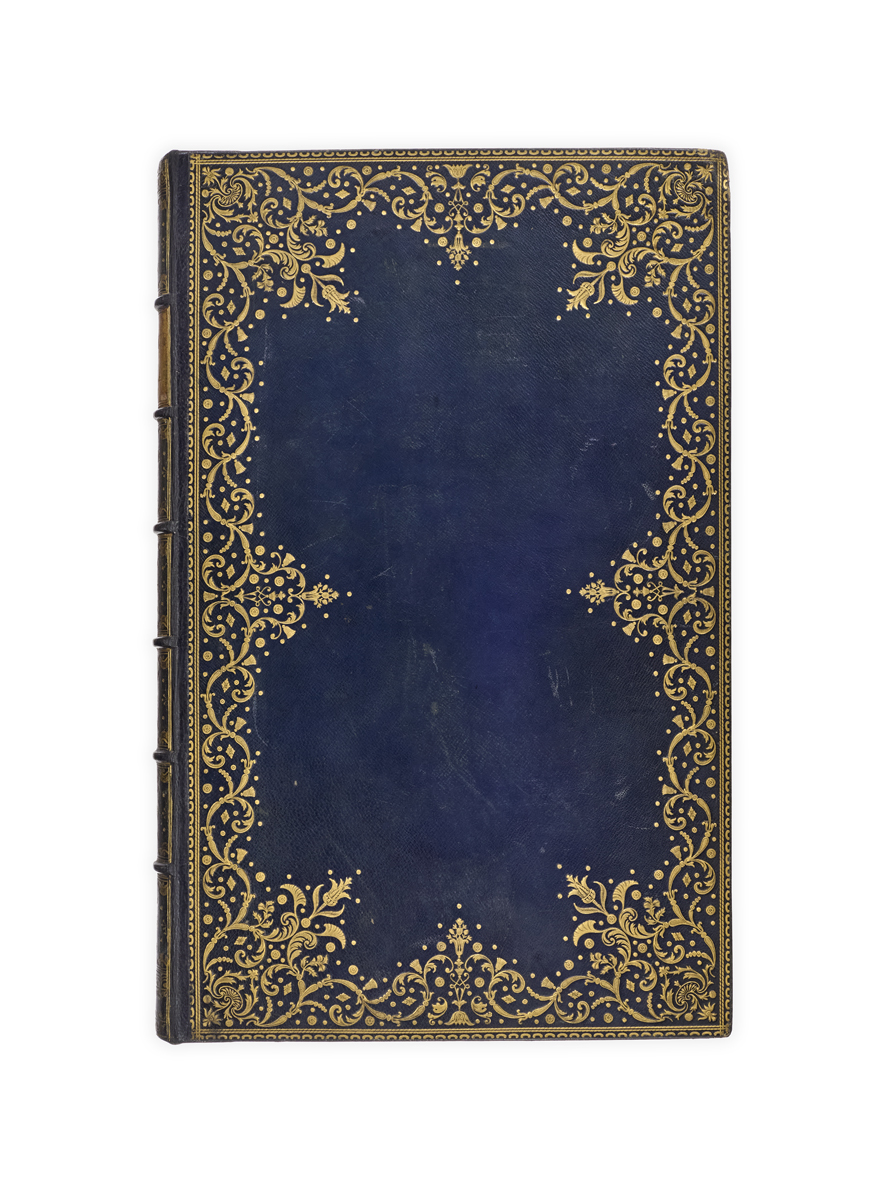
Four parts bound in three vols, folio, pp. I: i: [xxxvi], 542, II: ii: [viii], 992, III: iii: [viii], 416, iv: 139; vol. I bound without the final blank Yy8; printed in Latin and Greek in parallel columns, large printer’s device to titles, woodcut initials, woodcut head- and tail-pieces; bifolia I Nn3.4 and III NNNN6 misbound; very small marginal paper-flaws to I Ll1, small marginal paper-flaw to title of vol. II (neatly repaired), a few very light spots to the preliminary leaves of vol. I, withal a very good set; bound in late nineteenth-century blue morocco gilt à la dentelle, endpapers signed in black (MacKenzie?), spines gilt in compartments with gilt red morocco lettering-pieces, edges gilt, marbled endpapers; vols I and II neatly rebacked with spine relaid, joints and extremities a little rubbed with some old retouching, a few slight scuffs, corners bumped; modern private collector’s book label to front pastedowns.
A magnificent large-paper copy of the first complete edition of Plato’s corpus, edited by Henri Estienne and accompanied by a new parallel translation by Jean de Serres.
‘Henri Estienne’s monumental edition of Plato, the first complete edition, which for two centuries remained the indispensable instrument of Platonic studies; to this day its pagination is universally accepted as the standard system of reference to the text of Plato’ (Schreiber). The ‘Stephanus’ reference to chapters and paragraphs, still used in scholarship today, refers to the arrangement devised by Henri Estienne for this edition.
This landmark edition of Plato’s collected works ranks among the most remarkable and influential achievements of the eminent scholar-printer Henri Estienne II. He established the Greek text through meticulous comparison of the 1513 Aldine edition, the Basel printings of 1534 and 1566, and the 1531 Louvain edition of the Laws, supplementing these with manuscript sources. Maintaining his exacting scholarly principles, Estienne emended corrupt passages through conjecture, but printed the latter in the margins, clearly setting them apart from the text proper; he also rejected Ficino’s Latin translation and arranged for a fresh one by Jean de Serres, which he carefully revised. Serres, a committed Protestant, prefaced the three volumes with individual dedicatory letters addressed to Elizabeth I of England, James VI of Scotland, and the Canton of Berne.
‘Of all Estienne’s publications the Plato is perhaps the most lavishly decorated: besides numerous woodcut initials, culs-de-lampe, and a striking, elaborate title-device, it is the only publication in which Estienne used his entire series of decorative headpieces. Although this sumptuous Plato further contributed to Estienne’s financial ruin, it is also (after the Thesaurus) the work which most contributed to his fame’ (Schreiber). Both Renouard and Brunet note that copies in good condition are rare, while Dibdin writes: ‘This work has long been considered as a very valuable acquisition to the libraries of the learned, and for its magnificence and variety of critical material must be always held in estimation’.
USTC 450772; GLN 15-16 2690; Adams, P 1439; Brunet IV, 695; Dibdin II, p. 134-6; Renouard 145-6, 1; Schreiber 201.