The Birth of the Mail Coach
[POSTAL SERVICE.]
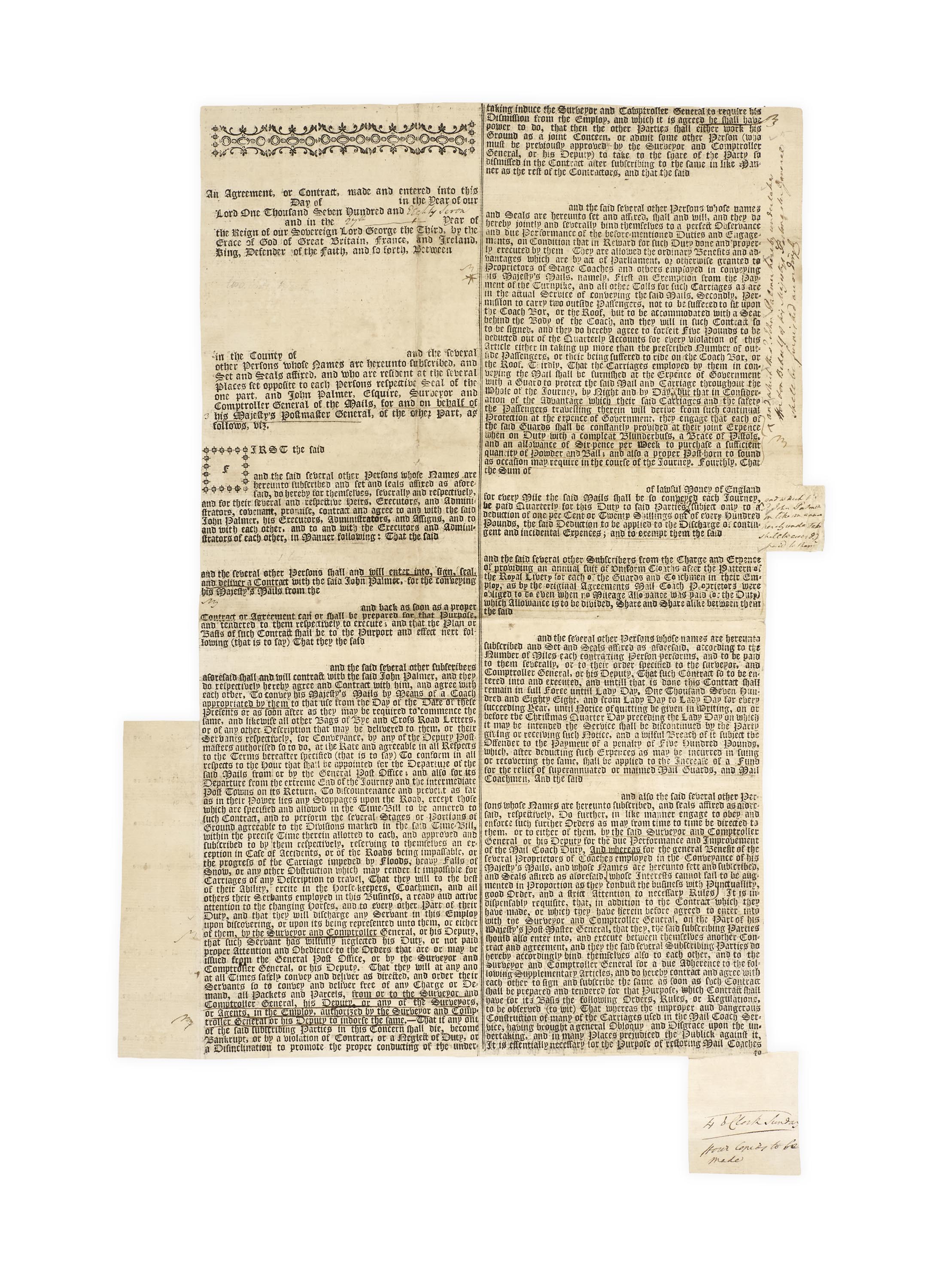
Part-printed draft contract with manuscript corrections: ‘An Agreement, or Contract, made an entered into this [blank] Day of [blank] in the Year of our Lord one thousand Seven hundred and [eighty seven] … between [blank] … and John Palmer, Esquire, Surveyor and Comptroller General of the Mails, for and on behalf of his Majesty’s Postmaster General’ [London? 1787].
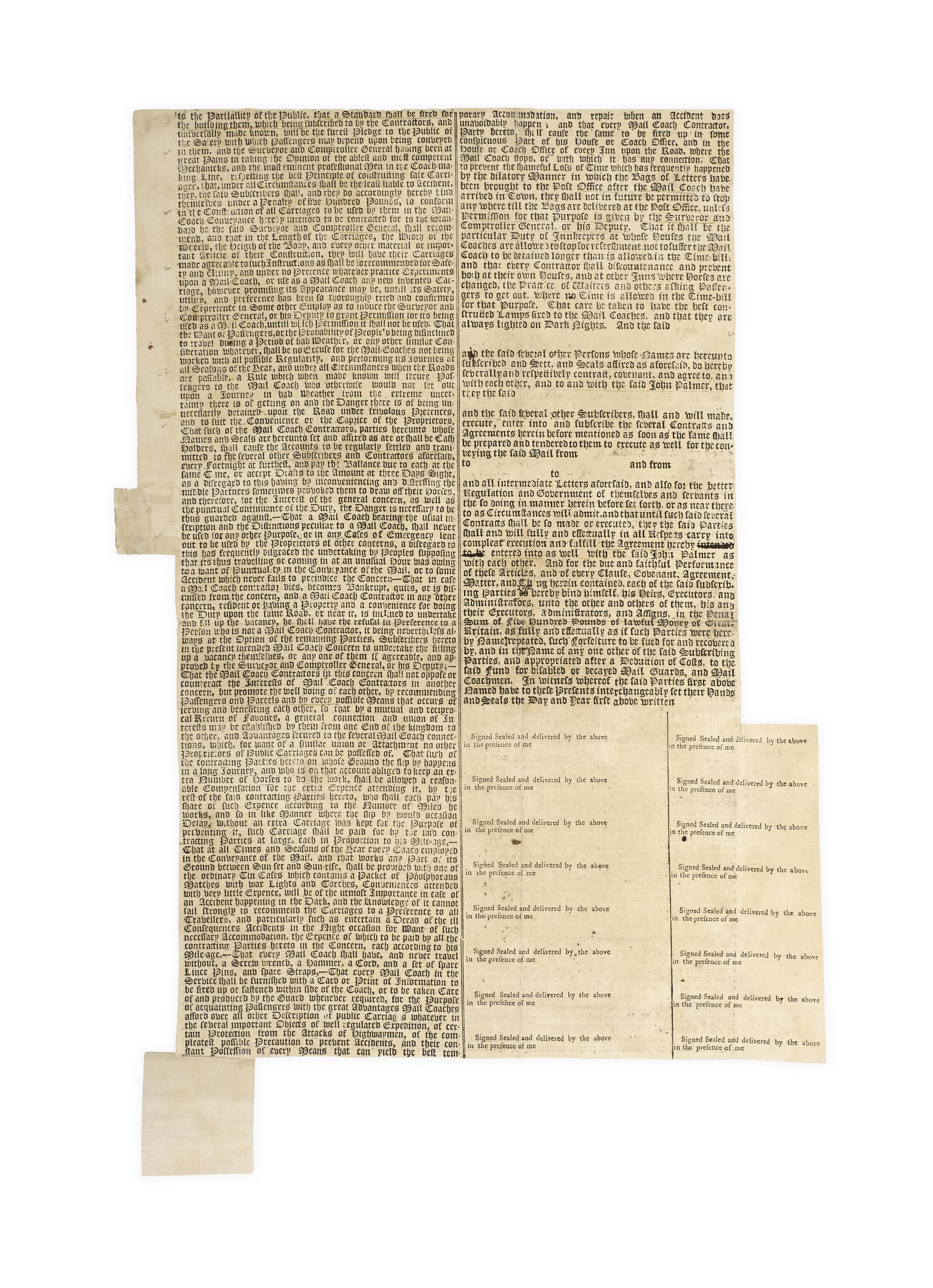
Folio, pp. [2], printed on both sides in two columns in black letter, with a decorative border at the head of the first column; manuscript additions/corrections in the margin, a few deletions, manuscript instruction to the printer at the foot; margins cut down but preserving the annotations on flaps, a couple of short tears, creased where folded, else very good.
Added to your basket:
Part-printed draft contract with manuscript corrections: ‘An Agreement, or Contract, made an entered into this [blank] Day of [blank] in the Year of our Lord one thousand Seven hundred and [eighty seven] … between [blank] … and John Palmer, Esquire, Surveyor and Comptroller General of the Mails, for and on behalf of his Majesty’s Postmaster General’
An apparently unrecorded draft printed contract for the mail coach service pioneered by John Palmer in the 1780s.
Palmer (1742–1818) was the son of a prosperous tradesman who ran several concerns in Bath as well as a theatre, into which part of the business Palmer moved, securing a royal patent for the Orchard Street Theatre in 1768 (the only one outside London). In 1778 he obtained the same status for a second theatre in Bristol, its season shared with that of Bath, and he set up a coach service to transfer the actors, props, stagehands etc. between the two cities. ‘This experience, and Palmer’s own travels and correspondence in search of talent, convinced him of the need for improved communications … The essence of the scheme devised by Palmer was that the unarmed post boy with a “worn-out hack” or small cart, should be replaced by mailcoaches, similar to the stagecoaches on the improved turnpike roads that were already completing journeys with speed and security, which meant they were sometimes the preferred but unofficial way of sending letters and packages. The mailcoaches would be equipped with a strongbox, watched over by an armed guard. Mail was to be dispatched promptly – that from London no longer held back by government letters. The coaches contracted from private firms would travel overnight, stopping only to change horses, deal with mail bags, and meet the needs of passengers. Momentum would be maintained by an exemption from tolls and by the granting of priority over other vehicles’ (ODNB). Palmer’s plan came to Pitt’s attention in 1782, a successful trial was held in 1784, and the scheme was introduced to most major routes in 1785; but it was supported more by the Treasury than by the Post Office and he long remained out of pocket for his efforts. ‘Despite these battles, Palmer had managed not only to reform the national system for the collection and delivery of mail, but also to improve some antiquated procedures within the Post Office’ (ibid.).
The present draft contract is between Palmer and the unspecified private firms who would provide the coach service itself. They agree to deliver all mail on their routes, ‘discountenance and prevent’ delays, and dismiss any employees who have demonstrated neglect of duty. Coaches will be exempt from tolls, can carry two outside passengers, and will be manned by a guard ‘with a compleat Blunderbuss, a Brace of Pistols … Powder and Ball; and … a proper Post-horn’. By his manuscript addition here Palmer undertakes to furnish these himself on behalf of the Postmaster General.
Supplementary articles deal with the importance of the proper construction of coaches (poor coaches ’having brought a general Obloquy and Disgrace upon the undertaking, and in many Places prejudice the Publick against it’ (indeed a new patented coach designed by John Besant was adopted in 1787); of their operation to the agreed schedule even in inclement conditions; and of the provision of a tin case with matches and a torch in case of a night-time accident, and a box of tools for emergency repairs. Any infractions would be subject to a fine of £500, the money to go to a fund for ‘disabled or decayed Mail Guards, and Mail Coachmen’. Despite the terms, there was strong competition for the contracts because they offered a guaranteed income, and the mail coach service ran very successfully until the development of the railways in the 1830s.
At the foot is the note ‘4 o’Clock Sunday / Four Copies to be made’.
Not in ESTC, Library Hub, or OCLC.