Subscriber’s Copy – Presented to Lady Grisell Baillie
PRIOR, Matthew.
Poems on several Occasions. London, printed for Jacob Tonson and John Barber, 1718.
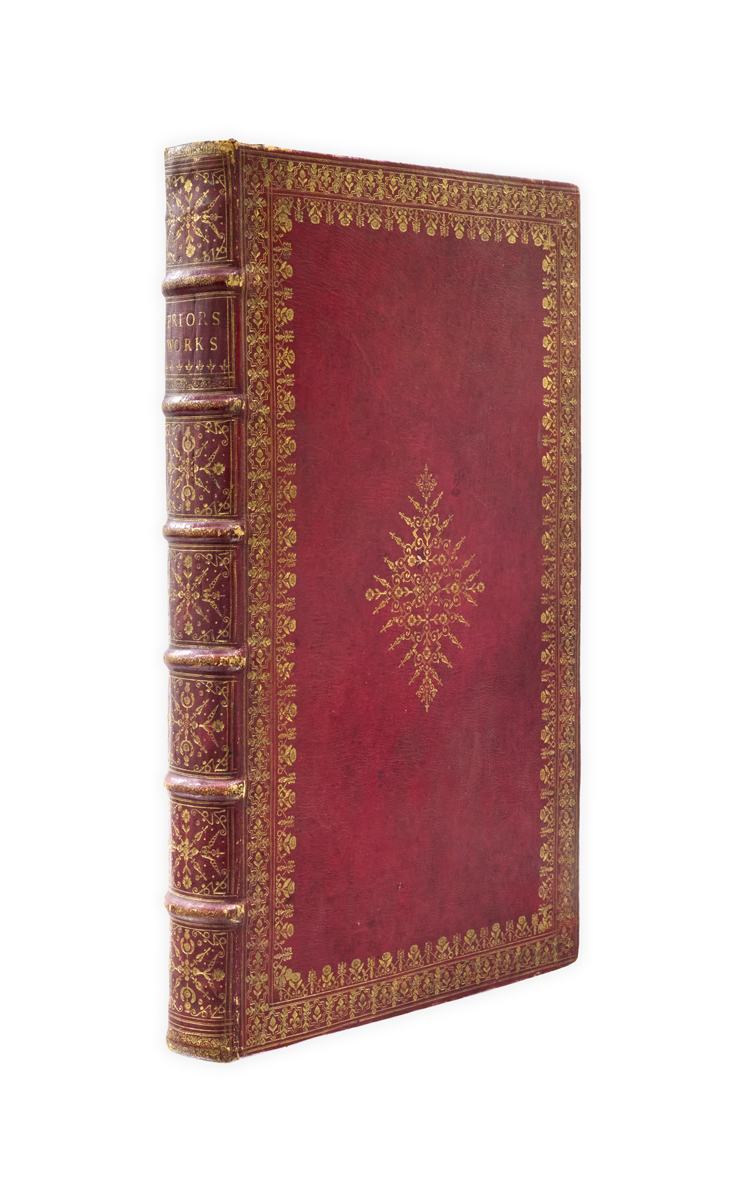
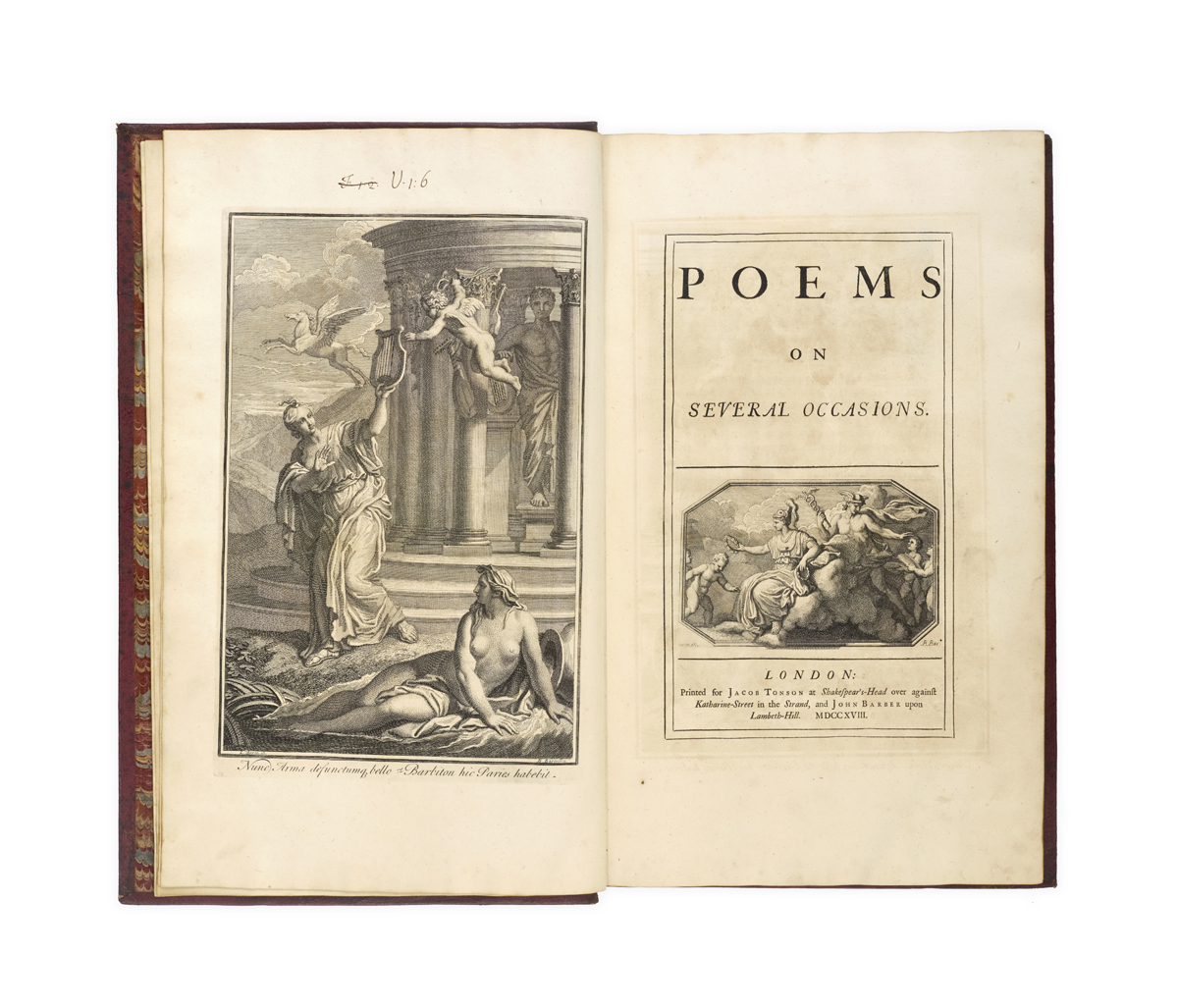
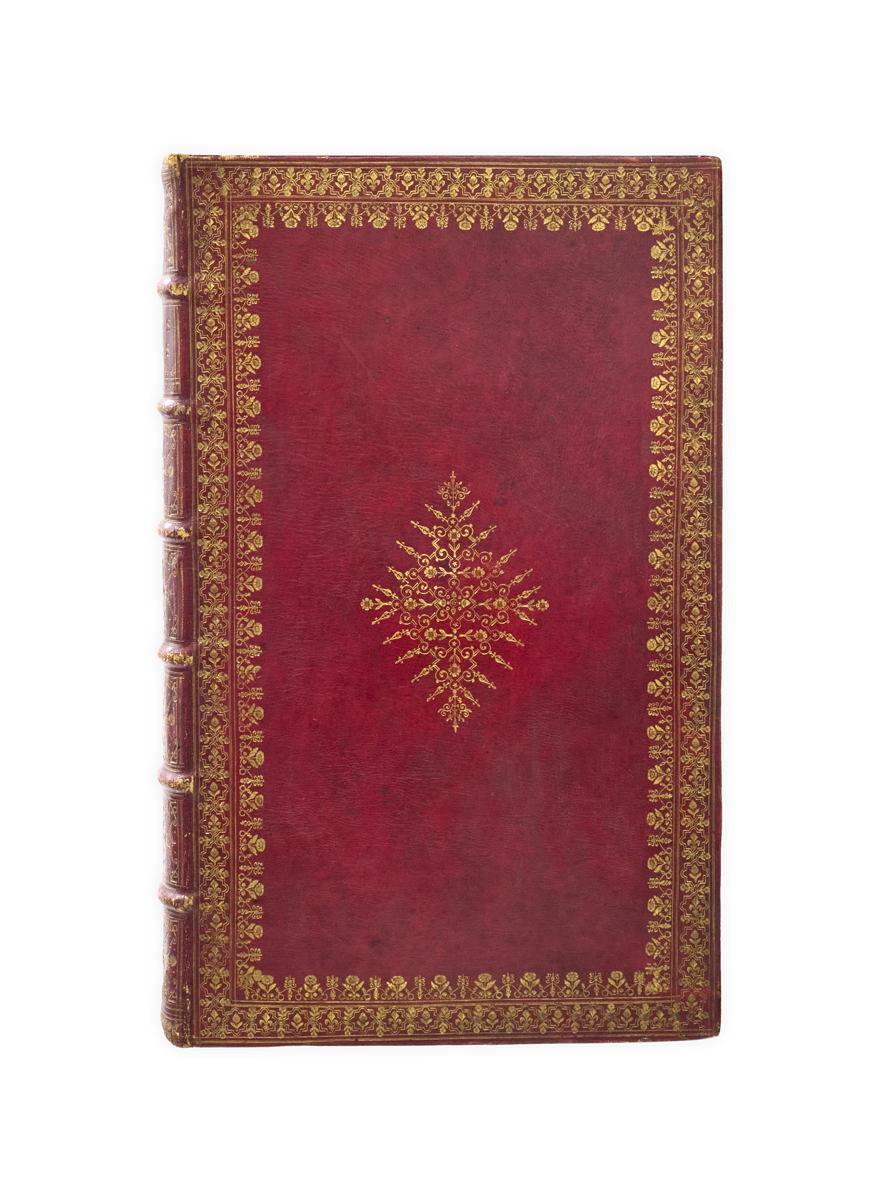
Folio (480 × 288 × 50 mm), pp. [xlii], 506, [6, contents], allegorical frontispiece, engraved vignette to title and other vignettes in text, list of subscribers; with the usual cancels N2, 4E2, 4K1 and, presumably, 4T2, Strasbourg bend watermark (endleaves on same paper stock as text); a fine copy in contemporary red morocco in the Harleian style, the covers tooled in gilt with a border formed of linked compartments containing acorns and fleurs-de-lys and a floral roll, enclosing a lozenge-shaped centrepiece built up from small tools, spine divided into seven panels, lettering in one, the others tooled in gilt, comb-marbled endpapers, gilt edges; joints a little rubbed at bands, very small tear at head of top joint; armorial bookplate of ‘The Honble George Baillie Esqr / One of the Lords of the Treasury / 1724’ to front pastedown; 1718 ownership inscription of Grisell Baillie to title verso (see below).
First edition, a subscriber’s copy on large paper, of one of the most imposing volumes of verse of the eighteenth century, with endleaves on the same paper stock as the text, our copy in a strictly contemporary binding and presented to the Scottish poet and songwriter Lady Grisell (or Grizel) Baillie (1665–1746).
This was the last authorised edition before the poet’s death less than three years later. Prior laboured diligently to make the book correct as well as grand, and he and Humfrey Wanley, Edward Harley’s librarian, corrected the proofs with minute care (an effort partly compromised by the need to reprint seventy-three sheets to meet the increased demand for the subscribers’ edition). There was also a trade edition, on smaller paper (watermark London arms); and a few copies were printed for presentation on still larger paper (watermark fleur-de-lys on shield). From the beginning the work was thought of primarily as a book for subscribers. Pope, Gay, Arbuthnot, and other friends started to obtain subscriptions (one guinea down and a second on delivery) as early as January 1717, but subscriptions were still coming in two years later. Tonson and Barber knew how many copies of the trade edition to print, and Prior knew how many of the largest size were wanted for presentation, but apparently the demand for subscribers’ copies was underestimated when printing began, so that seventy-three sheets up to 3Z had to be reset and reprinted to complete the 1790 copies ultimately subscribed.
Like all subscribers’ copies, this one will presumably have some of the reprinted sheets.
Provenance:
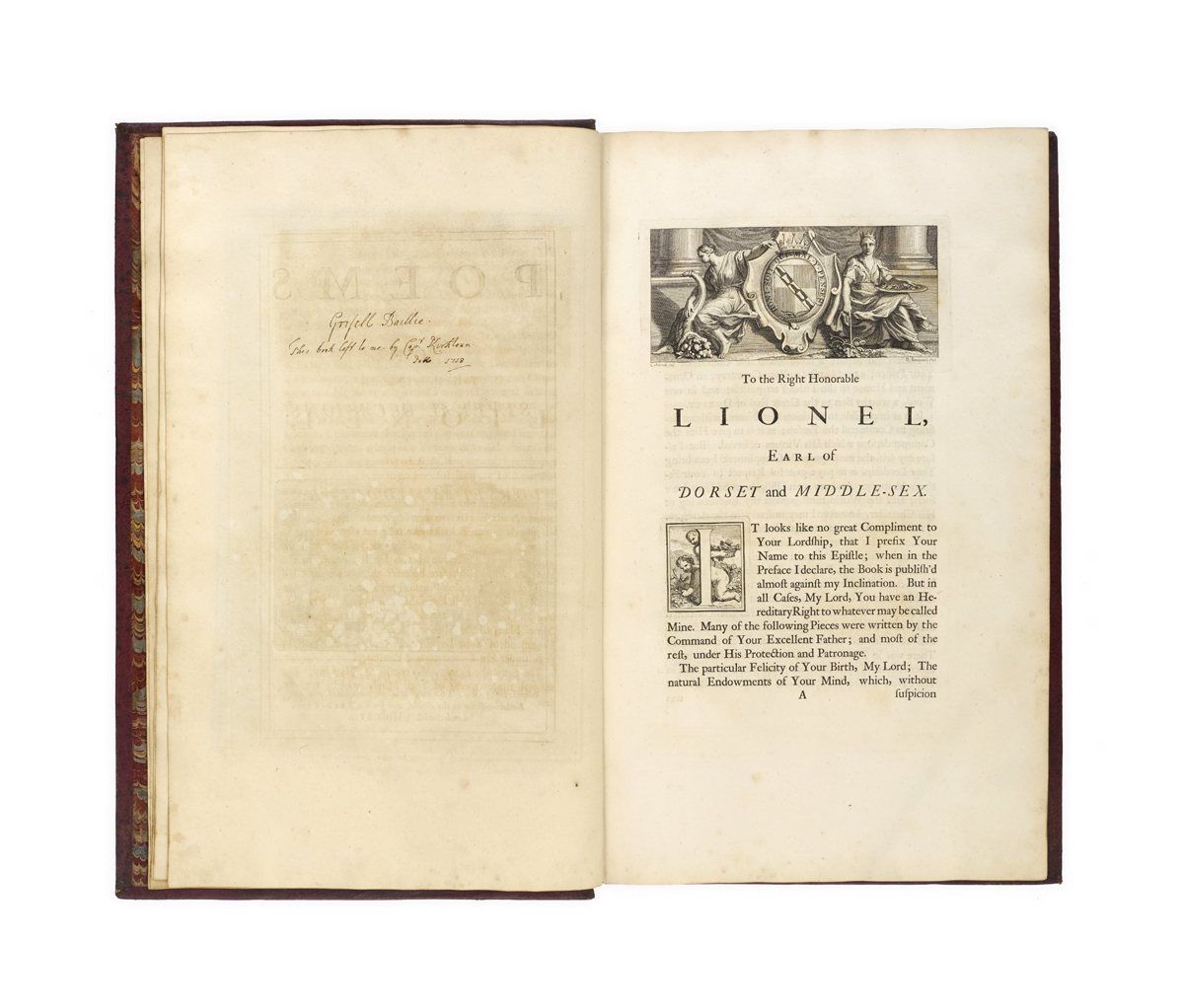
Likely one of two copies subscribed for by Robert Kirktown, the book is inscribed on the verso of the title-page: ‘Grisell Baillie. This book left to me by Capt. Kirktoun. Jun. 1718’. The month was originally written as July, and this correction along with the confusion over the year (the book was not available to subscribers until March 1719) suggests that the inscription was written some time after the gift. Kirktown (elsewhere Kirkton), a naval captain, had been involved in the capture of Gibraltar and was wounded at the Battle of Málaga in 1704; he died in 1718, perhaps bequeathing this copy to Baillie before his death. Grizel Baillie (1665–1746) was the daughter of Sir Patrick Hume. She had concealed her father, who went into hiding in the aftermath of the Rye House plot, until he could flee the country, and later managed his estates as well has her husband’s; her Household Book, a series of account books kept over the course of fifty years, remain an important source of historical information.
She was the wife of the George Baillie (1664–1738) who had served in the Prince of Orange’s horse guards on the Continent and, along with Hume, joined the Prince’s expedition to England in 1689. Captain Kirktown perhaps made the Baillies’ acquaintance at the time of these military events.
ESTC T75639; Foxon, p. 641; Bunker Wright, ‘Ideal Copy and authoritative Text: the Problem of Prior’s Poems on several Occasions’, in Modern Philology XLIX (1952), pp. 234–41; Maggs catalogue 1212, Bookbinding in the British Isles (1996), no. 88 (this copy).