Printed by Uniate Monks in Ukraine
[PSALTER.]
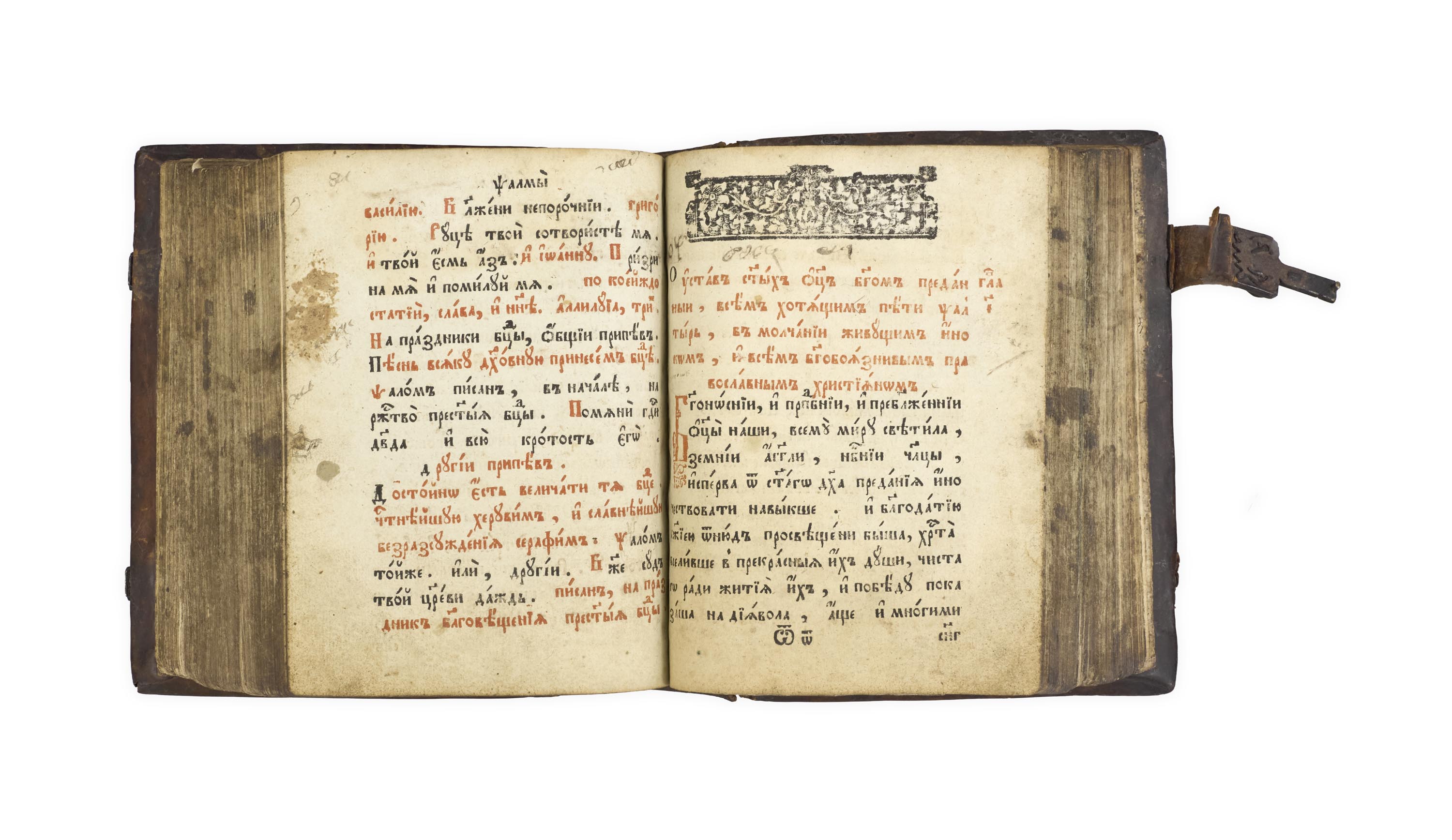
[Psalter in Church Slavonic.] Pochayiv, [Monastery Press, 1809].
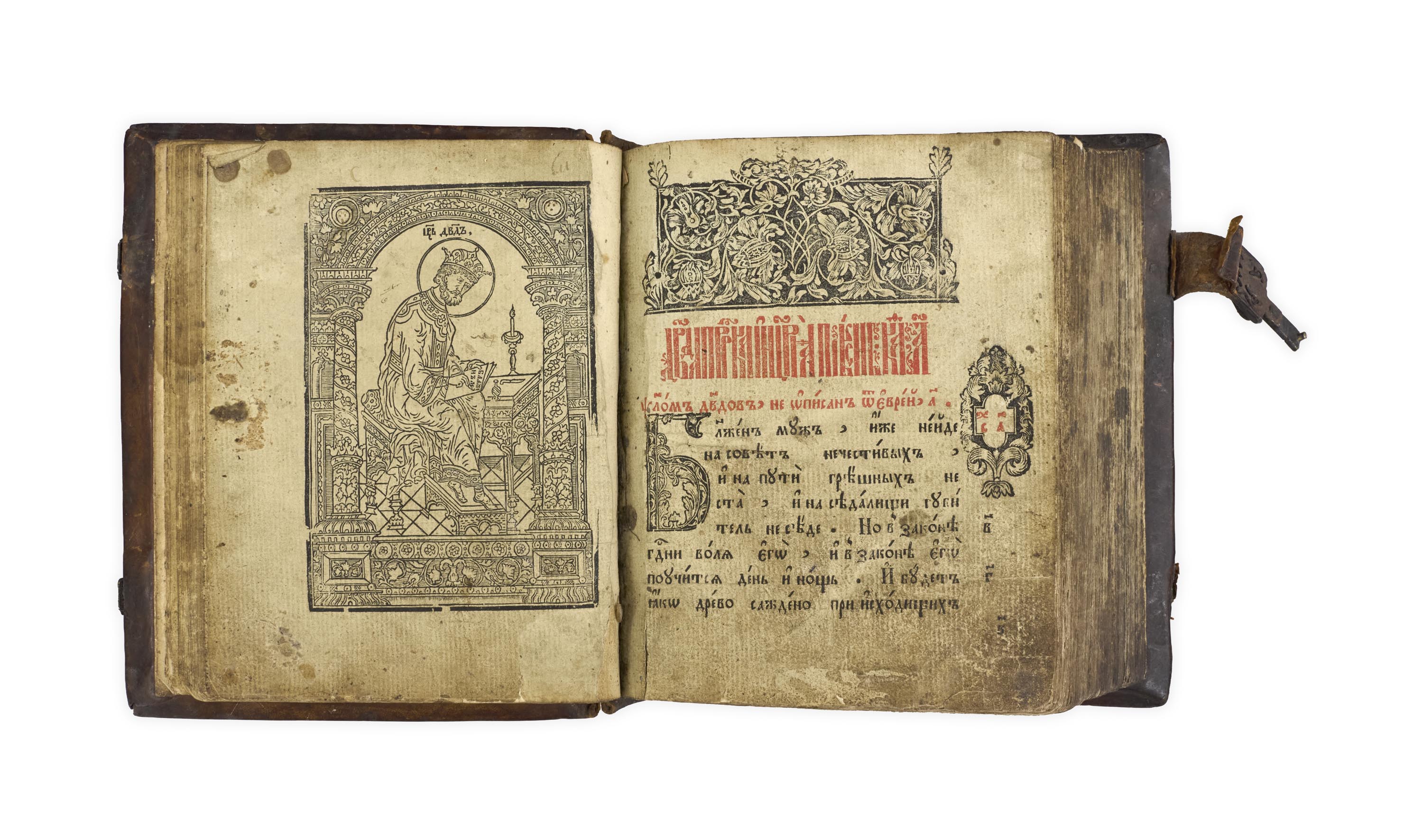
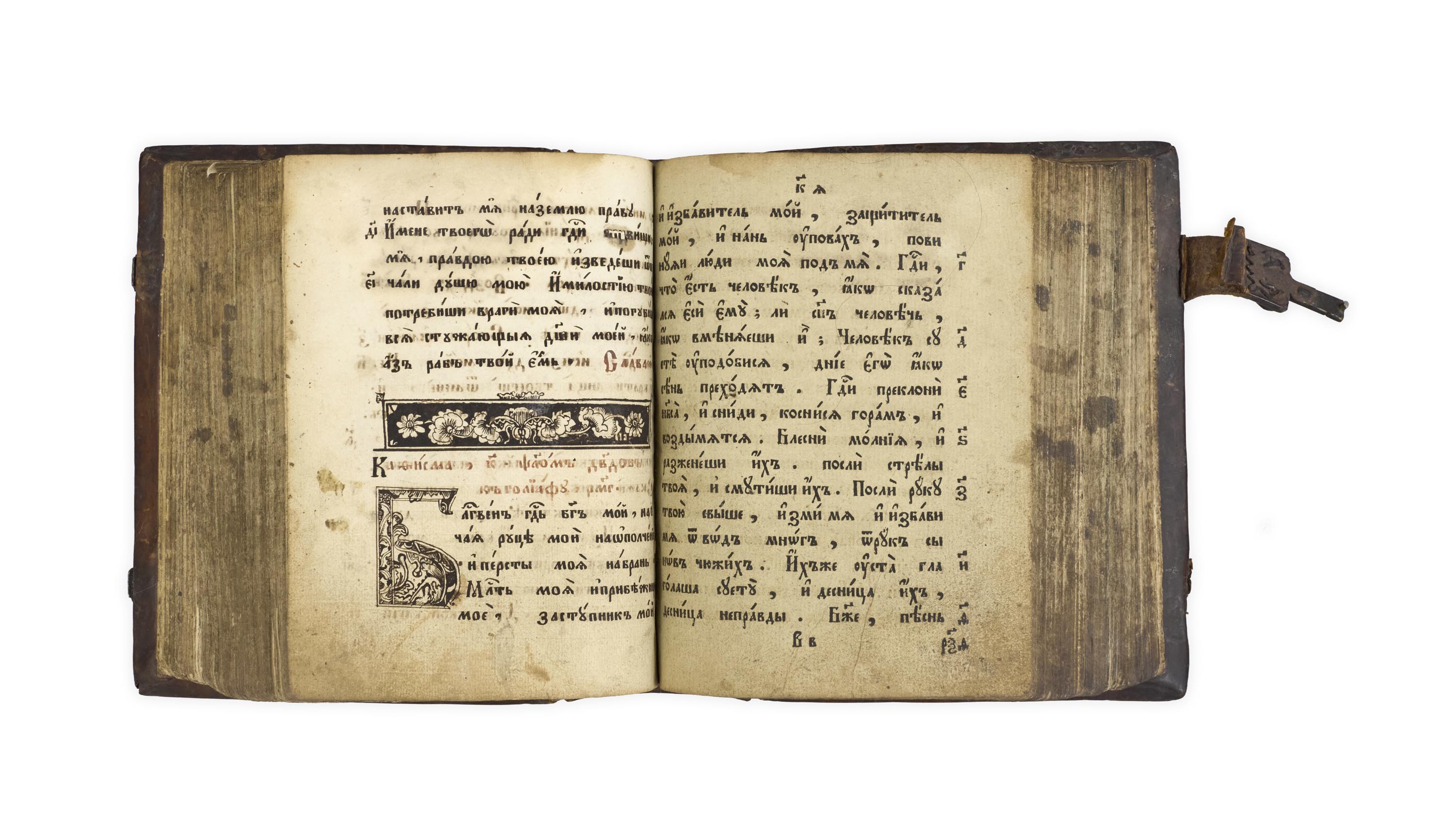
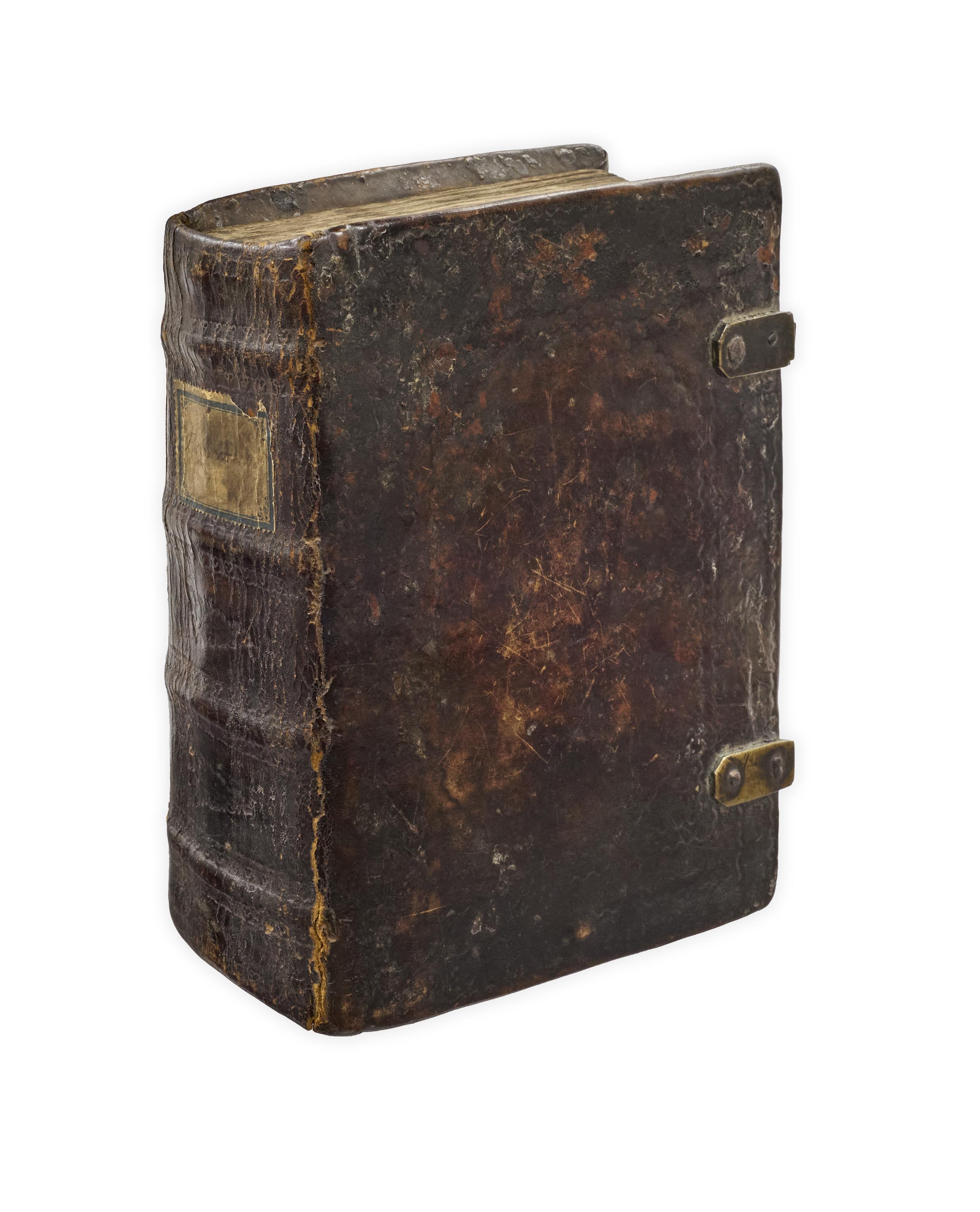
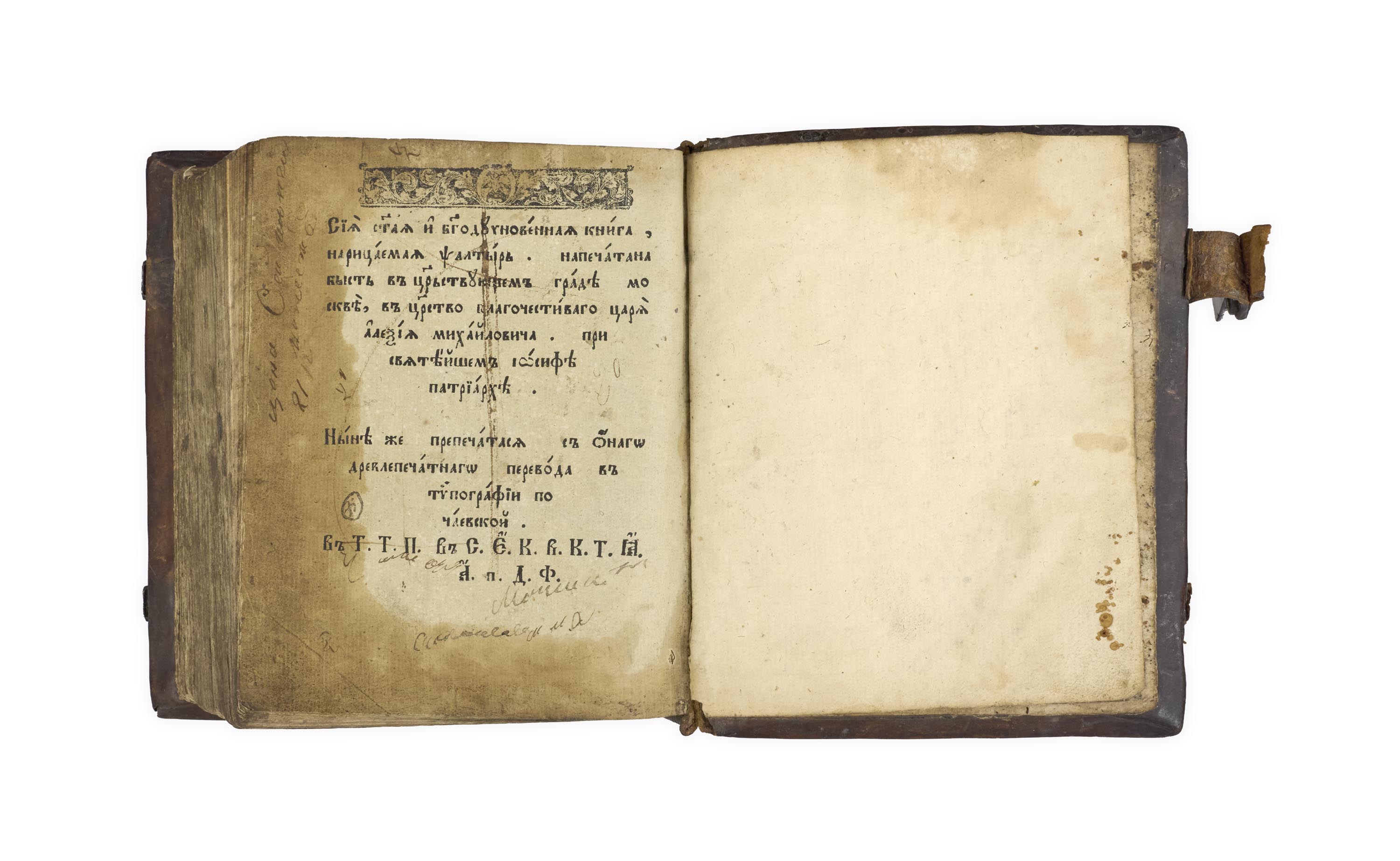
4to, ff. ки [i.e. 28], тк [i.e. 320], ҙ [i.e. 60]; ff. 165–168 lacking and supplied in neat near-contemporary manuscript facsimile; printed in red and black throughout, woodcut headpieces and decorative typographic initials, full-page woodcut of St David opposite start of Psalter, quires Юю–Ѫѫ (16 leaves) printed on blue paper; many marginal defects and repairs, staining and finger-soiling, wax drops and stains, indicating practical use of the volume (particularly in the first part of the Psalter proper), though much of the volume still in good condition; bound in contemporary Ukrainian calf over thick bevelled wooden boards, blind-tooled leafy border surrounded by undulating lines, spine blind-tooled in compartments with later paper label, two clasps (one strap remaining); binding a little rubbed with repair to section of lower cover; ownership inscription to front flyleaf dated 1850.
A possibly unique survival of a Psalter printed at the renowned monastery press at Pochayiv, in its original calf binding, retaining drops of candle wax from regular liturgical use.
This volume contains, beyond the text of the Psalter in Church Slavonic with its customary frontispiece of St David, an introduction to znameny chant, selected psalms, prayers, canons (on blue paper), a calendar of saints from September to August (following the Orthodox year), and tables for calculating Easter from 1809 to 1870.
The monastery in Pochayiv, the Pochaevskaya Lavra of the Greek Catholic Order of St Basil (now in western Ukraine but then within the Polish-Lithuanian Commonwealth) officially established a press in 1732, and as a prominent cultural centre for that region it printed books in Polish, Latin and Ruthenian; from 1782 it also began printing books in Church Slavonic. After the Third Partition of Poland in 1795 it became part of the Russian Empire and was transferred to the Orthodox Church in 1831 by order of the Tsar, becoming one of the four most significant Lavras in Romanov territories.
The press was active throughout the eighteenth century and into the nineteenth, producing not just liturgical works for both Uniate and Orthodox rites, as here, but also vernacular works on devotion, farming and agriculture, conduct and education, printed in the local Ruthenian/Ukrainian language. The monastery also produced numerous devotional engravings to sell to their congregation; it has been suggested that the press may have provided the monastery with around twenty to forty percent of its income in the later eighteenth century. The monastery press finally closed in the early twentieth century.
Unsurprisingly, the press issued numerous editions of the Psalter in various formats, from tiny 24mo editions to folios. A recent bibliography of Pochayiv printing, covering the years 1734 to 1830, indicates at least eight quarto editions of the Orthodox Psalter between 1786 and 1827, though a few have no recorded copies, including this 1809 edition. Although the date does not appear in the colophon, the table of ecclesiastical dates at the end of the volume covers the years 1809 to 1870.
The replacement manuscript leaves are a very close copy of the appearance of the rest of the book and may even have been produced in the monastery print shop; the pen and ink facsimile headpieces and initials are finely drawn, and the gap in the printed text is filled very precisely.
See Drukarnya Pochaivskoho Uspenskoho monastyria ta ii starodruky: zbirnyk naukovykh prats (Kyiv, 2011), bibliography (pp. 162–192), no. 285 (no copies recorded).