A Qur’an From Islamic Spain
QUR’AN.
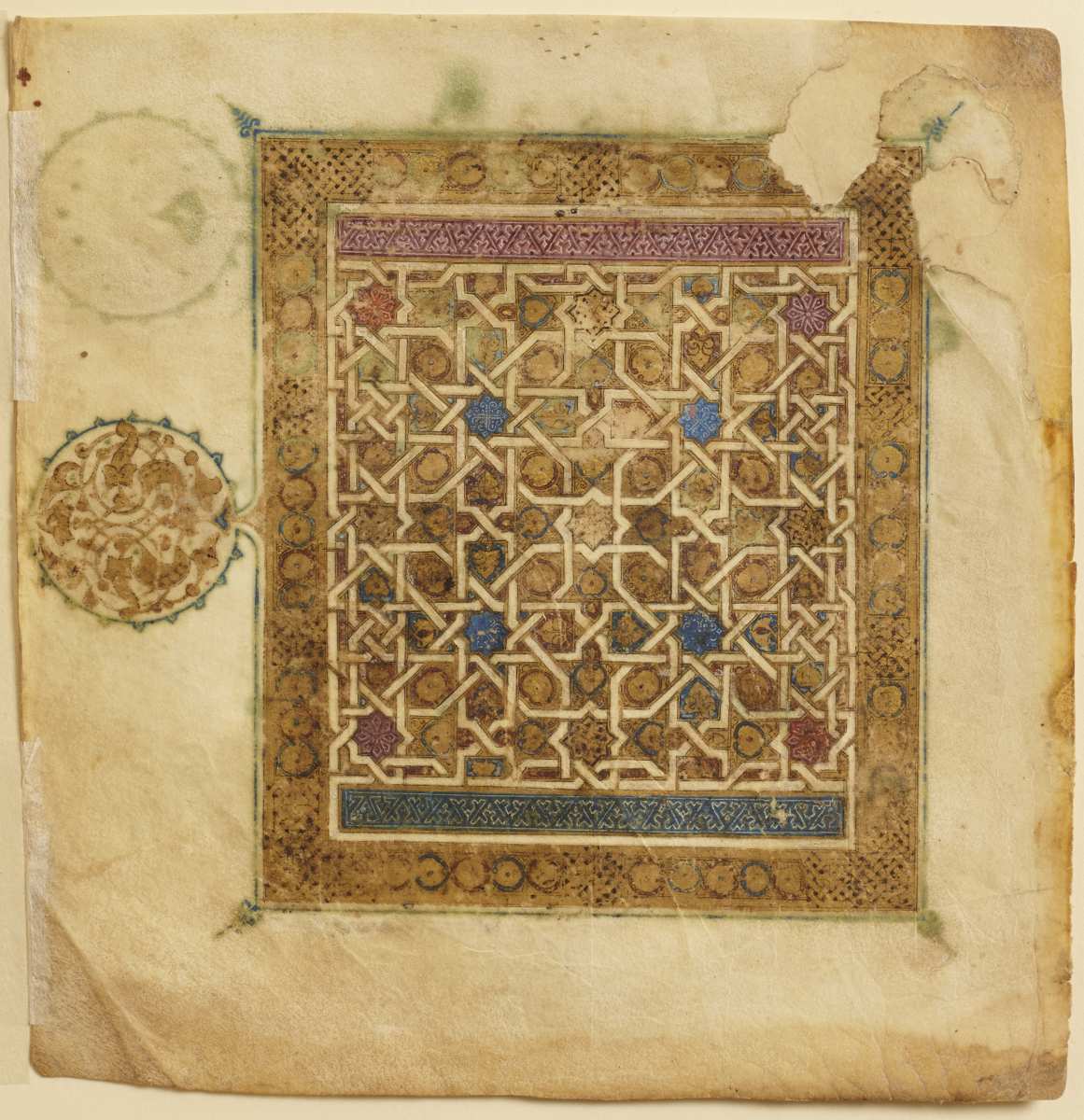
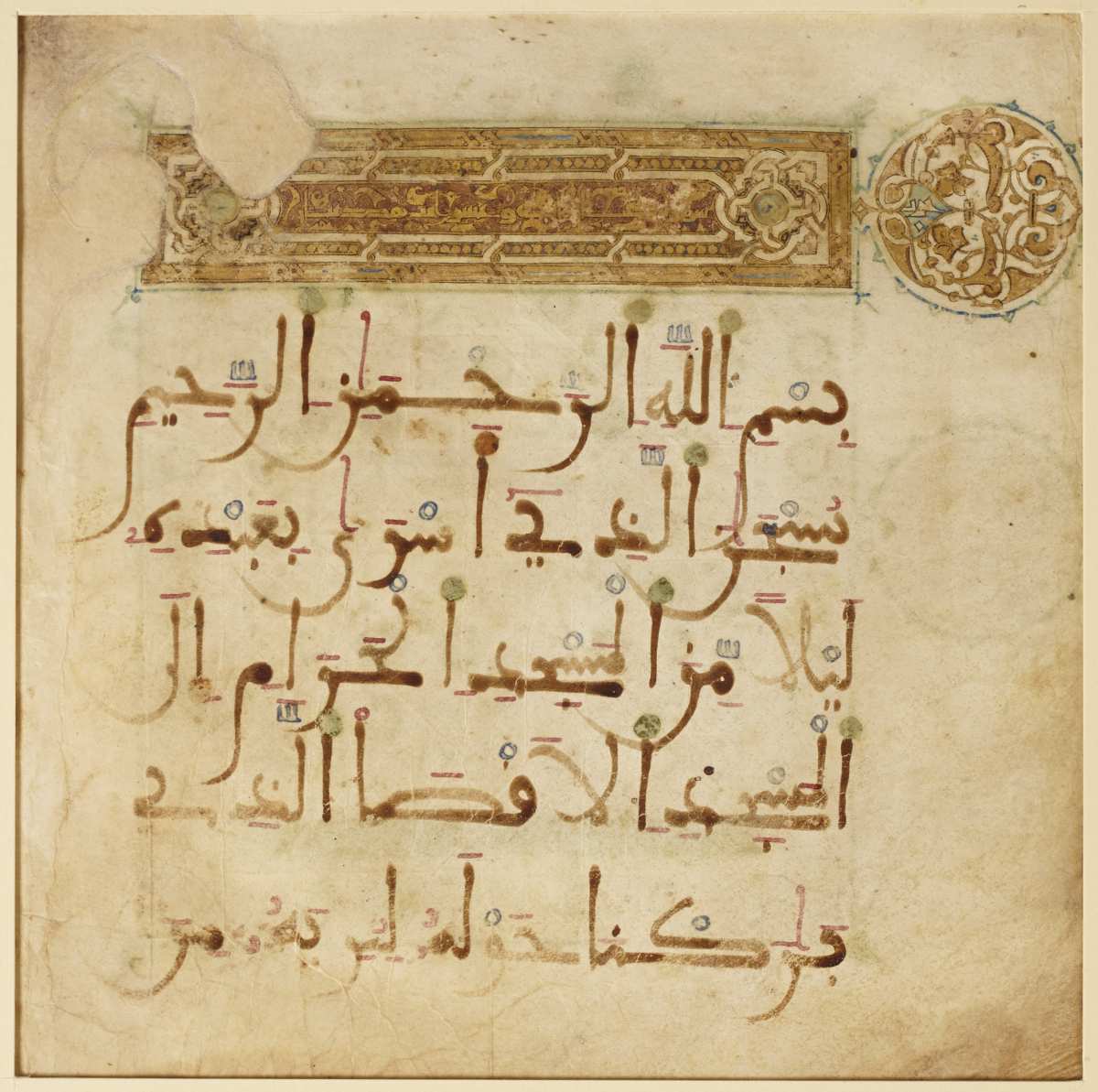
Maghribi Qur’an leaf with illumination and text. ?Andalusia, c. 1250–1350 AD.
Vellum leaf (190 x 185 mm), verso with six lines of maghribi script in brown ink, diacritics and vocalisation in green, red and blue, sura heading in gold in an ornamental kufic script against a red-brown ground and contained within a cartouche framed by white strapwork, palmette medallion in blue and gold extending into the margin, recto with a full-page ornamental frontispiece consisting of an elaborate geometric design in white strapwork, the compartments filled with designs either in gold or in white on red, blue or purple grounds, the whole surrounded by an outer border of gold interlace; slightly worn, loss at upper inner corner repaired with blank vellum.
A fine example of a maghribi frontispiece most likely from Islamic Spain, with a particularly complex geometrical design.
This would doubtless originally have formed the left-hand half of a double-page frontispiece of a Qur’an section. The sura heading on the verso, which is also a hizb (sixtieth) division, is also unusually elaborate for a Qur’an of this format. The text comprises the beginning of the first verse of sura 17, Bani Isra’il (the Children of Israel).
Vellum Qur’ans of the size and format of this leaf were standard in both North Africa and Spain, making it very difficult to localise them purely on the basis of script and illumination. Indeed, the present frontispiece has stylistic features in common with examples from both North Africa (e.g. the finispiece of a Qur’an produced in Morocco and dated AH 718/AD 1318; see Fraser 2006, no.21) and Spain (e.g. the finispiece of Bibliothèque nationale, Paris, Ms. or. Arabe 385, copied in AH 703/AD 1303 and loosely attributed to Nasrid Granada, and the finispiece of British Library MS. Or. 12523C, part of a multi-section Qur’an which according to tradition was brought from Spain to Morocco by a princely family at the time of the Christian re-conquest of Granada at the end of the fifteenth century; see Lings 1976, nos. 48 and 45 respectively).