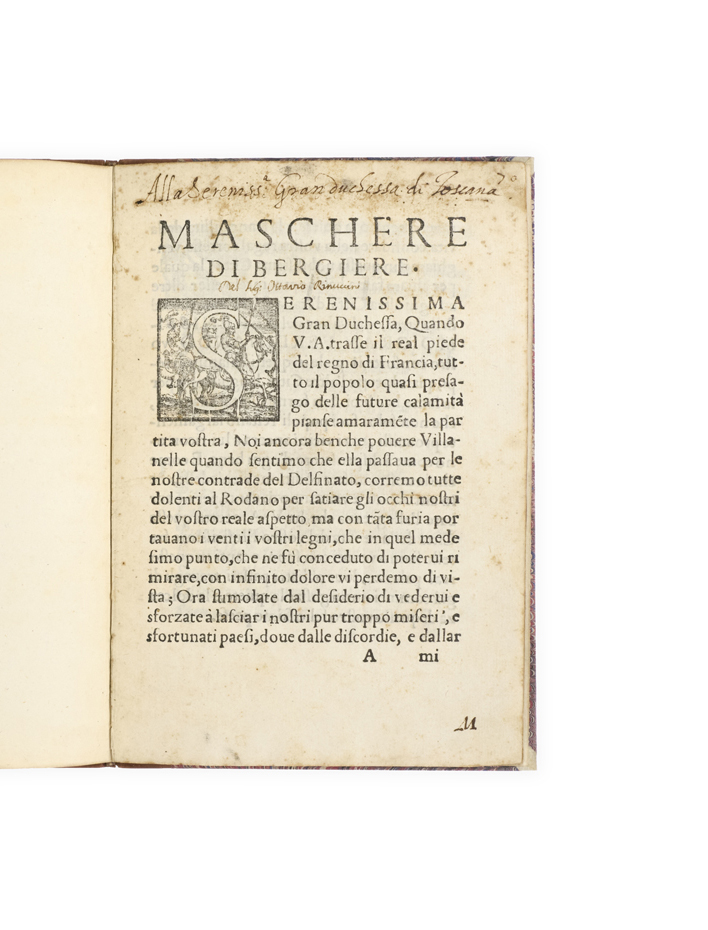
Presented to the Grand Duchess of Tuscany
[RINUCCINI, Ottavio, librettist.]
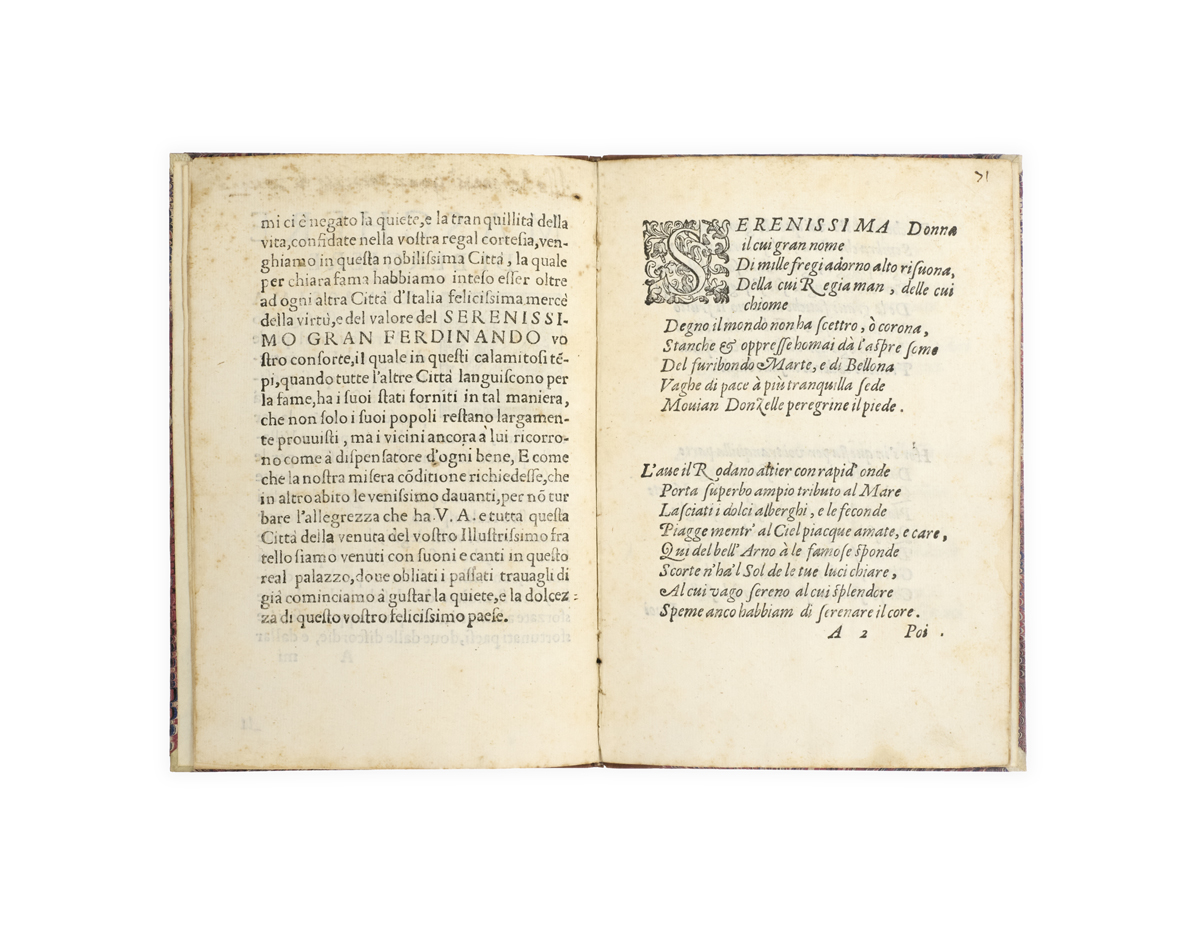
[Drophead title: Maschere di bergiere]. [(Colophon:) Florence, Giorgio Marescotti, 1590.]
4to, ff. [4]; two woodcut initials, woodcut tailpiece; lightly creased where folded, light marginal foxing, but a very good copy; bound in late nineteenth-century calf-backed boards with marbled sides and vellum tips, spine gilt in compartments and lettered directly in gilt; contemporary presentation inscription (apparently not in Rinuccini’s hand) to the Grand Duchess of Tuscany ‘Alla Sereniss[im]a Granduchessa di Toscana’ to head of f. [1]r, eighteenth-century? manuscript addition of the author’s name below the title, old manuscript foliation ‘70–73’ to outer upper corners.
Extremely rare first edition of Rinuccini’s Maschere di bergiere, one of the earliest recorded stage performances by a female court musician in Florence, a dedication copy inscribed to Christina of Lorraine, Grand Duchess of Tuscany.
Written by Ottavio Rinuccini (1562–1621) as a court entertainment, the Maschere di bergiere (‘Ballet of the Shepherdesses’) was first performed in 1590, the year after the marriage of the dedicatee, Christina of Lorraine to Ferdinando de’ Medici. Danced and sung by the soprano Lucia Caccini (née Gagnolanti), it is one of the earliest records of a female court musician giving stage performances in Florence, which followed Ferrara in the use of the concerto di donne (Treadwell, p. 181, note 359). Lucia was the first wife of the composer and singer Giulio Caccini, and while the composer of the music of the Maschere di bergiere is not known with any certainty, most scholars have attributed it to Caccini due to evident analogies with his other music.
‘The “plot” of the Maschere di bergiere has a group of French country-girls fleeing their country, now torn apart by war, and coming to Florence to plead for sanctuary. This mascherata is clearly divided into two sections. The first (lines 1–48) is a lament addressed to Christine of Lorraine and a call for peace and honor to reign again. Needless to say, this is quite in line with the new direction given by Ferdinando I to Florentine foreign politics, which sees Florence more involved in French affairs, leading to Ferdinando’s key role in bringing peace to France and Henry Navarre to the throne’ (Chiarelli).
‘In the second part (lines 49 onwards), the “bergiere” address themselves directly to the men in the audience, in a defense of rustica beltà: this shift is signalled in the text with the assertion that Florence is governed by Love, while France is apparently governed by Mars. And if mascherate of this period are mainly concerned with literary topoi rather than with dramatic or theatrical situations, the Maschere di bergiere is representative in this respect as well, with its last section resembling a puzzle of literary topoi. The praise of humble, natural beauty is presented by way of the pastoral topos, of the contrast between the woods, where natural beauty resides, and the city, home to proud and artificial beauty. Opposition between the humble beauty of the villanelle and the conceited beauty of the dame di corte is also a typical topos of courtly literature. And the passion for make-up, expensive clothes, and jewels had offered an easy target for any satire against Florentine women since Dante’ (ibid.).
The printer, Giorgio Marescotti, was active in Florence from the 1550s, eventually taking over the print shop of the heirs of Lorenzo Torrentino and becoming the first printer of music in Florence. He produced many of the programmes and accounts of the wedding celebrations of Ferdinando and Christina, and would publish many of Rinuccini’s works, including the Dafne in 1600.
USTC and OCLC list one copy only, at the Bibliothèque nationale de France; not found in ICCU, EDIT16, or Library Hub.
USTC 870248; Melzi, p. 167. Not in Gamba (see p. 567); not in Watanabe-O’Kelly & Simon. See Chiarelli, ‘Before and After: Ottavio Rinuccini’s Mascherate and their relationship to the operatic libretto’, in Journal of Seventeenth-Century Music 9, no. 1 (2003), and Treadwell, Restaging the Siren: Musical Women in the Performance of Sixteenth-Century Italian Theatre, PhD dissertation (2000).