
What Is Democracy?
Small Republics and Their Problem with the Social Contract
ROUSSEAU, Jean Jacques.
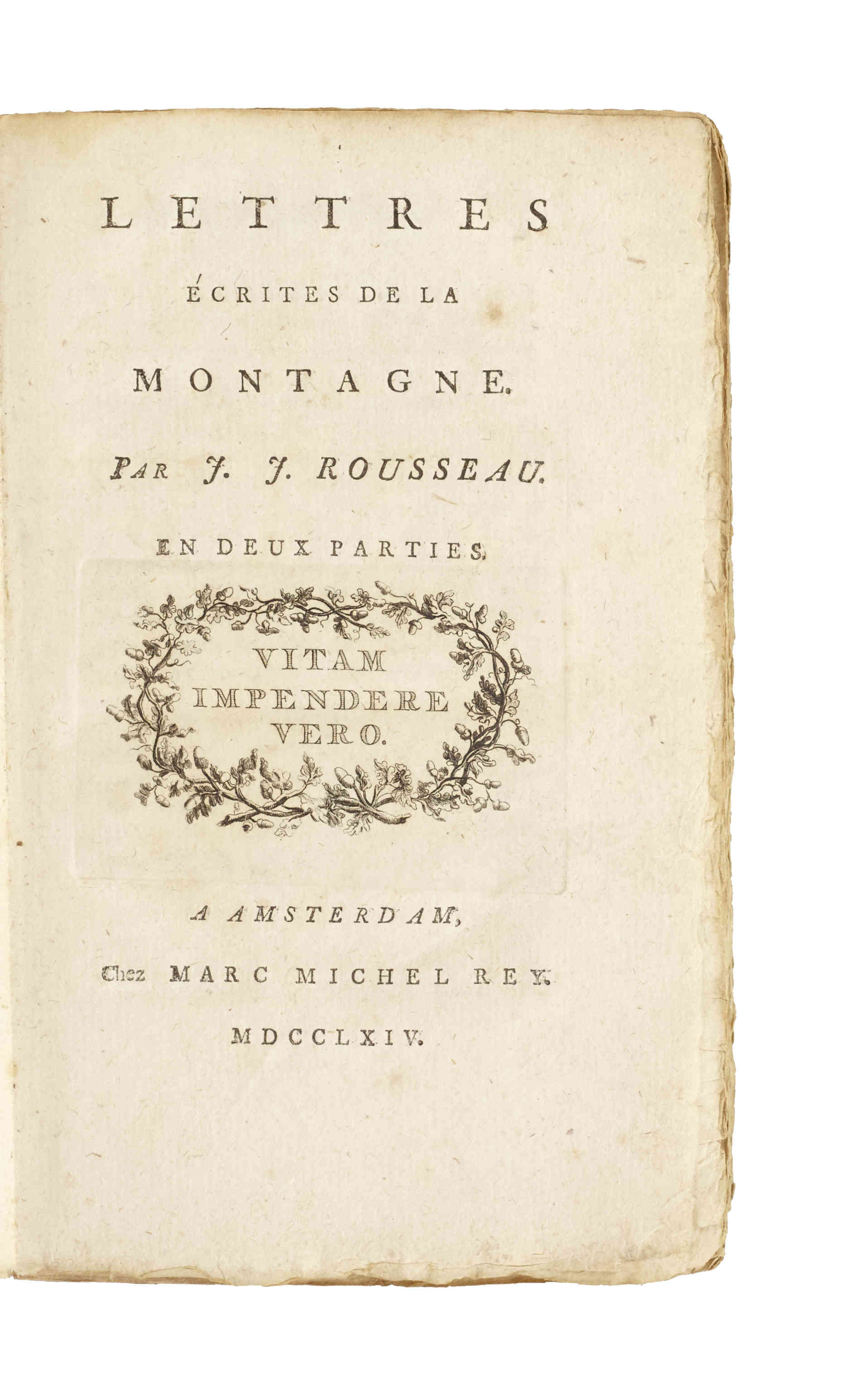
[half-title: Oeuvres de J. J. Rousseau. Tome neuvieme. Contenant les …] Lettres écrites de la montagne. En deux parties. Amsterdam, Rey, 1764.
12mo, pp. [8], 368; half-title; engraved vignette to title-page; a very good copy, uncut in contemporary half marbled paper over drab boards, slightly dusty, manuscript label to spine.
Added to your basket:
[half-title: Oeuvres de J. J. Rousseau. Tome neuvieme. Contenant les …] Lettres écrites de la montagne. En deux parties.
Rare. The ninth volume of the first collected edition of Rousseau’s works to be published by Rey (1762–1764), and printed the same year as the first edition, using a reprinted title-page conjugate with the half-title present here, and without the errata leaf.
In 1762, the same year that the Contrat social and Émile were published, the Small Council of Geneva condemned Rousseau. In 1763 Rousseau dramatically relinquished his rights and citizenship of Geneva, thus dividing the city politically between the aristocratic and the popular parties. A group of Genevan citizens forming part of the latter party challenged the legality of the Small Council’s condemnation, and demanded that the case be referred to the General Council of burghers. The defence of the Small Council’s power of veto over the burghers’ wishes was put forward by Jean-Robert Tronchin in 1763, in his Lettres de la campagne, to which Rousseau’s Lettres de la montagne is the direct and lively rejoinder.
‘The second part of them may interest the student of political history by its account of the little republic. We seem to be reading over again the history of a Greek city; the growth of a wealthy class in face of an increasing number of poor burgesses, the imposition of burdens in unfair proportions upon [them], the gradual usurpation of legislative and administrative function (including especially the judicial) by the oligarchs, and the twisting of democratic machinery to oligarchic ends … the Four Hundred at Athens would have treated any Social Contract that should have appeared in their day, just as sternly as the Two Hundred or the Twenty-five treated the Social Contract that did appear, and for just the same reasons’ (Morley). The result of all this legal fomentation was ‘a more concrete presentation of democratic ideas than the Contrat Social … based on a close reading of the lawbooks and histories of Geneva, which Rousseau now for the first time digested in his Neuchâtel retreat’ (Palmer, The age of the democratic revolution (1959), p. 131).
STCN 325827095; Dufour 371. See Dufour 234.