Emblems of Diplomacy
SAAVEDRA FAJARDO, Diego de.
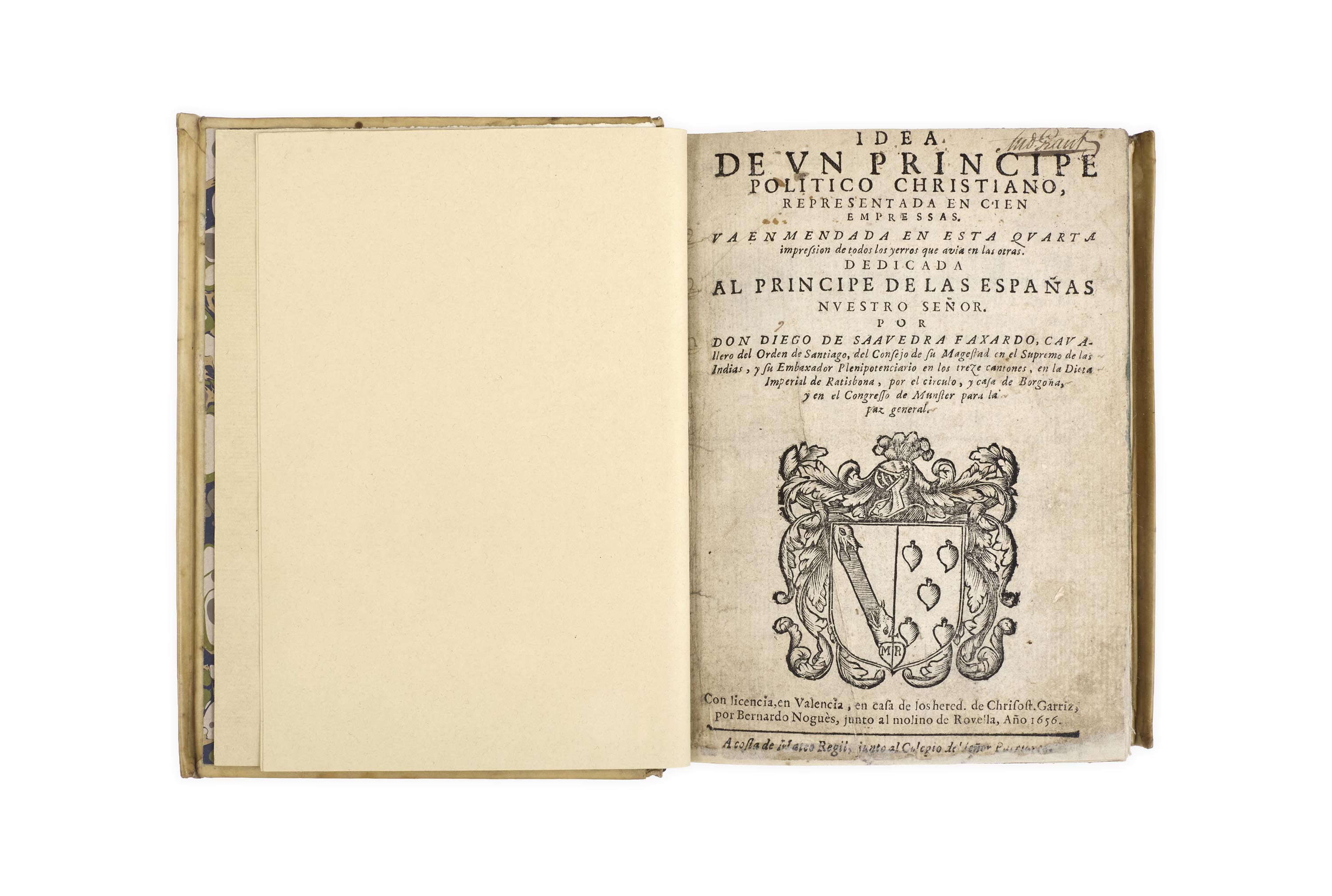
Idea de un Principe politico christiano, representada en cien empressas. Va enmendada en esta quarta impression de todos los yerros que avia en las otras … Valencia, heirs of Crisóstomo Garriz, for Bernardo Noguès, at the cost of Mateo Regil, 1656.
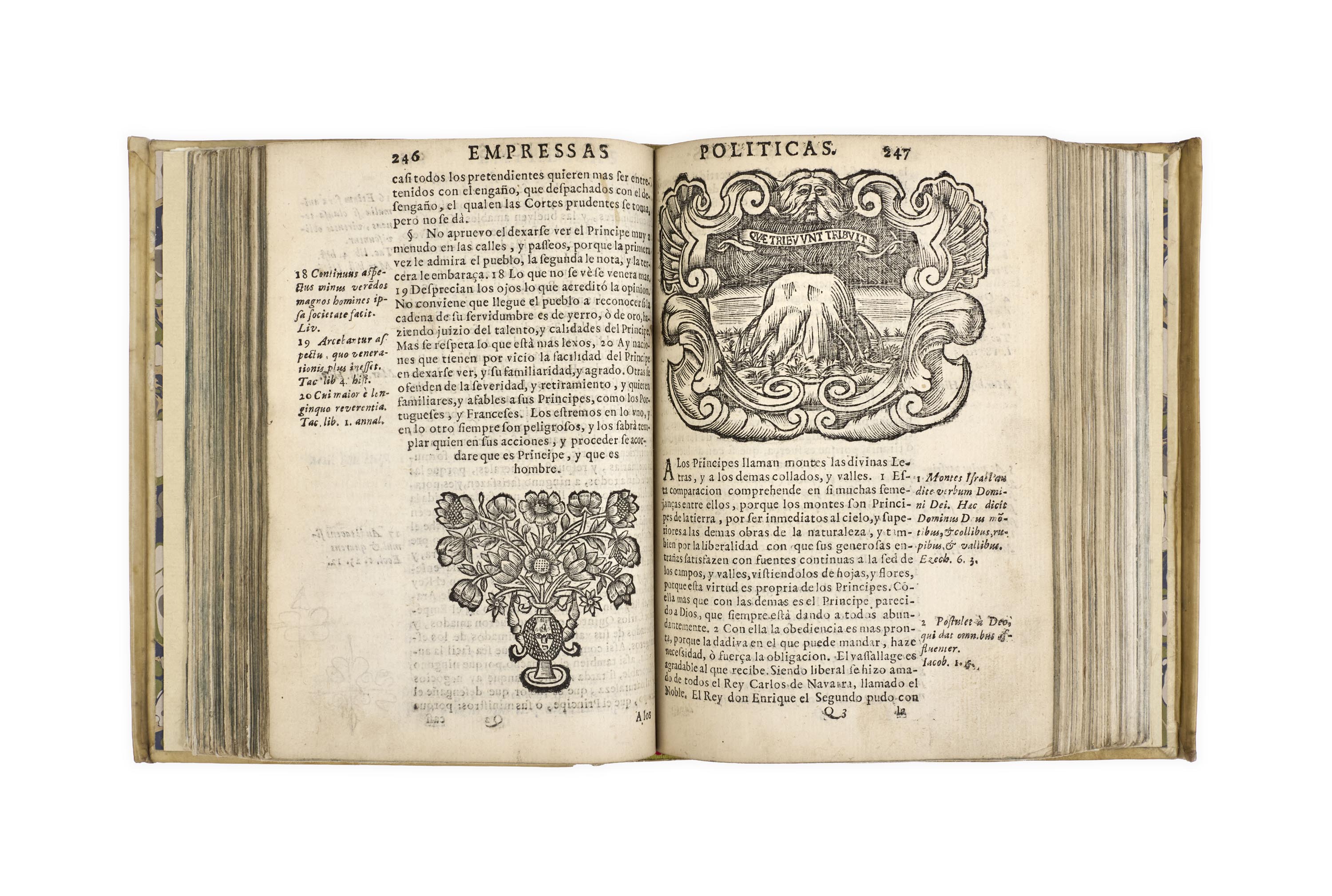
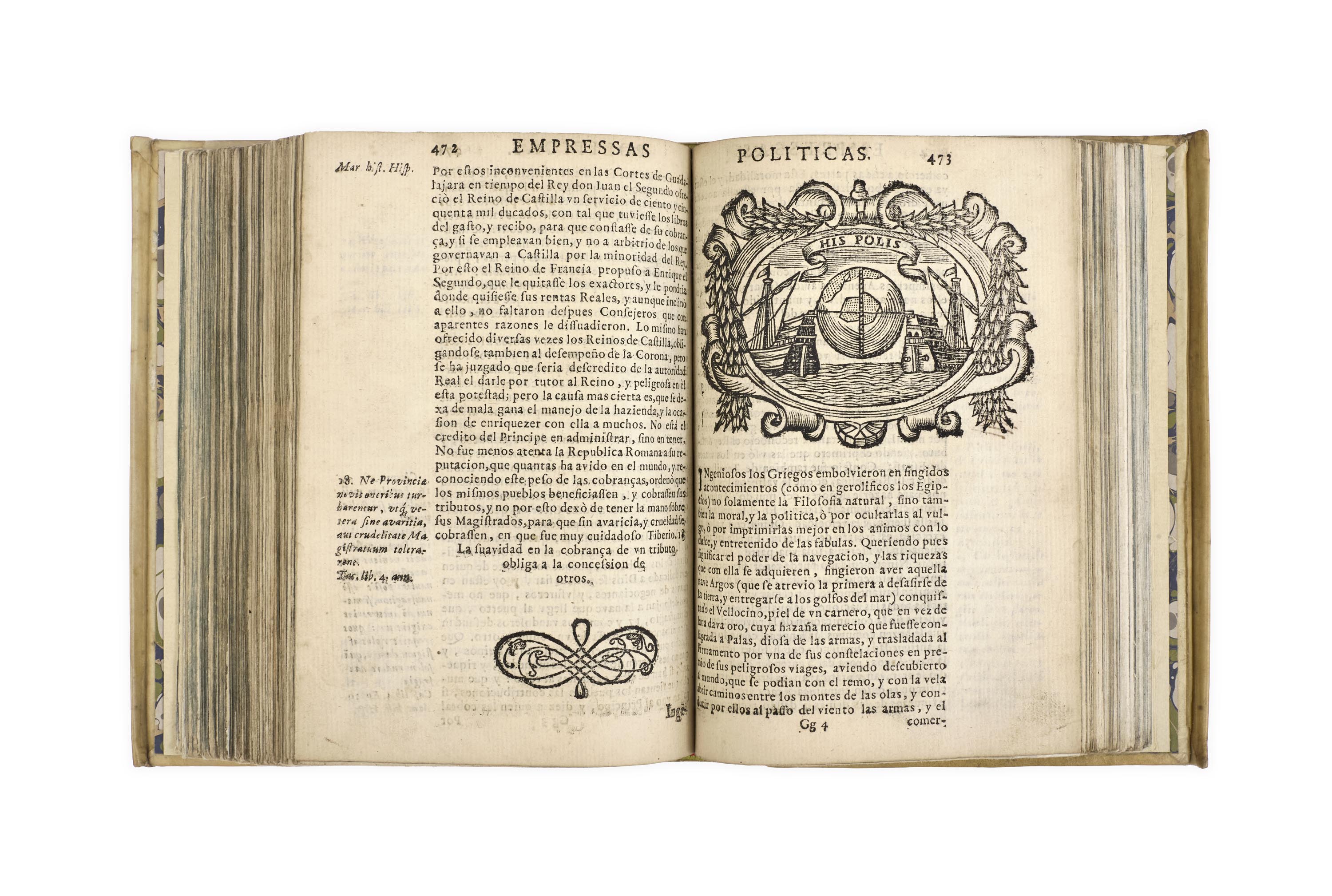
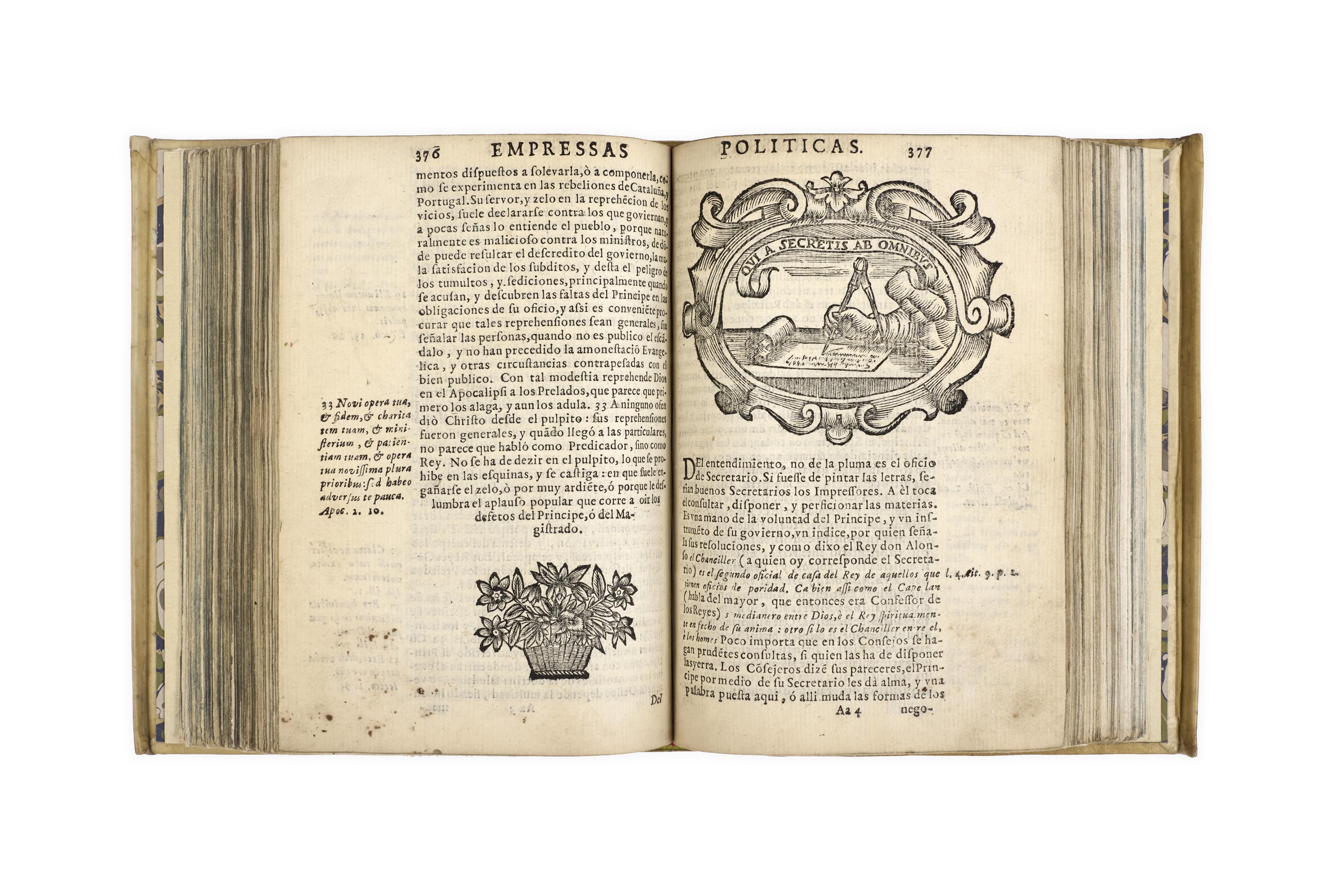
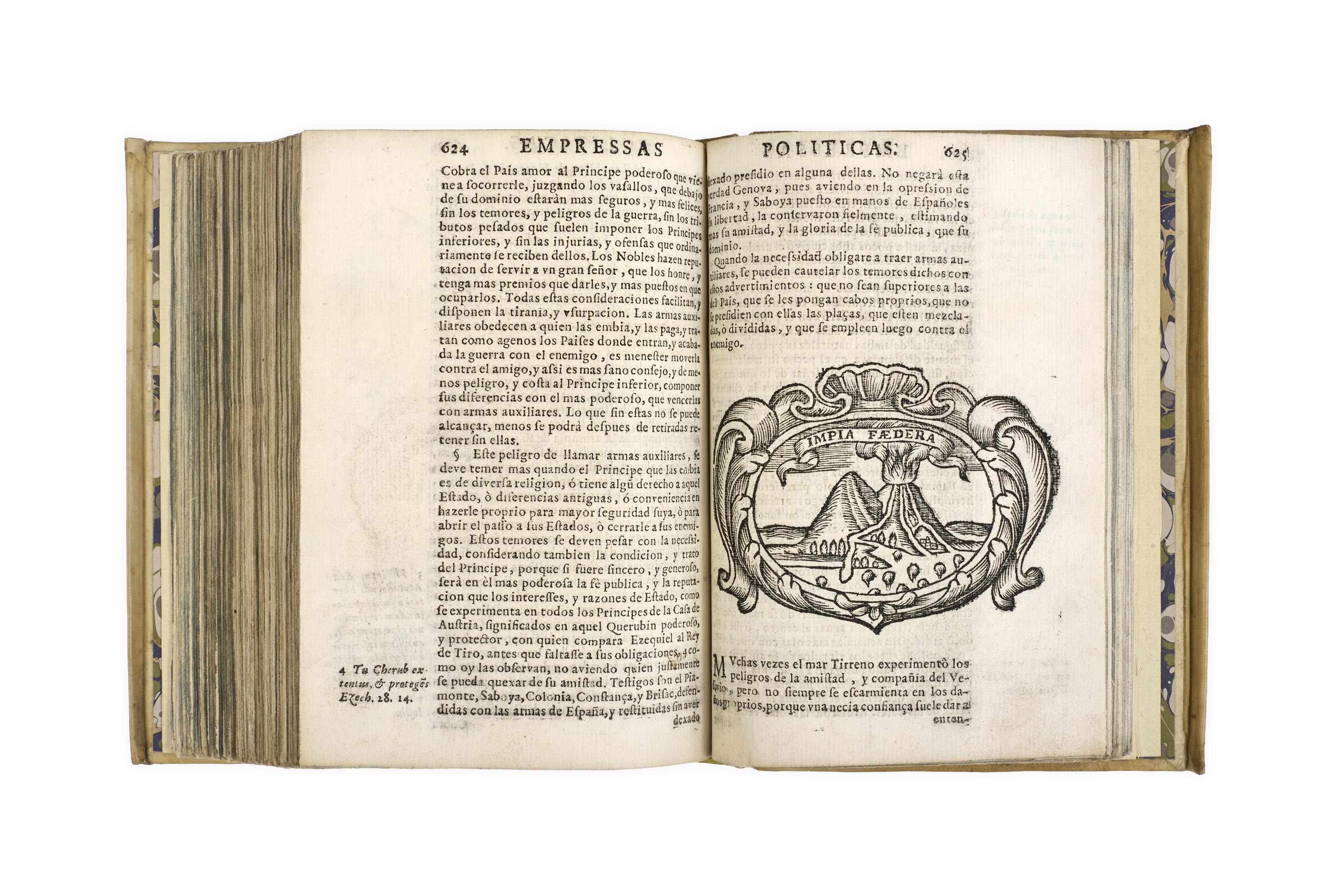
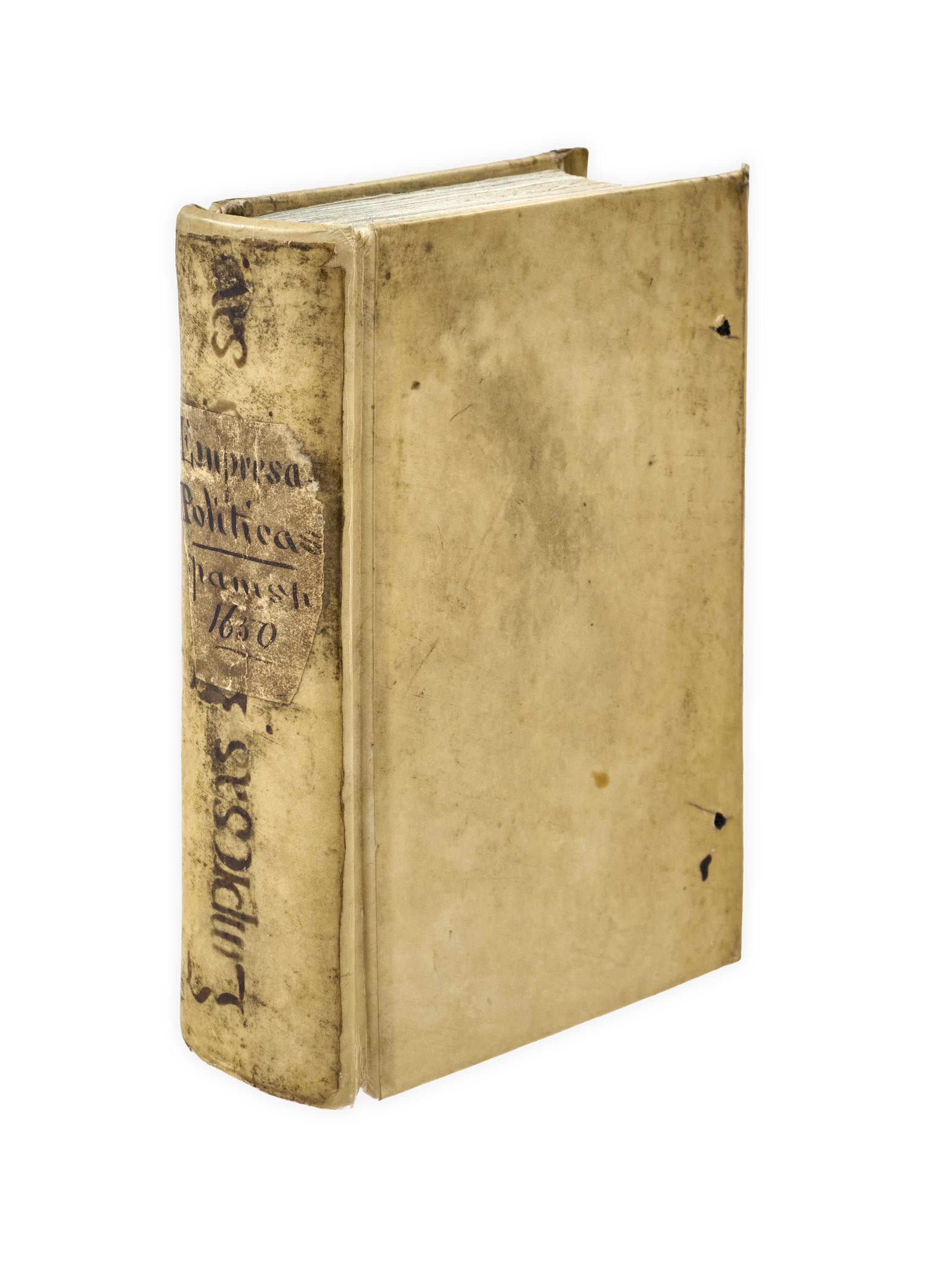
4to in 8s, pp. [xvi], 240, ‘243–694’ (i.e. 241–692); with 103 woodcut illustrations after Jan Sadeler, woodcut arms of Mateo Regil to title, woodcut initials and tailpieces; lower margin of title-page neatly repaired (touching a few characters of imprint), a few skilful marginal repairs elsewhere (touching a few characters to N7 and partially obscuring a few words to Qq3), otherwise a very good copy; bound in modern vellum over boards with old spine-piece and sides relaid, spine lettered in manuscript with later paper label, remains of ties to fore-edge, marbled endpapers, edges formerly stained blue; housed in a black morocco-backed pull-off box with marbled sides, spine lettered directly in gilt; ownership inscriptions of ‘And. Grant’ to title-page and ¶2, contemporary annotations to pp. 348 and 501 with marginal markings and underlinings in the same hand, early inscriptions to final verso.
Added to your basket:
Idea de un Principe politico christiano, representada en cien empressas. Va enmendada en esta quarta impression de todos los yerros que avia en las otras …
Fourth Valencian edition of ‘the most remarkable treatise of political devices for the use of a prince’ (Praz), illustrated with numerous woodcut emblems.
The Empresas first appeared in 1640 at Munich, where Saavedra Fajardo (1584–1648) was serving as a diplomat, and most of the subsequent editions were based on the 1642 Milan edition. These early editions had engravings by Jan Sadeler, which were then copied for the Valencia editions (first 1645) as slightly crude woodcut illustrations. The final emblem, ‘Ludibria mortis’ (The games of Death), accompanies a poem directing the virtuous prince to prepare for death. The book was dedicated to Balthasar, the only son of Philip IV, and evidently intended for his instruction; he died in 1646, aged sixteen.
Saavedra Fajardo composed his book of statecraft during the chaos of the Thirty Years’ War, which had led to his posting to the court of Bavaria in 1633 to represent Spanish interests. He saw first-hand (and surely contributed to) the machinations and dissimulations of diplomats which eventually led to the Peace of Westphalia, though he died shortly before it was signed. He pursued an anti-Machiavellian stance in this work, attempting to promote peace as the bringer of prosperity and power, not military strength, and emphasizing the importance of God’s laws and Christian morality to his prince.
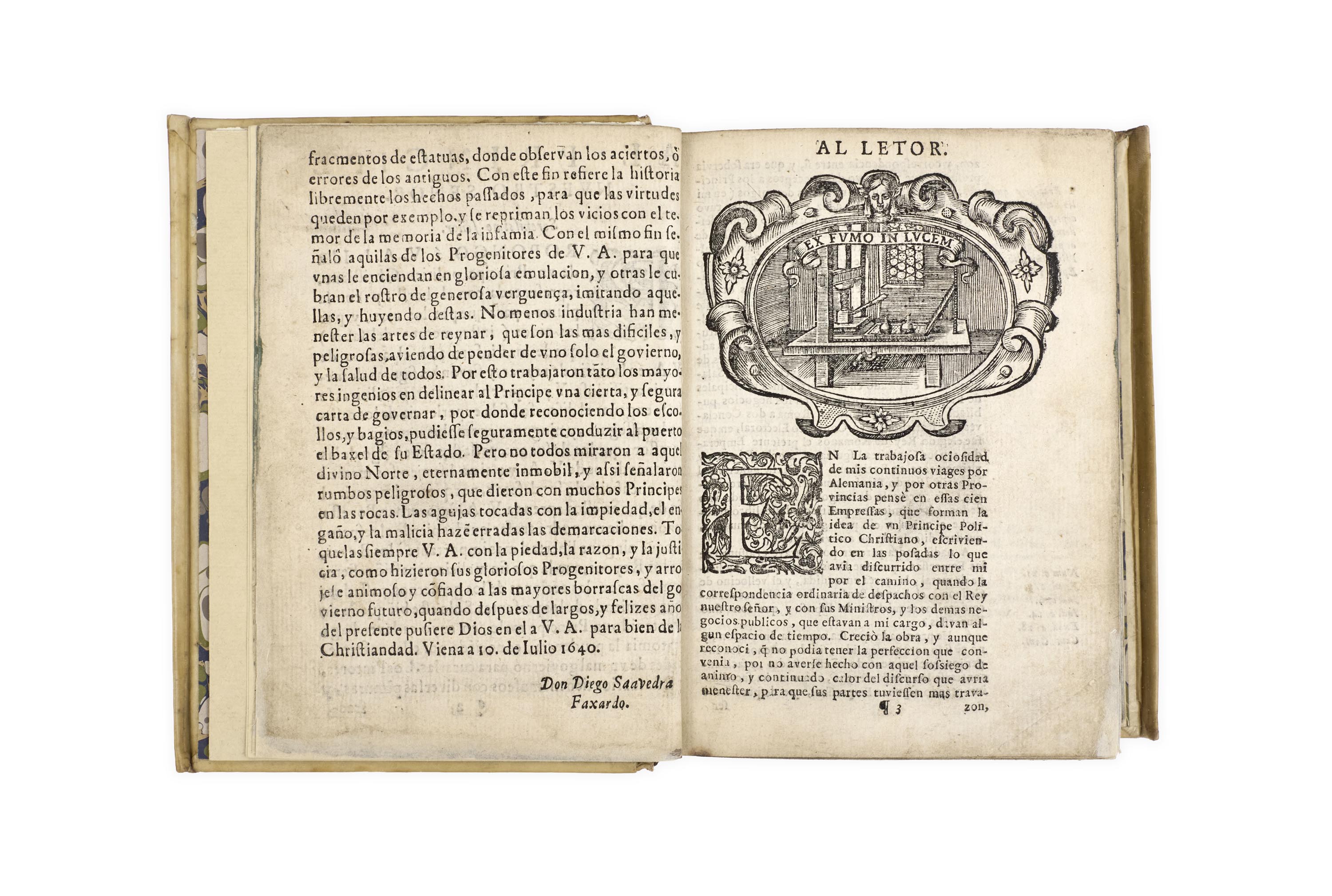
The first woodcut, at the start of the preface, depicts a printing press, with the motto ‘From smoke into light’ (illustrated opposite the Bibliography).
Provenance:
The contemporary annotations refer to the visit of Don Lorenzo Santos de San Pedro, a Castilian court official, to the judicial court in the Canary Islands (he was appointed in 1667).
Palau 283447; USTC 5063199; Campa, Emblemata Hispanica SX16; Praz, p. 483; cf. Landwehr, Romanic 658 (1660 Valencia printing).