

Classical Literature and Theology Interwoven
SABELLICO, Marco Antonio (or Marcantonio) Coccio; Petrus PONTANUS (or Du Pont, De Brugge).
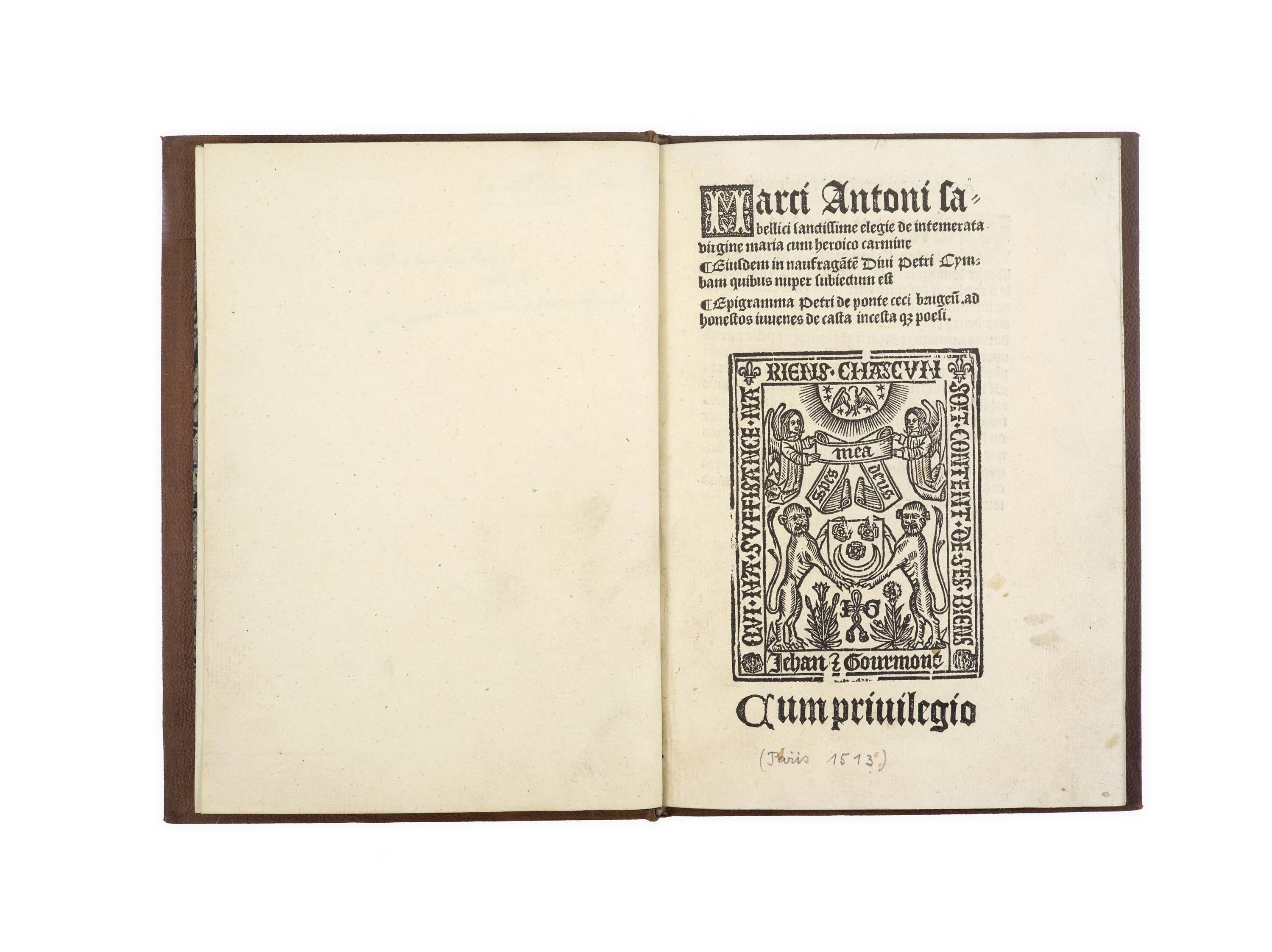
Sanctissime elegie de intemerata virgine Maria cum heroico carmine. Ejusdem in naufragantem Divi Petri Cymbam quibus nuper subiectum est. Epigramma Petri de Ponti … ad honestos iuvenes de casta incesta … Paris, Jean de Gourmont, [c. 1513].
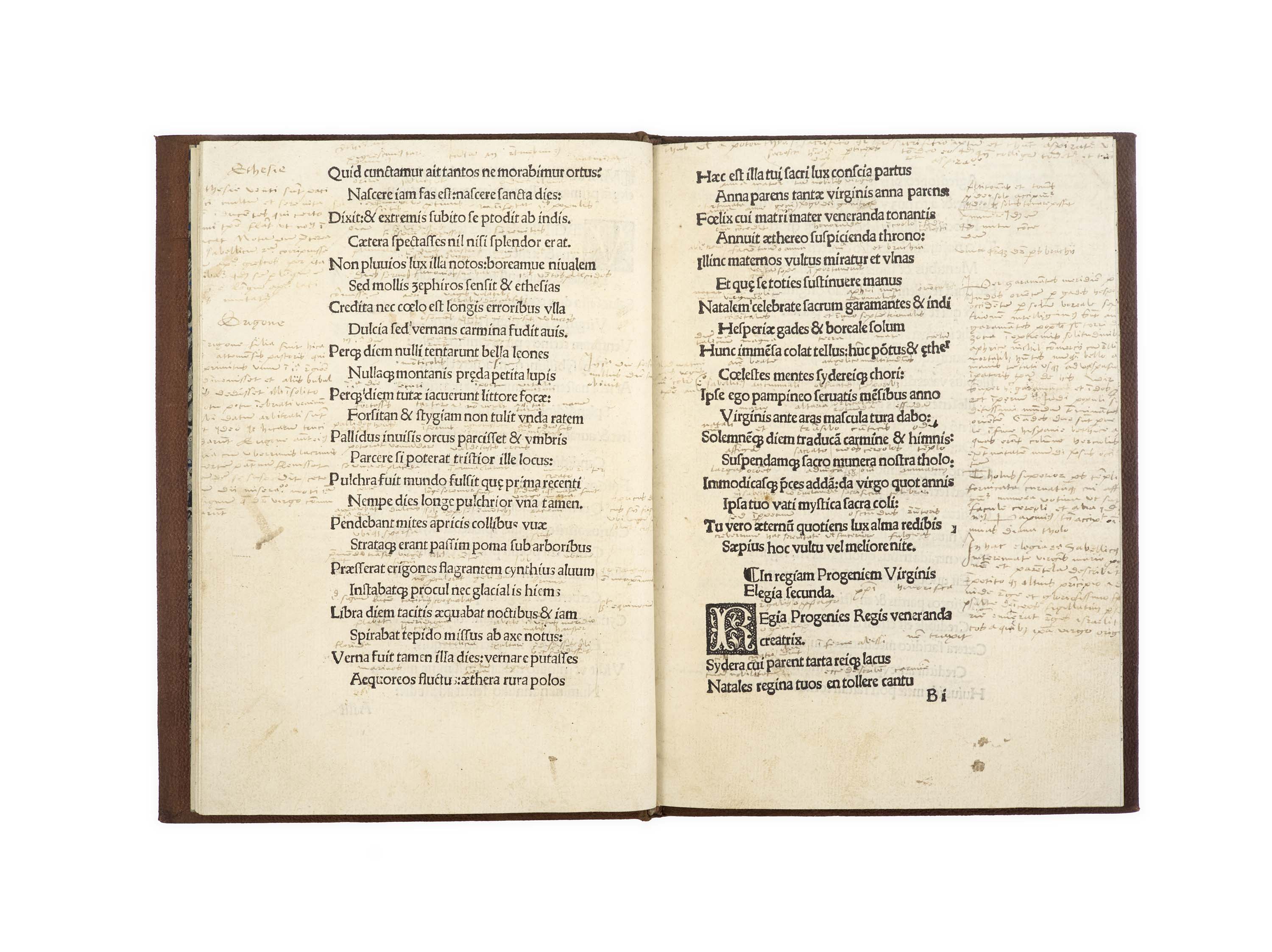
4to, ff. [25], [1, blank]; A–E4 F6, with final blank F6; large woodcut printer’s device and small criblé initial to title, further criblé initials; one or two minor stains, but a very good, crisp copy; bound in nineteenth-century brown cloth, spine lettered directly in gilt, marbled endpapers; minor soiling; numerous and substantial interlinear and marginal annotations in a contemporary hand to almost all of the elegies to the Virgin (slightly cropped in places).
Added to your basket:
Sanctissime elegie de intemerata virgine Maria cum heroico carmine. Ejusdem in naufragantem Divi Petri Cymbam quibus nuper subiectum est. Epigramma Petri de Ponti … ad honestos iuvenes de casta incesta …
One of only two recorded editions, both very rare, of this set of elegies addressed to the Virgin Mary, followed by verses ‘on St Peter’s sinking boat’, the former extensively annotated by a contemporary French student.
Marco Antonio Sabellico (1436–1506), a humanist and historian, professor of rhetoric at Udine and Venice, obtained fame as the author of a remarkable work of history, Enneades seu Rapsodiae historiarum (including a study of Christopher Columbus’ voyages), and of Rerum venetiarum ab urbe condita, understood to be the first guide of Venice and a celebration of the city’s laws, freedoms and traditions. Sabellico’s elegiac production has not, so far, been the object of much consideration. It probably belonged in the early part of his life, up to the early 1470s, which he spent in Rome, under the guidance of such humanists as Gaspare Veronese, Domizio Calderini and Pomponio Leto.
Sabellico himself later ‘destroyed [his own elegies] almost completely’ (DBI). Both this Paris edition and the only preceding one (1508, of which apparently a single copy survives, at the National Library of Poland), were published after his death. They include a moral, exhortative epigram by the Dutch humanist Peter de Brugge, or Pontanus.
The contemporary owner who annotated this copy, likely French, devoted much study to the first six (of eight) elegies, exploiting the generous blank spaces in the wide margins. Interlinear annotations bear paraphrases and interpretations of the dense weaving of theology with classical allusions, while marginalia host commentaries, sometimes extensive, including detailed summaries framing the scope of each elegy. Themes range from the birth of Mary and her lineage, to modes of worship, to retrospectives on how illustrious Classical and post-Classical poets celebrated the Virgin, to the most theologically, literarily and rhetorically complex composition of the sixth elegy, which is given the largest interpretative apparatus.
Rare: OCLC finds a single copy in the UK (Cambridge), two in France (BNF, Douai), one in Spain (BNE) and one in the US (Dayton).
Graesse VII, 202; Moreau 712; Renouard, ICP, II, 712.