
Sallust with a Salacious Sketch
SALLUST.
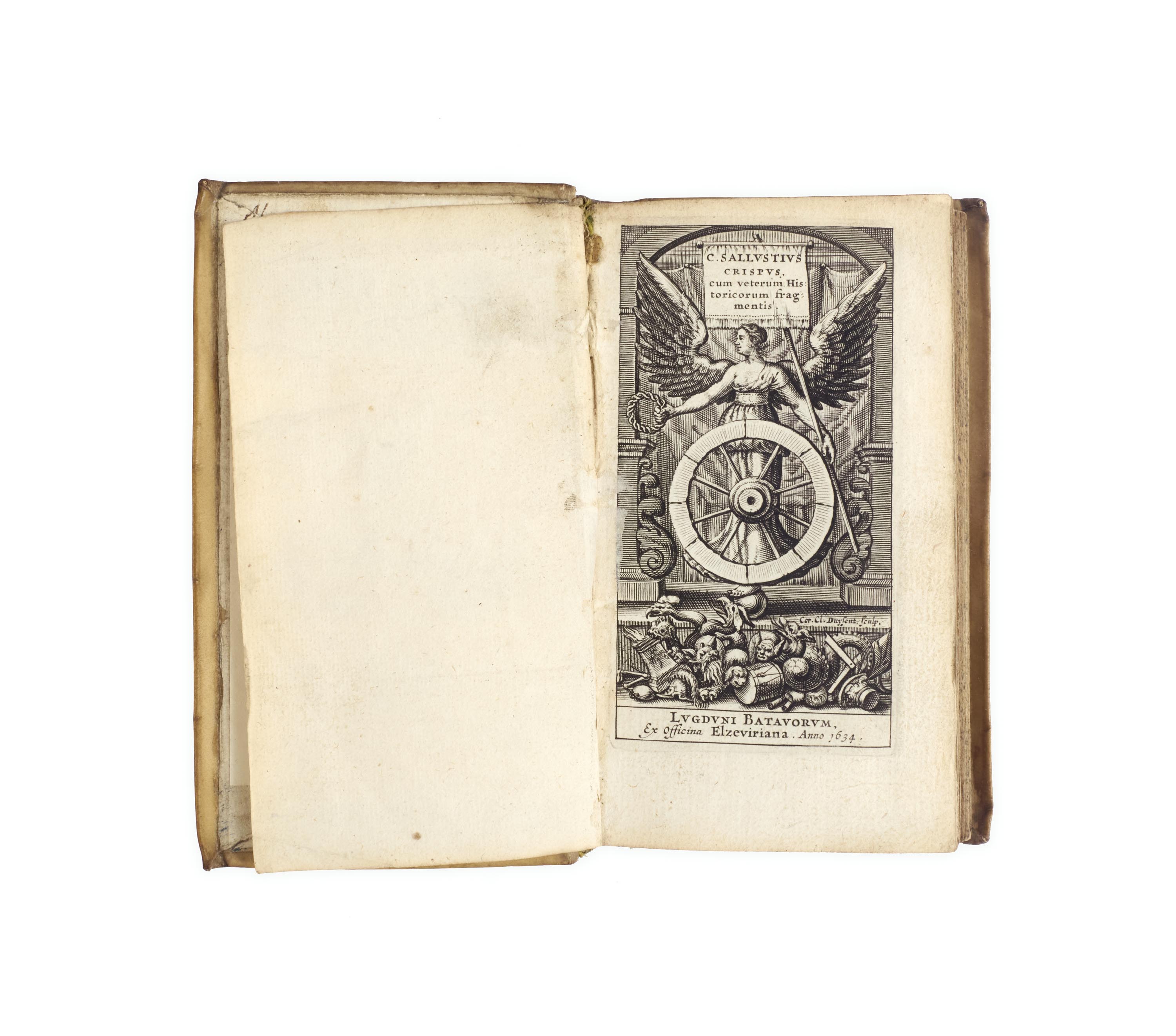
C. Sallustius Crispus cum veterum Historicorum fragmentis. Leiden, ex officina Elzeviriana, 1634.
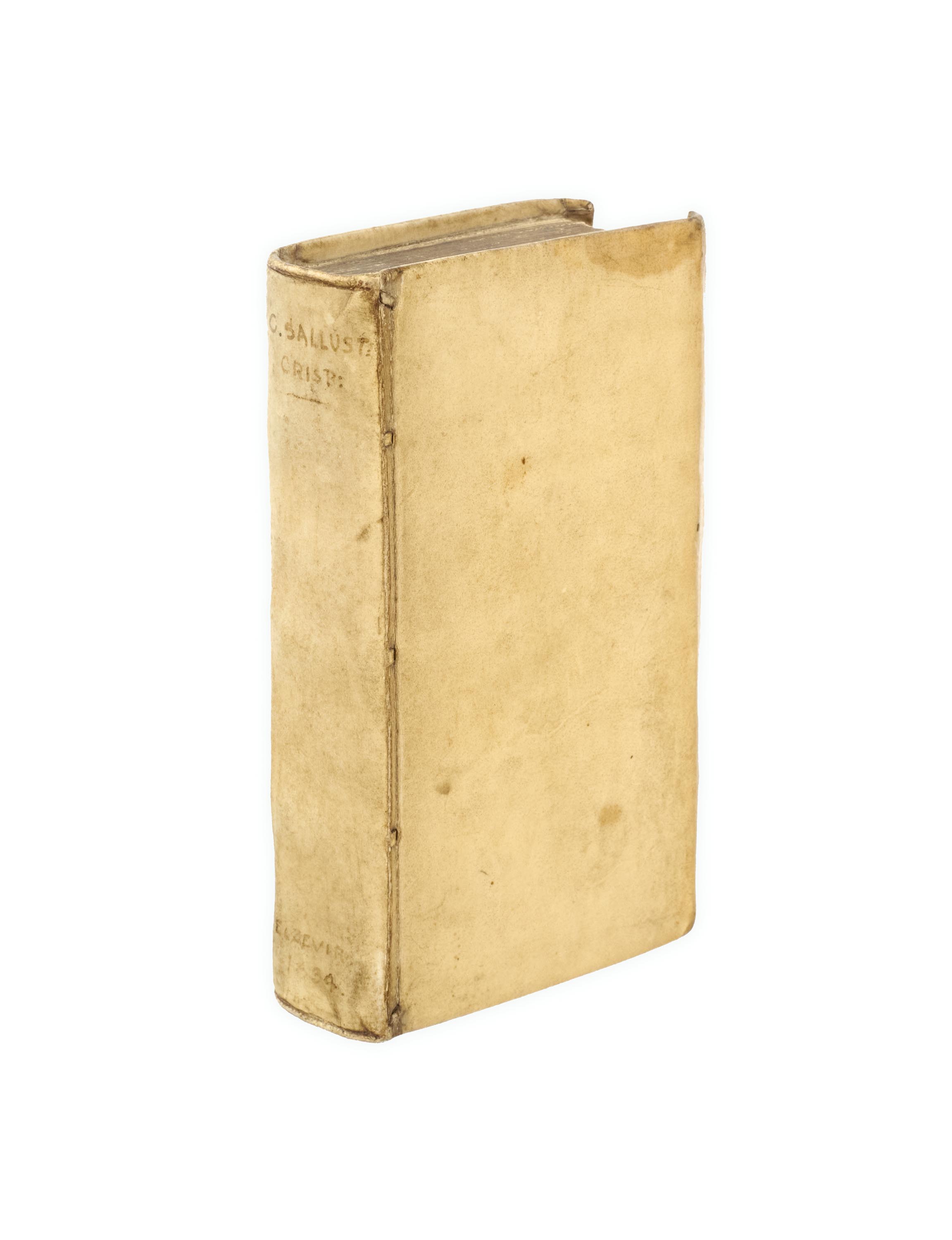
12mo, pp. [xvi], 310, [36]; engraved title-page, woodcut initials, head- and tailpieces, woodcut medallion portrait of the author to *8v; tiny stain to head of *8, otherwise a fine copy; bound in contemporary Dutch vellum, slight foredge flaps, manuscript title to spine, edges speckled blue; binding very lightly soiled; seventeenth-century ink drawings to rear endleaves (see below), bookplate with initials JYS and the motto ‘Amo’ (of the Scote family of Cumberland) to inside front cover.
The first small format Elzevir printing of Sallust with a contemporary ink sketch of a Peeping Tom at the rear of the volume. The volume contains the two major works of Sallust, the Jugurthine War and the Conspiracy of Catiline, along with the surviving fragments of his annalistic history of his own times (for the years 78–67 BC); these are followed by two speeches addressed to Julius Caesar and an invective against Cicero, now considered to be spurious, and further fragments from both named and unknown Roman historical writers, including Fabius Pictor. The medallion portrait of Sallust is based on a coin in the collection of Fulvio Orsini (published in his 1570 Imagines et elogia virorum illustrium), probably struck in Constantinople in the fourth century.
There are contemporary ink drawings on the rear flyleaves, as well as calligraphic flourishes to two consecutive rear endleaves (legible upside down) with ‘Salustii | anno 1650’ written on the first and ‘Crispi | Datum Slusa’ [i.e. Sluis in Zeeland] on the second. The inside rear cover has a profile of a male head drawn in ink (seemingly contemporary with typically long hair and a moustache), and opposite it is an ink sketch of a woman seated alone in a room and lifting her skirts, with a man in a tall hat and cloak peeping through the door at her. The sketch has Dutch text beneath, the first part of which has been transliterated into Greek characters, and roughly translated reads ‘How his heart is struck and his trousers are strained’.
This is one of three recorded variants, with ‘Catilina’ on A1r line 3, ‘Macrobius’ on K6v line 14, as well as the tailpiece containing the head of Medusa on p. 216. The text was most likely edited by the Leiden professor Marcus Zuerius van Boxhorn (1612–1653), to whom the Elzevirs dedicated this edition. He edited the texts of several Roman historians, whose writings he quoted from extensively in his own works.
STCN 833618512; USTC 1028564; Willems, Elzevier 412 (one of the three variant reimpressions; the main entry has an additional four leaves of preliminaries).