Semitology Fit for a Prince
SAULCY, Louis Félicien, Caignart de.
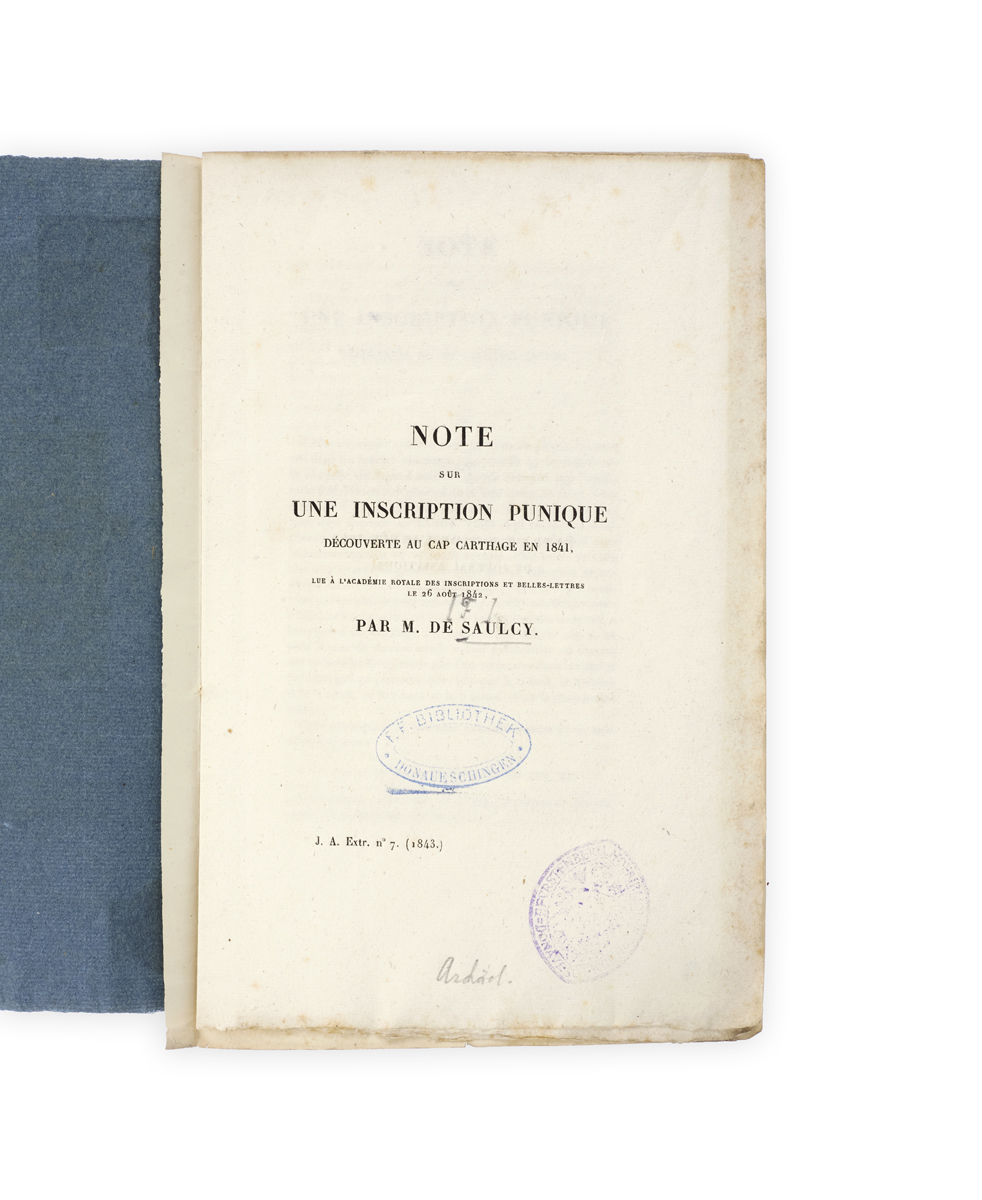
Note sur une inscription punique découverte au Cap Carthage en 1841. Lue à l’Académie Royal des Inscriptions et Belle-Lettres le 26 Août 1842. [Paris], Imprimerie Royale, 1843.
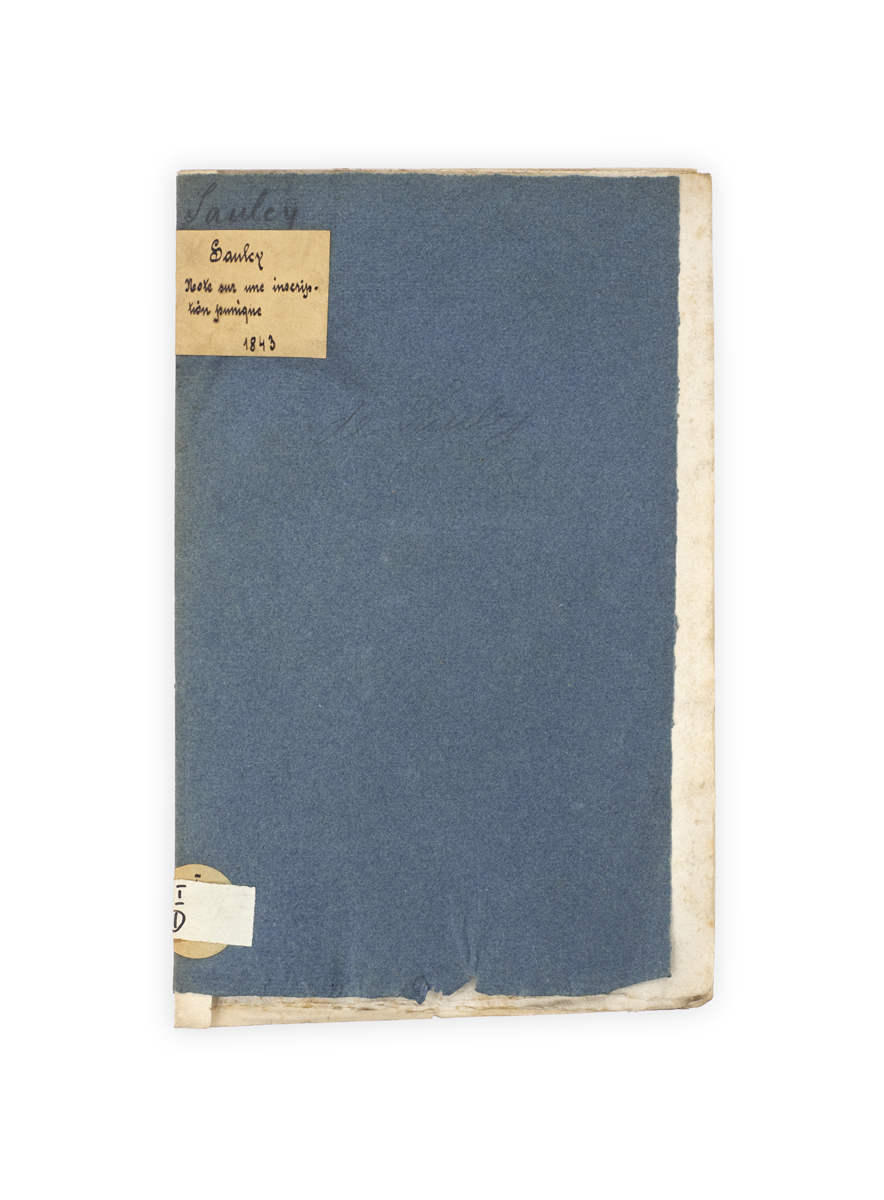
8vo, pp. [2], 4, [2 (blank)], with an engraved plate; some light spotting and marginal creasing to plate; but overall very good, in the original blue wrappers; later paper labels with titles and shelfmark to front wrapper; stamps of Donaueschingen library to title (see below).
Added to your basket:
Note sur une inscription punique découverte au Cap Carthage en 1841. Lue à l’Académie Royal des Inscriptions et Belle-Lettres le 26 Août 1842.
Rare offprint from the Journal Asiatique on a stone found at Carthage inscribed with Phoenician text, and a contribution to the deciphering and study of the Phoenician-Punic language.
Louis Félicien Joseph Caignart de Saulcy (1807–1880) was a French archaeologist and numismatist, renowned for his extensive excavations in Palestine, including the Tombs of the Kings in Jerusalem. The Phoenician inscription was unearthed in 1841 during the construction of the Chapelle Saint-Louis de Carthage in present-day Tunisia. On 26 August 1842, Saulcy delivered a lecture concerning the finding at the Académie Royal des Inscriptions et Belle-Lettres, which was published in the Journal Asiatique, series IV, vols I–II, the following year.
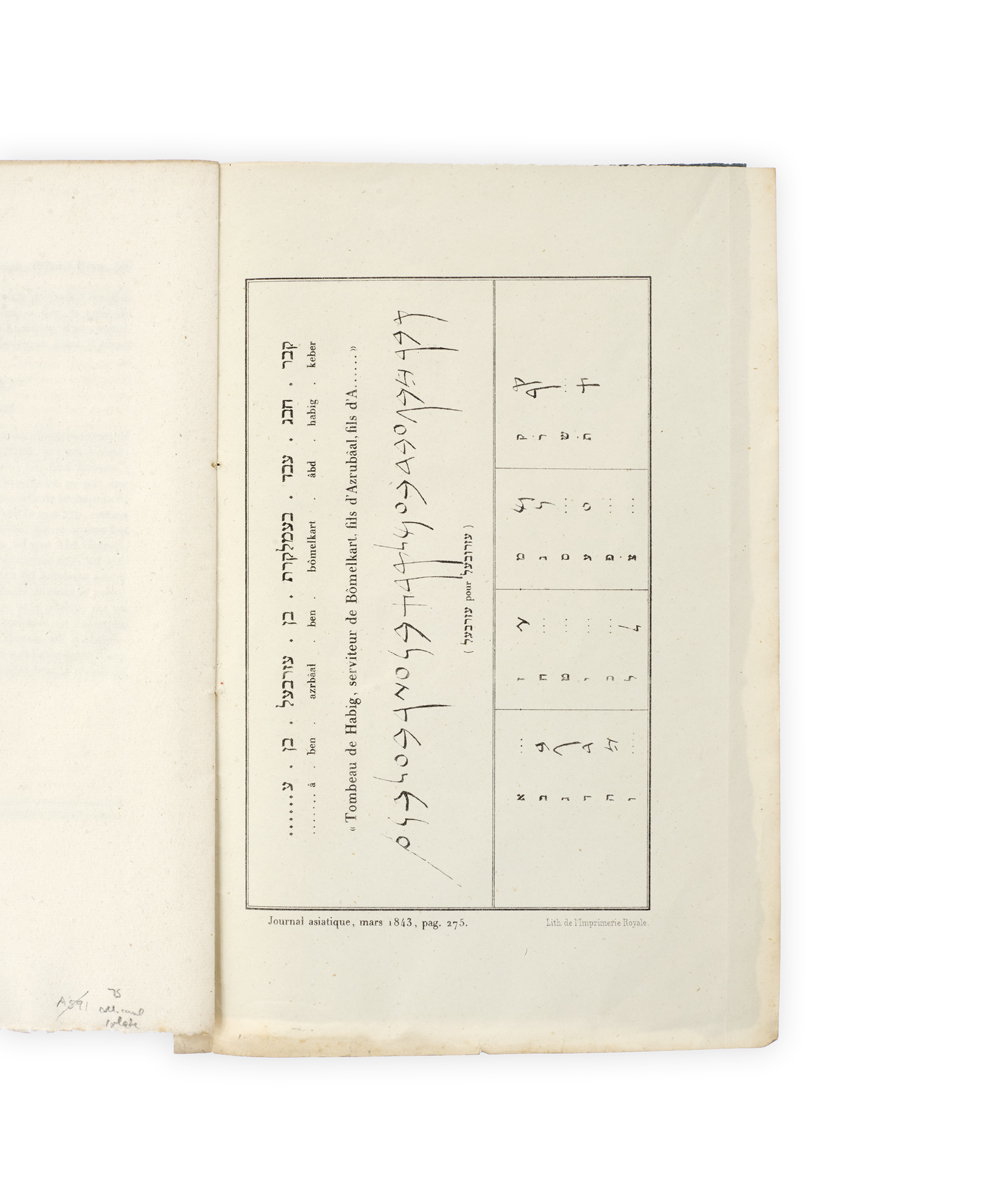
Due to the monotony and formulaic style of its corpus of inscriptions, Phoenician is considered ‘the worst transmitted and least known of all Semitic languages’ (Röllig). When Saulcy’s Note sur une inscription appeared in 1843, only eighty Phoenician-Punic inscriptions had been discovered, in contrast to the approximately ten thousand known today. The offprint includes a table featuring a reproduction of the inscription, its typographic rendition, a transcription in Latin script, and translation into French, subsequently sparking a debate with the Italian orientalist Michelangelo Lanci (1779–1867) over its deciphering and interpretation.
Provenance: From the court library of the Fürstenberg princes at Donaueschingen in southern Germany.
Very rare: OCLC traces only four copies, all in France.
See Lanci, Paralipomeni alla illustrazione della sagra Scrittura per monumenti fenico-assirii ed egiziani, vol. I (1845); Röllig, ‘The Phoenician language: Remarks on the present state of research’, in Atti del I congresso internationale di studi fenici e punici (1983).